

Özgür Özel is the leader of Turkey’s main opposition “New Party” and a member of parliament from Manisa.
The world is running out of time to deliver on the Paris Agreement. The UN Environment Programme’s latest Emissions Gap Report concludes that the chance of keeping warming below 1.5C without overshooting it is gone. Even if every country delivers its current national pledges, the planet is heading for about 2.6C of warming this century.
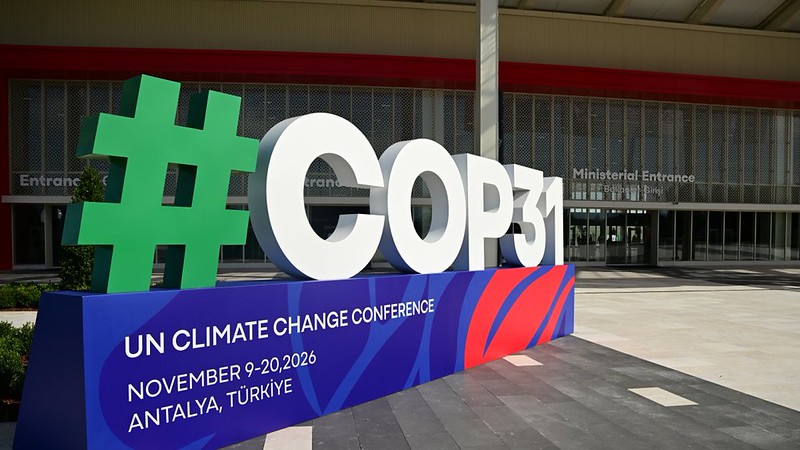
This is the backdrop as governments and their leaders gather in Antalya for COP31, ten years after the Paris Agreement took effect. Turkey lies in the Mediterranean, one of the regions most exposed to climate change, and hosting the summit is a real opportunity.
It is also a responsibility, and that responsibility begins at home. The world does not lack targets. What it has lacked – almost everywhere – is delivery. If Antalya is remembered for anything, it should be for shifting the focus from what countries promise to what they actually do.
For many people in Turkey, the climate crisis is already part of daily life. In 2021, forests in Manavgat, a district of Antalya, burned for more than a week. Last year, wildfires forced more than 50,000 people from their homes around the western coast city of Izmir. This October, Istanbul had its heaviest rainfall in more than 80 years, with the floods killing at least eight people.
COP31 Briefing: What to expect from the Antalya climate summit?
Electrification, the fossil fuel transition, adaptation to rising impacts, climate science and trade are key themes as governments gather for COP31 in TürkiyeBrazil’s fossil fuel roadmap sketches out first global timetable
The COP30 presidency’s voluntary timetable asks countries to plan first, then build up clean energy – only turning to oil and gas supplies from 2031


Measurable outcomes
Two weeks of climate negotiations cannot deliver everything that is needed to resolve the crisis, but COP31 can push for a few things that can be measured. The first is a voluntary fossil-fuel transition roadmap, with national milestones for 2030 and 2035 reported in the same format every year.
The second is a stronger commitment to protecting forests, with progress tracked over time. The third is yearly reporting on progress towards the agreed $1.3 trillion a year in climate finance by 2035, backed by a financial roadmap.
On adaptation, the indicators agreed in Belém should become funded national plans. By COP32, we should be able to see how many countries have an adaptation plan and the financial commitment behind each one.
Regional resilience partnership
The summit also has an unusual shape. Turkey hosts, Australia leads the negotiations, and the Pacific island nations play a central role. Climate diplomacy now sits at the centre of energy security, trade and development, and Turkey, which bridges developed and developing economies, is well placed to help build consensus between them. The lasting value of its presidency will depend on the practical partnerships it leaves behind.
One such partnership could connect two very different regions. On a map, the Mediterranean and the Pacific seem to have little in common, but their problems look similar: eroding coastlines, salt creeping into aquifers, failing harvests, fishing towns with fewer fish.
Turkey and Australia could launch a Mediterranean–Pacific Climate Resilience Partnership, linking coastal cities, scientists, institutions including development banks and island governments. It does not need a new bureaucracy. It can start with a few projects: shared satellite data and early-warning systems, better coastal flood defences, and trials of water-saving farming in the communities most at risk. What matters is visible results on the ground, not a ceremony.
Turkey’s track record
Turkey does have progress to point to. It has committed to net zero by 2053, and its solar and wind capacity has grown fast. The sunshine, the wind and the industrial base are all there. But the long-term direction of the energy mix is still unclear.
Turkey also signed the Glasgow Leaders’ Declaration on Forests and Land Use at COP26, pledging to halt and reverse forest loss by 2030. With four years left, COP31 is a chance to show how that promise will be kept.
COP30 roadmap says faster use of existing tools can halt forest loss by 2030
And while the summit celebrates zero waste, Turkey took in more than half a million tons of European plastic waste last year, much of it bound for Mersin and Adana. On November 21, the day after COP31 closes, an EU ban on plastic-waste exports to non-OECD countries takes effect. Turkey, as an OECD member, is exempt. That should worry us more than it seems to.
None of this will carry much weight unless Turkey’s own record holds up. A leadership at odds with its own environment and its own citizens will struggle to inspire global confidence in its commitment to protecting the planet.
Threat to local climate action
Cities are where adaptation happens. Water, flood protection, waste and urban planning fall largely to municipalities. That is why the imprisonment and removal of more than 50 elected opposition mayors, including the mayor of Istanbul, matter for environment and climate policy, as well as for democracy.
When local leadership is disrupted, investment plans stall and work on flood defences and water supplies loses continuity. As a result, local governments are left paralysed.
Comment: From Australia to Chile, our cities are driving a green investment boom
Inconsistent policymaking when it comes to the environment and climate deepens the problem in Turkey as it does in other countries. A few practical steps would make a real difference.
Set out a gradual, well-planned energy transition. Stop new construction in streambeds and drinking-water basins and put zoning maps online. Inspect every imported plastic shipment and cap total imports. Hold public hearings on environmental impact assessments before permits are issued, not after. And publish an independently audited climate scorecard each year covering emissions, renewables capacity, forest loss and adaptation spending.
This could set an example beyond Turkey. Many emerging economies are trying to cut emissions while protecting jobs and keeping industry competitive. Digital tools and artificial intelligence are already available to help forecast wildfire risk, reduce grid losses and track water use.
With the 1.5C limit now set to be breached, Antalya’s success will be measured by the greenhouse gases avoided, the investments delivered and the forests still standing in the years that follow. It is our responsibility to watch closely and see whether those commitments are delivered, transparently and in line with international standards.
The post Turkey must make COP31 a turning point for global climate action appeared first on Climate Home News.
Turkey must make COP31 a turning point for global climate action

The ongoing “super El Niño” is likely to peak at the end of 2026 and push average global temperatures to record levels next year.
That is according to Carbon Brief’s latest “state of the climate” update, which analyses El Niño forecasts from more than a dozen climate models, as well as six global temperature datasets.
Dr Zeke Hausfather, Carbon Brief’s climate science contributor, described this year’s El Niño as “simply staggering” when answering questions from CB+ members during a CB Connect “ask me anything” session.
El Niño is a naturally occurring climate pattern in the tropical Pacific that releases heat from the ocean into the atmosphere and temporarily boosts global temperatures.
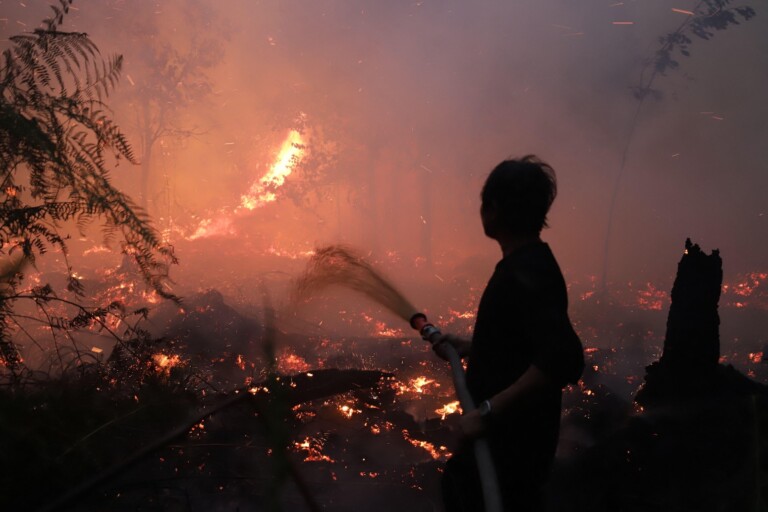
This year’s El Niño event – which has been underway since June – has already broken a number of records and reshaped the world’s weather, fuelling fires in Indonesia and “super typhoons” in the west Pacific.
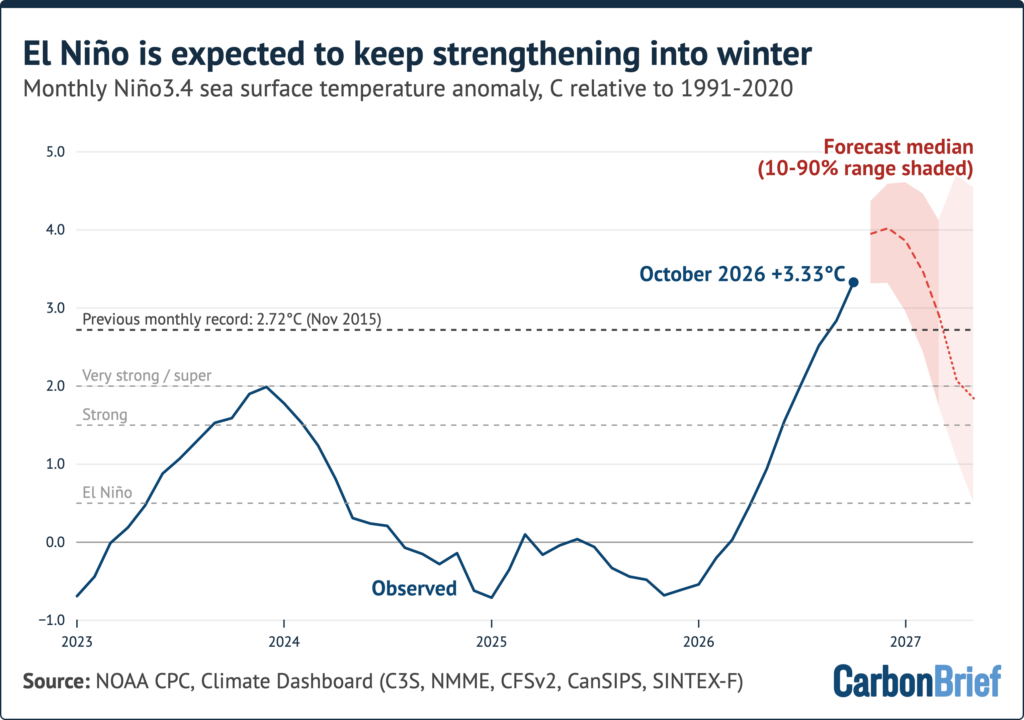
The strength of an El Niño is tracked using the “Niño3.4 anomaly”, which is a measure of how much warmer sea surface temperatures are than average in a section of the central Pacific.
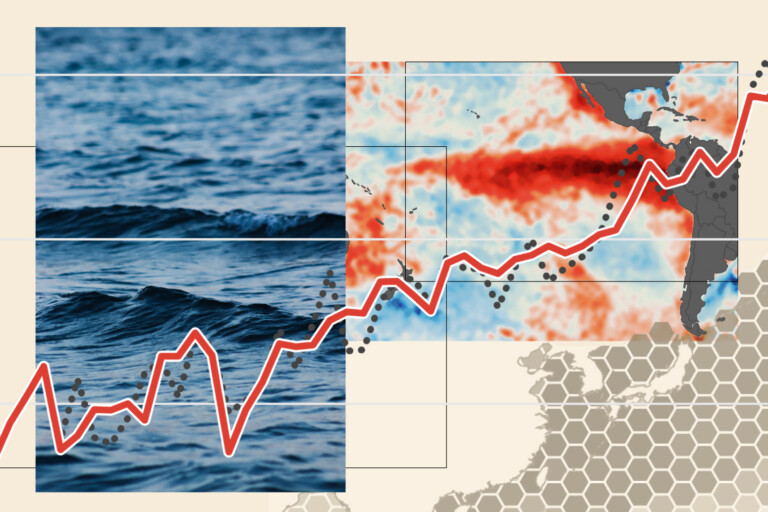
Analysis of more than 600 forecasts from 14 different climate models by Hausfather for Carbon Brief’s “state of the climate” update shows how models project this year’s El Niño will peak with an anomaly of around 4C. This would be more than a degree above the previous record in 2015-16.
Writing on CB Connect on 5 November, Hausfather wrote:
“This El Niño event is developing so quickly and is reaching sea surface temperatures so warm that it’s simply staggering. We haven’t seen anything like this in the historical record and it may end up being the strongest El Niño event in the past millennium.”
This year’s El Niño has already chalked up a number of milestones.
On 18 September, the daily anomaly in the Niño3.4 region broke the satellite-era record set in 2015 when it reached 3.11C.
Meanwhile, September as a whole recorded the highest monthly Niño3.4 region temperature anomaly – 2.84C – since sea surface temperature records began in the mid-1800s.

Membership
Support award-winning climate journalism
Hausfather wrote on CB Connect that this year’s El Niño had been “running well above any prior El Niño event since June, at times by a full degree [Celsius]”.
Carbon Brief’s “state of the climate” analysis indicates that El Niño is set to continue to intensify into December, with 10 out of 14 models expecting temperatures in the Niño3.4 region to peak in the final month of this year. The remainder anticipate a November peak.
While human emissions of greenhouse gases are responsible for almost all of long-term global warming, temperatures in specific years are strongly influenced by El Niño events.
The “state of the climate” analysis explains that this year’s El Niño event will have its largest effect on global temperatures in 2027. This is because global temperatures typically lag warming in the tropical Pacific by around three months.
Carbon Brief projects that the 2027 average global temperature will reach around 1.74C above pre-industrial levels. It calculates a 96% chance that next year will be the warmest on record.
This projection is based on the historical relationship between year-on-year temperature changes and El Niño conditions the preceding autumn. It also factors in uncertainty around how global temperatures will develop across the remainder of 2026.

The post ‘Simply staggering’: Rapidly developing ‘super El Niño’ on track to peak in December appeared first on Carbon Brief.
‘Simply staggering’: Rapidly developing ‘super El Niño’ on track to peak in December
Some things are too precious to risk. And Scott Reef is one of them.
Today, we’re launching a bold new campaign starring iconic Australian actor Michael Caton and a green sea turtle named Sandy to rally Australians behind one simple message: Flip off Woodside to save Scott Reef.
Off the coast of Western Australia, Scott Reef is one of Australia’s most extraordinary marine environments. It is home to vulnerable green sea turtles, endangered pygmy blue whales and thousands of other marine species.
Each year, one thousand endangered green sea turtles return to Scott Reef to nest. It’s where they lay their eggs. It’s where baby turtles hatch. It’s where they make their first brave dash from the sand to the ocean. It’s their home.
But this remarkable ecosystem is under threat from Woodside’s plans to drill for gas, with up to 57 toxic wells proposed around the reef.
Turtles can’t speak up for their home, so we’re asking Australians to make their voices heard instead.

From one Aussie icon to another
At the heart of our new campaign is an iconic Australian voice, Michael Caton. Caton is using his voice to speak out for, what will soon be, another Australian icon – Scott Reef.
In a cinematic courtroom showdown, Caton lends his unmistakable voice to one of Scott Reef’s most vulnerable inhabitants: a green sea turtle fighting to protect her home from corporate destruction.
As Sandy the turtle defiantly flips her flippers at Woodside, Caton delivers a message that every Australian can get behind.
“Some things are too precious to risk.”
Because when it comes to protecting our natural environment, sometimes being polite just isn’t enough.

Turning a gesture into a movement
We’ve launching a campaign designed to do more than grab attention. We want to turn public concern into meaningful action.
The idea is simple: flip off Woodside and make sure our political leaders know exactly where Australians stand.
We’re calling on people across the country to share the campaign, get involved on social media and, most importantly, tag their local MPs.
We need Environment Minister Murray Watt and Prime Minister Anthony Albanese to hear loud and clear that Australians want Scott Reef protected, not sacrificed for another gas project.
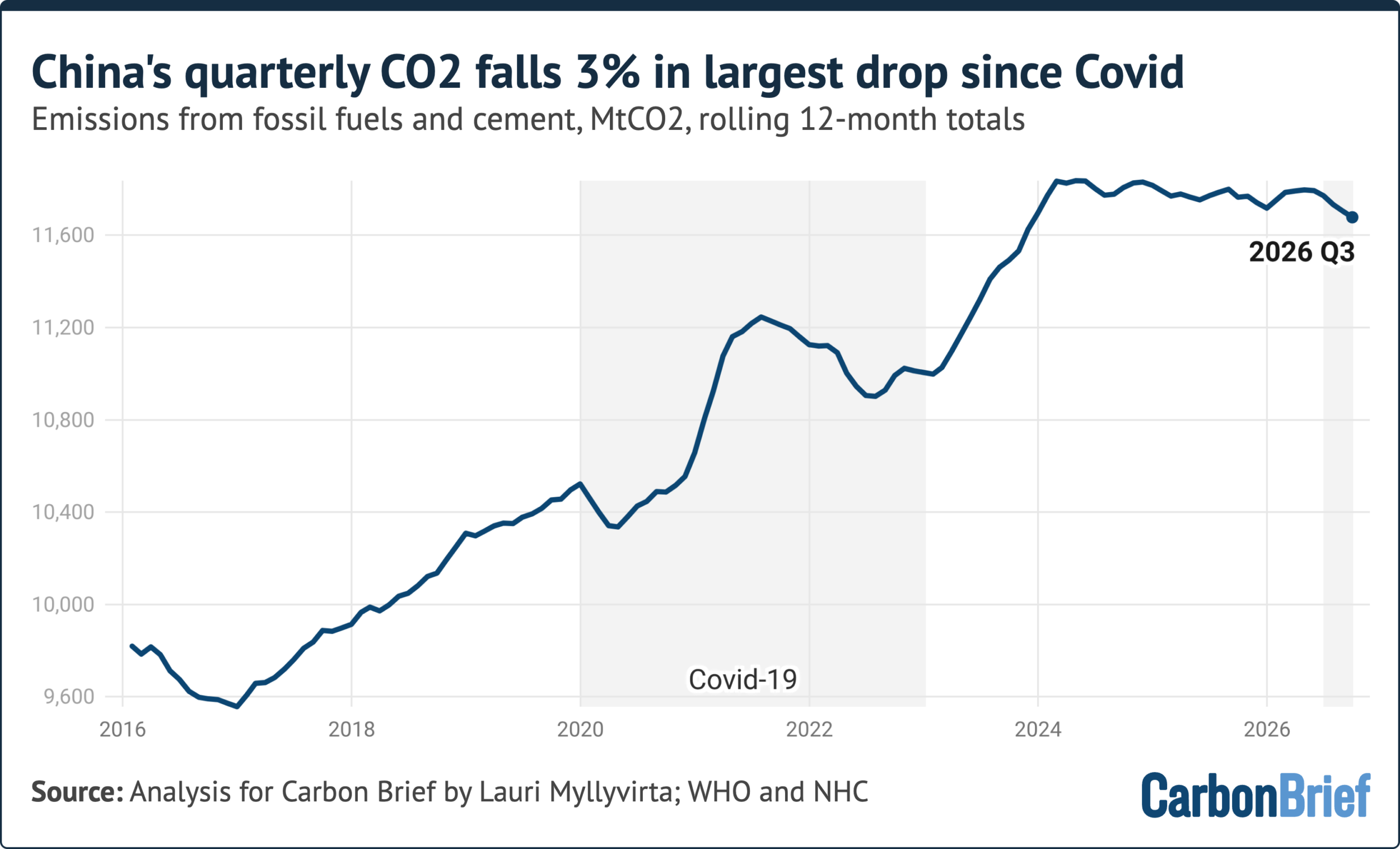
China’s carbon dioxide (CO2) emissions fell by 3.1% in the third quarter of 2026, as the Hormuz crisis continued to hit oil demand and coal use also dropped.
This guest post is by:
Lauri Myllyvirta, lead analyst at the Centre for Research on Energy and Clean Air
This was the largest quarterly reduction since the 2022 Covid lockdowns and means that China’s CO2 emissions have now fallen by an estimated 0.5% in the year to date.
The new analysis for Carbon Brief, based on official figures and commercial data, shows that coal use fell by 3% year-on-year in the third quarter of 2026, while oil was down 4%.
The main drivers were a fall in power-sector coal consumption, a continued sharp reduction in transport oil consumption and slowing growth in the coal-to-chemical industry.
The sharp decline in China’s CO2 emissions extends a “flat or falling” trend that began in March 2024 and has now lasted more than two years, as shown in the figure below.
The outlook for China’s CO2 emissions depends on the balance between rising energy demand, clean-energy growth and the government response to a GDP slowdown.
Decline drivers
Key drivers of the fall in CO2 in the third quarter of 2026 included a 3.3% drop in coal-power generation, after demand growth slowed and the amount of “wasted” wind and solar fell.
Power generation from solar, wind and nuclear increased by 110 terawatt hours (TWh) year-on-year, more than twice as much as the growth in total electricity demand. This added clean-power generation equal to Germany’s total power output in the same time period.
The fall in coal-power output and CO2 emissions came despite the fact that China continues to build new coal-power capacity at near-record rates. This means that average running hours for coal plants are falling even faster than total generation, eroding their profits.
Meanwhile, transport oil consumption continued to fall sharply, down