


- Formal negotiations
- Finance
- Global review
- Global report
- Digital sequence information
- Harmful subsidies
- Marine biodiversity
- Planning, monitoring, reporting and review
- Article 8(j) implementation
- Biodiversity and climate change
- Links with other bodies
- Around the COP
- Armenian presidency
- Protests
- Lobbying and influence
- Carbon and biodiversity markets

There is very little authorities in Nepal could have done to prevent the deaths and devastation caused by the flash flood on its border with Tibet in late August, scientists with the World Weather Attribution (WWA) group have said.
Launching a study that highlighted the role of climate change in causing the glacial rock and ice collapse that triggered the Himalayan flood, WWA co-founder Friederike Otto told reporters that “no amount of local adaptation can fully shield vulnerable people downstream from this scale of destruction”.
The findings released on Thursday are likely to strengthen Nepal’s case for emergency support from the UN’s Fund for Responding to Loss and Damage. Its board members met informally on Wednesday to discuss whether to grant the country a maximum of $20 million towards its estimated $4.8 billion cost of recovery and reconstruction, but no decision has yet been taken.
Nepal’s foreign minister Shisir Khanal told Climate Home News last week that the destructive flood was “exactly the kind of climate-driven catastrophe the Fund was created to address”.
Hard to predict
The WWA study found that rock-ice avalanches are very hard to predict and that moving people out of areas vulnerable to such floods is difficult as their livelihoods revolve around the rivers along which the floods travel.
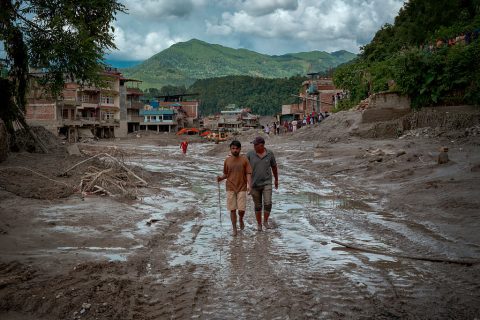
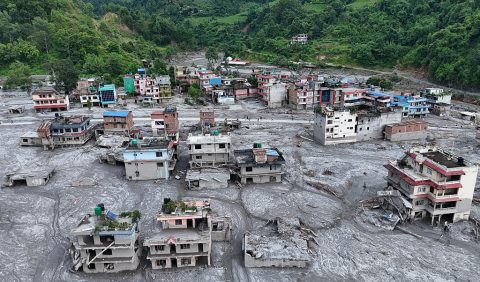
The recent disaster began on the morning of August 26, when an avalanche started falling beneath a glacier. This caused huge amounts of rocks and glacier ice to fall over a kilometre to a valley floor, where they then picked up more rock and ice and became a flood of debris heading downhill and downstream along the border of Nepal and Tibet.
The torrent entered the narrow Lhende Khola gorge and crashed through the busy Gyirong port border crossing at 170 kilometres an hour. It continued many kilometres downstream before eventually turning from rock and ice to water and slowing down.
The flood swept through villages, roads, bridges and hydropower stations, killing over 1,300 people in Nepal with more than 5,000 still missing. The flood also killed at least 40 people in Chinese-run Tibet.
Those on higher ground away from the river mainly survived but the flood’s speed meant that many people received no warning to seek higher ground or shelter.
While Nepal has early warning systems for flooding caused by rain and glacial lake outbursts, the WWA study noted that rock-ice avalanches are complex and understudied, with methods to monitor them still being explored.
Co-author Walter Immerzeel, mountain hydrology professor at Utrecht University, told journalists that with current methods, the disaster could not have been predicted.
But, he said, in the future it may be possible to use remote sensing techniques to analyse glaciers and rocks to generate a warning before a collapse occurs.
A technique called radar interferometry can detect hotspots which should be monitored with field-based sensors and drones, he said, adding that early warning systems could be installed in these areas using seismometers, water-level measurements and CCTV.
Because doing this for thousands of glaciers across the Himalayas would be difficult, authorities could monitor only the rock and ice faces that are a danger to the river valleys with the most people and infrastructure in them, he added. But this would still require lots of investment together with international collaboration and coordination, he warned.
The study found that another potential adaptation strategy – restricting development in flood-prone river valleys – is socially, economically and politically difficult.
The scientists said habitable land is scarce in these steep river valleys and economic activities like transport and hydropower generation are dependent on the river itself.
Madhab Uprety, a Nepali scientist from the Red Cross Red Crescent Climate Centre, said that, while new development should assess the risks of floods, many existing communities and buildings are already at risk.
Loss and damage
Otto said the flood should be discussed in the context of loss and damage as “there is no doubt that climate change is one of the drivers” and “it’s also one of the types of events that are absolutely outside of the limits we can possibly adapt to”.
As well as the deaths, a Nepali government’s assessment has found that a large amount of infrastructure was damaged, including more than 7,500 homes, 105 bridges, 48 public buildings, 47 cultural heritage assets, 18 schools, 13 hydropower facilities, seven health facilities, and numerous shops, hotels, restaurants, irrigation systems and farms. Over 30,000 people were affected.
Developing countries have called for the loss and damage fund’s board to hold an emergency meeting to discuss how to respond to Nepal’s request for funding. Instead of a full board meeting though, board members met only informally and online on Wednesday, Climate Home News understands. A source with knowledge of discussions said the informal nature of the meeting meant they were not able to take decisions or agree on next steps, which have been left up to the board’s co-chairs.
-
Foreign minister: Nepal needs “meaningful” international support to face climate threats
Following its recent Himalayan flooding disaster, the South Asian nation is seeking urgent help from a new UN climate fund, appealing for “stronger global solidarity” -
Loss and damage fund urged to hold crisis meeting on Nepal
The new fund is coming under pressure from developing nations to respond quickly to climate disasters rather than just financing longer-term projects -
Nepal’s EV revolution pays off as oil crisis causes pain at the pumps
Import subsidies, abundant hydropower and charging investments have spurred EV adoption, with electric vehicles now making up about three-quarters of new car sales
Speaking before that meeting started, Nepali climate negotiator Manjeet Dhakal said he had “heard of an extremely positive response” to Nepal’s request from board members. “Hopefully there will be something – a decision that the fund will do for exactly the reason that the fund was established,” he said.
Ajay Mathur, former Indian climate negotiator and now head of The Energy and Resources Institute in New Delhi, told a separate press briefing on Wednesday that the Nepal flood disaster would push loss and damage higher up the agenda of international climate talks, particularly if the United Nations Secretary-General decides to champion the cause at the UN General Assembly in New York next week.
Murat Kurum, Turkish environment minister and president-designate of COP31, told Climate Home News last week that he would be “pleased” if the fund could support Nepal and that he will keep calling in every speech for countries to give money to the loss and damage fund.
Jennifer Morgan, former German climate envoy and now a senior fellow at the Fletcher School of Law and Diplomacy, called for the loss and damage fund – which currently has around $630 million in contributions – to be topped up with new pledges from governments as well as solidarity levies on things like luxury air travel, super-rich individuals and fossil fuel firms’ windfall profits.
The post Nepal flood destruction shows “limits to adaptation”, scientists say appeared first on Climate Home News.
Nepal flood destruction shows “limits to adaptation”, scientists say
Continue Reading
Prepared by a coalition of nine Western Australian union, industry, conservation, and community organisations—including UnionsWA, the Conservation Council WA, and the Smart Energy Council—the WA Clean Energy, Jobs & Industry Plan provides a practical roadmap to transform Western Australia into a clean energy powerhouse while creating thousands of secure local jobs.
Western Australia stands at a pivotal crossroads: lead the global clean energy economy or watch investment, future industries, and secure jobs go elsewhere. The WA Clean Energy, Jobs & Industry Plan outlines a transformative blueprint to harness the state’s world-class solar and wind resources. Discover how legislated renewable targets, green iron manufacturing, and a dedicated regional training strategy can generate tens of thousands of local jobs, lower household bills, and build a resilient, net-zero future for all Western Australians.


WA needs a clear and forward-thinking plan if it is going to become a competitive renewable energy powerhouse and maintain its economic strength through the energy transition.
“Western Australians know a faster renewable energy transition will lower their household expenses and prevent harmful climate pollution. But the community also needs clear direction to ensure this transition will create jobs, lower costs and not cause undue environmental harm.
“Here, sectors representing a broad range of interests have laid the groundwork for those outcomes, clearly outlining what is needed to create a future for WA that is good for the environment, for the climate, for workers and for the economy.
Summary
The WA Clean Energy, Jobs & Industry Plan sets out a strategic roadmap to position Western Australia as a global clean energy superpower while creating thousands of secure local jobs.
The report establishes three overarching goals:
- Creating local employment.
- Maintaining industrial competitiveness.
- Lowering household energy costs
To realize this vision, the framework details actionable measures to follow on from the recent WA Government announcement of a 75% Renewable Energy Target by 2031 for the South West Interconnected System. This includes developing a statewide Renewable Energy Target, coordinating statewide workforce and training pipelines, strategically planning regional infrastructure to safeguard high-value biodiversity and cultural heritage, and ensuring equitable benefit-sharing through household electrification incentives and First Nations equity partnerships. Ultimately, the plan highlights that establishing clear policy and regulatory certainty will unlock lower energy bills, boost power reliability, and secure the state’s global competitiveness in emerging green commodity export markets.

Key Findings
- Statewide Renewable Energy Target and Emissions Reduction Targets: The report calls for a statewide RET and 1.5°C aligned emission reduction targets to remove policy risk, lower capital costs, and attract clean energy investment.
- Transformative Job Creation: Accelerating the transition offers massive employment prospects, including up to 8,800 solar and battery jobs by 2050, as well as 24,000 ongoing and 11,000 construction jobs in a commercial green iron industry.
- Industrial Electrification & Competitiveness: Requiring large gas users to adopt binding electrification timetables and providing concessional financing will protect existing energy-intensive manufacturers from rising energy costs and impending domestic gas shortfalls.
- Green Commodity Export Leadership: Western Australia can build new export markets in green iron, green ammonia, and offshore oil/gas decommissioning by constructing shared common-user infrastructure and setting dedicated Green Commodity Export Targets.
- Coordinated Workforce & Training Pipeline: To address critical skill shortages the plan recommends establishing a WA Clean Energy Jobs Plan 2050, three regional training hubs, and dedicated pathways for female and under-represented apprentices.
- Environmental Safeguards & Community Benefits: Fast-tracked development must be paired with State Planning Policies that avoid high-biodiversity and cultural heritage lands, mandate new data centres to run on additional renewable power, and deliver household electrification rebates and First Nations equity partnerships.

What you can do
WA has an opportunity to lead on sustainable, clean energy and associated industries. You can help by:
- Sending an email to Environment Minister Murray Watt and Prime Minister Anthony Albanese, calling on them to reject Browse.
- Sharing this story to help more Australians understand what’s at stake.
- Encouraging your friends and family to take action.
Countries have completed the first “global review” of their progress towards reversing nature loss by 2030 at the COP17 biodiversity talks in Yerevan, Armenia.
The review “notes with deep concern” that, unless action is “rapidly accelerated”, the goal to reverse nature loss and meet a set of 23 targets by 2030 “will not be achieved”.
It “urges” countries to accelerate action, including by “increased ambition in addressing the gaps”.
Much of the discussions in Yerevan focused on how to raise the necessary funds to help developing countries protect nature.
Some major economies pushed to expand the range of nations that are expected to provide finance, with countries agreeing at the end of the two weeks of talks that non-donors that want to contribute can “signal interest” before COP18.
This came after developed countries failed to meet a target to significantly ramp up nature finance over the last few years.
It also came as a landmark fund agreed at COP16 in Colombia to pay communities for the genetic resources derived from nature stands nearly empty two years on.
The Yerevan talks marked the halfway point of the “Kunming-Montreal Global Biodiversity Framework” (GBF), the “Paris Agreement for nature” first made in 2022 and due to be achieved by 2030.
During the nearly 12-hour-long final plenary, countries voted for Quito, Ecuador, to host the COP18 nature talks, which will be held in 2028.
Countries managed to sign off on all the major negotiation texts, marking a stark contrast to COP16, which ran so far over time that the Colombian presidency lost “quorum”, forcing talks to resume in Rome months later.
Below, Carbon Brief has detailed analysis of all of the key outcomes from COP17.