

All the ambulance services in England experienced some of their busiest-ever days during this summer’s record-breaking June heatwave, according to data obtained by Carbon Brief.
In June, temperatures climbed past 37C in parts of the country as authorities declared only the second ever “red” extreme heat warning.
Four out of 10 NHS ambulance services, including London’s, responded to unprecedented numbers of life-threatening emergencies on at least one day from 23-27 June.
Another two services – in the south-west and east of the country – received their highest volume of 999 calls on record.
Ambulance services provided data on their busiest days since records began, in response to freedom-of-information (FOI) requests from Carbon Brief.
The results show how demand during the June heatwave exceeded levels seen during the traditionally busy winter season in other years – and even the height of the Covid-19 pandemic – for many services.
Heat demand
Extreme heat ramps up the risk of numerous life-threatening conditions, including heart disease and respiratory problems.
England experienced record-breaking temperatures at the end of June, with the whole country covered by amber or red “heat health alerts” from the government.
A red alert, which was issued for the entire Midlands and south of England, indicates “significant risk to life for even the healthy population”. This was only the second time such an alert has been triggered.
Researchers calculated that there were nearly 3,000 heat-related deaths in the UK this summer. There has also been unprecedented demand for A&E departments and some ambulance services.
To investigate the strain facing ambulances, Carbon Brief sent FOI requests to the 10 NHS ambulance trusts in England, asking for lists of their busiest days.
This covered both the total volume of 999 calls and “category 1” responses – referring to incidents involving “life-threatening injuries and illnesses”, such as heart attacks.
The chart below shows the busiest days on record for England’s ambulances, including both total calls and category 1 responses. Most services were able to provide records back to the 2010s. (See: Methodology.)
The five-day period from 23-27 June is overrepresented in these results, with at least two heatwave days ranking in the top 20 for every service in the country.
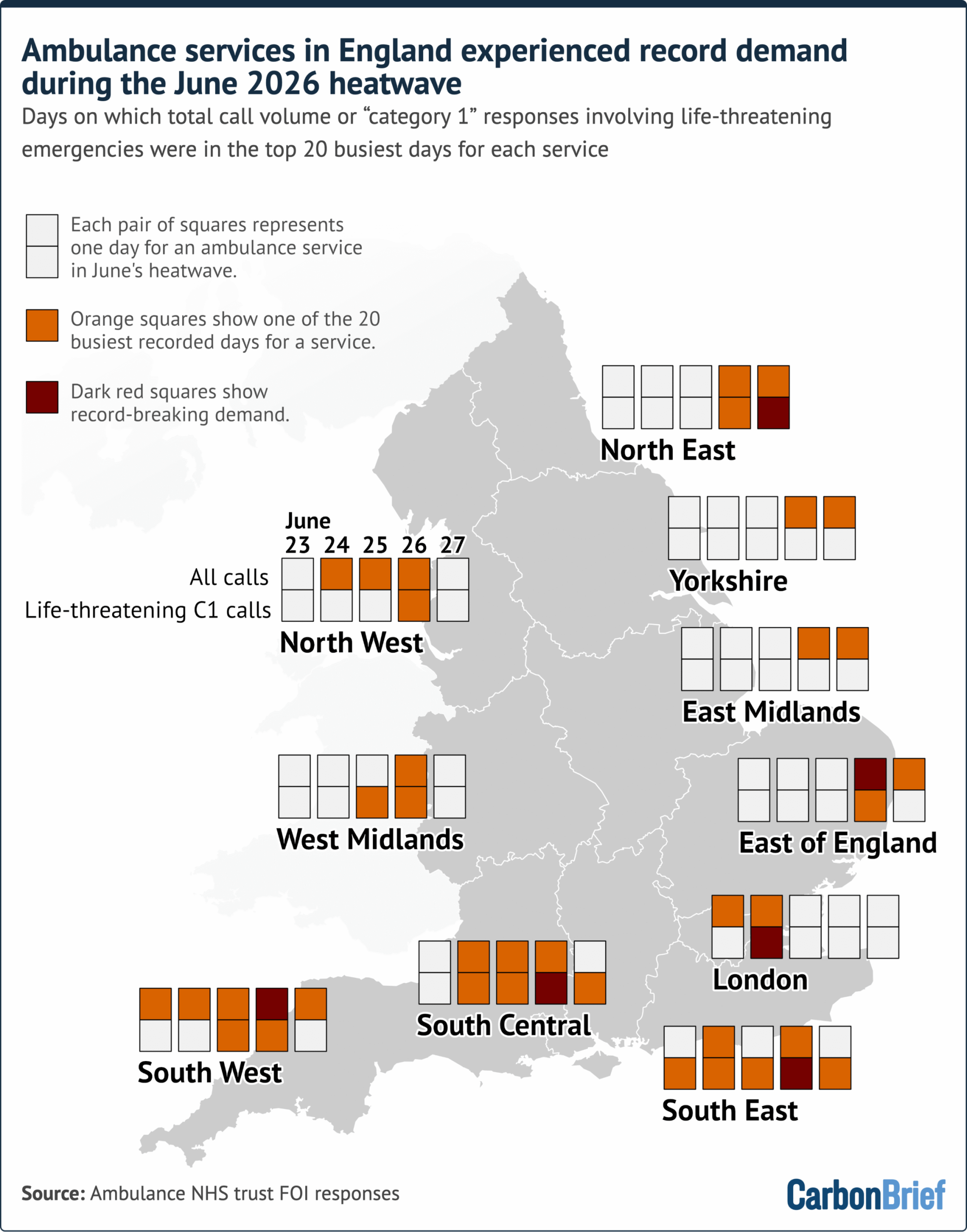
This trend is especially pronounced in the south and east of England, where June temperatures exceeded 36C and even approached 38C in some regions.
London, South East Coast, South Central and North East ambulance services all reported daily records for responding to life-threatening emergencies during the heatwave.
For the South East Coast and South Central services – which cover a region stretching from Oxfordshire to Kent – 25, 26 and 27 June all saw unprecedented numbers of category 1 callouts.
South Western and East of England services both saw record numbers of 999 calls on 26 June, the same day the highest-ever June UK temperature was reported in Norfolk.
It is worth noting that demand for ambulance services – including category 1 calls – has been growing for many years, driven by factors such as an ageing population, more complex health conditions and growing mental-health pressures.
This helps to explain why dates from before the 2020s are rare in the top rankings provided to Carbon Brief.
Beyond the heatwave, 2026 as a whole is on track to be a record year for ambulance demand.
‘Stifling heat’
On 26 June, the busiest day of the heatwave, ambulances across England responded to 4,084 life-threatening emergencies.
The average daily volume of such incidents is normally around 2,500 during the summer months.
Stu Holliday, head of emergency preparedness, resilience and response at North East Ambulance Service, tells Carbon Brief:
“During periods of hot weather, we typically see an increase in calls from people affected by dehydration, heat exhaustion and heatstroke, as well as those whose existing health conditions, particularly heart and respiratory illnesses, can be made worse by prolonged high temperatures.
“Older people, young children and pregnant people can be especially vulnerable.”
Ambulance teams are generally busier in the winter because cold weather and seasonal illnesses drive up the number of severe medical emergencies.
However, the data from June shows that extremely hot days are starting to match or even edge out cold ones as the busiest days. This is a trend seen across the healthcare system.
While not every service provided records back to 2019, the data broadly shows that ambulances were busier during the heatwave than at the height of the Covid-19 pandemic.
As well as patients, heatwaves put pressure on ambulance workers. The UNISON union has warned of crews facing “stifling heat with faulty or no air conditioning” and “back-to-back callouts” due to increased demand.
Methodology
Carbon Brief requested data on the top 50 busiest days for England’s 10 main ambulance services.
These are: London; South East Coast; South Central; South Western; West Midlands; East Midlands; East of England; North East; Yorkshire; and North West.
Data was requested for as far back as service records go. Most were able to provide records going back to some point in the 2010s, with the exception of North East and South Central, which only had records from 2021 and 2022 onwards, respectively.
Rising annual demand for ambulance services means that most of the busiest days for ambulances have been in the 2020s. For example, all but four of the busiest days for category 1 emergencies reported to Carbon Brief were in the 2020s.
Carbon Brief requested data on ambulance demand for all the UK nations. In Scotland and Northern Ireland – where temperatures are cooler – services did not see call volumes reach the top 50 rankings during the June heatwave. The Welsh Ambulance Service did not respond to Carbon Brief’s request.
related

Revealed: More than 1,000 NHS operations cancelled due to record UK heatwaves

Climate change is driving a ‘shift’ in childhood malaria risk across Africa

Q&A: How heat-related deaths are counted by scientists and public health authorities

Guest post: France’s June heatwave caused more than 2,700 heat-related deaths
The post Revealed: England’s June 2026 heatwave sparked record demand for ambulances appeared first on Carbon Brief.
Revealed: England’s June 2026 heatwave sparked record demand for ambulances

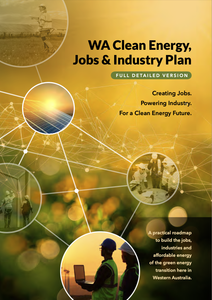
Prepared by a coalition of nine Western Australian union, industry, conservation, and community organisations—including UnionsWA, the Conservation Council WA, and the Smart Energy Council—the WA Clean Energy, Jobs & Industry Plan provides a practical roadmap to transform Western Australia into a clean energy powerhouse while creating thousands of secure local jobs.
Western Australia stands at a pivotal crossroads: lead the global clean energy economy or watch investment, future industries, and secure jobs go elsewhere. The WA Clean Energy, Jobs & Industry Plan outlines a transformative blueprint to harness the state’s world-class solar and wind resources. Discover how legislated renewable targets, green iron manufacturing, and a dedicated regional training strategy can generate tens of thousands of local jobs, lower household bills, and build a resilient, net-zero future for all Western Australians.

WA needs a clear and forward-thinking plan if it is going to become a competitive renewable energy powerhouse and maintain its economic strength through the energy transition.
“Western Australians know a faster renewable energy transition will lower their household expenses and prevent harmful climate pollution. But the community also needs clear direction to ensure this transition will create jobs, lower costs and not cause undue environmental harm.
“Here, sectors representing a broad range of interests have laid the groundwork for those outcomes, clearly outlining what is needed to create a future for WA that is good for the environment, for the climate, for workers and for the economy.
Summary
The WA Clean Energy, Jobs & Industry Plan sets out a strategic roadmap to position Western Australia as a global clean energy superpower while creating thousands of secure local jobs.
The report establishes three overarching goals:
- Creating local employment.
- Maintaining industrial competitiveness.
- Lowering household energy costs
To realize this vision, the framework details actionable measures to follow on from the recent WA Government announcement of a 75% Renewable Energy Target by 2031 for the South West Interconnected System. This includes developing a statewide Renewable Energy Target, coordinating statewide workforce and training pipelines, strategically planning regional infrastructure to safeguard high-value biodiversity and cultural heritage, and ensuring equitable benefit-sharing through household electrification incentives and First Nations equity partnerships. Ultimately, the plan highlights that establishing clear policy and regulatory certainty will unlock lower energy bills, boost power reliability, and secure the state’s global competitiveness in emerging green commodity export markets.

Key Findings
- Statewide Renewable Energy Target and Emissions Reduction Targets: The report calls for a statewide RET and 1.5°C aligned emission reduction targets to remove policy risk, lower capital costs, and attract clean energy investment.
- Transformative Job Creation: Accelerating the transition offers massive employment prospects, including up to 8,800 solar and battery jobs by 2050, as well as 24,000 ongoing and 11,000 construction jobs in a commercial green iron industry.
- Industrial Electrification & Competitiveness: Requiring large gas users to adopt binding electrification timetables and providing concessional financing will protect existing energy-intensive manufacturers from rising energy costs and impending domestic gas shortfalls.
- Green Commodity Export Leadership: Western Australia can build new export markets in green iron, green ammonia, and offshore oil/gas decommissioning by constructing shared common-user infrastructure and setting dedicated Green Commodity Export Targets.
- Coordinated Workforce & Training Pipeline: To address critical skill shortages the plan recommends establishing a WA Clean Energy Jobs Plan 2050, three regional training hubs, and dedicated pathways for female and under-represented apprentices.
- Environmental Safeguards & Community Benefits: Fast-tracked development must be paired with State Planning Policies that avoid high-biodiversity and cultural heritage lands, mandate new data centres to run on additional renewable power, and deliver household electrification rebates and First Nations equity partnerships.
What you can do
WA has an opportunity to lead on sustainable, clean energy and associated industries. You can help by:
- Sending an email to Environment Minister Murray Watt and Prime Minister Anthony Albanese, calling on them to reject Browse.
- Sharing this story to help more Australians understand what’s at stake.
- Encouraging your friends and family to take action.