



- What are the benefits and challenges of using AI in weather and climate forecasting?
- What are some other current uses of AI in climate science research?
- How is AI being used to advance climate policy and action?
- How could AI be used in climate research over the coming years?
- Are there any misconceptions about the use of AI in climate science?
- Could AI improve or exacerbate inequalities in climate research?
- What are some other risks and challenges of AI in climate change research?

A relatively ambitious deal to reduce the shipping industry’s 3% of global emissions now looks more likely after four days of closed-door talks in London, observers say.
The International Maritime Organization (IMO), which oversees the negotiations, said there had been “constructive discussions” and “genuine willingness within the group to make concrete further progress”.
Em Fenton, senior director at the NGO Opportunity Green who attended the talks last week, said they “demonstrated a strong spirit of solidarity in the face of blatant attempts to undermine the credibility, ambition and equity of a hard-fought multilateral agreement”.
After several years of debate, governments provisionally agreed in April 2025 on a “Net-Zero Framework” (NZF) – a series of emissions reduction targets for shipowners aimed at incentivising them to use cleaner fuels, backed up with financial rewards for meeting the targets and fees for missing them.
But in October 2025, after a high-profile intervention by US President Donald Trump and threats of US sanctions and visa restrictions, the US convinced a majority of voting nations to postpone the adoption of the NZF for a year.
UCL analysis found that, of those who expressed a view at last week’s talks, 38 were in favour of an NZF-style solution while only 17 were against. Those opposed are “consistently composed of strongly fossil fuel-aligned governments”.
An observer of the talks, who did not want to be named, said the countries opposed include the US, Russia, India, Thailand, Argentina, Ecuador and Uruguay, as well as eight oil-rich Gulf nations and shipowner-reliant Liberia and Panama. Governments that support an NZF-style deal include China, Brazil, Mexico, Türkiye, Canada, Australia, Chile, nine African nations, most European countries and small islands.
A new framework to tackle shipping emissions could be adopted if two-thirds of countries that are present and signed up to a regulation called Marpol Annex VI – endorsed by just over 100 states – vote in favour of it, as they did in April 2025.
UCL’s analysis said it was “reassuring” that governments which had taken strong positions in the media against the NZF were being more compromising in the negotiations.
Tweaks are probable
While there is majority support for the NZF, UCL said adopting it would be difficult politically. “The process from here could therefore be as much about producing what appears to be a new package, but one that broadly ends up with similar outcomes in relation to objectives,” UCL argued.
But tweaking the NZF, which resulted from years of negotiations, comes with risks, it warned. For example, changes could reduce the new system’s planned support for low-income countries, turning them against it. Fenton said compromising should not mean “abandoning the principle of justice in the maritime transition”.
UCL said the speed at which shipowners must reduce their ships’ emissions or face fees is likely to be reduced in the short-term but raised in the long-term to meet a goal of net zero emissions by mid-century.
-
Palestine: Israel’s bombing has left Gaza vulnerable to climate change
With homes, hospitals and water storage destroyed, Palestine’s government says that Gazans have little protection from climate impacts and sets conditional emissions targets -
More support needed to power Africa’s food systems with renewables, experts say
Renewable energy could help African food businesses boost productivity and competitiveness, but the upfront cost, fragmented markets and limited financing stand in the way -
Loss and damage fund urged to hold crisis meeting on Nepal
The new fund is coming under pressure from developing nations to respond quickly to climate disasters rather than just financing longer-term projects
This was a compromise put forward by NZF-supporter Brazil. However, an analysis by the the Institute of Marine Engineering, Science and Technology (IMarEST) has found that this change would lead to more overall emissions than the original NZF trajectory.
UCL has warned it could incentivise liquefied natural gas as a shipping fuel over greener options, which include hydrogen-based methanol and ammonia.
Analysis by UCL and the Rocky Mountain Institute suggests that, while a slower start to the NZF would reduce transport costs in the short term, it would increase them later due to the costs involved in switching the industry over from more polluting fuel to cleaner fuel.
NZF won’t meet emissions goals
IMarEst’s analysis finds that even in its current form – the most ambitious deal on the table – the NZF will not be sufficient for shipping to meet its emissions reduction goals.
It says that only a Pacific proposal to place a levy on ships’ total emissions – rather than just those above a certain level – would meet the industry’s targets to reduce emissions 20% between 2008 and 2030, 70% by 2040 and then reach net zero “by or around, i.e. close to 2050”. This is highly unlikely to be adopted.
Additional talks will be held from November 23-27 and from November 30-December 3 before a potentially final round of official negotiations begins on December 4.
The post London talks raise hopes for green shipping deal appeared first on Climate Home News.
Continue Reading
Climate Change
Loss and damage fund agrees $20m for Nepal but rich nations warn it should not set precedent
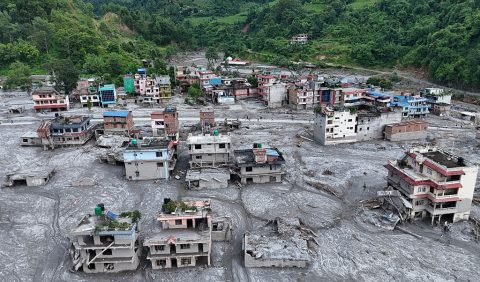
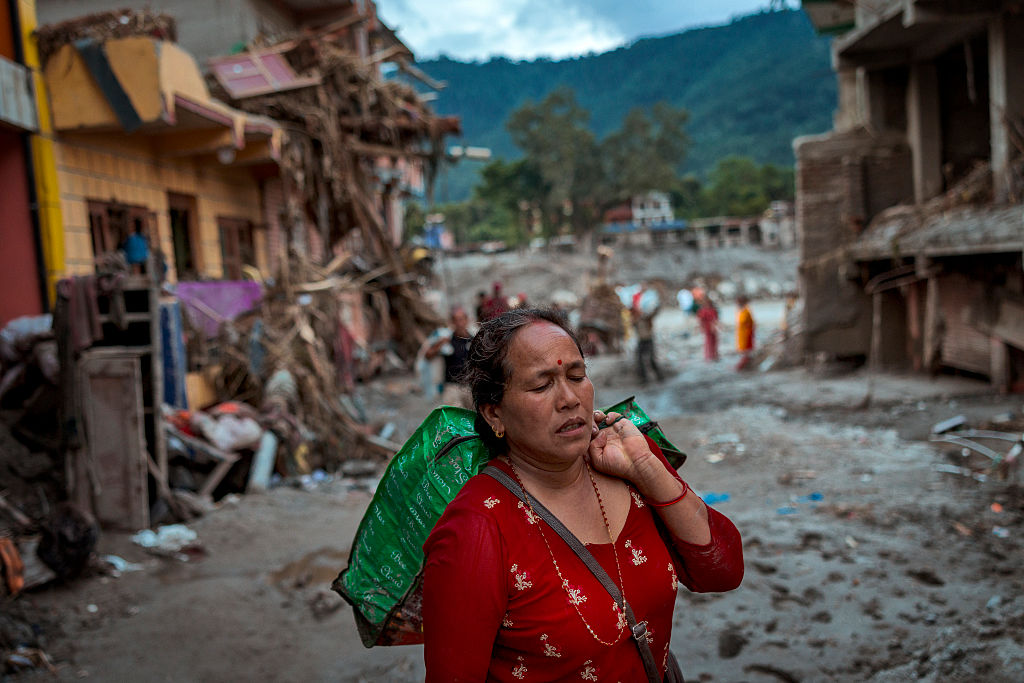
The board of the UN’s Fund for Responding to Loss and Damage agreed on Thursday to set aside $20 million to help Nepal recover from the devastating climate-driven flood it suffered in August.
At an extraordinary online meeting, board members unanimously invited Nepal’s government to submit a proposal for how to use the money, which will be considered at a future board meeting.
The board’s co-chair Camila Minerva Rodriguez described the decision as “truly historic” as it is the first time the new fund has allocated any money since it was set up three years ago. It is expected to approve its first set of projects at its next board meeting in December.
Maheshwar Dhakal, a senior official at Nepal’s climate ministry, told the meeting the decision was “a powerful expression of humanity, compassion, solidarity and hope” and, for the flood victims, a “recognition of their suffering, respect for their dignity and hope that they are not alone in their darkest hour”.
While board members were united in approving the $20 million, plus $1.6 million of administrative costs, representatives of developed and developed countries were divided over the extent to which the decision should set a precedent for the fund’s long-term way of operating.
Germany and Czechia’s board members said it should not set a “precedent” while Japan’s representative said the decision is “truly exceptional” and that the fund’s support must be “in accordance with established rule and procedure”.
Learning the lessons?
Responding, Pakistan’s Ali Sheikh said the lessons from the Nepal case should “feed the long-term model and its work on rapid disbursement” of funds.
He added that he had heard Jan Dusik, Czechia’s board member saying that “we are open for learning but not in setting precedent”. “Please do not define the boundaries for learning,” he emphasised.
Sheikh complained that the decision approved by the board – the result of negotiations between a group of four developed and four developing-country representatives – was narrower than developing countries had hoped for.
“We are saying it is a one-time and Nepal-only window, a sentiment against which many developed countries have raised their voice,” he said, adding there had been no time to review the decision.
Walter Schuldt from Ecuador echoed Sheikh, saying “we should not put limits on lesson learning”. He said the decision, which he was involved in negotiating through “intense exchanges”, tells the fund’s staff to assess the lessons learned.
The fund is currently in a start-up phase and the board will debate its long-term model – including whether and how to rapidly disburse funds in response to climate-driven disasters – at its next board meeting in the Philippines in December.
At Thursday’s meeting, several developing-country board members called for wealthy nations to put more money into the fund. Recovery and reconstruction from Nepal’s flood alone is estimated to cost $4.8 billion – in comparison, the fund has only around $350 million to allocate, with a current cap of $20 million per project.
The post Loss and damage fund agrees $20m for Nepal but rich nations warn it should not set precedent appeared first on Climate Home News.
Loss and damage fund agrees $20m for Nepal but rich nations warn it should not set precedent
Artificial intelligence (AI) is developing at a rapid pace and is increasingly being used by scientists to better understand climate change.
AI is perhaps best-known for its use in “large language models”, such as ChatGPT, Claude and Gemini.
However, the field is vast.
From weather forecasting to analysing satellite images, climate scientists are using various types of AI to develop faster and more efficient ways to study the warming planet.
However, the technology comes with no shortage of risks and challenges, including overreliance on unverified results, intensive energy use and exacerbating existing inequalities in climate science.
Carbon Brief spoke to 10 experts working across a range of climate-related fields – from developing climate forecasts to analysing changes in the energy grid – about how AI is being used.
Their answers are set out below, grouped by theme.
- What are the benefits and challenges of using AI in weather and climate forecasting?
- What are some other current uses of AI in climate science research?
- How is AI being used to advance climate policy and action?
- How could AI be used in climate research over the coming years?
- Are there any misconceptions about the use of AI in climate science?
- Could AI improve or exacerbate inequalities in climate research?
- What are some other risks and challenges of AI in climate change research?
What are the benefits and challenges of using AI in weather and climate forecasting?
Dr Doug McNeall, science lead in data-driven climate modelling at the UK Met Office:
One of the most significant recent developments has been the success of AI weather-prediction models, which learn from large volumes of weather data to predict the next few hours ahead and then repeatedly feed those predictions back into themselves to generate forecasts up to two weeks into the future.
These models have demonstrated that AI can provide accurate predictions while requiring far less computing power than existing numerical models [which rely on mathematical equations to simulate the climate].
One of the main challenges is that AI weather-prediction models have been developed for relatively short timescales, where large amounts of observational data [for example, temperature, rainfall or sea ice extent data] is available and model performance can be evaluated quickly and rigorously.
Climate prediction is fundamentally different. To provide useful climate information, we need to make projections for future climates that lie outside the observational record.
One promising route forward is, therefore, to use AI to emulate or accelerate these existing models, rather than relying solely on purely data-driven approaches. This blended approach could make climate risk information far more accessible and affordable to produce, while retaining the physical understanding [based on mathematical and scientific principles] that underpins confidence in climate projections.
Prof William Collins, professor of AI for climate science at the University of East Anglia:
We’re seeing a really exciting renaissance in both weather and climate science…Machine learning [a subset of AI that uses algorithms to let computers learn from data and make predictions without being explicitly programmed] has had an enormous impact on numerical weather prediction.
So, for example, the European Center for Mid-Range Weather Forecasts is now deploying an AI forecast system as part of their official communication of weather predictions to the European community, alongside the traditional forecast system. AI systems have become good enough that they’re absolutely competitive with the world’s leading numerical weather prediction…So that’s been quite remarkable.
Much of machine learning and AI involves learning from data and climate represents a future for which we do not have data. We’re literally trying to predict the future. We don’t have observations of it. So, where does the data come from to inform the models? That is, at the moment, the central challenge that the climate community is attempting to overcome.
Dr Amirpasha Mozaffari, researcher in Earth artificial intelligence at the Barcelona Supercomputing Centre:
AI forecast models do well on typical weather, but underperform physics-based models on record-breaking and unprecedented extremes – precisely the events that matter most for adaptation [to climate change].
Solving that – whether through hybrid models [which combine AI with traditional models], physical constraints [in which rules are implemented based on the laws of physics to help the models make realistic forecasts] or new ways of evaluating models on what they have not seen – is the central open problem for the field.
What are some other current uses of AI in climate science research?
Dr Stefano Materia, researcher in climate variability and change at the Barcelona Supercomputing Centre:
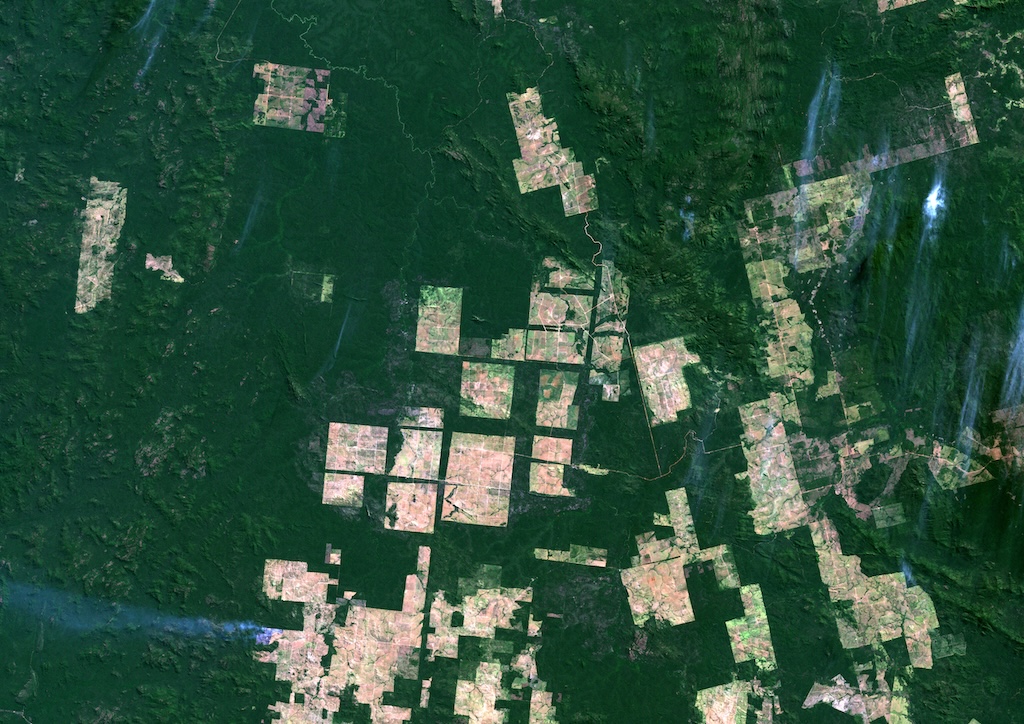
Besides the climate modelling and prediction framework, the proliferation of Earth-observation satellites has created a massive influx of geospatial data (for example, images showing deforestation or sea ice melt). AI is used to translate raw pixel data into actionable climate intelligence.
Methane tracking and ecosystem monitoring are two examples of this kind of application. Methane is a potent greenhouse gas, but leaks are largely invisible and hard to track. AI algorithms now automatically scan hyperspectral imagery [which uses data from across the electromagnetic spectrum] from satellites to pinpoint specific industrial methane leaks globally, alerting operators in near real-time.
At the same time, machine-learning models process thousands of satellite images daily to detect illegal logging, track land-use changes and monitor glacier retreat long before humans could manually review the footage.
Dr Clare Eayrs, polar research scientist at the Environmental Fluid Dynamics Lab at New York University:
In sea ice research, machine learning is now used across the sea ice modelling workflow…The most mature application is extracting more information from observations, for example, mapping fine-scale sea ice deformation from ship radar and classifying snow layers in micropenetrometer profiles [which measure the hardness or softness of different layers of snow].
Forecasting is the most visible application in this field. Ice Net [a sea ice forecasting system] was an early demonstration that a deep-learning system [which uses models inspired by the layers of a human brain to process information] could outperform a leading physical model in seasonal Arctic forecasts. Machine-learning systems are now used to predict [climate] variables such as sea ice concentration, thickness and drift.
Prof Cristiana Stan, vice-chair of the World Climate Research Programme (WCRP):
AI now appears across all major parts of the WCRP. [For example,]…the ”weather prediction model intercomparison project” [an initiative to create a centralised database of physics- based, machine-learning and hybrid model forecasts] includes physics-based numerical weather prediction models, hybrid [models] and AI weather prediction models. Because it is focused on operational models, the project offers a direct comparison between state-of-the art systems. [It] is intended to accelerate the deployment of the next generation of operational models and contributes to development of metrics needed to assess relative strengths and weaknesses of models.
Downscaling is another area that is harnessing AI power to refine the coarse-resolution model output into high-resolution.
Dr William Collins:
The Intergovernmental Panel on Climate Change (IPCC) is performing its seventh assessment report (AR7)…This time, for the very first time, there’s a model intercomparison project just for models using AI [for weather and climate forecasting]. So that is a real milestone…It’s a very exciting proof of principle or proof of concept and, I think, the harbinger of many more developments of this kind to come.
[For more on how model intercomparison will inform IPCC AR7, see Carbon Brief’s recent guest post.]
Dr Amirpasha Mozaffari:
A few years ago, it took two or three years for a new architecture to make its way from the machine-learning community into weather and climate work. Today it is a matter of months: diffusion models,