

A small jellyfish-like animal recently reported from Vejle Fjord has attracted attention. Clear photographs suggest that it belongs to the genus Gonionemus and may possibly be the clinging jellyfish, Gonionemus vertens (Picture courtesy to Jonas Bøgelund Poulsen)
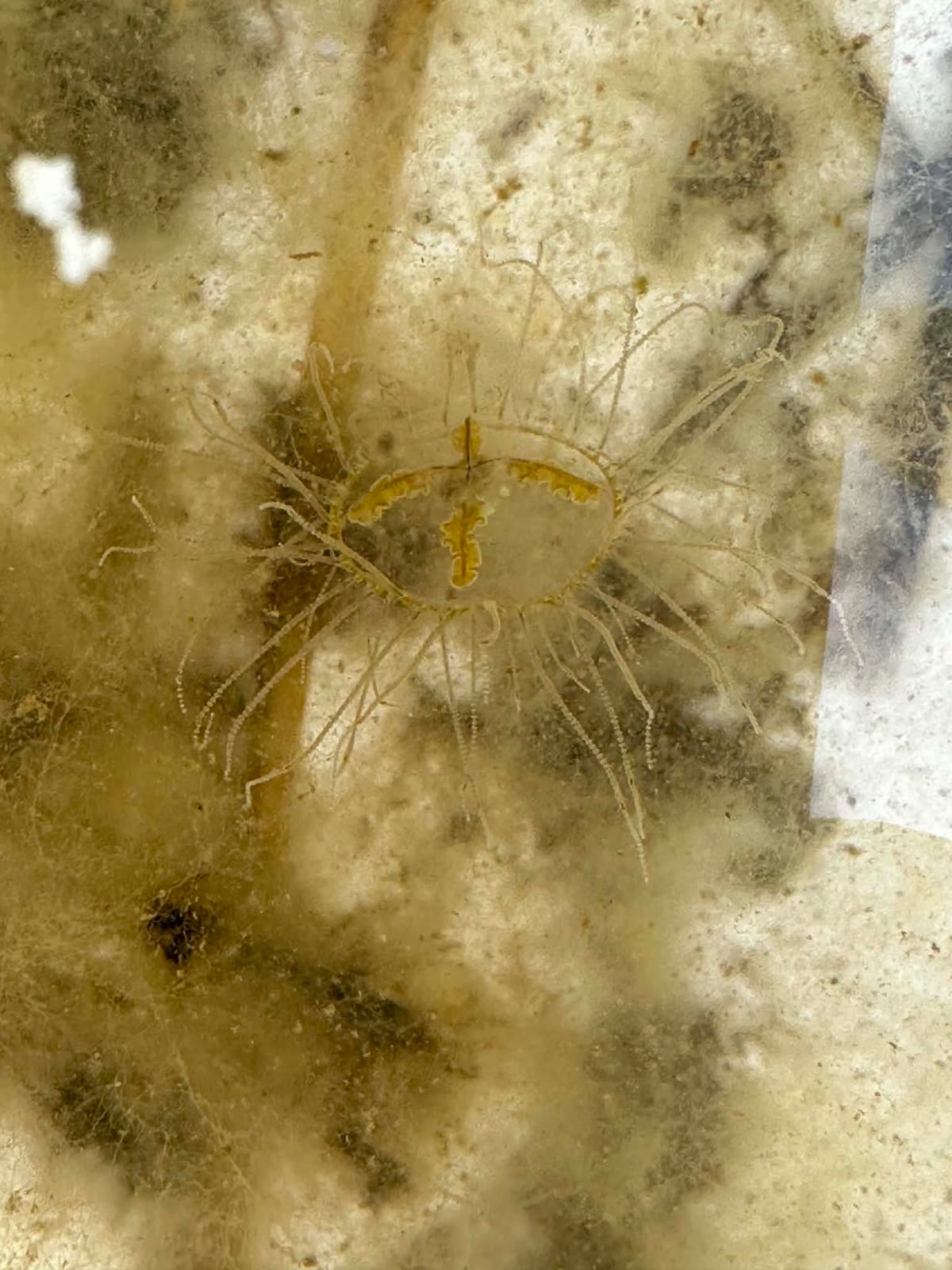
Unlike the large jellyfish commonly encountered along Danish coasts, Gonionemus vertens is a small hydromedusa, usually only around 1.5–2.5 centimetres across. Its transparent bell reveals four coloured reproductive structures arranged like a cross. Numerous fine tentacles surround the bell, often appearing bent or angled. Small adhesive pads near the ends of the tentacles allow the animal to attach itself to eelgrass, seaweed and other submerged vegetation.
This unusual behaviour explains its English name: the clinging jellyfish. During the day, it often remains attached to vegetation rather than drifting freely with the current. At night, it becomes more active and swims into the water column to feed on zooplankton and small crustaceans. Consequently, it can easily remain unnoticed even in places where it is already established. Another reason the species can be difficult to detect is its life cycle. The visible medusa is only one stage. For much of its life, the animal may persist as a minute polyp attached to a hard surface, shell or vegetation. These inconspicuous polyps can reproduce asexually and later release new medusae when environmental conditions become favourable.
Gonionemus vertens is generally considered native to the northern Pacific but has been introduced into several parts of Europe and the Atlantic. Transport on ship hulls, in ballast water or with movements of oysters and other marine organisms has been suggested as possible pathways, although the pathway responsible for any particular occurrence is rarely known with certainty.
Despite its delicate appearance, the animal should not be touched. Some populations possess powerful stinging cells and have caused intense pain, swelling, muscle cramps and, in rare cases, serious allergic reactions. Sting severity differs considerably among regions, which is one reason researchers suspect that animals currently grouped under the name G. vertens may represent a complex of closely related forms.
The Vejle Fjord observation is therefore scientifically interesting, but it should not yet be presented as a confirmed record of G. vertens. Anyone encountering a similar animal should photograph it without handling it and record the date, exact location, approximate size, number observed and surrounding habitat. Observations can be submitted to Denmark’s national species portal, Arter, where they can be evaluated and contribute to tracking changes in Danish marine biodiversity. Please use either my App: GoJelly JellySpotter or reprot to the Arter.dk: Gonionemus taxon page and Danish species-reporting portal.
References:
Edwards, C. (1977). A study in erratic distribution: The occurrence of the medusa Gonionemus in relation to the distribution of oysters. Advances in Marine Biology, 14, 251–284. DOI: 10.1016/S0065-2881(08)60448-4.
Govindarajan, A. F., Källström, B., Selander, E., Östman, C., & Dahlgren, T. G. (2019). The highly toxic and cryptogenic clinging jellyfish Gonionemus sp. (Hydrozoa, Limnomedusae) on the Swedish west coast. PeerJ, 7, e6883. DOI: 10.7717/peerj.6883.

This fall, Ocean Conservancy is celebrating its 41st annual International Coastal Cleanup® (ICC), once again bringing together volunteers to protect the beaches and waterways we all love. Ocean Conservancy recently hosted flagship events in Long Beach and Washington, D.C. that celebrated this global movement close to home.
Over the past four decades, nearly 20 million volunteers have rolled up their sleeves to remove more than 405 million pounds of trash from beaches and waterways around the world. And their impact extends far beyond what they collect. ICC volunteers have documented nearly 440 million individual items, creating the world’s largest marine debris database and providing invaluable information that helps Ocean Conservancy and others better understand—and tackle—ocean plastic pollution.
This year’s celebration continued that incredible legacy. At Alamitos Beach in Southern California, more than 150 volunteers gathered on September 19 and removed 1,109 pounds of trash, alongside members of Team USA Artistic Swimming and Olympic and Paralympic athletes. In Washington, D.C., 439 volunteers gathered on September 26 to remove 2,182 pounds of trash from Anacostia Park along the Anacostia River.


“I am so grateful to all of the volunteers who came out today for our ocean—and every volunteer who has made the last 41 years of impact possible,” said Ocean Conservancy’s Senior Director of Conservation Cleanups, Allison Schutes. “Every piece of plastic collected helps protect marine animals and habitats and contributes to research and advocacy.”
And the impact doesn’t stop when the cleanup ends. During International Coastal Cleanup events, volunteers do more than remove trash: They document what they find, helping build a clearer picture of the plastic pollution threatening our waterways and wildlife. Through the Clean Swell® app or paper data sheets, ICC volunteers contribute to Ocean Conservancy’s online, open-access database, the world’s largest repository of marine debris data. These records help scientists, conservation groups and governments understand pollution trends and identify solutions.
That data can also drive meaningful policy change. ICC data were recently used in a peer-reviewed study showing that plastic bag bans lead to reduced plastic bag pollution. The data have also helped advance policies ranging from California’s SB 54 to Florida’s balloon release ban and the federal Farewell to Foam Act. From a neighborhood cleanup to statewide action, every piece of documented trash helps build the evidence needed to tackle plastic pollution at its source.
Get Ocean Updates in Your Inbox
Sign up with your email and never miss an update.
Want to get involved?
Whether you join a local cleanup, record the trash you find using the Clean Swell app, or take action to reduce plastic pollution, you can be part of this incredible collective effort to protect our ocean. Here are a few ways to make an impact:
- Find a cleanup near you.
- Download our Clean Swell app to easily record the trash you collect.
- Take action to reduce plastic pollution.
- Explore our Wildlife Impact Calculator to estimate the potential benefits of your cleanup for marine wildlife.
- Donate today to Ocean Conservancy to help us fight plastic pollution for years to come!
The post Celebrating 41 Years of the International Coastal Cleanup® appeared first on Ocean Conservancy.
For generations, stories of people being swallowed by enormous sea creatures have painted awe-inspiring tales of human survival and perseverance. From the biblical account of Jonah to the legendary battle of Hercules and Cetus to the timeless story of Pinocchio, these legendary tales have captivated people since time immemorial.
But all these stories raise the question: Could someone really be swallowed by a whale? With the premiere of the film Whalefall on October 16, 2026, you may find yourself in conversations about this very situation. Based on the bestselling 2023 thriller authored by Daniel Kraus, the film tells the story of a scuba diver who is accidentally gobbled up by a sperm whale while searching for the remains of his late father. With only an hour of oxygen left in his tank, the diver must fight to escape the whale’s gut before time runs out.
The answer to whether it’s anatomically possible for a whale to swallow a person is actually a bit more complicated than you might think.
Get Ocean Updates in Your Inbox
Sign up with your email and never miss an update.