


Article Contents

Welcome to Carbon Brief’s DeBriefed.
An essential guide to the week’s key developments relating to climate change.
This week
Heat and firewaves
‘FIREWAVE’: Wildfires ravaged Europe and North America this week. France utilised water-dumping planes collecting from the Seine to contain a fire in the Fontainebleau forest near Paris, according to the Associated Press. The Financial Times reported that the UK has had “25 non-consecutive days with temperatures of 30C or more, including nine days above 34C”, creating a “firewave” and putting pressure on emergency services. Meanwhile, an “orange haze from Canada wildfires” could be “seen in Ontario and northern US”, said BBC News.
‘NEW NORMAL’: Climate events previously seen as extreme are becoming the “new ‘normal’”, said the Met Office, in a report on the UK’s climate. While last year was the UK’s hottest on record, rising temperatures mean it is expected to be surpassed in the next few years, reported Reuters. Liz Bentley, head of the Royal Meteorological Society, told the Guardian that “climate change has been described by scientists for many years but is now increasingly being felt by the UK population in their own homes and communities”.
Around the world
- ELECTRIFYING PUSH: The European Commission has announced a target for electricity to account for 46% of energy consumption across the bloc by 2040, reported Carbon Pulse. The commission has also made plans to adapt its emissions trading system to “bring relief to industry”, it said.
- FALLING OIL: The International Energy Agency said that global oil demand is expected to decline this year for the first time since 2020, reported the Associated Press.
- US ROLLBACKS: Trump cuts to clean energy support “led to the cancellation or delay of $83bn in investment across hundreds of projects”, reported Reuters. The Trump administration has also changed environmental law to allow development in the habitats of endangered species, according to CNN.
- BURNHAM BEGINS: Incoming UK prime minister Andy Burnham is preparing to announce new North Sea drilling “within days of taking office”, said Bloomberg. Carbon Brief looked at 28 statements that Burnham has made about climate change and fossil fuels.
- DRY JULY: Drought in Uganda led to significant crop losses and at least 16 deaths from starvation, said BBC News.
- ON AI: Australia planned to implement restrictions on energy and water usage for datacentres “amid [an] AI boom”, said the New York Times.
38%
The drop in Brazilian Amazon deforestation in the first half of 2026, compared to last year, reported Al Jazeera.
Latest climate research
- The area of land burned by wildfires in Africa each year has reduced due to a shrinking dry season | Geophysical Research Letters
- Most people do not distinguish between climate adaptation and mitigation when thinking about tackling climate change | Climate Outreach
- An “effort-sharing framework” has been developed to support progress towards the Paris Agreement | npj Climate Action
(For more, see Carbon Brief’s in-depth daily summaries of the top climate news stories on Monday, Tuesday, Wednesday, Thursday and Friday.)
Captured
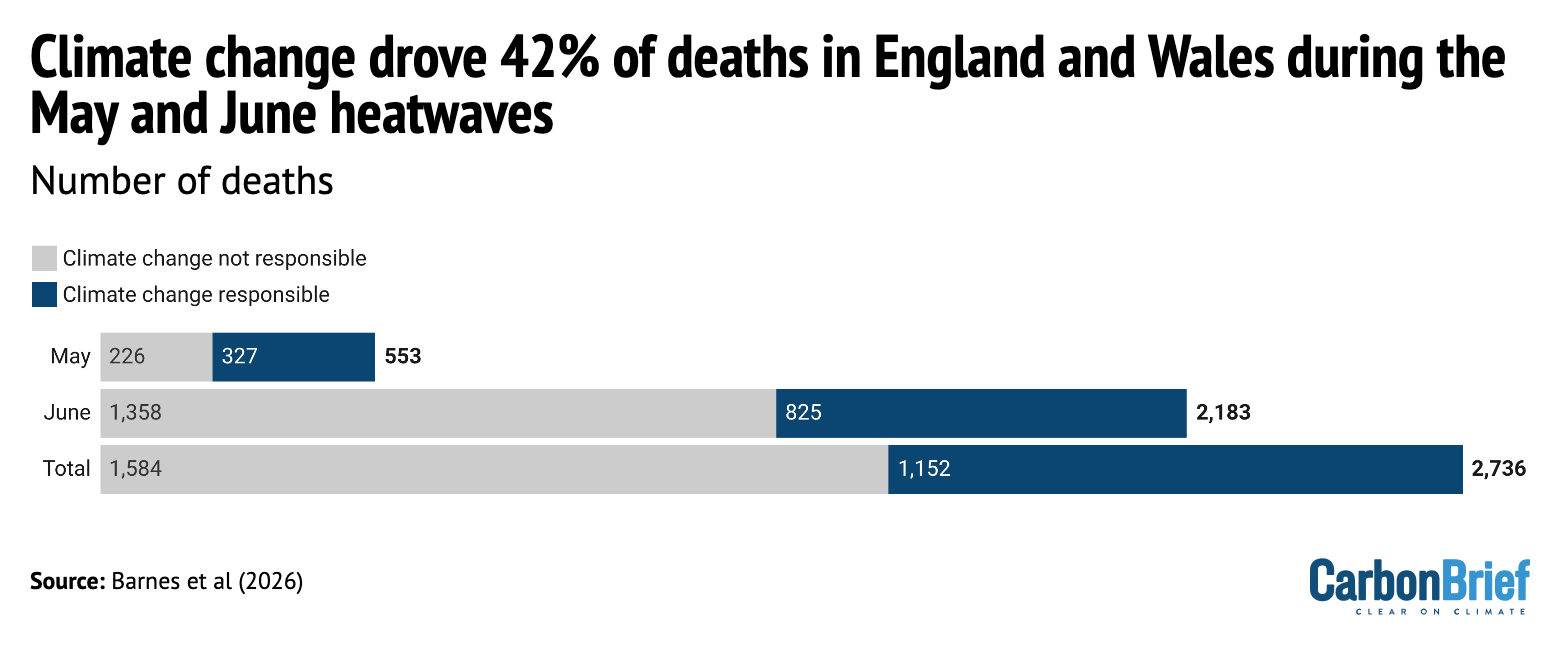
Carbon Brief explained how more than 1,000 heat-related deaths in England and Wales during May and June were attributed to climate change, accounting for almost half of all heat-related deaths experienced during those months. The article also unpacked the different methods for estimating heat deaths around the world.
Spotlight
Natural History Museum exhibits climate change
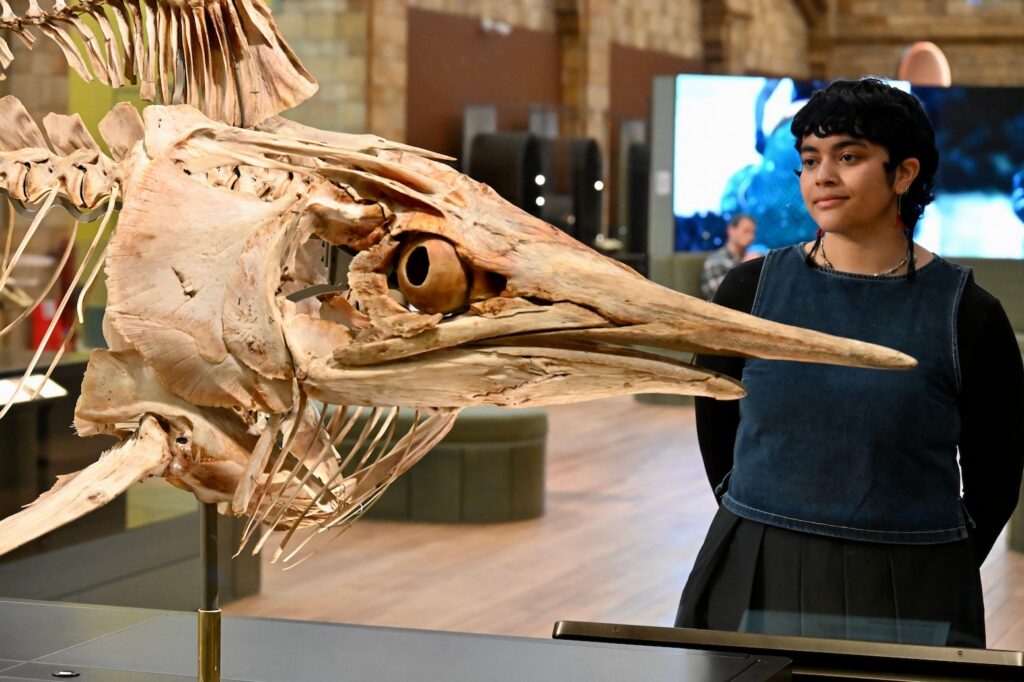
This week, Carbon Brief interviews Meaghan Macdonald, senior project and programme manager for London’s Natural History Museum, about their first permanent climate-themed exhibition, Fixing Our Broken Planet.
Carbon Brief: Why are programmes such as Fixing Our Broken Planet so important?
Meaghan Macdonald: One of the main things we’re trying to achieve with Fixing Our Broken Planet is to place the museum as a convener of conversations around the planetary emergency…trying to bring together the different groups of people who need to be involved in this conversation in order to work together to find a solution.
And we find that a lot of the people who come into the gallery weren’t necessarily coming here to see it; they come across it, which is a really great way to engage people who may not have been engaged in that discussion previously.
CB: How does the exhibition engage and inspire visitors?
MM: A driving force for this exhibition is that you are dealing with a subject matter that can be quite disheartening, and one of the things that we were very careful about is to try to make sure that woven throughout the scientific data… is a sense of hope… to enable people to feel empowered to make a difference.
We were able to do things like our “what you can do” labels, which give an example that people can take away with them. We also have “conversation starters”, which is a digital screen that asks people a series of questions related to the planetary emergency. Things like: “Should we mine the deep sea to power the green economy?”…And there’s no right or wrong answer.
We [also] set out very specifically to…forefront the science that’s happening here. We know from multiple studies from thinktanks and organisations that people actually trust our scientists the most.
CB: The museum has set out a goal to “create advocates for the planet”. What does this mean? How does it relate to the exhibition and the museum’s wider climate action?
MM: The aim of the museum is to get to a place where both people and the planet thrive. Being a library of the natural world, it is our duty to be standing up for it and to help people find their way, fighting for nature’s side.
In order to create those advocates, the aim of the [exhibition] and the wider advocacy programmes at the museum is to try to find ways to bring all these people [individuals, policymakers, industry, scientists] together.
We have the wider programme with Fixing Our Broken Planet. We have Generation Hope…a free graphic panel version of our display in the gallery that we have been able to get into a number of venues in Bangalore…the very long-standing and beloved wildlife photographer of the year [exhibition]…our urban nature movement…[and] an initiative that we are doing with the Department for Education called the National Education Nature Park.
Watch, read, listen
STUBBORN HOPE: For the Conversation, climate scientist Prof Peter Stott argued that researchers need to “talk more about the very worst-case scenarios” and the possibility for action.
EXTREME: Vox’s the Gray Area podcast spoke to New York Times journalist David Wallace-Wells about the possibility of a “Godzilla” El Niño.
RESPONSIBILITY: For Climate Home News, two researchers from the Center for International Environmental Law explored how “major emitting countries knew of climate risks decades earlier than claimed”.
Coming up
- 13-31 July: Meeting of the International Seabed Authority assembly and council, Kingston, Jamaica
- 17-19 July: 3rd International Conference on Environment and Sustainable Development, London
- 19 July: Presidential election, São Tomé and Príncipe
Pick of the jobs
- Zero Carbon Analytics, research lead | Salary: Unknown. Location: Remote
- Met Office, ocean climate scientific manager | Salary: £54,515-£58,582. Location: Exeter
- National Trust, land use and nature delivery partner | Salary: £44,499. Location: Newcastle or York
DeBriefed is edited by Daisy Dunne. Please send any tips or feedback to debriefed@carbonbrief.org.
This is an online version of Carbon Brief’s weekly DeBriefed email newsletter. Subscribe for free here.
The post Debriefed 17 July 2026: UK ‘firewave’ | Fossil-fuelled heat deaths | London’s Natural History Museum spotlights climate appeared first on Carbon Brief.
Continue Reading
An older teaching about land acknowledgement
As I have come to understand the spirit and intention of land acknowledgement, I often return to fond memories of my grandmother and her words of wisdom. She taught that the health of the places we call home comes first, because the wellbeing of the people depends on it.
In her teaching, land acknowledgement began with the land. Long before it became a paragraph read at the start of a meeting, it was a way of recognizing a homeland: its waters, its species, its seasons, and the spirit that revealed whether the place was well.
Her teaching echoes a practice found across many Indigenous Nations. Haudenosaunee gatherings, for example, have long opened with the Ohén:ton Karihwatéhkwen, the Thanksgiving Address, often translated as “the words that come before all else.” The speaker greets and gives thanks to the people, the earth, the waters, the plants, the animals, the winds, the sun, the moon and the stars. Only after everything that sustains life has been acknowledged does the gathering turn to its own business.
That order changes what an acknowledgement is for. Its purpose was to share the story of a place with neighbours and to draw them into the work of tending it. People entered the story second, as the ones responsible for what had just been named.
Understood this way, an acknowledgement does more than open a meeting. It asks us to reconsider where we stand, and what we owe the ground beneath us.
Nations among nations
In her teaching, people are one nation among many. The salmon are a nation. So are the cedars, the bison, the medicine plants, and the pollinators. Each belongs to a place, carries its own responsibilities, and offers gifts no other nation can give.
This idea of kinship runs through many Indigenous philosophies. The phrase “all my relations,” heard in ceremonies and gatherings across Turtle Island, is a reminder that family extends beyond people to the animals, plants, waters and lands that make life possible. Some Indigenous languages carry the same understanding in their grammar, speaking of many plants, animals and natural forces as living beings rather than objects.
Sovereignty, understood through this relationship, is a kind of standing more than a form of control. Each nation belongs fully to its place and carries its share of that place’s life. No nation thrives alone, and none thrives by taking over the whole.
The land is also the source of instruction. Over generations, people watched how a river valley or a stretch of prairie kept itself well: who arrived when, who fed whom, and how much could be taken before the giving stopped. In my grandmother’s telling, those observations became instructions, and those instructions helped shape law and protocol. They guided when to harvest, where to camp, how to enter a neighbour’s territory, and what was owed in return.
Indigenous legal scholars today often describe this as law that comes from the land itself, learned by watching how living systems sustain one another. A plainer name for it is knowing how to live somewhere.
The host and the guest
One of the clearest teachings in this understanding of the world is the relationship between host and guest. My grandmother invited us to recognize that relationship in the lives of plants and animals.
A host prepares the place before anyone arrives. A beaver family dams a stream, and the pond becomes a home for fish, frogs, birds and plants. A fallen tree becomes a nurse log, feeding the next generation of seedlings as it returns to the soil.
A host offers first. A flowering plant sets out nectar. A berry bush ripens fruit. These provisions come in their own season, not whenever a visitor happens to want them.
A host also makes its presence known. Birdsong, scent and the marks left along a trail tell newcomers that a place is already inhabited. The visitor does not arrive in an empty world.
The guest has responsibilities too. A guest attends to the season and to what the place can offer. A guest does not assume that everything within reach is theirs to take. A guest leaves something that helps sustain the relationship.
A bee takes nectar and carries pollen. Read through this teaching, that exchange offers an image of visiting well: receiving a gift while helping the host continue its life.
Many Indigenous harvesting protocols carry the same ethic into daily practice: ask before taking, take only what is needed, offer thanks, and leave enough for others and for the plant or animal to recover.
None of this suggests that every relationship in nature is peaceful or generous. These are ways of seeing responsibilities that people can learn to carry.
Everyone is both
No being is only a host or only a guest.
A tree makes room for other life while depending on soil, water, sunlight, fungi, and relationships beyond itself. People, too, may welcome others into their homes while remaining dependent on the larger homeland that sustains them.
The distinction between host and guest is therefore about roles, not ranks. Everyone receives. Everyone has something to give.
The question is whether the exchange sustains the place.
A visitor who takes without restraint leaves less for those who come next. A host who neglects the place has less to offer. Both have responsibilities, and neither can fulfil them alone.
This is the heart of reciprocity, a principle found across Indigenous philosophies: relationships stay healthy when gifts move in both directions. The Haudenosaunee teaching of the seventh generation extends that exchange across time, asking that decisions made today leave the place well for those not yet born.
Mutual benefit begins here, with the recognition that different beings carry different gifts and obligations.
What people carry forward
My grandmother’s teaching connects these relationships to the ways people meet their neighbours.
The host prepares a place, offers food and rest, and explains where the visitor has arrived. The guest makes themselves known, explains why they have come, listens to the terms of the visit, and brings something in return. The gift may be material. It may also be labour, knowledge, news, or a commitment to help.
Nations around the Great Lakes carried this ethic into treaty. The Dish with One Spoon, an agreement among the Haudenosaunee, Anishinaabe and allied Nations, describes shared hunting grounds as a single dish. Everyone eats from it with one spoon, takes only what they need, leaves enough for others, and keeps the dish clean. The Two Row Wampum, between the Haudenosaunee and European newcomers, shows two vessels travelling side by side on the same river, each keeping its own ways and neither steering the other.
In this understanding, acknowledgement is more than naming the people associated with a territory. It is learning enough about a homeland to behave responsibly within it.
Whose home is this? What sustains it? What laws and agreements guide our presence? What can we receive, and what must we return?
These questions make acknowledgement a relationship rather than a recital.
They also make it diplomatic. A guest who recognizes the host’s homeland recognizes that they have entered a place with its own relationships and responsibilities. A host who welcomes the guest makes room for an encounter governed by those relationships.
Neither arrives without standing. Neither arrives without obligations.
Beginning with place
I write from the shores of the Bay of Quinte. Here, the teaching asks me to begin with the water, the shoreline, and the life they sustain. Before I describe myself, I must attend to where I am.
That does not make people or history less important. It places them within the homeland that gives them meaning. The people, their laws, their agreements, and their responsibilities all belong to the place.
In a time of longer fire seasons, troubled waters, and uncertainty about what the next season will bring, this teaching asks something difficult and useful of us: pay attention before you speak.
An acknowledgement cannot tell the story of a place if the speaker has stopped noticing it.
The land came first. Beginning there again means learning to name what sustains us, and accepting that what sustains us also asks something of us.
By Rye Karonhiowanen Barberstock
Photo by Andrik Langfield on Unsplash
The post The Land Came First appeared first on Indigenous Climate Hub.