

Hina West is managing director of Climate Strategies.
The first Global Conference on Transitioning away from Fossil Fuels, organised by Colombia and the Netherlands, in Santa Marta late last month convened nearly 60 countries, as well as activists, Indigenous peoples, the private sector and academia. The aim of this historic event was to build a “coalition of the willing” driving action for fossil fuel phase-out beyond the UN climate process.
The stakes could not have been higher. As the planet grapples with catastrophic warming, economic instability and geopolitical conflicts fuelled by fossil fuel dependence, this conference represented a rare opportunity to reshape global energy governance, putting science and justice at the core.
For decades, fossil fuel phase-out has been the elephant in the room at climate COPs. Now is finally the time to have this conversation, with Santa Marta as the starting point.
So, what’s needed for this process to succeed? In the days preceding the political conference, all the different social group chapters – including academia, labour, private sector, civil society and Peoples (including Indigenous Peoples, Afro-descendant Peoples, peasants, frontline collectives and youth, among others) – developed ambitious recommendations to inform this new multilateral process.
As one of the co-hosts of the academic dialogue, I have learned a clear lesson on what is needed for Santa Marta to create actual breakthroughs for the global energy transition.
Looking where it matters
As someone working at the climate science-policy interface, I believe that science-based evidence is a crucial pathway towards implementing just, orderly and equitable transitions away from fossil fuels.
Yet, as Santa Marta convened colleagues from all over the world, we heard a clear call from representatives of regions directly impacted by the fossil fuel economy: We are over-diagnosed. The evidence is all here, and what we need now is action.
This is a humbling call for the research community: while we remain committed to the creation of knowledge, how can we ensure that these efforts lead to practical outcomes?
As we explored within the academic dialogue ahead of and at Santa Marta, international support for Just Transitions does not often strengthen the capacity of local actors (who are at the frontline) to develop and deliver just transition strategies. If the Santa Marta process wants to translate high-level commitments into credible and effective transition strategies, it must address this gap.
-
Developing countries must hold the pen to script the fossil fuel transition
While the Santa Marta summit has broken the UNFCCC deadlock on phasing out fossil fuels, the new process must not be taken over by Global North nations and their institutions -
Santa Marta summit kick-starts work on key steps for fossil fuel transition
The conference offers some 60 nations help to develop roadmaps to shift their economies away from coal, oil and gas, and make international trade green


Our discussion created a series of recommendations to address the challenge. Among them, we see the need for stronger collaborative governance across all scales and regions – from the global to the local and including South-to-South partnerships – that explicitly supports the local delivery of transition pathways. This is a gigantic task, made harder by the limited resources available.
Today, climate finance remains systematically skewed towards technical and infrastructural investment, at the expense of social and justice programmes. Current regulatory frameworks and investment criteria must be redesigned so that following Just Transition goals brings financial returns, to ensure that resources are directed where they are most needed. Grant-based mechanisms and highly concessional finance must also be strengthened.
Social dialogue and public participation
Local communities and livelihoods must be placed at the centre of this process, to ensure that interventions are inclusive, aligned with territorial development strategies, and comprehensively address transition impacts (including informal and gendered work).
This requires strong mechanisms for social dialogue and public participation, to be established early on and maintained throughout the implementation of Just Transition strategies. These can take different forms, such as legally binding participation frameworks, public interest committees and community-led advisory bodies.
Grassroots communities must be recognised as co-producers of knowledge, not as consultees or receivers of information. This is also applicable to the Santa Marta process.
An expected highlight of this conference was the inclusion of underrepresented groups, including subnational governments, frontline communities, and Indigenous Peoples. Their active participation is crucial to ensure that the transition strategies discussed are not just technically sound, but socially just and locally relevant. These voices must be at the heart of the conference’s final outcomes.
Nevertheless, Santa Marta was only the starting point of this ambitious multilateral process, and also in itself, not free from controversies. The transition away from fossil fuels will bring many uncertainties which require continuous learning and adaptation.
What next?
Taking a ‘build the ship as we sail it’ approach to this new layer of cooperation did not come without friction – be it from balancing Global South and North representation and short input deadlines, to knowing who had charge of the pen before, during and after the creation of our chapter’s output report, intended to feed into the subsequent high-level segment.
I believe that robust, inclusive and context-specific analysis is essential for Just Transition planning and implementation. But as the expert community, we must provide this with solidarity, humility, and willingness to learn from those at the frontline of the transition.
Many learnings surfaced regarding methodology and decision-making, and enhancing overall transparency and inclusivity for the next pre-science convening (and the broader event), currently mooted to be happening in Ireland, with the diplomatic gathering in Tuvalu, at some point next year.
Türkiye’s COP31 presidency and IEA join forces on clean energy push
As we look towards the multilateral milestones ahead – Bonn, Tuvalu, Antalya – the message from Santa Marta is clear. This international momentum must be laser-focused on ensuring practical outcomes on the ground.
What we need now is not another layer of dialogue or more diagnosis, but concrete action: binding and consistent commitments, robust and accountable governance, and finance that prioritises people and the planet. The future we want is within reach, and we have more than enough evidence to demonstrate it, but we need our resources and efforts to be aligned where it matters.
The post Santa Marta was a learning moment for how to shape inclusive just transitions appeared first on Climate Home News.
https://www.climatechangenews.com/2026/05/11/santa-marta-was-a-learning-moment-for-how-to-shape-inclusive-just-transitions/

China’s carbon dioxide (CO2) emissions fell by 3.1% in the third quarter of 2026, as the Hormuz crisis continued to hit oil demand and coal use also dropped.
This guest post is by:
Lauri Myllyvirta, lead analyst at the Centre for Research on Energy and Clean Air
This was the largest quarterly reduction since the 2022 Covid lockdowns and means that China’s CO2 emissions have now fallen by an estimated 0.5% in the year to date.
The new analysis for Carbon Brief, based on official figures and commercial data, shows that coal use fell by 3% year-on-year in the third quarter of 2026, while oil was down 4%.
The main drivers were a fall in power-sector coal consumption, a continued sharp reduction in transport oil consumption and slowing growth in the coal-to-chemical industry.
The sharp decline in China’s CO2 emissions extends a “flat or falling” trend that began in March 2024 and has now lasted more than two years, as shown in the figure below.
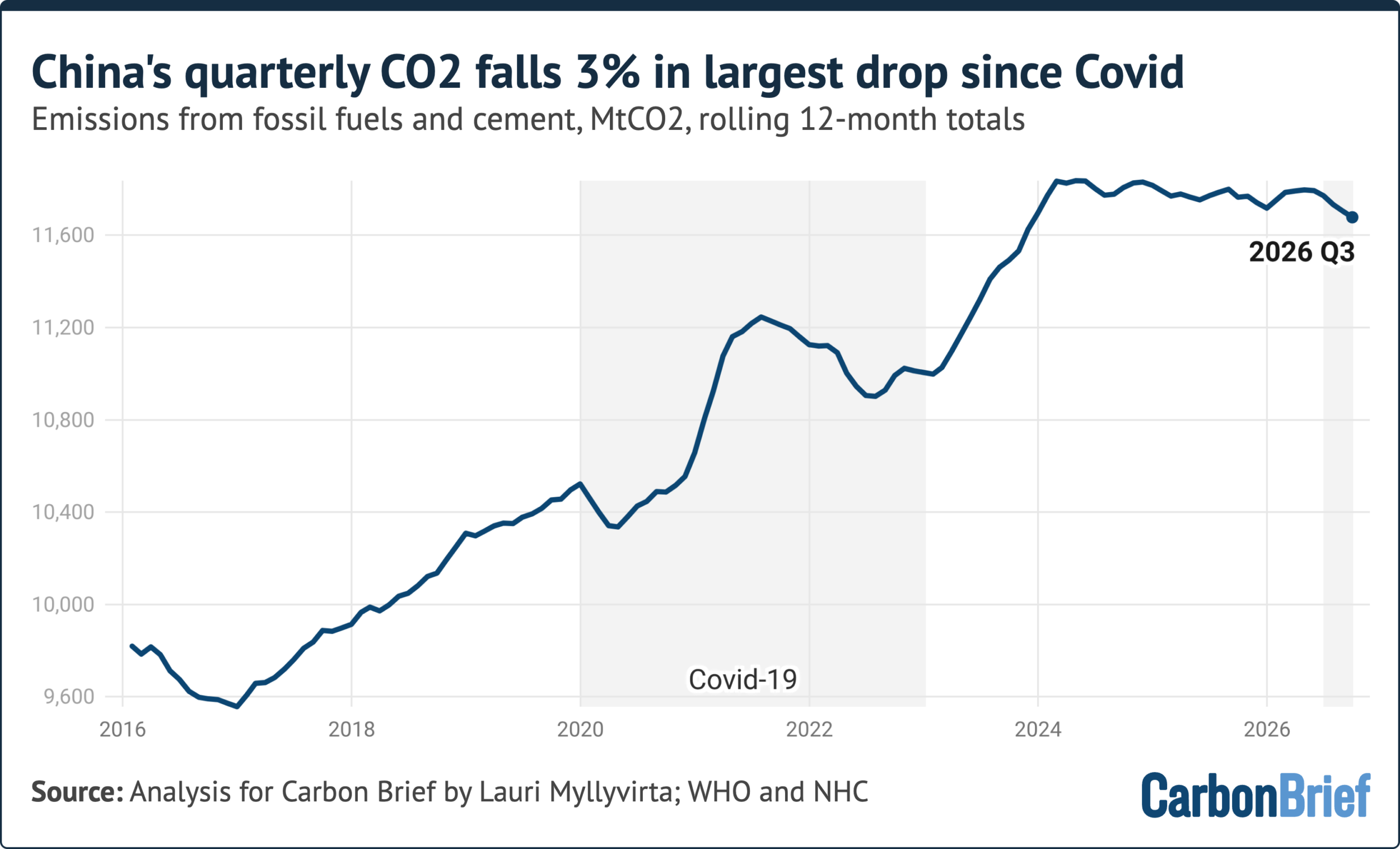
The outlook for China’s CO2 emissions depends on the balance between rising energy demand, clean-energy growth and the government response to a GDP slowdown.
Decline drivers
Key drivers of the fall in CO2 in the third quarter of 2026 included a 3.3% drop in coal-power generation, after demand growth slowed and the amount of “wasted” wind and solar fell.
Power generation from solar, wind and nuclear increased by 110 terawatt hours (TWh) year-on-year, more than twice as much as the growth in total electricity demand. This added clean-power generation equal to Germany’s total power output in the same time period.
The fall in coal-power output and CO2 emissions came despite the fact that China continues to build new coal-power capacity at near-record rates. This means that average running hours for coal plants are falling even faster than total generation, eroding their profits.
Meanwhile, transport oil consumption continued to fall sharply, down 9% year-on-year in the third quarter of 2026. Electric vehicles (EVs) continued to gain market share, hitting a record 67% of passenger car sales and 50% of heavy trucks in September.
The amount of electricity used by EVs grew by 53%, much faster than the number of EVs on the road, showing increased usage of the existing fleet in preference to fuelled vehicles.
Elsewhere, growth in the coal-to-chemical industry continued to slow down in the third quarter of 2026. The sector has been a key source of emissions growth, but high coal prices have weakened profitability and higher output prices hurt downstream demand.
Finally, CO2 emissions from cement and steel production continued to fall in the third quarter, as the contraction in construction volumes accelerated.
Outlook for emissions
Energy consumption growth has been falling after a period of exceptionally high growth during Covid, while clean-power growth has been robust.
This makes it likely that the growth in clean-power generation will exceed total energy demand growth this year, maintaining the structural fall in fossil-fuel use.
Looking ahead, this balance also relies on progress in removing barriers to new solar and wind power being added to the grid, which result in some clean electricity being “wasted”.
The recent slowdown in energy demand growth is partly – but not fully – explained by exceptionally mild weather in the third quarter.
Another key factor is weaker GDP growth. Since reported GDP growth remains within target, however, there is reduced pressure for further stimulus policies.
The focus of the economic stimulus announced to date is “six networks”, which includes the power grid and the transportation network.
These networks are highly relevant for energy and emissions – and they are already covered by policies that emphasise “green” and zero-carbon solutions.

The post Analysis: China’s quarterly CO2 falls 3% in largest drop since Covid appeared first on Carbon Brief.
Analysis: China’s quarterly CO2 falls 3% in largest drop since Covid
Climate Change
Coles, Woolworths grilled as beef buyers receive fail grade on new deforestation scorecard
MELBOURNE, Friday 6 November 2026 — As Coles holds its Annual General Meeting today, Greenpeace Australia Pacific has branded the major supermarkets with a fail grade on their commitment to source deforestation-free beef, with an updated scorecard revealing none of the major beef buyers are following through on forest sustainability commitments.
It comes after Woolworths’s AGM last week where the board copped a grilling by environmentalists and shareholders over its failed sustainability commitments. Both Coles and Woolworths committed to eliminating deforestation in their supply chains by the end of 2025, but a year past the deadline, neither company could guarantee that their beef was not sourced from deforested pastures.
From outside the Coles AGM, Adele Chasson, Nature Policy Lead at Greenpeace Australia Pacific, said:
“This is a report card Coles and Woolworths should be ashamed to take home. While all major beef buyers had promised to take deforestation off the shelves, none of them followed through. Shareholders and the public demanded answers from Woolworths last week and from Coles today, and we will continue to hold their feet to the fire on their promises.
“Beef is the leading cause of deforestation in Australia, and Coles and Woolworths keep putting off action while koalas continue losing their homes. Aussies must be able to get their groceries without having to worry if their dinner is contributing to the bulldozing of forests or driving extinction of iconic Australian animals.
“Without strong, rapid implementation plans, these companies continue with business as usual, flying in the face of Australia’s deforestation crisis. Big beef buyers like Coles and Woolworths must stop the bulldozers now, make good on their sustainability promises and play their part in stopping Australian forest destruction.”
The scorecard assesses how eight of Australia’s largest beef buyers stack up against a conversion and deforestation-free target. It charts whether the major supermarkets, Aldi, McDonalds, Hungry Jacks, Teys, Metcash/IGA and JBS are taking proper action to end Australia’s deforestation crisis. They all failed.
-ENDS-
Media contact: Kimberley Bernard on 0407 581 404 or kbernard@greenpeace.org
Coles, Woolworths grilled as beef buyers receive fail grade on new deforestation scorecard
Özgür Özel is the leader of Turkey’s main opposition “New Party” and a member of parliament from Manisa.
The world is running out of time to deliver on the Paris Agreement. The UN Environment Programme’s latest Emissions Gap Report concludes that the chance of keeping warming below 1.5C without overshooting it is gone. Even if every country delivers its current national pledges, the planet is heading for about 2.6C of warming this century.
This is the backdrop as governments and their leaders gather in Antalya for COP31, ten years after the Paris Agreement took effect. Turkey lies in the Mediterranean, one of the regions most exposed to climate change, and hosting the summit is a real opportunity.
It is also a responsibility, and that responsibility begins at home. The world does not lack targets. What it has lacked – almost everywhere – is delivery. If Antalya is remembered for anything, it should be for shifting the focus from what countries promise to what they actually do.
For many people in Turkey, the climate crisis is already part of daily life. In 2021, forests in Manavgat, a district of Antalya, burned for more than a week. Last year, wildfires forced more than 50,000 people from their homes around the western coast city of Izmir. This October, Istanbul had its heaviest rainfall in more than 80 years, with the floods killing at least eight people.
COP31 Briefing: What to expect from the Antalya climate summit?
Electrification, the fossil fuel transition, adaptation to rising impacts, climate science and trade are key themes as governments gather for COP31 in TürkiyeBrazil’s fossil fuel roadmap sketches out first global timetable
The COP30 presidency’s voluntary timetable asks countries to plan first, then build up clean energy – only turning to oil and gas supplies from 2031


Measurable outcomes
Two weeks of climate negotiations cannot deliver everything that is needed to resolve the crisis, but COP31 can push for a few things that can be measured. The first is a voluntary fossil-fuel transition roadmap, with national milestones for 2030 and 2035 reported in the same format every year.
The second is a stronger commitment to protecting forests, with progress tracked over time. The third is yearly reporting on progress towards the agreed $1.3 trillion a year in climate finance by 2035, backed by a financial roadmap.
On adaptation, the indicators agreed in Belém should become funded national plans. By COP32, we should be able to see how many countries have an adaptation plan and the financial commitment behind each one.
Regional resilience partnership
The summit also has an unusual shape. Turkey hosts, Australia leads the negotiations, and the Pacific island nations play a central role. Climate diplomacy now sits at the centre of energy security, trade and development, and Turkey, which bridges developed and developing economies, is well placed to help build consensus between them. The lasting value of its presidency will depend on the practical partnerships it leaves behind.
One such partnership could connect two very different regions. On a map, the Mediterranean and the Pacific seem to have little in common, but their problems look similar: eroding coastlines, salt creeping into aquifers, failing harvests, fishing towns with fewer fish.
Turkey and Australia could launch a Mediterranean–Pacific Climate Resilience Partnership, linking coastal cities, scientists, institutions including development banks and island governments. It does not need a new bureaucracy. It can start with a few projects: shared satellite data and early-warning systems, better coastal flood defences, and trials of water-saving farming in the communities most at risk. What matters is visible results on the ground, not a ceremony.
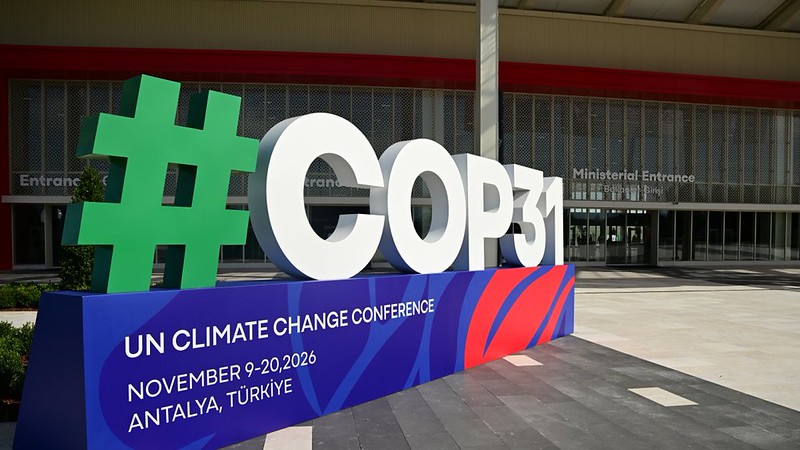
Turkey’s track record
Turkey does have progress to point to. It has committed to net zero by 2053, and its solar and wind capacity has grown fast. The sunshine, the wind and the industrial base are all there. But the long-term direction of the energy mix is still unclear.
Turkey also signed the