

In a Q&A with Climate Home News, the head of sustainability at global lighting company Signify explains how the firm is doubling down on its efforts to protect the climate and strengthen resilience.
In March, Signify launched its latest corporate sustainability programme, “Brighter Lives, Better World 2030”.
The programme is the third iteration of a project that started in 2016, aimed at shifting how the company – and its customers – can reduce their environmental impact.
It centres on enhanced targets to improve energy efficiency, cut greenhouse gas emissions and promote the circular economy. In addition, Signify has set itself a challenging goal to source 41% of its revenue from solutions “that support benefits beyond illumination” by the end of 2030, up from 31% in 2024. Those benefits include efficient food production and increased access to solar lighting.
Signify is aiming to save 60 terawatt hours (TWh) of electricity for its customers; achieve a 35% reduction in the CO2 emissions intensity of its portfolio; and grow its circular product business from 10% to 27.5% of revenue.
Climate Home News spoke with the company’s global head of sustainability, Maurice Loosschilder, to find out how the Netherlands-based multinational plans to reach its targets despite a tough political landscape for green action.
Q: How does Signify’s new sustainability programme build on lessons learned from previous versions?
A: If we look back a little bit, it is a natural next step. Signify [formerly Philips Lighting] became a standalone company roughly 10 years ago and in 2016 we launched our first “Brighter Lives, Better World 2020” programme at the same time.
The first programme mirrored developments in the lighting industry and was very much based on our own operations: reaching 100% renewable electricity, zero waste to landfill in our manufacturing facilities, increasing the energy efficiency in our own portfolio.
Since then, we’ve moved on to think about our entire value chain and the wider social contributions we want our work to be making. But we still want to be thinking about how to improve our own business. Our continued target to double the amount of women in leadership positions is an example of that.
Q: Looking at the political climate, both in the US and Europe, there isn’t the same concern for environmental issues as there was a few years ago. Many corporates are perceived to be rolling back on their environmental commitments. How are you as a company navigating some of these challenges?
A: This is not something new. If we look back on the last five to 10 years, we’ve seen a lot of disruption and change in the market. We’ve had a global pandemic, supply chain disruptions, energy insecurity. At the same time we’ve seen the increased impacts of climate change and all of that is changing the dynamics of doing business right now.
I think these changes have really tested resilience – the resilience of companies, the resilience of people, the resilience of societies. We really believe that resilience is becoming more and more important to businesses right now. And if you look at what a resilient company is, it is one that decarbonises faster, invests in people, invests in circular solutions and makes its business model more circular. And that’s exactly what we have focused on. It’s about making sure we can cope, and help our customers cope, with changing market circumstances and the geopolitical tensions we see in the world.
Q: Turning to your own commitments, do you feel you have set the right balance between ambitious and achievable?
A: Yes, we strongly believe this programme is the right one for us and our customers, and has been informed by a thorough double-materiality assessment. It is built on three pillars: benefits beyond illumination, energy efficiency and resource efficiency. These are supported by new initiatives, such as Signify Circle, which will support professional customers with their circular economy ambitions.
If we just look at the first pillar, it’s about the positive impact that lighting brings, in terms of productivity, in terms of safety, in terms of food availability, health and well-being, and now we have added solar in there. This is what we mean by “benefits beyond illumination”.
Q: If we take one of your targets to save 60 TWh of electricity for your customers, that seems quite hard to work out. Do you find data availability to be an issue?
A: Data is a challenge in sustainability, but we have been measuring our avoided emissions for years, so we know the data requirements behind it. We’ve done all our homework and with that we have set this target.
The 60 TWh figure is about the annual electricity usage of Switzerland so it is a substantial amount. But it also reflects the role that lighting plays in general. If you look at a typical city, street lighting alone accounts for about 40% of electricity use. So the potential is enormous.
The International Energy Agency reports that about 8% of global electricity use comes from lighting, and this translates into 2% of global greenhouse gas emissions. That’s really significant and why the opportunity here is so big.
Q: How has the new programme been informed by the UN’s Sustainable Development Goals (SDGs)?
A: Our strategic compass is the Sustainable Development Goals. We committed to six SDGs in the previous programme. The new one has been expanded to cover eight and we conducted a mapping exercise for each of the commitments. I’m hoping that, by the end of this programme, we will see a new version of the SDGs to replace the current goals when they expire in 2030. We remain committed to making our contribution to the SDGs.
Q: Are you seeing higher demand for circular products? What is it that attracts businesses to that option?
A: Yes, we do see an increased demand. For example, we see greater interest in “remanufacturing”, which is a circular business model where we take down the lighting, send it back to our manufacturing site, and upgrade it to the latest technology, but keep the majority of the hardware intact.
I think customers are becoming more and more aware of the fact that regulation is pushing resource efficiency on businesses. And in some countries we see incentives to use circular products, and penalties around sending certain material to landfill. More businesses are becoming aware of this and we strongly believe there is a market for circular products.
How off-grid solar is beating the odds to transform lives in rural Africa
Q: Do you have customers that are facing real resource pressures, in terms of scarcity, increased costs or supply chain constraints that are making them think more about circular issues?
A: The whole market is currently impacted by geopolitical tensions and the disruptions that come as a result. Light as a Service, for example, could be a way for businesses to de-risk because there is no capital expenditure involved. Customers see real value in only having to pay to keep it running.
If we look longer term, then resource and material efficiency is something the whole world should be thinking more about. How can we decouple economic growth from the increased use of natural resources? We believe the circular economy is the answer.
This interview has been shortened and edited for clarity.
Adam Wentworth is a freelance writer based in Brighton, UK.
The post Signify: “We believe resilience is becoming more important to businesses right now” appeared first on Climate Home News.
Signify: “We believe resilience is becoming more important to businesses right now”

Some things are too precious to risk. And Scott Reef is one of them.
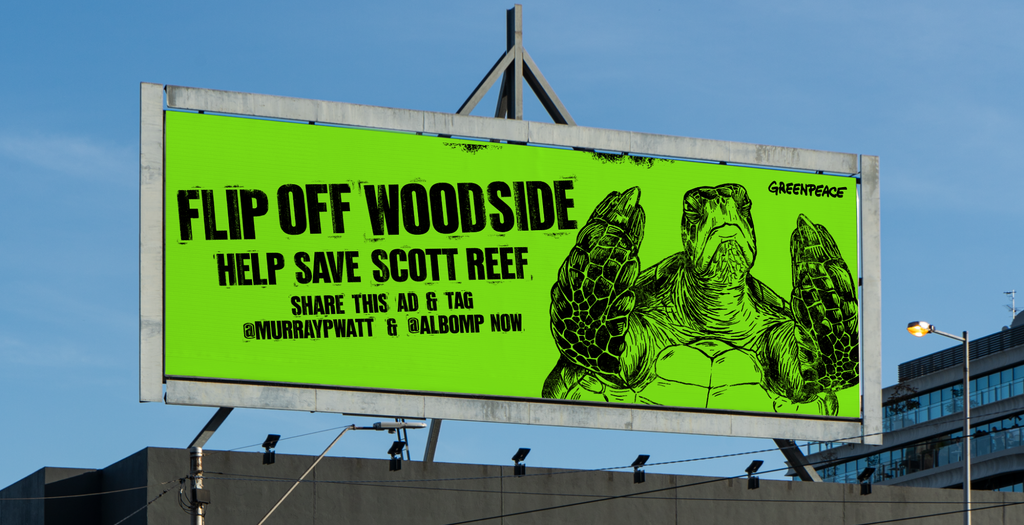
Today, we’re launching a bold new campaign starring iconic Australian actor Michael Caton and a green sea turtle named Sandy to rally Australians behind one simple message: Flip off Woodside to save Scott Reef.
Off the coast of Western Australia, Scott Reef is one of Australia’s most extraordinary marine environments. It is home to vulnerable green sea turtles, endangered pygmy blue whales and thousands of other marine species.
Each year, one thousand endangered green sea turtles return to Scott Reef to nest. It’s where they lay their eggs. It’s where baby turtles hatch. It’s where they make their first brave dash from the sand to the ocean. It’s their home.
But this remarkable ecosystem is under threat from Woodside’s plans to drill for gas, with up to 57 toxic wells proposed around the reef.
Turtles can’t speak up for their home, so we’re asking Australians to make their voices heard instead.

From one Aussie icon to another
At the heart of our new campaign is an iconic Australian voice, Michael Caton. Caton is using his voice to speak out for, what will soon be, another Australian icon – Scott Reef.
In a cinematic courtroom showdown, Caton lends his unmistakable voice to one of Scott Reef’s most vulnerable inhabitants: a green sea turtle fighting to protect her home from corporate destruction.
As Sandy the turtle defiantly flips her flippers at Woodside, Caton delivers a message that every Australian can get behind.
“Some things are too precious to risk.”
Because when it comes to protecting our natural environment, sometimes being polite just isn’t enough.
Turning a gesture into a movement
We’ve launching a campaign designed to do more than grab attention. We want to turn public concern into meaningful action.
The idea is simple: flip off Woodside and make sure our political leaders know exactly where Australians stand.
We’re calling on people across the country to share the campaign, get involved on social media and, most importantly, tag their local MPs.
We need Environment Minister Murray Watt and Prime Minister Anthony Albanese to hear loud and clear that Australians want Scott Reef protected, not sacrificed for another gas project.
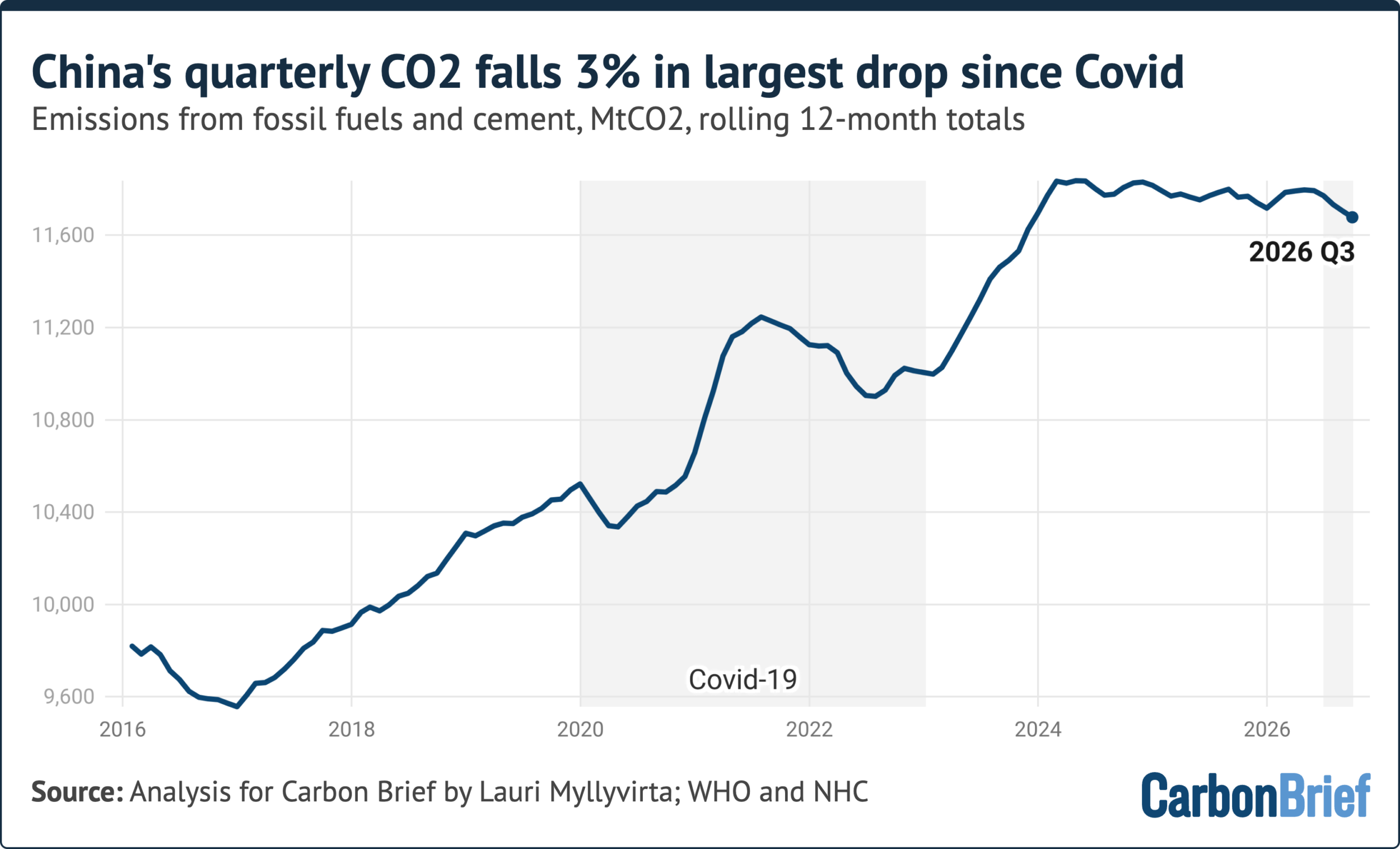
China’s carbon dioxide (CO2) emissions fell by 3.1% in the third quarter of 2026, as the Hormuz crisis continued to hit oil demand and coal use also dropped.
This guest post is by:
Lauri Myllyvirta, lead analyst at the Centre for Research on Energy and Clean Air
This was the largest quarterly reduction since the 2022 Covid lockdowns and means that China’s CO2 emissions have now fallen by an estimated 0.5% in the year to date.
The new analysis for Carbon Brief, based on official figures and commercial data, shows that coal use fell by 3% year-on-year in the third quarter of 2026, while oil was down 4%.
The main drivers were a fall in power-sector coal consumption, a continued sharp reduction in transport oil consumption and slowing growth in the coal-to-chemical industry.
The sharp decline in China’s CO2 emissions extends a “flat or falling” trend that began in March 2024 and has now lasted more than two years, as shown in the figure below.
The outlook for China’s CO2 emissions depends on the balance between rising energy demand, clean-energy growth and the government response to a GDP slowdown.
Decline drivers
Key drivers of the fall in CO2 in the third quarter of 2026 included a 3.3% drop in coal-power generation, after demand growth slowed and the amount of “wasted” wind and solar fell.
Power generation from solar, wind and nuclear increased by 110 terawatt hours (TWh) year-on-year, more than twice as much as the growth in total electricity demand. This added clean-power generation equal to Germany’s total power output in the same time period.
The fall in coal-power output and CO2 emissions came despite the fact that China continues to build new coal-power capacity at near-record rates. This means that average running hours for coal plants are falling even faster than total generation, eroding their profits.
Meanwhile, transport oil consumption continued to fall sharply, down 9% year-on-year in the third quarter of 2026. Electric vehicles (EVs) continued to gain market share, hitting a record 67% of passenger car sales and 50% of heavy trucks in September.
The amount of electricity used by EVs grew by 53%, much faster than the number of EVs on the road, showing increased usage of the existing fleet in preference to fuelled vehicles.
Elsewhere, growth in the coal-to-chemical industry continued to slow down in the third quarter of 2026. The sector has been a key source of emissions growth, but high coal prices have weakened profitability and higher output prices hurt downstream demand.
Finally, CO2 emissions from cement and steel production continued to fall in the third quarter, as the contraction in construction volumes accelerated.
Outlook for emissions
Energy consumption growth has been falling after a period of exceptionally high growth during Covid, while clean-power growth has been robust.
This makes it likely that the growth in clean-power generation will exceed total energy demand growth this year, maintaining the structural fall in fossil-fuel use.
Looking ahead, this balance also relies on progress in removing barriers to new solar and wind power being added to the grid, which result in some clean electricity being “wasted”.
The recent slowdown in energy demand growth is partly – but not fully – explained by exceptionally mild weather in the third quarter.
Another key factor is weaker GDP growth. Since reported GDP growth remains within target, however, there is reduced pressure for further stimulus policies.
The focus of the economic stimulus announced to date is “six networks”, which includes the power grid and the transportation network.
These networks are highly relevant for energy and emissions – and they are already covered by policies that emphasise “green” and zero-carbon solutions.

The post Analysis: China’s quarterly CO2 falls 3% in largest drop since Covid appeared first on Carbon Brief.
Analysis: China’s quarterly CO2 falls 3% in largest drop since Covid
Climate Change
Coles, Woolworths grilled as beef buyers receive fail grade on new deforestation scorecard
MELBOURNE, Friday 6 November 2026 — As Coles holds its Annual General Meeting today, Greenpeace Australia Pacific has branded the major supermarkets with a fail grade on their commitment to source deforestation-free beef, with an updated scorecard revealing none of the major beef buyers are following through on forest sustainability commitments.
It comes after Woolworths’s AGM last week where the board copped a grilling by environmentalists and shareholders over its failed sustainability commitments. Both Coles and Woolworths committed to eliminating deforestation in their supply chains by the end of 2025, but a year past the deadline, neither company could guarantee that their beef was not sourced from deforested pastures.
From outside the Coles AGM, Adele Chasson, Nature Policy Lead at Greenpeace Australia Pacific, said:
“This is a report card Coles and Woolworths should be ashamed to take home. While all major beef buyers had promised to take deforestation off the shelves, none of them followed through. Shareholders and the public demanded answers from Woolworths last week and from Coles today, and we will continue to hold their feet to the fire on their promises.
“Beef is the leading cause of deforestation in Australia, and Coles and Woolworths keep putting off action while koalas continue losing their homes. Aussies must be able to get their groceries without having to worry if their dinner is contributing to the bulldozing of forests or driving extinction of iconic Australian animals.
“Without strong, rapid implementation plans, these companies continue with business as usual, flying in the face of Australia’s deforestation crisis. Big beef buyers like Coles and Woolworths must stop the bulldozers now, make good on their sustainability promises and play their part in stopping Australian forest destruction.”
The scorecard assesses how eight of Australia’s largest beef buyers stack up against a conversion and deforestation-free target. It charts whether the major supermarkets, Aldi, McDonalds, Hungry Jacks, Teys, Metcash/IGA and JBS are taking proper action to end Australia’s deforestation crisis. They all failed.
-ENDS-
Media contact: Kimberley Bernard on 0407 581 404 or kbernard@greenpeace.org
Coles, Woolworths grilled as beef buyers receive fail grade on new deforestation scorecard



