

Joie Chowdhury is senior attorney and climate justice and accountability manager at the Center for International Environmental Law (CIEL) and Jule Schnakenberg is director of World’s Youth for Climate Justice (WYCJ).
A resolution that will come before the UN General Assembly (UNGA) later this month brings a reckoning for multilateralism: will governments stand behind international law or not?
On May 20, UN member states will consider a resolution to welcome and operationalise the International Court of Justice’s historic Advisory Opinion (ICJ AO) on states’ obligations in respect of climate change, which clarified that they have binding legal duties to prevent and repair climate harm.
Translating that clarity into action should be straightforward. That the resolution is instead contested exposes efforts to evade responsibility. Those most responsible for the crisis will often be the first to resist accountability – that’s predictable, but it’s not acceptable.
-
Santa Marta summit kick-starts work on key steps for fossil fuel transition
The conference offers some 60 nations help to develop roadmaps to shift their economies away from coal, oil and gas, and make international trade green -
How Shell is still benefiting from offloaded Niger Delta oil assets
Shell used its exit from onshore operations in Nigeria to boost its climate credentials, but new reporting shows that the firm continues to trade oil from its former business


At a time when multilateral cooperation is under strain, the resolution’s backing by a strong majority of countries, or its passing by consensus, holds power. It would send a clear signal: governments remain committed to the rule of law and to collective action to protect the climate, a shared foundation on which all life depends.
State of play
Led by Vanuatu, with support from a core group of diverse countries including the Netherlands, Kenya, Sierra Leone, Singapore, Barbados, the Marshall Islands, Micronesia, Palau, Jamaica, the Philippines and Burkina Faso, the resolution, now open for co-sponsorship, has already secured broad cross-regional backing – especially from countries at the sharp edge of climate change.
The final text of the draft resolution faithfully reflects the full breadth of legal obligations articulated in the advisory opinion. It affirms the imperative of a just transition away from fossil fuels, the stability of legal entitlements for countries facing sea-level rise, and the duty to provide full reparation for climate-related harm under international law. It also underscores the centrality of equity and provides for structured follow-up for implementation, including a report on ways to do that from the UN Secretary-General.
While the final resolution text could have gone further on critical justice dimensions, it reflects a carefully balanced outcome, integrating diverse perspectives emerging from the genuine engagement of over a hundred states.
Vanuatu pushes new UN resolution demanding full climate compensation
In negotiations, resistance tracked a familiar set of arguments to protect fossil fuel interests and evade accountability. Many of the usual suspects – polluters with disproportionately high historical and current responsibility for the climate crisis, including major oil producers – have engaged actively, but with the aim of weakening the authority of the Court’s opinion, or references to fossil fuels in the resolution.
There is still time for things to shift. For the incoming COP presidencies of Australia, Türkiye and Ethiopia, and European states that profess their climate leadership, positioning on this resolution is a litmus test of their commitment to ensuring that climate action accords with the law.
Closing the accountability gap
Claims from countries with a disproportionate share of emissions that the resolution duplicates existing processes, particularly under the UN Framework Convention on Climate Change (UNFCCC), miss the point. The climate treaty regime has yet to deliver accountability. It has not delivered on ambition, nor on the imperative to phase out fossil fuels, and certainly not on tackling loss and damage. The draft resolution text explicitly seeks to ensure coordination, coherence and complementarity with existing processes, while closing the accountability gap.
Assertions that the resolution “reinterprets” or “goes beyond” the advisory opinion similarly ring hollow. This is standard UN practice: General Assembly resolutions give effect to legal norms clarified by the Court. The text does not create new law; it reflects existing obligations in the Court’s own terms.
ICJ ruling expected to shape US climate lawsuits in defiance of Trump
It is also important to be clear: the advisory opinion itself stands as the most authoritative clarification of international law on climate change. Its weight or persuasiveness does not depend on this resolution. Since its delivery, it has been taken up by courts and policymakers worldwide. What is at stake is not whether states will act, but whether they will do so in good faith or under mounting pressure.
Consensus carries weight
The advisory opinion carries exceptional legitimacy: requested through a resolution adopted by consensus, following legal proceedings with record participation, and delivered unanimously. Against this backdrop, there is no credible basis for opposing a resolution that seeks to welcome and advance the AO.
Consensus would send a powerful message of states’ commitment to climate action and the rule of law, but the resolution does not require unanimity to pass. As precedents show, including the Ghana-led General Assembly resolution recognising the transatlantic slave trade as a crime against humanity, global majority support can carry decisive weight, even in the face of resistance from powerful states.
From the outset, the ICJ advisory opinion process has been driven and deeply shaped by youth leadership, and responding to their call now requires completing the task the General Assembly set for itself in 2023 by requesting an advisory opinion from the ICJ.
A vote for climate justice
In a powerful poem, Pacific environmental advocate Dylan Kava writes:
“….They call it negotiation.
We know it as survival.
While they draft options
our coastlines disappear…”
The survival and dignity of people facing escalating climate harm is not a matter of political convenience. It is a matter of existing law; a matter of political responsibility, moral courage and actual leadership.
We urge all member states to support the resolution as presented on May 20, with a view to adoption by consensus. History will not judge those in power by how forcefully they defended the status quo, but by whether they rose to meet a crisis that threatens us all.
The post ICJ follow-up resolution is a test of climate leadership at the UN appeared first on Climate Home News.
ICJ follow-up resolution is a test of climate leadership at the UN

Some things are too precious to risk. And Scott Reef is one of them.
Today, we’re launching a bold new campaign starring iconic Australian actor Michael Caton and a green sea turtle named Sandy to rally Australians behind one simple message: Flip off Woodside to save Scott Reef.
Off the coast of Western Australia, Scott Reef is one of Australia’s most extraordinary marine environments. It is home to vulnerable green sea turtles, endangered pygmy blue whales and thousands of other marine species.
Each year, one thousand endangered green sea turtles return to Scott Reef to nest. It’s where they lay their eggs. It’s where baby turtles hatch. It’s where they make their first brave dash from the sand to the ocean. It’s their home.
But this remarkable ecosystem is under threat from Woodside’s plans to drill for gas, with up to 57 toxic wells proposed around the reef.
Turtles can’t speak up for their home, so we’re asking Australians to make their voices heard instead.

From one Aussie icon to another
At the heart of our new campaign is an iconic Australian voice, Michael Caton. Caton is using his voice to speak out for, what will soon be, another Australian icon – Scott Reef.
In a cinematic courtroom showdown, Caton lends his unmistakable voice to one of Scott Reef’s most vulnerable inhabitants: a green sea turtle fighting to protect her home from corporate destruction.
As Sandy the turtle defiantly flips her flippers at Woodside, Caton delivers a message that every Australian can get behind.
“Some things are too precious to risk.”
Because when it comes to protecting our natural environment, sometimes being polite just isn’t enough.

Turning a gesture into a movement
We’ve launching a campaign designed to do more than grab attention. We want to turn public concern into meaningful action.
The idea is simple: flip off Woodside and make sure our political leaders know exactly where Australians stand.
We’re calling on people across the country to share the campaign, get involved on social media and, most importantly, tag their local MPs.
We need Environment Minister Murray Watt and Prime Minister Anthony Albanese to hear loud and clear that Australians want Scott Reef protected, not sacrificed for another gas project.
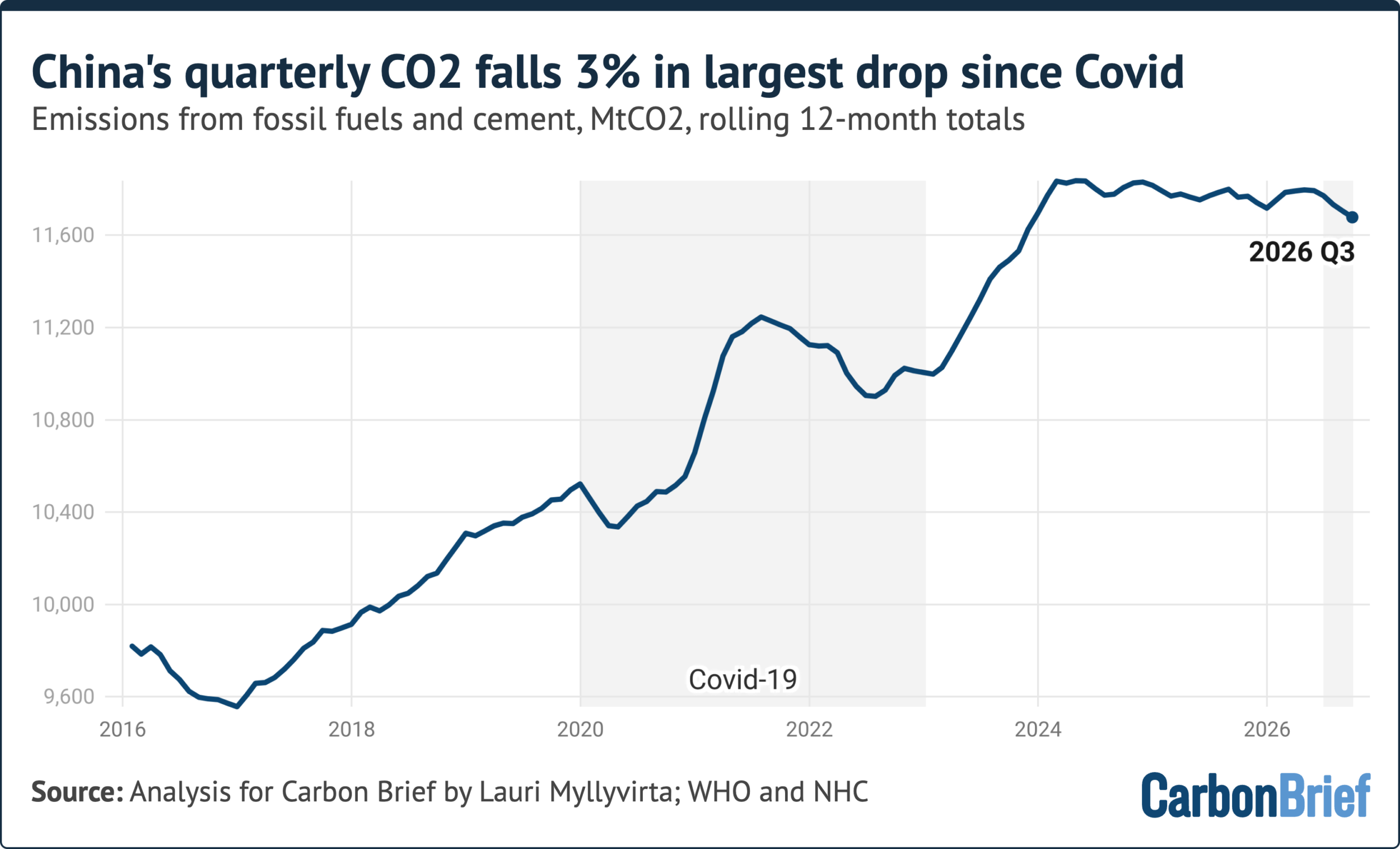
China’s carbon dioxide (CO2) emissions fell by 3.1% in the third quarter of 2026, as the Hormuz crisis continued to hit oil demand and coal use also dropped.
This guest post is by:
Lauri Myllyvirta, lead analyst at the Centre for Research on Energy and Clean Air
This was the largest quarterly reduction since the 2022 Covid lockdowns and means that China’s CO2 emissions have now fallen by an estimated 0.5% in the year to date.
The new analysis for Carbon Brief, based on official figures and commercial data, shows that coal use fell by 3% year-on-year in the third quarter of 2026, while oil was down 4%.
The main drivers were a fall in power-sector coal consumption, a continued sharp reduction in transport oil consumption and slowing growth in the coal-to-chemical industry.
The sharp decline in China’s CO2 emissions extends a “flat or falling” trend that began in March 2024 and has now lasted more than two years, as shown in the figure below.
The outlook for China’s CO2 emissions depends on the balance between rising energy demand, clean-energy growth and the government response to a GDP slowdown.
Decline drivers
Key drivers of the fall in CO2 in the third quarter of 2026 included a 3.3% drop in coal-power generation, after demand growth slowed and the amount of “wasted” wind and solar fell.
Power generation from solar, wind and nuclear increased by 110 terawatt hours (TWh) year-on-year, more than twice as much as the growth in total electricity demand. This added clean-power generation equal to Germany’s total power output in the same time period.
The fall in coal-power output and CO2 emissions came despite the fact that China continues to build new coal-power capacity at near-record rates. This means that average running hours for coal plants are falling even faster than total generation, eroding their profits.
Meanwhile, transport oil consumption continued to fall sharply, down 9% year-on-year in the third quarter of 2026. Electric vehicles (EVs) continued to gain market share, hitting a record 67% of passenger car sales and 50% of heavy trucks in September.
The amount of electricity used by EVs grew by 53%, much faster than the number of EVs on the road, showing increased usage of the existing fleet in preference to fuelled vehicles.
Elsewhere, growth in the coal-to-chemical industry continued to slow down in the third quarter of 2026. The sector has been a key source of emissions growth, but high coal prices have weakened profitability and higher output prices hurt downstream demand.
Finally, CO2 emissions from cement and steel production continued to fall in the third quarter, as the contraction in construction volumes accelerated.
Outlook for emissions
Energy consumption growth has been falling after a period of exceptionally high growth during Covid, while clean-power growth has been robust.
This makes it likely that the growth in clean-power generation will exceed total energy demand growth this year, maintaining the structural fall in fossil-fuel use.
Looking ahead, this balance also relies on progress in removing barriers to new solar and wind power being added to the grid, which result in some clean electricity being “wasted”.
The recent slowdown in energy demand growth is partly – but not fully – explained by exceptionally mild weather in the third quarter.
Another key factor is weaker GDP growth. Since reported GDP growth remains within target, however, there is reduced pressure for further stimulus policies.
The focus of the economic stimulus announced to date is “six networks”, which includes the power grid and the transportation network.
These networks are highly relevant for energy and emissions – and they are already covered by policies that emphasise “green” and zero-carbon solutions.

The post Analysis: China’s quarterly CO2 falls 3% in largest drop since Covid appeared first on Carbon Brief.
Analysis: China’s quarterly CO2 falls 3% in largest drop since Covid
Climate Change
Coles, Woolworths grilled as beef buyers receive fail grade on new deforestation scorecard
MELBOURNE, Friday 6 November 2026 — As Coles holds its Annual General Meeting today, Greenpeace Australia Pacific has branded the major supermarkets with a fail grade on their commitment to source deforestation-free beef, with an updated scorecard revealing none of the major beef buyers are following through on forest sustainability commitments.
It comes after Woolworths’s AGM last week where the board copped a grilling by environmentalists and shareholders over its failed sustainability commitments. Both Coles and Woolworths committed to eliminating deforestation in their supply chains by the end of 2025, but a year past the deadline, neither company could guarantee that their beef was not sourced from deforested pastures.
From outside the Coles AGM, Adele Chasson, Nature Policy Lead at Greenpeace Australia Pacific, said:
“This is a report card Coles and Woolworths should be ashamed to take home. While all major beef buyers had promised to take deforestation off the shelves, none of them followed through. Shareholders and the public demanded answers from Woolworths last week and from Coles today, and we will continue to hold their feet to the fire on their promises.
“Beef is the leading cause of deforestation in Australia, and Coles and Woolworths keep putting off action while koalas continue losing their homes. Aussies must be able to get their groceries without having to worry if their dinner is contributing to the bulldozing of forests or driving extinction of iconic Australian animals.
“Without strong, rapid implementation plans, these companies continue with business as usual, flying in the face of Australia’s deforestation crisis. Big beef buyers like Coles and Woolworths must stop the bulldozers now, make good on their sustainability promises and play their part in stopping Australian forest destruction.”
The scorecard assesses how eight of Australia’s largest beef buyers stack up against a conversion and deforestation-free target. It charts whether the major supermarkets, Aldi, McDonalds, Hungry Jacks, Teys, Metcash/IGA and JBS are taking proper action to end Australia’s deforestation crisis. They all failed.
-ENDS-
Media contact: Kimberley Bernard on 0407 581 404 or kbernard@greenpeace.org
Coles, Woolworths grilled as beef buyers receive fail grade on new deforestation scorecard


