

Chinese government leaders published a policy document on 22 April – Earth Day – calling for stricter controls on fossil-fuel consumption and greater oversight of heavy emitters.
It has been interpreted by experts as a signal of China’s ongoing commitment to climate action and a bridging policy between the 15th five-year plan, published in March, and future thematic and sectoral five-year plans expected to be published in the months and years ahead.
While the policy document – known as “guiding opinions” – is not strictly binding, it bears the stamp of the two highest bodies in China’s political system, conveying a strong sense of authority.
One expert tells Carbon Brief that this is the first high-level document to explicitly link decarbonisation efforts with energy security and industrial development.
It was also followed on 23 April by a second document, which is binding, that strengthens environmental inspections of provincial governments and creates new metrics for future evaluations, such as total emissions and coal consumption.
Below, Carbon Brief examines how the policies could impact China’s approach to peaking its carbon dioxide (CO2) emissions.
- Why are ‘guiding opinions’ important?
- What does the new ‘opinions’ document say about fossil fuels?
- How have climate evaluation rules been strengthened?
- What does the ‘opinions’ document say about energy security?
Why are ‘guiding opinions’ important?
Documents play an important role in disseminating political messages through China’s vast government bureaucracy. There is a well-defined hierarchy for different types of policies, each of which infer a different level of importance and flexibility.
“Opinions” are officially defined by the Chinese government as the “presentation of views and proposed solutions regarding important issues”.
They outline broad principles and general policy directions for lower levels of government to incorporate into more concrete policies.
Policy recommendations included in an opinion are implied to be non-binding, allowing officials more discretion in how they are implemented on the ground.
Prof Yuan Jiahai from the North China Electric Power University in Beijing previously told Carbon Brief that naming a document “guiding opinions” means it will have a “long-term, directional and systematic impact”.
An example is a set of opinions on a “green and low-carbon circular development economic system” issued in February 2021, which laid out broad policy recommendations across several economic sectors to spur “green planning, green design, green investment, green construction, green production, green circulation, green life and green consumption”.
“Following these opinions, China’s green growth accelerated significantly,” Prof Christoph Nedopil, professor at the University of Queensland, tells Carbon Brief. He adds:
“This is not to say that some of the developments would not have happened without such a guidance, but the guidance provided the clear direction and authority to various government departments and businesses to strengthen the support for the green and low-carbon transition.”
The new “opinions” document, on energy saving and carbon reduction, carries additional weight because of the bodies that issued it. Specifically, it was issued jointly by the general offices of the central committee of the Communist party of China (CCCPC), the highest party organ and headed by President Xi Jinping, and the state council, the highest government body and headed by Premier Li Qiang. This indicates that it has the approval of all of China’s most senior policymakers.
The document “signals China’s increasing confidence in its clean-energy sector”, says Yang Biqing, energy analyst for Asia at thinktank Ember.
The timing also makes the document important, says Hu Min, director and co-founder for the Beijing-based thinktank Institute for Global Decarbonization Progress.
She notes that the document, published soon after the close of the “two sessions” in March, is a “way to move things forward” in energy and climate policy. Hu adds that it sends a signal of the direction likely to be taken in upcoming thematic and sectoral five-year plans on topics such as peaking carbon emissions, renewable energy and coal.
“I’m quite excited about it,” she tells Carbon Brief.
What does the new ‘opinions’ document say about fossil fuels?
The opinions document includes a plethora of recommendations across several sectors, from promoting energy-saving measures in data centres and clean heating solutions to developing “integrated steel-to-chemicals” projects and “zero-carbon transport corridors”.
But some of the most interesting language was reserved for the use of coal.
China’s carbon reduction “situation…remains relatively severe”, says a government statement summarised by carbon-market information platform Tanpaifang, with the energy system still “reliant” on coal.
The “opinions” document is, therefore, of “great significance for building broader and stronger consensus across society”, it adds.
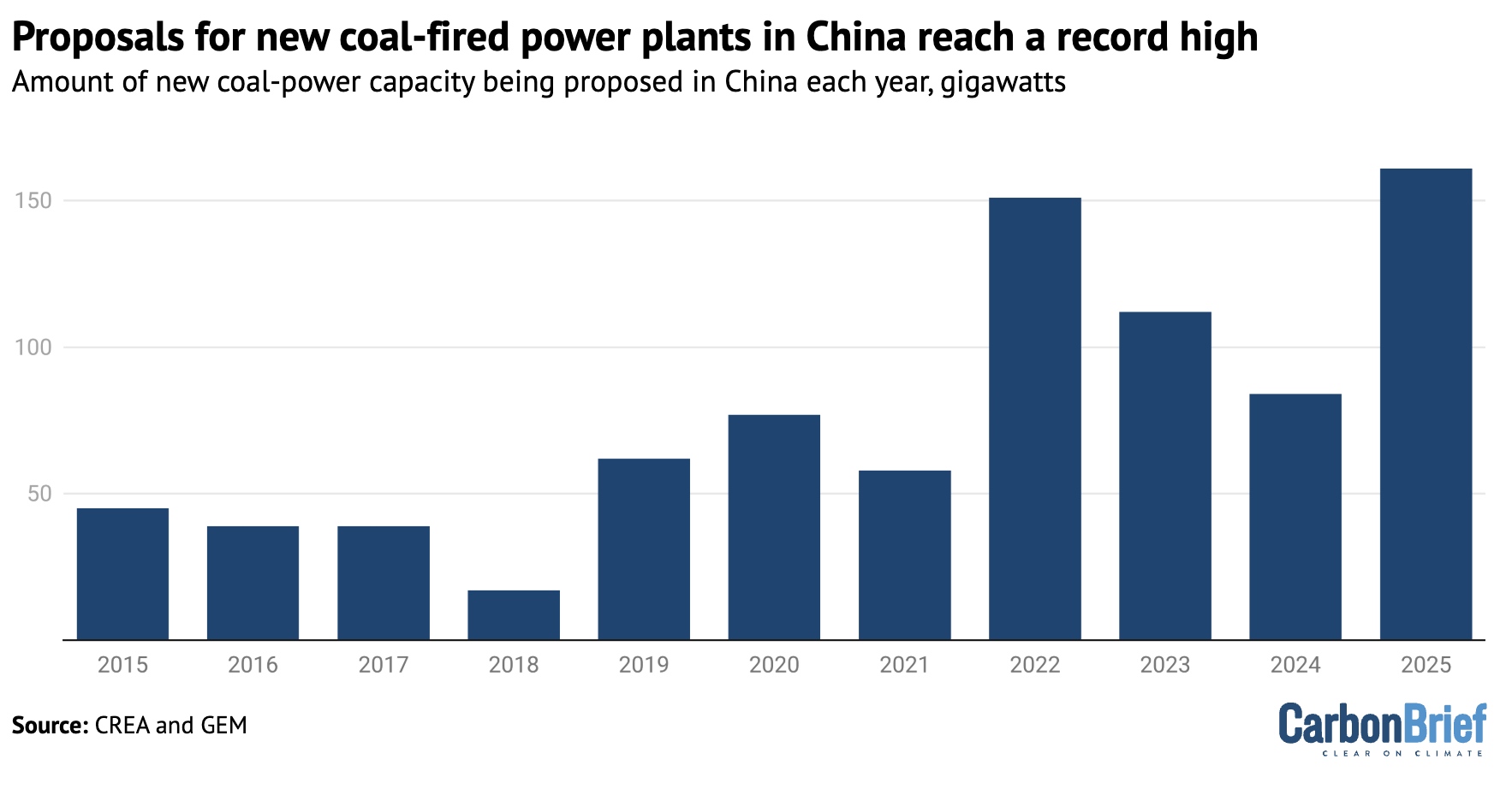
In 2025, developers in China submitted new or reactivated proposals to build a total of 161 gigawatts of new coal-fired power plants, as shown in the figure below.
The new document acknowledges the need to “strictly control fossil-fuel consumption”, in language significantly stronger than the 15th five-year plan published after the two-sessions meeting in March.
The five-year plan only pledged to “promote the peaking” of coal and oil use.
The document also outlines several other measures for managing fossil-fuel CO2 emissions, including “deepening efforts to reduce coal and oil use”, “actively promoting the clean replacement” of coal-fired equipment and “advancing” the replacement of “dispersed coal” use in an “orderly” manner.
However, it stops short of a complete rejection of coal-fired power, saying, for example, that policymakers should “reasonably control the scale of coal-fired power generation capacity and output”.
Nevertheless, Hu tells Carbon Brief, the document represents efforts by China’s leaders to “articulate” what controlling fossil fuels might look like.
Yang agrees, saying that the shift in the language on coal was “encouraging”.
She notes the granularity of the recommendations around coal, such as a line urging policymakers to “determine the dispatch sequence and load regulation for coal-fired power”.
“It is very interesting that, at this high level [of government], they have so clearly outlined this obstacle in coal’s [changing] role…from baseload to flexibility,” she says.
Experts interviewed by Carbon Brief said the language on renewable energy, which signalled ongoing support for China’s clean-energy buildout, was positive but unsurprising.
The document urges officials to “vigorously develop non-fossil energy sources and new-energy storage technologies”, highlighting the need for technologies such as pumped-storage hydropower and microgrids to boost consumption.
For Hu, market conditions, investment and local policies are now more important than central government signals for China’s clean-energy buildout.
The main debate is fossil fuels, she says, and any signals that encourage limiting coal use will “make a difference”.
How have climate evaluation rules been strengthened?
The guiding opinions document also dedicates significant space to outlining measures for reviewing and evaluating carbon-reduction efforts.
It states that local officials should undertake “comprehensive” evaluations of the energy consumption, coal consumption and carbon emissions of new projects, with plans to reduce or offset emissions becoming a “key component” of evaluating the project.
Similarly, the plan pledges to strengthen the review by the central government of local governments’ annual reports on energy use and carbon emissions, with warnings issued to local governments for “lagging progress” or “unreasonable increases in indicators”.
The central government will also strengthen supervision through “regular special inspections”, the “opinions” document says.
For regions that are “severely” falling behind on targets or are found to have “insufficient” ability to run their own inspections, the opinions threaten to “adjust or suspend their authority” for conducting evaluations and “delay or restrict” approvals for new projects.
The document also makes “local party committees and governments” responsible for their jurisdictions’ carbon reduction work. Party members and state-owned enterprises must “lead by example”, it adds.
The day after the opinions were released, the CCCPC and state council also issued a series of measures for “comprehensive evaluation” of local efforts to peak and reduce carbon emissions.
Unlike the guiding opinions, this document is considered binding policy – in this case overseen primarily by the National Development and Reform Commission (NDRC), China’s powerful economic planning agency.
Under the new rules, central government officials – led by the NDRC with significant input from the Ministry of Ecology and Environment (MEE), National Energy Administration (NEA) and other departments – will grade local governments on their carbon-reduction efforts.
The measures largely align provinces’ emissions reduction evaluations with China’s existing climate pledges for 2030.
Key targets include reducing carbon intensity by more than 65% by 2030, compared to 2005 levels, “reasonably” controlling coal-fired power generation, achieving a “25% share of non-fossil energy consumption by 2030” and “gradually” covering all new power demand with clean energy.
The government also sets out 14 indicators, shown in the table below. At the top of the list are five key “control indicators”: total carbon emissions; reductions in carbon intensity; total coal consumption; total oil consumption; and the share of non-fossil energy consumption.
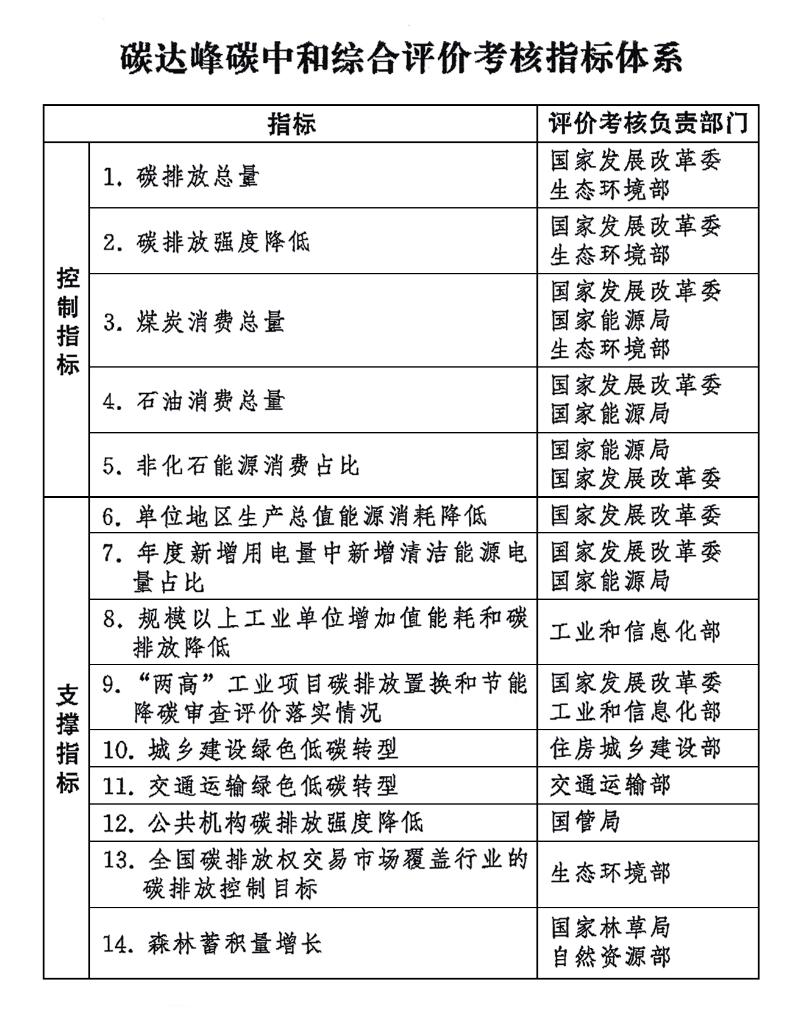
The NDRC is responsible for evaluating all five of the key indicators, with the MEE also overseeing the first three.
Provinces that fail to meet any of the control indicators will receive an “unsatisfactory” rating, leading to “corrective measures”, according to solar news outlet Zhihui Photovoltaic.
In a comment article in finance news outlet Caixin, Chen Lihao says that the two documents together “form the institutional foundation” for China’s “full-scale transition” to a dual control of carbon system.
Chen is the deputy director of the special committee on resources and environment at the Jiusan Society, the political party that environment minister Huang Runqiu belongs to.
The measures build on China’s existing inspection system to create a “much stronger accountability and compliance system”, says Qin Qi, China analyst at the Centre for Research on Energy and Clean Air.
The “real step forward”, she adds, is how climate and carbon targets – including China’s international commitments – have now been explicitly placed inside a “party-backed assessment framework” that uses pass-or-fail judgements on each indicator, rather than letting weak performance disappear inside a broad score.
Li Shuo, China climate hub director at the Asia Society Policy Institute echoes this, telling Carbon Brief that the new policy represents a “helpful step toward implementation, bringing greater clarity on tasks and responsibilities”.
Inspections are regarded as a powerful tool for the MEE in enforcing climate policy, allowing it to publicly identify non-compliant bodies, with state media often announcing results.
In 2021, inspection teams even publicly criticised the NEA, scolding it for “falling behind” on developing low-carbon energy in a move described at the time as “unprecedented”.
The emphasis that the opinions document places on evaluations and the stronger requirements that it represents “shows…the whole system that this is very important…it’s not just talk”, says Hu. (Hu spoke with Carbon Brief before the evaluation framework was released.)
However, both Li and Qin note that much depends on how the evaluations are enforced.
The strength of the system will “inevitably involve further political bargaining within the Chinese system”, says Li, shaped both by differences in the priorities of different ministries and geopolitical developments – particularly the outcomes of the conflict in the Middle East.
Qin highlights the greater capacity that the measures give the MEE to enforce inspections.
“The ministry has a more formal standing to push back on coal expansion and to speak on climate policy in a more direct way,” she says, but adds that the NDRC will still be the “central driver” of evaluating emissions.
She also notes that, while earlier central government inspections incorporated explicit instructions about making evaluation results public, the new measures place more emphasis on “internal” mechanisms, rather than public disclosure.
What does the ‘opinions’ document say about energy security?
The opinions document also settles a debate on energy security that has been playing out in the Chinese media since the start of the conflict in the Middle East.
It opens with a statement that “energy conservation and carbon reduction are key” both for China’s “dual-carbon” goals and energy transition and for “safeguarding national energy security”.
“The first sentence connects directly decarbonisation with energy security and industrial development, which is, if I’m not mistaken, the first time…that this has been linked and recognised [in such a high-level policy],” Yang tells Carbon Brief.
Although not always explicitly referencing the conflict, several outlets have run stories highlighting the importance of various energy technologies to China’s energy security.
Some outlets, including state broadcaster CCTV and the Communist Youth League’s official newspaper, China Youth Daily, focused on the positive role low-carbon energy plays in China’s energy system. Others have underscored the importance of fossil fuels, including state news agency Xinhua, which has run a series on becoming an “energy powerhouse” interviewing representatives of the fossil fuel industry.
On 20 April, NDRC head Zheng Shanjie wrote in the Communist party-affiliated People’s Daily that China should further strengthen energy security, including by increasing oil and gas reserves and production, reinforcing the role of coal-fired power as a “base-load guarantee” and expanding Sino-Russian oil and gas cooperation. He flagged “disruptions” in the Strait of Hormuz as a cause for concern.
Zheng’s article came out on the same day that Chinese premier Li Qiang held a “study session” meeting with other high-level officials discussing the need to implement a “new strategy for energy security”, deepening energy system reforms to support the country’s low-carbon transition.
The guiding opinions specifically instruct the NDRC, the country’s powerful economic planning agency, to “conscientiously fulfill its duties” in achieving China’s carbon goals, including across planning, implementation and evaluation.
It adds that “all relevant [government] departments shall perform their respective duties, cooperate closely and form a concerted effort”.
However, experts had differing opinions on whether this signalled heightened scrutiny of the NDRC, or if it emphasised its importance to emission reduction efforts.
“The mention…seems to highlight an elevated scrutiny of its work on energy transition”, says Nedopil, but “does not seem to signal an increase of its responsibilities in the energy transition, considering the mention of [the responsibilities of other departments]”.



The post Q&A: China’s leadership calls for ‘strict control’ of fossil fuels appeared first on Carbon Brief.
Q&A: China’s leadership calls for ‘strict control’ of fossil fuels

The launch of the Africa Energy Bank (AEB) has been put back yet again, raising doubts about the institution’s future ability to finance fossil fuel projects – its main objective – as global lenders retreat from such investments over climate concerns, experts told Climate Home News.
The bank, which had been billed to launch in September after a series of delays, is now scheduled to begin operations in November, according to the head of the African Energy Chamber, an advocacy body for the continent’s oil and gas sector.
Even as the world aims to transition away from fossil fuels, many African leaders have made clear they want to continue exploring and extracting the continent’s large oil and gas deposits – estimated at around 125 billion barrels of crude and over 600 trillion cubic feet of gas – to boost economic development.
As a group, Africa sided with a number of powerful oil-and-gas producing nations in blocking progress on negotiations to craft a global roadmap to transition away from fossil fuels at last year’s UN COP30 climate talks, although some countries did individually support the proposal.
-
Campaigners oppose Dangote’s planned Kenya refinery over climate and ecological risks
Plans to build Africa’s second largest oil refinery in ecologically sensitive region criticised as “environmental recklessness” -
Tanzania pushed African nations to oppose fossil fuel transition at COP30
While chairing the African group at the summit, the gas-dependent nation advised the continent’s ministers to block language on transitioning away from fossil fuels


Meanwhile, major projects under development across the continent – including the 1,443-km East African Crude Oil Pipeline (EACOP) and Dangote’s 700,000-barrel-per-day Kenyan refinery – show that African governments see oil and gas as playing a significant role in meeting their energy and economic needs for many years to come.
In 2022, at a gathering of the African Petroleum Producers’ Organization (APPO) in oil-rich Angola, ministers from its member states adopted a resolution to create the Africa Energy Bank to finance projects for the production, use and trade of oil, gas and broader energy sources.
African control over energy resources
An article on the APPO website explains that the bank was conceived as a way to overcome “disenchantment” with fossil fuels among “the international community” which it said had crystallised around the “energy transition” concept.
“If Western countries, after having long taken advantage of the energy sources they now revile to develop, can afford the luxury of abandoning them, this is not the case in Africa,” it adds, noting that many of the continent’s economies are still largely dependent on oil and gas revenues.
A separate web page about the bank, also hosted on APPO’s website, says its objectives include financing the exploration, production and refining of oil and gas, as well as supporting member states in transitioning from fossil fuels to cleaner energy sources “while ensuring energy security”.
Said Addi, a former executive with Shell and energy commodities trading house Gunvor, said the new bank was judged necessary because financing for hydrocarbons from many traditional international lenders has become constrained.
In trying to fill this financing gap, Africa is not simply setting up another fund to support oil and gas, he added. “It is also an attempt to give African countries greater control over how their energy resources and infrastructure are financed,” he explained.
Nigeria to host the AEB
The energy bank – a joint initiative of APPO and the African Export–Import Bank (Afreximbank) – has so far suffered several delays and is almost two years behind schedule. The initial plan was to start operations in January 2025, with Nigeria as the host country, but the bank’s opening was delayed to June of that year to allow Nigeria time to finalise the construction of the bank’s headquarters in Abuja.
After the government announced the completion of the offices in late November 2025, a new launch date was set for January 2026, which was moved back to April, June and then September. Now it has shifted again to November, raising concerns that the institution may be losing momentum.
Former Shell executive Addi said that if the capital is eventually paid in, the bank becomes operational and its first projects are commercially credible, then the delays will be regarded as normal teething troubles in setting up a multilateral institution. But, he added, scepticism will be justified if it continues to stall.
Uganda may see lower oil revenues than expected as costs rise and demand falls
Baron Lamarré, an oil and gas expert and former Petronas oil trader, said that missing “three deadlines in a row is not normal”, and warned that if the timeline slips again, “the story flips from ‘ambitious institution finding its footing’ to ‘good idea that lost momentum before it found any’.”
The Nigerian government, APPO and Afreximbank did not respond to requests for comment by the time of publication.
The funding challenge
The Africa Energy Bank is targeting base capital of $5 billion, with plans to scale up to $120 billion within five years by mobilising private-sector funds. However, it is expected to start operations with initial seed capital of $500 million.
The funding plan is to have the 18 member countries of the APPO contribute $83 million each to the bank as equity for a combined $1.5 billion. Afreximbank, other non-APPO African countries and investors outside the continent are expected to provide the remaining $3.5 billion.
But even the initial $500 million has not been easy to mobilise. In May, APPO Secretary-General Farid Ghezali called on members to deliver on their pledges towards the startup goal before the end of June. But the delays suggest this may not have been met, with experts saying Africa may be finding it difficult to self-fund its oil and gas projects in the absence of international capital.
Lamarré said every extension of the deadline points to the fact that “raising fossil fuel capital in Africa without the majors and their financing networks is brutally hard”.
Why the global electrification agenda misses the point on Africa’s energy crisis
Since 2020, Western lenders, export credit agencies and insurers have been in steady retreat from African hydrocarbons, he said, while oil majors are divesting their African assets, handing over fields to smaller local operators whose credit ratings are not high enough to borrow cheaply.
Even capital from China and the Gulf, which has partially filled the gap, cannot match the volume, tenor or pricing that Western investors once offered, Lamarré argued.
“If mobilising the first $500 million of seed capital [for the AEB] has taken this long, that’s the clearest signal yet of how steep the climb to $120 billion looks,” he said, noting that the continent’s energy financing gap is as large as $30 billion-$45 billion per year.
Africa’s investment landscape, meanwhile, has been shifting. While foreign direct investment dropped from a 2024 peak, inflows remained roughly one-third above the continent’s long-term average in 2025, according to the 2026 World Investment Report from UN Trade and Development (UNCTAD). They are concentrated in a few sectors including critical minerals needed for renewable energy technologies, battery manufacturing and advanced industrial production.
At the same time, data on global energy investment from the International Energy Agency (IEA) shows that fossil fuel investment in Africa has declined over the last decade.

“Trojan horse” for fossil fuels
While the Africa Energy Bank struggles to get off the ground, climate campaigners have criticised its primary aim of financing oil and gas on the continent at a time when the world is starting to move away from high-carbon fuels to cleaner alternatives.
Bhekumuzi Dean Bhebhe, founder of Africa Change Lab, described the bank as a “Trojan horse”, arguing that its focus on fossil fuel financing runs counter to the global energy transition and the African Union’s Agenda 2063 goals of sustainable development and inclusive growth.
The energy bank, he warned, “risks locking Africa into a new cycle of debt, dependency and fossil fuel entrenchment”, adding that its financing blueprint does not pave the way for a climate-resilient future. “In truth, it is to deepen the same extractive, carbon-heavy pathways that the continent should be moving away from,” he added.
Ugandan farmers use British court to try to stop East Africa oil pipeline
Kenya-based climate and energy expert Joab Okanda said the AEB’s plan to finance oil and gas is “a misplaced priority” and it should instead back clean energy in line with the policies of some of Africa’s major export markets like Europe.
In addition, the new bank could struggle to mobilise enough resources to advance large-scale oil and gas projects, he added, noting that its proposed $5-billion initial capital is equivalent to the cost of the East African Crude Oil Pipeline alone.
The AEB’s aim of backing more fossil fuels should be flipped “to support countries that are oil-dependent to start working on their transition plans”, Okanda said.
The post Launch of Africa Energy Bank delayed again in blow to oil and gas hopes appeared first on Climate Home News.
Launch of Africa Energy Bank delayed again in blow to oil and gas hopes