

SYDNEY, Tuesday 21 April 2026 — New analysis of Woodside’s amended turtle and whale management plans for its Browse gas proposal has revealed supposed ‘mitigation methods’ still risk extinction of green turtles, will risk killing endangered whales and will likely accelerate the sinking of the only local turtle nesting ground at Scott Reef.
The independent technical analyses, commissioned by Greenpeace Australia Pacific and prepared by Oceanwise and whale expert Dr. Olaf Meynecke, also reveals Woodside’s plans rely on outdated or misrepresented data, are not in line with requirements under the EPBC Act and directly oppose Australia’s Conservation Management Plan for Blue Whales.
Woodside was forced to resubmit its Turtle Management Plan and Pygmy Blue Whale Management Plan after it was revealed WA’s Environmental Protection Agency (EPA) had issued a preliminary rejection of the Browse project in 2024 due to ‘unacceptable impacts’ on nature at Scott Reef.
Hannah Schuch, senior campaigner at Greenpeace Australia Pacific, said: “The EPA sent Woodside back to the drawing board for its Browse project because it was too risky for the endemic and endangered animals at Australia’s largest freestanding oceanic reef, Scott Reef.
“This new analysis shows that the ‘revised’ plans should not bring comfort to the EPA, the government or the Australian public, and still threaten to send green turtles extinct, sink a unique turtle nesting ground, and disrupt, injure or even kill endangered pygmy blue whales. Woodside has simply rolled its awful plan in glitter – the Browse plans are still too risky.”
The EPA is expected to hand down its recommendation on the Browse project this year.
Woodside’s planned Browse gas field would entail drilling up to 57 wells as close as two kilometres from Scott Reef, home to nesting sea turtles, endangered pygmy blue whales and dusky sea snakes.
Co-author of the Pygmy Blue Whale Plan analysis, Dr. Olaf Meynecke, said: “Woodside’s Management Plan for Scott Reef falls short of acknowledging the region as a critical habitat for pygmy blue whales. Scott Reef is an anchor point and whale hub for pygmy blue whales. The region provides shelter for mother-calf pairs during their long journeys from Indonesia to Australia and, most importantly, an area where they can feed to replenish nutrients when returning from their tropical breeding grounds.”
Schuch added: “Woodside can’t be trusted with Scott Reef. It was asked to put forward mitigation plans to ‘lower risk on the West Australian environment’, and it has presented a weak, gussied-up version of its original dangerous plans. The impacts on Scott Reef are still unacceptable, and Browse must be rejected.
“Scott Reef will be a major threshold test for this government’s legacy on nature protection–it’s time for Murray Watt to save Australia’s largest oceanic reef, Scott Reef, from Woodside’s massive fossil fuel project in the middle of endangered whale and turtle habitat.”
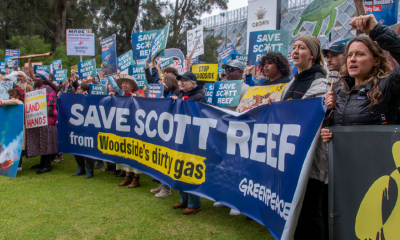
The analysis comes just days before Woodside is due to face shareholders and concerned community groups at its Annual General Meeting in Perth on Thursday. Each year, hundreds gather to protest Browse during the meeting, citing environmental and climate risks of Browse. This year, community groups, including Greenpeace, are calling on the Federal Government to save Scott Reef by saying no to Woodside’s Browse project.
—ENDS—
Contact: Kimberley Bernard on +61407 581 404 or kbernard@greenpeace.org or Emma Sangalli on +61 431 513 465 or emma.sangalli@greenpeace.org
New analysis reveals Woodside’s amended Browse plans still too risky for turtles, whales



For the first time, new-energy vehicles (NEVs) made up 67% of new car sales in China in September, according to the latest data from the China Passenger Car Association (CPCA).
The figures show that NEVs, which include battery electric cars and plug-in hybrids, captured a record share of sales, even though fewer were sold than last year.
This is because sales of combustion-engine cars are falling steeply, a trend that the CPCA has attributed to rising petrol prices following the start of the Hormuz crisis.
Indeed, sales of fuel-only cars were down 31% year-on-year in the first nine months of 2026, with plug-in hybrid sales down 26% – whereas battery EV sales were only down 4%.
One analyst tells Carbon Brief that China’s rapidly growing EV fleet has offset demand for 143m barrels of oil since the start of the Hormuz crisis.
Another says that the crisis is “reinforcing China’s electrification of road transport”.
Meanwhile, amid slowing domestic sales, Chinese carmakers’ exports of NEVs more than doubled [in 2026 to date / in September] from a year earlier.
NEV record
A record two out of every three cars sold in September in China were NEVs, according to CPCA data, as shown in the figure below.
(NEVs predominantly include battery electric vehicles – BEVs – and plug-in hybrids – PHEVs. BEVs only run on electricity, whereas PHEVs also have a combustion engine.)
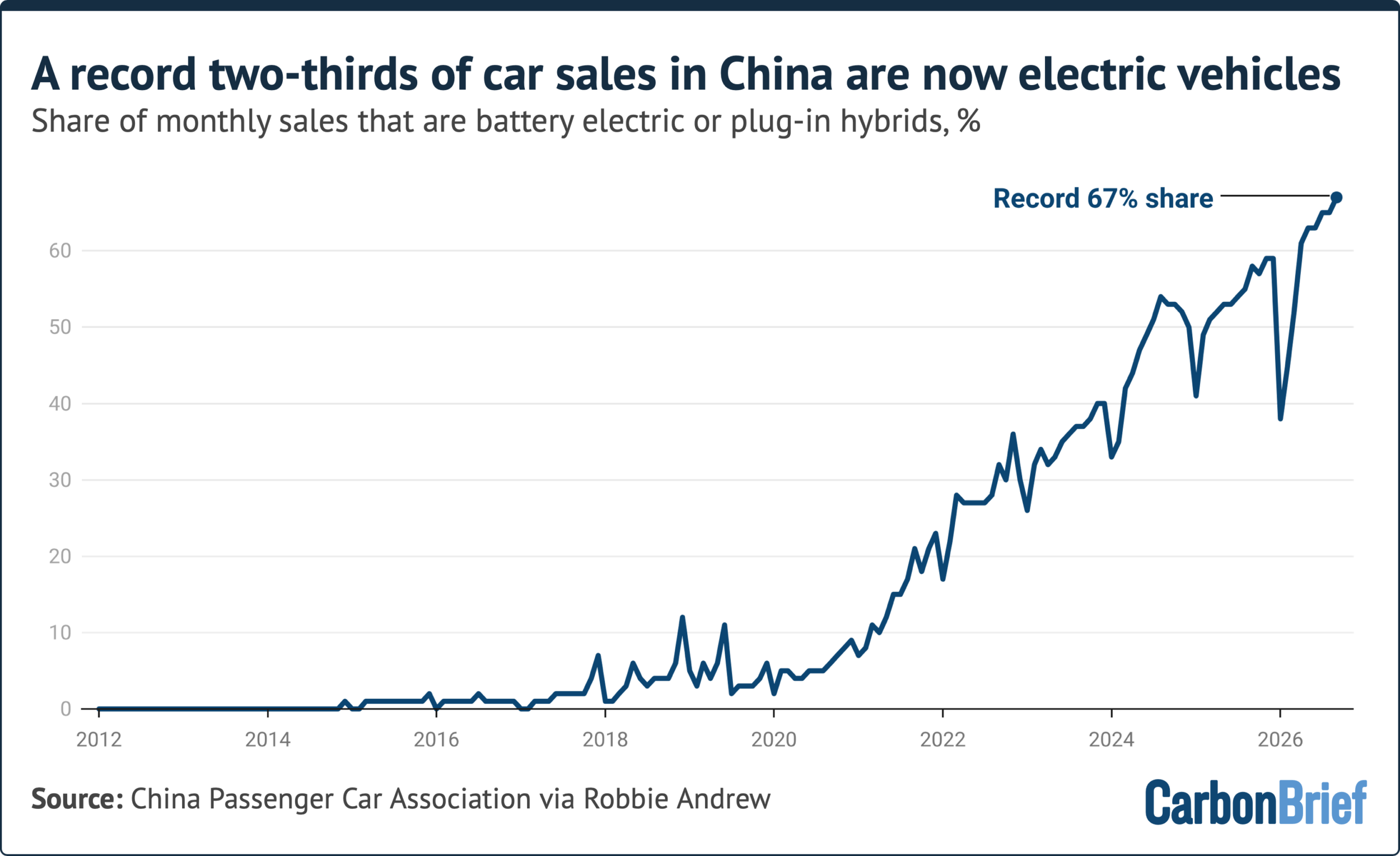
This marks a rapid rise for NEVs from just 6% of new car sales in 2020 up to 58% in 2026 to date – and a record 67% in the month of September.
This year, NEVs’ share of sales has also bounced back from a low of 39% in January, after the full purchase tax exemption that had been in place for more than a decade came to an end in December 2025.
The gain in NEV share in 2026 has come amid a slowdown across the wider domestic passenger-car market, which has hit sales of combustion-engine vehicles particularly hard.
This September, passenger-car retail sales across all categories declined, with overall sales volumes falling 28% year-on-year.
The contraction was led by combustion-engine vehicles, which saw sales fall 43% year-on-year in September and 31% in 2026 to date.
However, sales of PHEVs also fell by 36% year-on-year in September and by 26% in 2026 to date. By comparison, BEVs performed better, although sales still declined 8.5% from a year earlier in September and 4% in 2026 to date.
As a result, NEV sales overall fell by 17% in September and 13% in 2026 to date.
While the market changes in 2026 to date were particularly dramatic, they reflect a broad continuation of trends seen over the past decade.
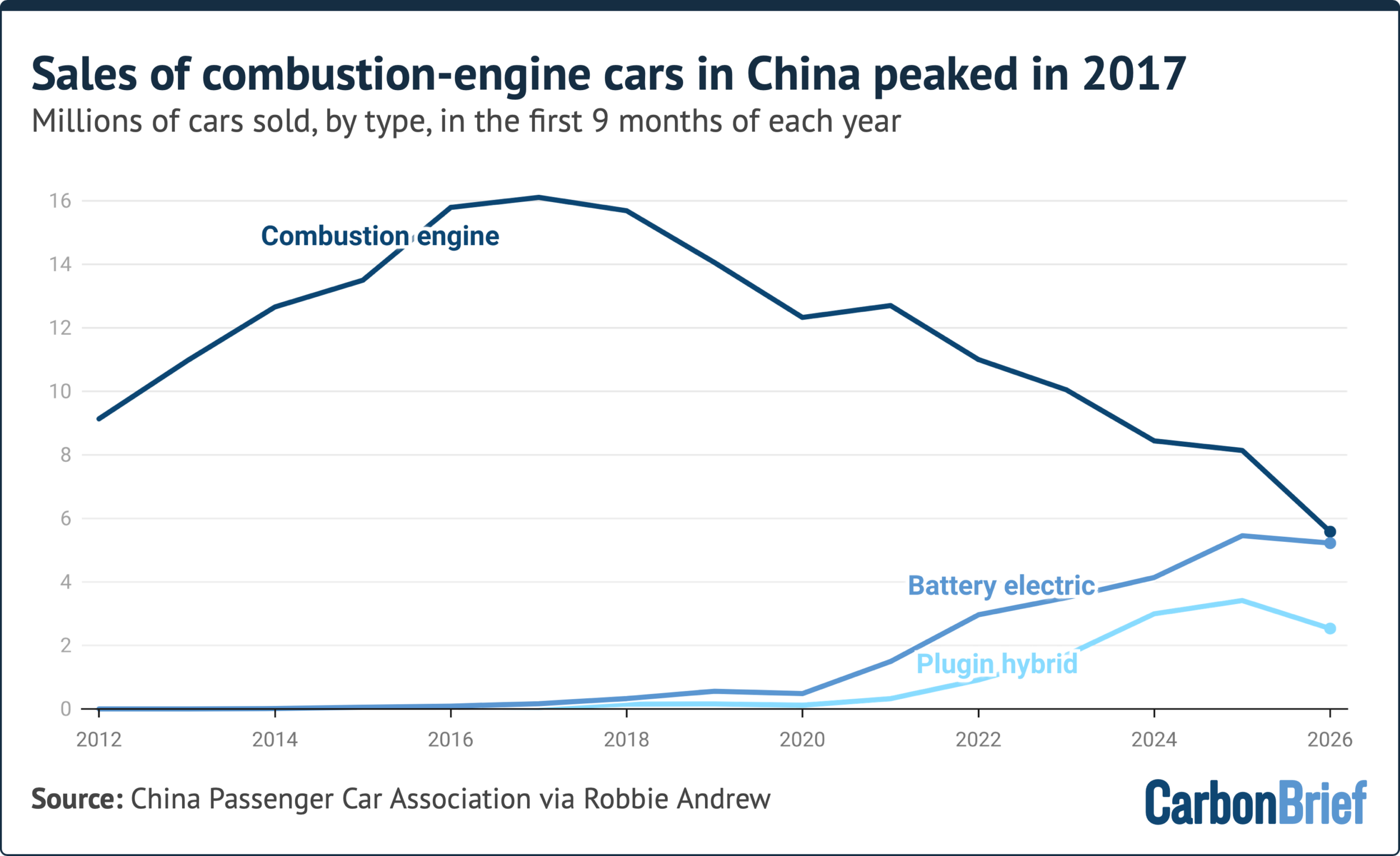
Indeed, sales of combustion-engine cars in China peaked in 2017 and they have been declining ever since, shown in the figure below.
Impact of Hormuz
Part of the reason for the advance of NEVs in 2026, said Chinese technology news outlet OFweek, was petrol cars “giving up market share” as they were outperformed by electric alternatives.
Cui Dongshu, secretary-general of the CPCA, cited higher petrol prices as an explanation for September’s weak combustion-car sales, in comments to financial news outlet National Business Daily.
Imports of oil into China in January-September have fallen 15% compared to 2025, equivalent to 470m barrels, as ongoing conflict tightened supply and drove up prices.
China’s passenger-car NEV fleet has displaced 143m barrels of oil so far during the strait of Hormuz crisis, Euan Graham, senior energy analyst at thinktank Ember, tells Carbon Brief.
EVs “accounted for 12% of the decrease in China’s oil use post-Hormuz”, according to an estimate provided to thinktank the Brookings Institute by an unnamed analyst.
Erica Downs, a senior research scholar at Columbia University’s Center on Global Energy Policy, tells Carbon Brief that the strait of Hormuz crisis and higher oil prices are “reinforcing China’s electrification of road transport”.
She says the “world’s largest oil supply disruption” vindicates China’s early bet on EVs, which was partly driven by concerns about oil-supply security.
NEV demand down
Nevertheless, NEV sales have fallen year-on-year, albeit at a slower rate than overall car sales. The growth in NEV market share has also been decelerating.
Zhang Yichao, a partner at consulting firm AlixPartners, tells Carbon Brief that NEVs benefit from government trade-in policies and a “strong pipeline” of new models, particularly those involving innovation.
He says these factors help explain why NEVs sales have fallen at a slower rate to their combustion-car counterparts.
Cui told the state-run China National Radio that the fall for NEVs and for cars overall in September 2026, is also due to a high baseline of sales from the same month in 2025, as well as changes to trade-in policies and disruptions from the holiday period.
Other factors, says consulting firm Wood Mackenzie, are the weakened demand due to “demand pull-forward” in 2025 caused by the end of subsidies, as well as “tighter financing conditions”.
Zhang tells Carbon Brief he does not “see much more room ahead” for further growth in NEVs’ market share.
He adds that, in his view, their share in China is unlikely to exceed 80%, as some premium-market segments and specific use cases will continue to require combustion-engine vehicles.
Exports surge
Meanwhile, while domestic NEV retail sales fell 17% in September 2026, exports more than doubled, increasing 164% year-on-year, according to the CPCA.
This extends the decline in domestic sales and very strong growth in exports seen across 2026 to date, as shown in the figure below.
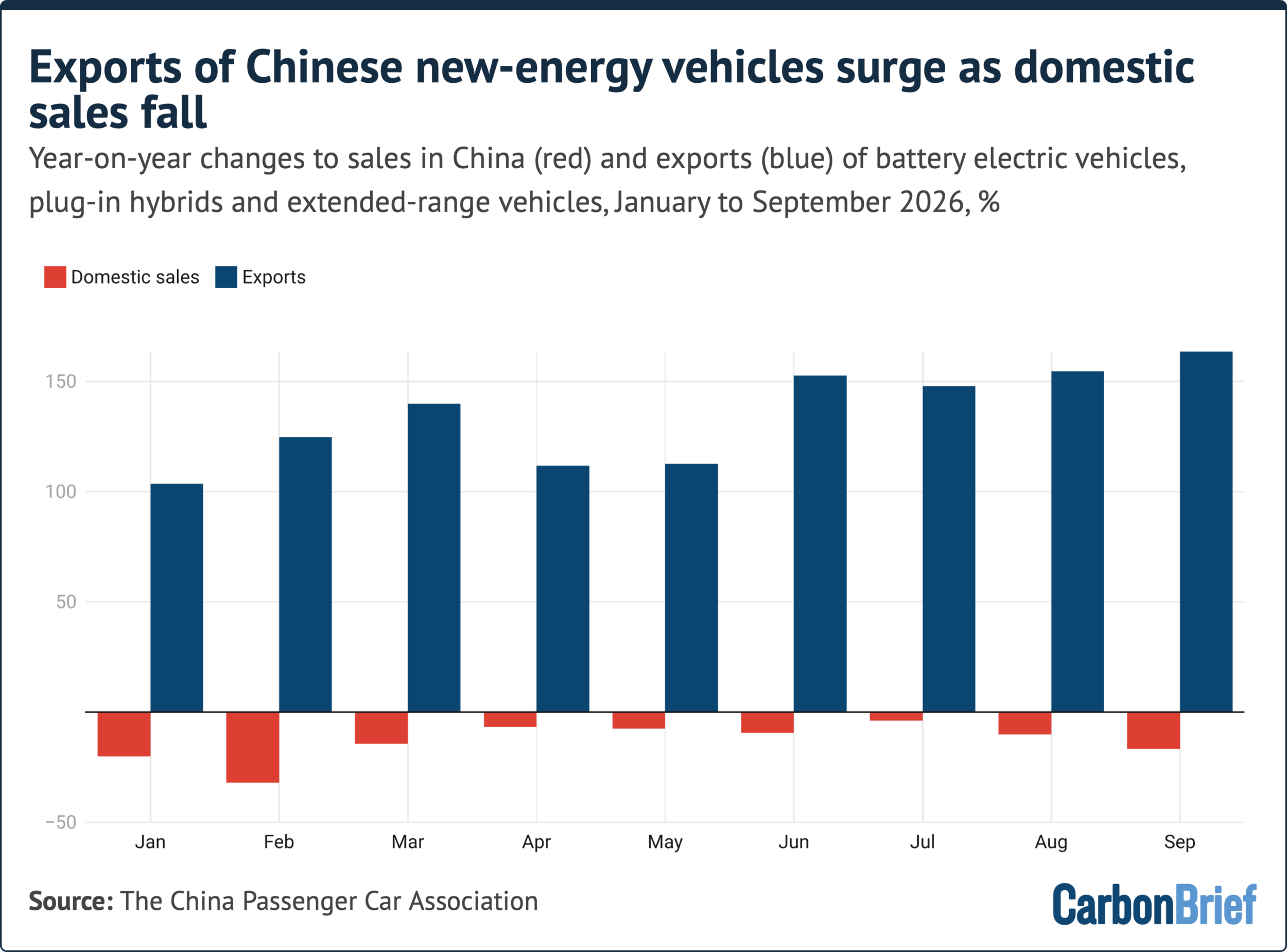
In September, 1,084,000 NEVs were sold domestically in China, while 558,000 NEVs were exported.
Exports are becoming increasingly important to Chinese carmakers, in the face of weaker domestic demand and cut-throat industrial competition.
The CPCA says exports have become “a core priority” for some carmakers.
However, the surge in exports from China has created concern in the EU, which has placed tariffs on imports of EVs from China and recently agreed plans to cut imports of hybrids.
Countries including Mexico and Turkey have also placed tariffs on Chinese EV imports.
At the same time, the Chinese government is putting policies in place that might be expected to disincentivise exports, such as cutting VAT export rebates.
Analysts differ on what impact this policy shift will have, with some saying it will be limited, while others believe it could cause the price of exported cars to rise.