

Alejandro Álvarez Iragorry is a Venezuelan ecologist and coordinator of Clima 21, an environmental NGO. Cat Rainsford is a transition minerals investigator for Global Witness and former Venezuela analyst for a Latin American think tank.
In 1975, former Venezuelan oil minister Juan Pablo Pérez Alfonzo gave a now infamous warning.
“Oil will bring us ruin,” he declared. “It is the devil’s excrement. We are drowning in the devil’s excrement.”
At the time, his words seemed excessively gloomy to many Venezuelans. The country was in a period of rapid modernisation, fuelled by its booming oil economy. Caracas was a thriving cultural hotspot. Everything seemed good. But history proved Pérez right.
Over the following decades, Venezuela’s oil dependence came to seem like a curse. After the 1980s oil price crash, political turmoil paved the way for the election of populist Hugo Chávez, who built a socialist state on oil money, only for falling prices and corruption to drive it into ruin.
-
What would Trump’s Venezuela oil plans mean for climate change?
While Trump’s aim of boosting oil production in Venezuela could worsen climate change, high costs and an oversupplied market might make investors think twice -
Explainer: What is the petrodollar and why is it under pressure?
As the US seeks to carve out a sphere of influence in the Western Hemisphere, questions grow about the dollar’s future as the lynchpin of the global economy -
The more Europe relies on the US for energy, the more it’s vulnerable to pressure by Trump
Risking energy security suicide through dependency on US gas, Europe’s leaders must instead reject resource colonialism


By 2025, poverty and growing repression under Chávez’s successor Nicolás Maduro had forced nearly 8 million Venezuelans to leave the country.
Venezuela is now at a crossroads. Since the US abducted Maduro on January 3 and seized control of the country’s oil revenues in a nakedly imperial act, all attention has been on getting the country’s dilapidated oil infrastructure pumping again.
But Venezuelans deserve more than plunder and fighting over a planet-wrecking resource that has fostered chronic instability and dispossession. Right now, 80% of Venezuelans live below the poverty line. Venezuelans are desperate for jobs, income and change.
Real change, though, won’t come through more oil dependency or profiteering by foreign elites. Instead, it is renewable energy that offers a pathway forward, towards sovereignty, stability and peace.
Guri Dam and Venezuela’s hydropower decline
Venezuela boasts some of the strongest potential for renewable energy generation in the region. Two-thirds of the country’s own electricity comes from hydropower, mostly from the massive Guri Dam in the southern state of Bolívar. This is one of the largest dams in Latin America with a capacity of over 10 gigawatts, even providing power to parts of Colombia and Brazil.
Guri has become another symbol of Venezuela’s mismanagement. Lack of diversification caused over-reliance on Guri for domestic power, making the system vulnerable to droughts. Poor maintenance reduced Guri’s capacity and planned supporting projects such as the Tocoma Dam were bled dry by corruption. The country was left plagued by blackouts and increasingly turned to dirty thermoelectric plants and petrol generators for power.
Today, industry analysis suggests that Venezuela is producing at about 30% of its hydropower capacity. Rehabilitating this neglected infrastructure could re-establish clean power as the backbone of domestic industry, while the country’s abundant river system offers numerous opportunities for smaller, sustainable hydro projects that promote rural electrification.

Venezuela also has huge, untapped promise in wind power that could provide vital diversification from hydropower. The coastal states of Zulia and Falcón boast wind speeds in the ideal range for electricity generation, with potential to add up to 12 gigawatts to the grid. Yet planned projects in both states have stalled, leaving abandoned turbines rusting in fields and millions of dollars unaccounted for.
Solar power is more neglected. One announced solar plant on the island of Los Roques remains non-functional a decade later, and a Chávez-era programme to supply solar panels to rural households ground to a halt when oil prices fell. Yet nearly a fifth of the country receives levels of solar radiation that rival leading regions such as northern Chile.
Developing Venezuela’s renewables potential would be a massive undertaking. Investment would be needed, local concerns around a just and equitable transition would have to be navigated and infrastructure development carefully managed.
Rebuilding Venezuela with a climate-driven energy transition
A shift in political vision would be needed to ensure that Venezuela’s renewable energy was not used to simply free up more oil for export, as in the past, but to power a diversified domestic economy free from oil-driven cycles of boom and bust.
Ultimately, these decisions must be taken by democratically elected leaders. But to date, no timeline for elections has been set, and Venezuela’s future hangs in the balance. Supporting the country to make this shift is in all of our interests.
What’s clear is that Venezuela’s energy future should not lie in oil. Fossil fuel majors have not leapt to commit the estimated $100 billion needed to revitalise the sector, with ExxonMobil declaring Venezuela “uninvestable”. The issues are not only political. Venezuela’s heavy, sour crude is expensive to refine, making it dubious whether many projects would reach break-even margins.
Behind it all looms the spectre of climate change. The world must urgently move away from fossil fuels. Beyond environmental concerns, it’s simply good economics.

Recent analysis by the International Renewable Energy Agency finds that 91% of new renewable energy projects are now cheaper than their fossil fuel alternatives. China, the world’s leading oil buyer, is among the most rapid adopters.
Tethering Venezuela’s future to an outdated commodity leaves the country in a lose-lose situation. Either oil demand drops and Venezuela is left with nothing. Or climate change runs rampant, devastating vulnerable communities with coastal loss, flooding, fires and heatwaves. Meanwhile, Venezuela remains locked in the same destructive economic swings that once led to dictatorship and mass emigration. There is another way.
Venezuelans rightfully demand a political transition, with their own chosen leaders. But to ensure this transition is lasting and stable, Venezuela needs more – it needs an energy transition.
The post There is hope for Venezuela’s future – and it isn’t based on oil appeared first on Climate Home News.
There is hope for Venezuela’s future – and it isn’t based on oil

Three countries have been named by the Paris Agreement’s compliance committee for failing to submit a nationally determined contribution (NDC) and repeatedly snubbing offers of help with their climate plans.
After months of internal debate over whether to identify serial non-responders, the Paris Agreement’s Implementation and Compliance Committee (PAICC) named the three countries which have failed to engage with it over their NDCs on Friday.
It named Democratic Republic of Congo, Senegal and North Korea in a footnote of its annual report, adding that it decided to name them “with a view to facilitating engagement”, adding that representatives of the three nations had been invited to its meeting in early 2027 “with the purpose of identifying any challenges and constraints”.
“The Committee noted the importance of Parties engaging with the Committee in a timely manner, while noting that some delays may be due to the national capabilities and circumstances of the Parties”, the report said.
-
Under US pressure, World Bank says it will back gas “where appropriate”
The US wants the World Bank to expand its gas support while climate campaigners are pushing for it to end – its head spoke this week of limited backing for the fossil fuel -
IPCC scientists vow to press on with climate reports despite political deadlock
After governments again failed to agree a timeline, nearly 120 IPCC authors pledged to complete their assessment on time and with full scientific rigour -
Paris Agreement committee snubbed over missing NDC climate plans
Many governments have still not submitted a nationally determined contribution to the UN, breaching a key requirement of the Paris Agreement

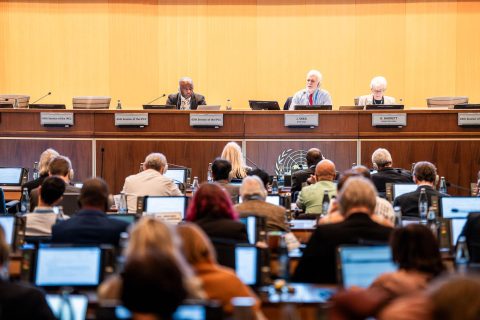

In July, PAICC said 12 countries had ignored its repeated attempts to discuss why they had not published an NDC as required every five years under the 2015 Paris accord.
Members of the committee had been divided over whether to name them, but at a September meeting decided to do so in their annual report to the annual climate COP summit.
By the time the report was published on Friday, only Congo, Senegal and North Korea “had not communicated an NDC or submitted a [Biennial Transparency Report] and had not yet responded to any of the Committee’s notifications, despite several reminders issued by the Committee in this regard”.
Rainforest and renewable energy ambitions
The silence from Congo and Senegal is notable because the former is home to much of the Congo Basin rainforest while the latter has sought billions of dollars in climate finance to support its renewable energy ambitions.
After Brazil, Congo has more rainforest than any country in the world. This forest, and the country’s peatlands, absorb huge amounts of greenhouse gas but are fast being lost to expanding farmland, charcoal production, logging and mining.
Senegal signed a Just Energy Transition Partnership with Canada and wealthy European nations in 2023, to help it meet its renewable energy targets under the-then government of Macky Sall. It was chair of the Least Developed Countries group between January 2022 and December 2023.

Tejas Rao, who is researching the PAICC as part of a doctoral thesis at Cambridge University, said the governments of the three countries should engage with the committee.
“Engagement costs these governments very little and the committee has shown it will listen,” he said.
“Silence leaves the committee with no basis to help, and it leaves the [governments] exposed to the narrative that they are simply disengaged,” he told Climate Home News.
Paris Agreement requirement
The 2015 Paris Agreement requires all parties to publish an NDC every five years outlining their emissions reduction targets, with each plan meant to be more ambitious than the country’s last NDC.
The latest set – the third round of plans, with new targets for 2035 – was due in February 2025. While most countries missed this deadline, all but around 30 – mostly small emitters but including Egypt, Vietnam and Argentina – have now submitted them.
Over the year, the PAICC – which is made up of government climate officials from developed and developing countries – has been communicating with governments that have not submitted NDCs and trying to overcome barriers to them doing so.
Some nations have cited exceptional circumstances as the reason for not submitting an NDC, a process that requires a significant amount of work in tracking emissions and consulting on how to curb them across the economy. For example, a letter from a Sudanese official to the PAICC, seen by Climate Home News, said that the country’s civil war had led to the suspension of its NDC preparation.
-
IPCC scientists vow to press on with climate reports despite political deadlock
After governments again failed to agree a timeline, nearly 120 IPCC authors pledged to complete their assessment on time and with full scientific rigour -
Under US pressure, World Bank says it will back gas “where appropriate”
The US wants the World Bank to expand its gas support while climate campaigners are pushing for it to end – its head spoke this week of limited backing for the fossil fuel -
Who shapes climate science? The equity question facing the IPCC
Early completion of the next global climate science assessment reports risks excluding research from the Global South, which is key to ensuring the findings are fair
The US and Iran are not signed up to the Paris Agreement and so do not have active NDCs, nor does Taiwan, which is not a UN member state.
Rao said that because the PAICC is “facilitative and non-punitive”, naming the countries “is meant to open a door, not close one – the invited consultation is the point”.
“In recent months, governments that explained their constraints, whether capacity, finance or domestic process, have been met with follow-up and support rather than sanction, and the number of silent governments has fallen sharply,” Rao said.
The post Paris Agreement committee names three countries snubbing it over NDCs appeared first on Climate Home News.
Paris Agreement committee names three countries snubbing it over NDCs