

尽管中国电力需求快速增长,但清洁能源发电的增长首次使该国的二氧化碳(CO2)排放量出现下降。
Carbon Brief的最新分析显示,2025年第一季度,中国的碳排放量同比下降了1.6%,过去12个月则下降了1%。
新增风电、太阳能和核电的装机容量所带来的出力,足以应对电力需求激增,从而削减燃煤发电量;而此前的排放下降则主要被归因于经济增长放缓。
这项基于官方数据和商业数据的分析显示,中国的碳排放量一年多来一直保持稳定或下降。
不过,该排放量仅比最近的峰值低1%,这意味着只要出现短期反弹,中国的碳排放就可能创下新高。
其他主要发现包括:
- 清洁能源发电增长速度已经超过当前及长期电力需求增长平均值,从而压低了化石燃料的使用量。
- 截至2025年3月的12个月内,电力行业的碳排放同比下降了2%。
- 若这一趋势得以保持,意味着中国电力行业排放可能已达峰并开始持续下降。
- 美国总统特朗普发动的“贸易战”促使中国更加努力将经济重心从出口转向内需。
- 新出台的可再生能源电价政策催生了“抢装潮”,企业争相在政策实施前完成项目建设。
- 如果中国要实现在《巴黎协定》下承诺的2030年排放目标,仍面临日益扩大的差距需要弥补。

如果这种因清洁能源增长而带来的电力行业碳排放下降趋势得以延续,可能预示着Carbon Brief此前在分析中预测的结构性排放下降的开始。
电力行业碳排放下降的趋势很可能在2025年继续。
然而,未来的走势在很大程度上将取决于中国即将于明年公布的下一份五年规划中所设定的清洁能源与减排目标,以及中国对特朗普政府敌对贸易政策的应对策略。
中国碳排放因清洁能源而下降
过去十年来,尽管中国化石燃料和水泥行业的碳排放量有高低起伏,但总体上升了20%。
最新数据显示,该排放量可能已经接近达峰以及趋稳,甚至正步入结构性下降的阶段。
截至2025年第一季度的最新数据显示,中国的碳排放量已经连续一年多呈现稳定或下降趋势,如下图所示。
不过,由于该排放量仅比最近的峰值低1%,这意味着其仍有可能在短期内反弹并创下新高。
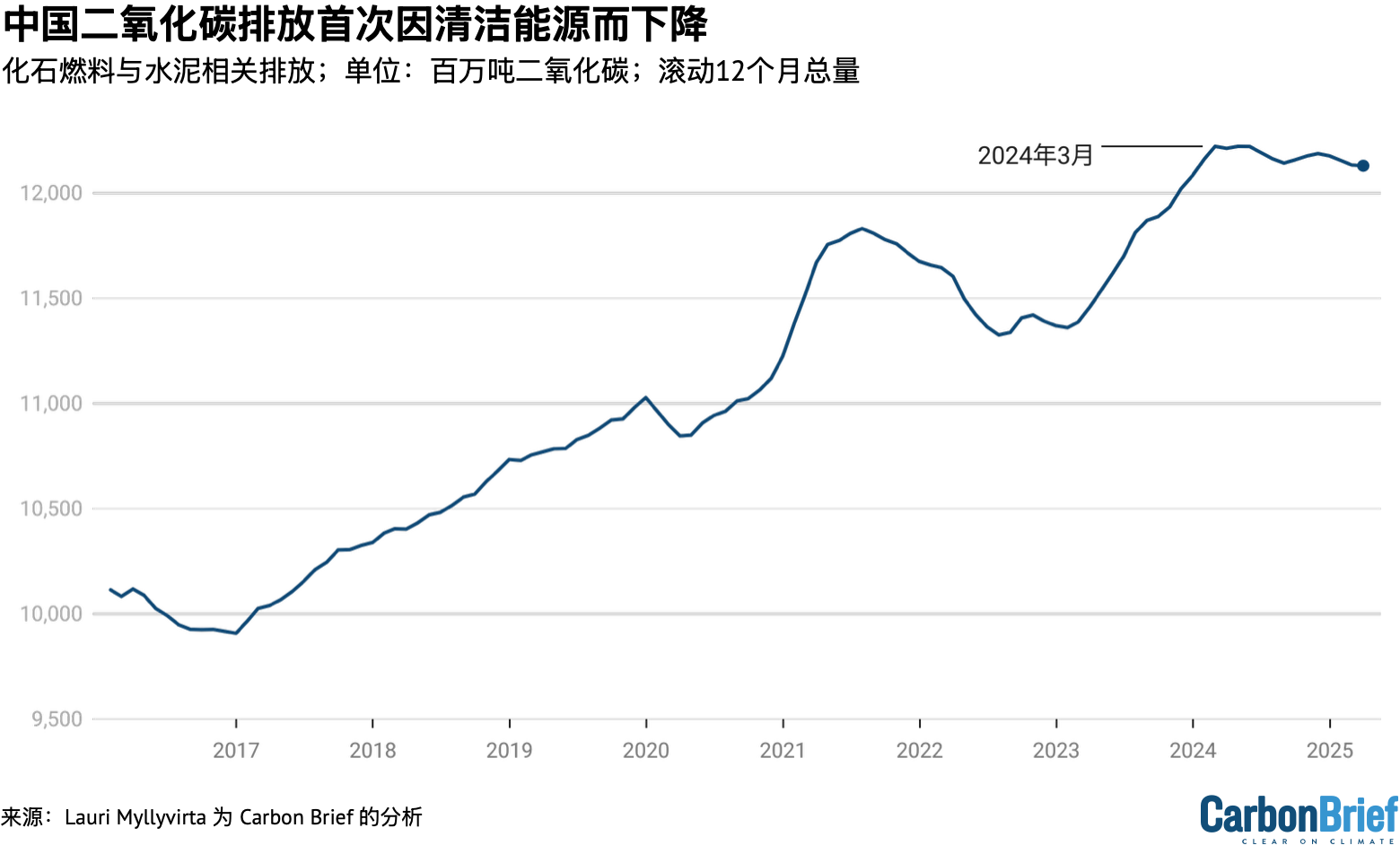
因此,中国未来的碳排放走向尚未确定,这取决于各经济部门的趋势,以及中国对特朗普关税政策的应对方式。
电力行业排放下降,其它行业却现反弹
2025年第一季度中国碳排放的下降主要源于电力行业排放下降了5.8%。尽管整体电力需求增长了2.5%,但火电(主要是燃煤和燃气发电)却减少了4.7%。
由于大量新建风电、太阳能和核电装机投入运行,发电量的增长足以弥补需求的增长。水电发电量也有所上升,虽然其受季节因素影响,但同样对化石能源的替代发挥了作用。
电力行业碳排放降幅超过化石能源发电量降幅,因为生物质和天然气的占比上升,同时燃煤电厂的平均能效也有所提升。
具体而言,燃煤电厂度电煤耗平均下降了0.9%。
下图底部显示了第一季度电力行业煤炭使用造成的碳排放量减少情况,该数据低于其他行业的碳排放量变化。
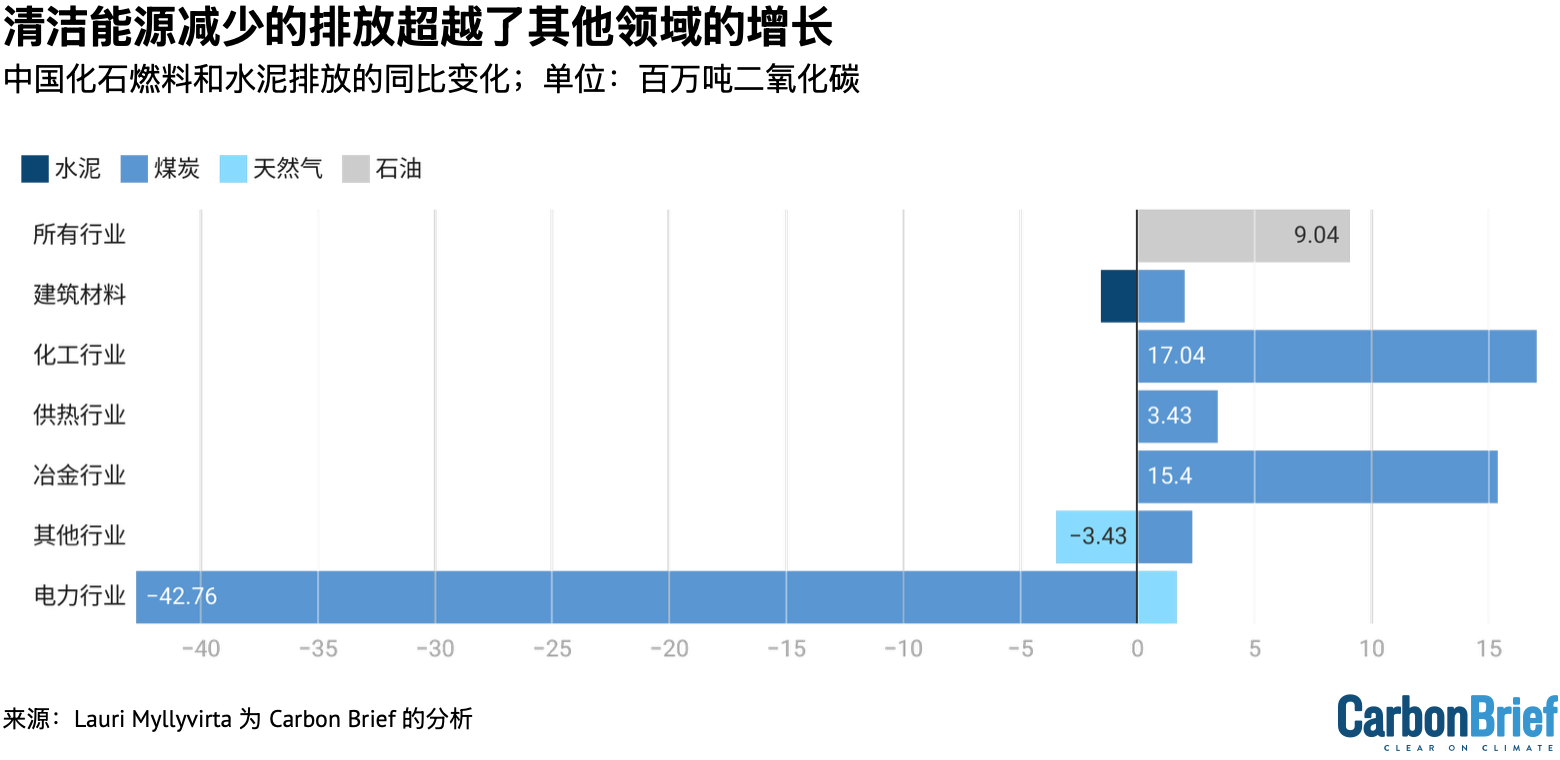
而在电力行业之外,碳排放量增长了3.5%,其中以金属和化工行业的煤炭使用增幅最大。
煤制化工产业正在快速扩张,背后的推动力包括对进口油气依赖的担忧。2025年第一季度,由于煤价走低而油价偏高,该产业的经济性更具吸引力。
粗钢产量同比增长了0.6%,金属制品增长6%,有色金属产量增长2%。这些增长主要集中在3月份,企业赶在关税生效前集中出口,带动金属需求激增,而高产出一直持续到4月。
房地产开工量同比下降24%,新房销售下降3%,反映出建筑行业对水泥、钢材和玻璃的需求持续疲软。
相比之下,汽车和机械制造的经济产出分别增长了12%和13%,表明对金属的需求正在上升。
水泥产量同比下降1.4%,降幅低于往年,可能是由于气温偏高使得依赖天气的施工活动提前启动。
由于燃气发电装机容量增长14%,尽管燃气发电的平均利用率下降,但电力行业的天然气消费量估计增长了6%。但在其他行业,天然气消费减少,总体上抵消了电力行业天然气需求量的增长。
石油制品消费略有上升,如图中最上方所示。由于天气偏暖,依赖天气的施工和农业活动与往年相比提前开工。
然而,从结构性角度来看,汽车电动化和货运行业改用液化天然气,预示着石油需求将持续走低。
中国是否已经碳达峰?
在2025年第一季度排放量同比下降1.6%之际,中国的碳排放自2024年3月以来已连续一年多保持平稳或下降态势。
然而,截至2025年3月底的12个月内,排放量仅比近期峰值下降了1%,这意味着只要出现短期反弹,排放量就可能再创新高。
继一季度大幅下降后,电力行业过去12个月的排放量同比也出现下滑。
在过去40年里,这种情况曾经发生过四次——分别是在2009年、2012年、2015年和2022年。但此次下降首次主要得益于清洁能源发电的增长。

2025年一季度清洁能源发电增速不仅超过整体用电需求增长,也高于过去15年电力需求的平均增长,如上图虚线所示。
此外,过去六个月水电发电量同比保持稳定,这意味着这轮清洁能源的增长是由太阳能、风能和核电装机容量的增长所推动的,而非水电的逐年波动所致。
除发电行业外,2024年12月到2025年3月期间,各行业碳排放均有所下降,但煤化工是个例外。
要使中国整体碳排放量达峰并开始下降,各下降行业的减排总量需超过仍在增长行业的排放增量。
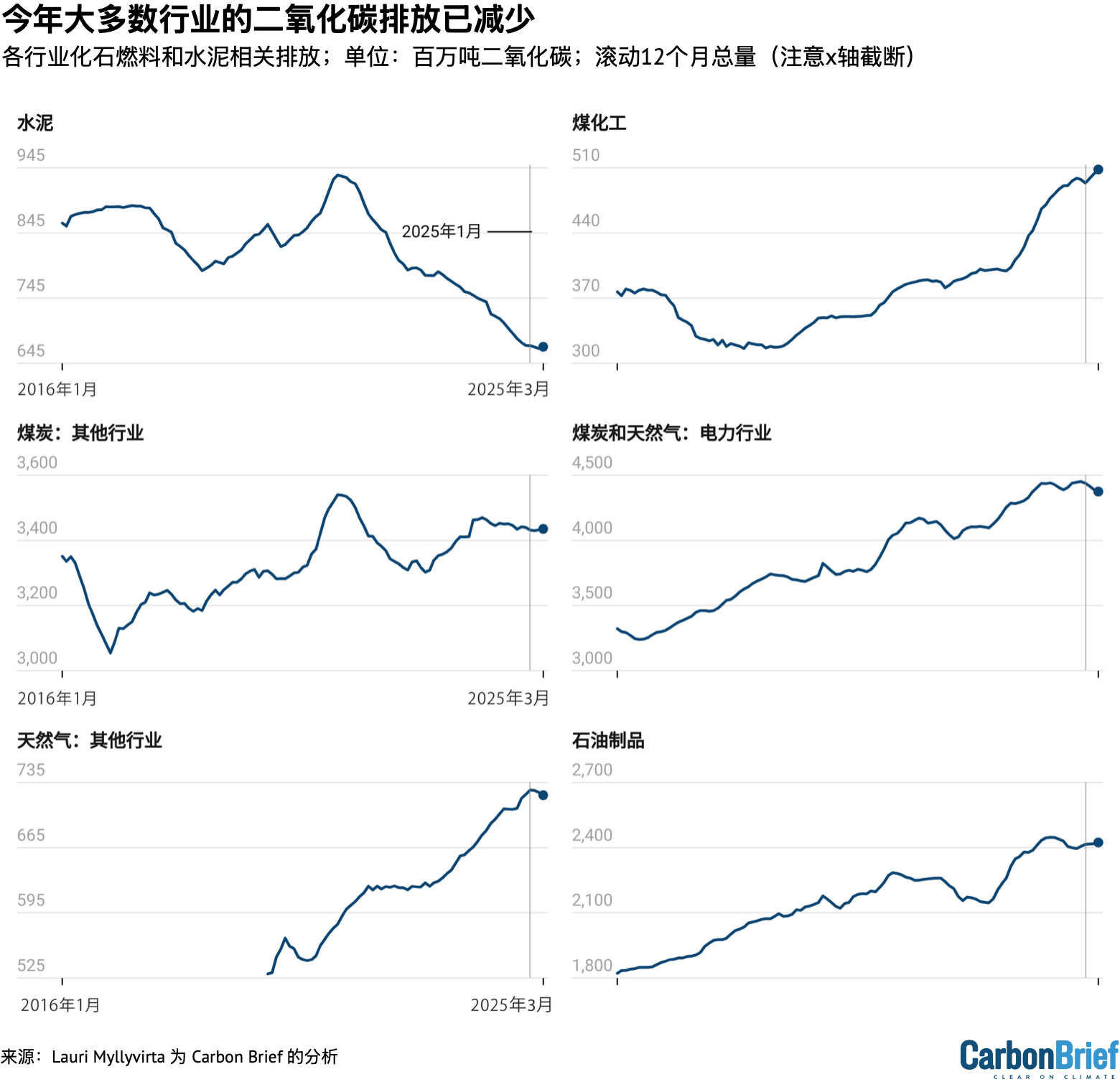
电力和化工以外的煤炭使用量与水泥行业同时达峰,但此后一直在反弹,目前已接近之前的峰值水平。
中国煤炭工业协会预计,钢铁和建材行业的煤炭使用量将下降,而化工行业的煤炭消费量将继续增长。
对煤炭未来需求增长的预期主要集中在化工行业,这也代表着煤炭从单纯的燃料向燃料和原料双重角色的转变。
该协会还认为,燃煤发电将至少在短期内恢复增长,但他们已将2025年的预测下调,与2024年底的展望相比有所保守。
“关税战”可能影响了预期。有分析指出,如果中国GDP因关税下降0.5到1个百分点,可能导致主要用于发电站的燃煤需求也出现类似的下降。
疫情后经济反弹到2024年3月结束,石油产品的消费量自此下降,较峰值减少了2%。尽管化工和航空领域的需求在上升,但由于交通运输领域电气化趋势增强,预计其长期仍呈下降趋势。
天然气的使用量近几个月有所下降,但总体趋势仍可能保持上升。
下表列出了每个行业在12 个月周期内的最高排放量,以及自最新峰值以来的减排量。
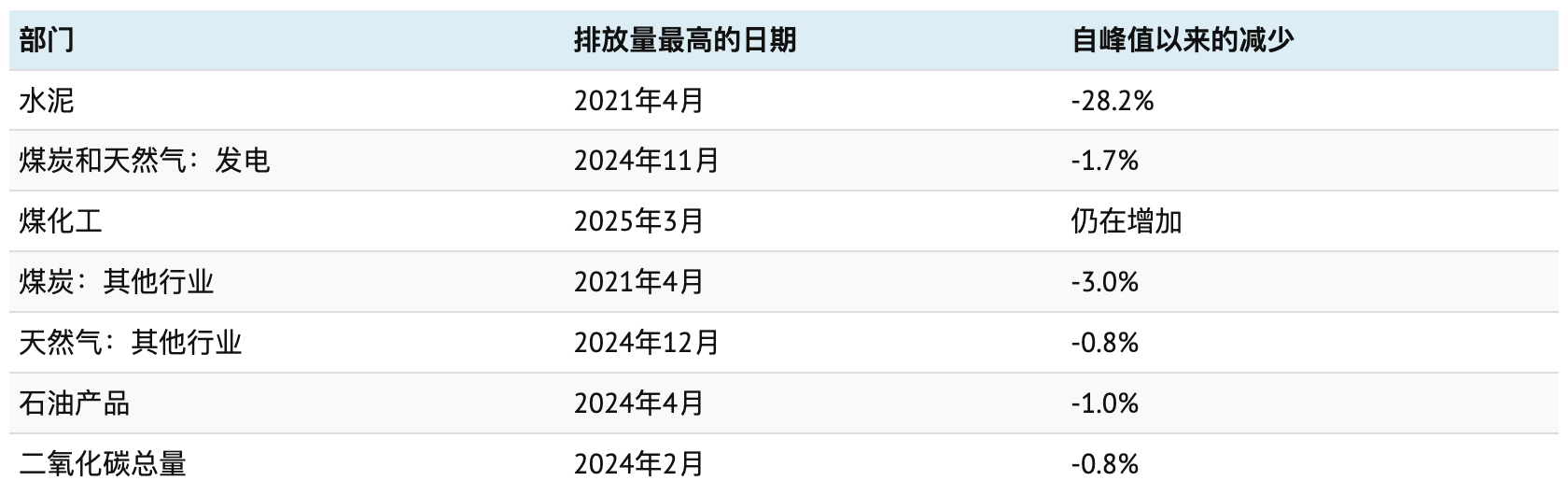
除了水泥生产之外,其他行业目前还不能明确判断是否已达排放峰值。然而,有迹象表明,其他行业的峰值也可能已经过去。
诚然,对于石油产品消费和钢铁生产而言,行业预测表明未来排放趋势可能会下降。
对于电力行业而言,只要新增清洁能源装机容量维持在当前或更高水平,就有望带来结构性的排放峰值——因为清洁能源的增长足以覆盖新增的电力需求。
这些行业碳排放量合计占全国八成以上。若这些行业均进入结构性下降阶段,那么中国碳排放总量很可能将开启持续下降通道。
中国推动内需应对美国关税
特朗普政府实施的史无前例的贸易关税政策,以及中国的反制措施,将影响今年及未来中国的经济和碳排放前景。
关税措施实施后,首当其冲的是中国沿海出口大省的工厂减产,从而导致排放下降,同时也可能波及投资和消费支出。
但因双方随后达成90天休战协议,反而刺激美国订单短期内激增,以弥补短暂的贸易放缓,并在休战结束前囤积商品。
中国对关税的反应主要集中在通过刺激措施抵消其经济影响。
虽然暂时的休战会降低出台刺激政策的紧迫性,但当前美国对中国的平均关税税率仍高达40%,远高于特朗普上台前的水平,因此中国领导层也很可能在为未来再次加征关税做好准备。
中国的重点将是为那些原本出口至美国的产品开拓国内市场。这一转向或将助力中国实现长期以来所希望推动的经济向消费驱动型增长转型,而成功实现经济再平衡,有望带来更低能耗的经济增长。
中国的应对措施还包括加大对“新质生产力”的重视,该概念强调新兴科技的发展。
这一概念涵盖了清洁能源产业,该产业如今已成为中国经济的重要引擎,因此难以在刺激计划中被忽视。
中国发改委最新公布的低碳示范项目清单,明确了清洁能源投资的重点方向。绿氢、储能、“虚拟电厂”以及基于氢能的工业脱碳是新的增长领域。
从碳排放角度来看,中国对特朗普关税的反应最关键的问题在于:针对这些优先领域(包括新兴的低碳领域及其他清洁能源产业)的刺激措施,是否足够有力。
新风光电价政策加剧不确定性
中国碳排放面临的另一个不确定性来源,是即将于今年6月生效的新可再生能源电力电价政策。
新政策取消了与煤电价格挂钩的价格保障机制,要求新的风电和太阳能发电项目与购电方直接签订电力合同。这可能导致新建风电和太阳能发电项目的售电价格下降。
不过,政策也为满足中央政府能源目标所需的新增装机容量提供了更有利的价格机制——“差价结算”。
该政策的直接影响可能是大量项目争相在6月前完成投产,以确保能够按现行政策享有机制电价。
其效果已经体现在最新数据中:仅 3 月份中国就增加了 23 吉瓦 (GW) 的太阳能和13GW的风能,比该月之前的新增太阳能和新增风能的最高记录高出80%和110%。
下图根据不同的预测显示,预计2025年和2026年新增清洁能源发电量仍将高于去年创纪录的水平。
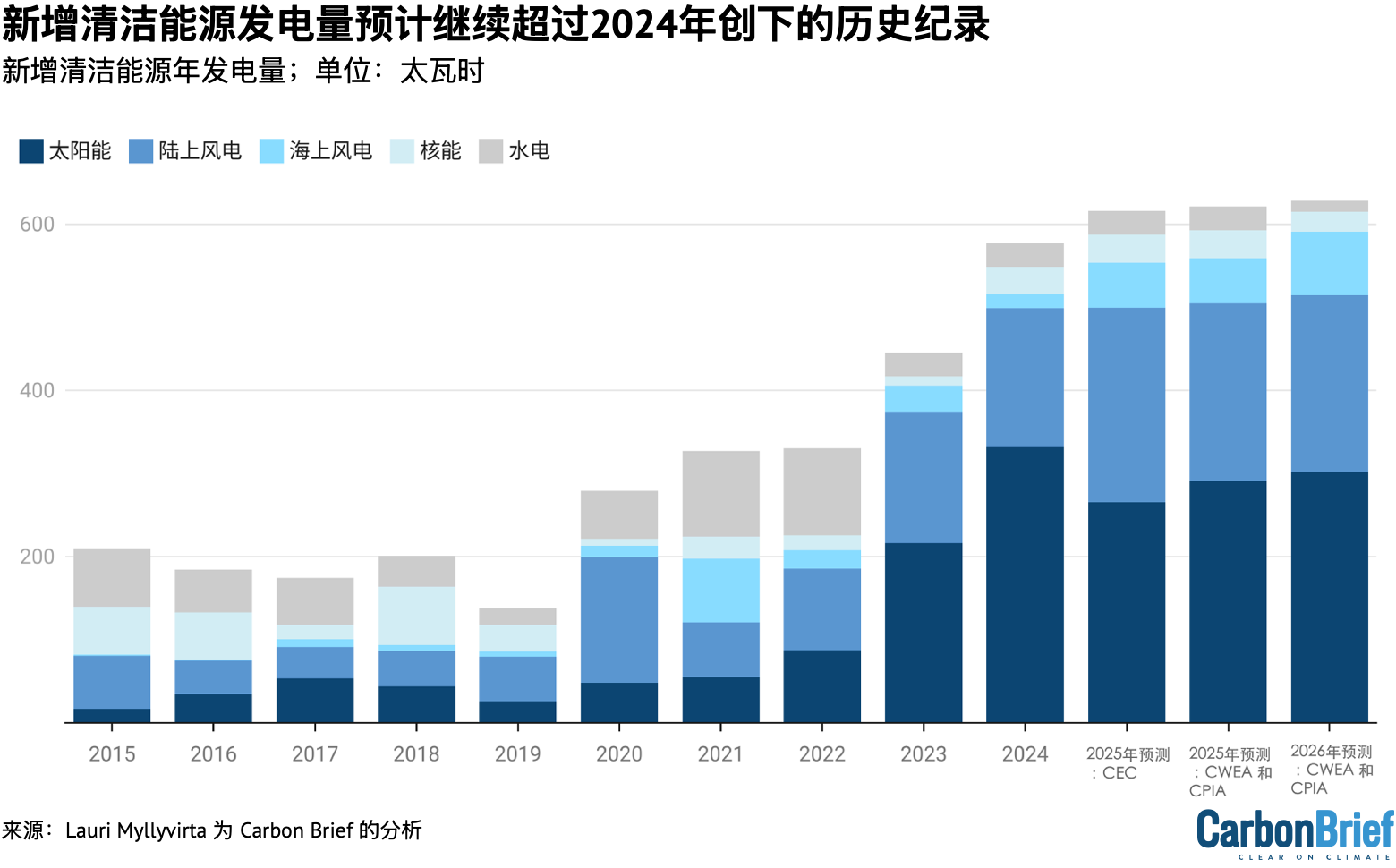
然而,这一政策也带来了更大的不确定性。一些行业,尤其是分布式光伏,将经历上半年装机量的激增而下半年放缓的艰难时期。
不确定性主要集中在两个方面。首先是地方如何执行这一政策,因为省级政府拥有相当大的回旋余地。考虑到清洁能源对许多省份经济的重要性,预计地方政府会力求以尽量不扰乱行业的方式来落实政策。
第二个不确定性来自中央政府的能源目标。新电价政策将更优惠的价格与中央政府的能源目标挂钩。而在过去几年中,清洁能源增长远远超过了官方设定的目标。
这凸显了即将出台的“十四五”规划中能源目标的关键作用。国家能源局设定的目标是“年均新增2亿千瓦(200吉瓦)以上新能源的合理消纳利用”,这一数字远低于去年实际新增的360吉瓦。
当然,电价政策的最终效果也取决于市场环境。当前中国煤电项目仍在快速上马,存在产能过剩风险。
中国与巴黎承诺之间的差距扩大
中国风电光伏发展面临的不确定性,也对该国履行《巴黎协定》下的国际气候承诺带来影响。
2020-2023年碳强度(即单位经济产出的排放量)下降进度明显滞后,中国已经明显偏离实现其2030年碳强度承诺的路径,几乎可以肯定将无法实现2025年的阶段性目标。2024年中国的碳强度下降了3.4%,未达到实现2025年和2030年目标所需的改善速度。
2025年政府工作计划中并未设定碳强度目标,仅包含单位国内生产总值能耗降幅超过3%(不包括原材料消耗)的目标。
这可以间接反映碳强度的改善幅度。2024年,中国的碳强度下降了3.4%,而化石能源使用强度下降了3.8%。如果2025年两者之间的比例相似,那么碳强度可能只能下降大约2.5%。在这种情况下,如果GDP增长达到5%的目标,碳排放量仍可能上升超过2%。
政府工作计划中没有设定碳强度目标,也没有特别强调碳强度的下降,显示出当局当前并未将实现这一目标作为优先事项。
政府工作报告中强调了“双碳”目标,即在2030年前实现碳达峰、2060年前实现碳中和。
然而,按照这些目标,2030年前碳排放仍可继续增长。这意味着到该年度,绝对排放量可能在2024年的水平上大幅增加。因此,即便“双碳”目标得以实现,也不能确保中国当前最核心的国际气候承诺——2030年碳强度目标——能够兑现。
即便今年碳排放有所下降,未来五年也需要大幅加快碳强度改善步伐,才能兑现中国2030年《巴黎协定》承诺。
如果中国仍然致力于兑现2030年承诺,那么该过程就需要体现在下一个五年规划设定的目标中。
2025年及未来展望
过去12个月可能标志着中国二氧化碳排放的一个重要转折点:清洁能源的增长首次超过电力需求增长,并在电力领域取代了化石燃料的使用。
尽管新的电价政策带来了一定的不确定性,但预计2025年仍将迎来创纪录的清洁能源新增装机容量,这表明这种趋势将在今年持续。
中国碳排放的未来长期走势将在很大程度上取决于即将出台的五年规划中设定的目标,以及北京应对美国关税和其他经济压力所采取的政策。
从短期看,美国加征关税将抑制能源需求增长和排放水平。为抵消特朗普关税影响而制定的经济政策,很可能会进一步推动清洁能源产业的发展,并可能促使经济重心转向国内消费,这意味着能源消费的增长将相对于GDP增长更少。
但另一方面,中国此前的经济刺激措施往往伴随着排放的急剧上升。中国若想转向消费和新技术驱动的刺激政策,而非高碳排的基建重工业,就必须突破传统发展模式。
电力行业的排放是否已经达峰,将取决于清洁能源供应增长与总体电力需求增长之间的竞赛。
按行业来看,除了电力行业,建筑材料、钢铁以及石油制品消费等领域的排放也可能已经达峰。
这些行业合计占中国与化石燃料相关碳排放的80%以上。然而,在所有这些行业中,都存在短期反弹的可能和不确定性。
目前仍有较大排放增长潜力的行业是煤化工。美国加征关税后国际油价的下跌将削弱该行业的盈利能力,可能导致即便新增产能增加,其工厂利用率也将下降。中国对自美国进口石化产品征收的报复性关税本可能本可能使煤化工行业受益,但这些关税据报已被豁免。
总体而言,这些因素可能推动中国未来五年排放持续下降,并有望在未来五年内实现大幅绝对减排。
然而,若政策出现转向,也同样可能导致碳排放在通往2030年的过程中继续上升。


The post 分析:清洁能源首次助力中国碳排放下降 appeared first on Carbon Brief.
https://www.carbonbrief.org/translations-analysis-clean-energy-just-put-chinas-co2-emissions-into-reverse-for-first-time/

The UN’s flagship climate fund has selected five locations for its new regional offices, a move aimed at bringing it physically closer to developing countries and making its finance easier to access.
After fraught discussions during a meeting last week, the board of the Green Climate Fund (GCF) decided in a secret vote on Saturday to open regional offices in Panama City, Amman in Jordan, Suva in Fiji, Nairobi in Kenya and Abidjan in Côte d’Ivoire. The African office will be split across two locations to better serve the continent with the largest number of countries and projects supported by the fund.
The decision marks a significant shift for the fund, which has operated from its headquarters in Songdo, South Korea, since its launch in 2013.
“This is a landmark moment for [the] GCF,” said the fund’s executive director Mafalda Duarte. “It has taken a lot of work, careful negotiation and persistent advocacy for a model that will bring us closer to the countries, to our partners and the communities we were created to serve”.
‘Less delay, more action’
The new offices are expected to act as the GCF’s front line, working more closely with governments, the private sector and civil society to improve access to climate finance and support the delivery of projects aimed at cutting emissions and strengthening resilience to climate impacts.
Welcoming the decision in a LinkedIn post, Fiji’s Permanent Secretary for the environment and climate change Sivendra Michael described it as “a win for the entire Pacific”, citing “long hours” and “tough negotiations” behind the outcome. “Less delay, more action — real support where it matters most,” he added.
-
Can new CEO steer Global Center on Adaptation back on course?
Madagascar’s Rindra Rabarinirinarison takes the helm of the troubled organisation promising to prioritise fundraising, rebuild trust with donors and hone its mission

A total of 43 countries applied to host the new offices, with 16 making a final shortlist after the GCF secretariat assessed bids on criteria including cost, connectivity and the ability to attract a “world-class workforce” through quality of life and access to international schools.
Panama emerged as the top-ranked location overall, according to a document seen by Climate Home News, while some selected hosts, including Amman and Abidjan, scored lower than rival candidates in their regions.
Establishing the new hubs is expected to cost an initial $6.5 million, but the fund anticipates these upfront expenses will be offset over time through operational savings, including lower staff and travel costs.
First Palestinian entity approved
The GCF board also accredited the first organisation in Palestine that will be able to directly apply for and access funding.
Created by the Palestinian Authority in the West Bank, the Municipal Development and Lending Fund supports local infrastructure projects and services. Working with partners, including the World Bank, it is developing projects to help communities cope with escalating climate risks such as drought and extreme heat.
In the West Bank, which is occupied by Israel, just under half of the population lives in areas classified as having high to very high climate exposure, according to a recent study.
The post Green Climate Fund picks locations for five developing country hubs appeared first on Climate Home News.
Green Climate Fund picks locations for five developing country hubs
Farmers and fishermen in the Maldives have long relied on an ancient calendar to guide their daily lives.
The Nakaiy system divides the year into 27 distinct periods, each named after a star or constellation in the night sky.
Any one period in the calendar tells you about expected weather and tidal patterns, navigational routes, and fishing conditions. The Nakaiy was created through centuries of careful observation and local knowledge, passed down through families as an essential tool for survival.
But things are now changing. The climate crisis is leading to more extreme weather events across the Indian Ocean island nation and upending the Nakaiy calendar.
“When you go and speak to communities and ask them what kind of impacts they are facing, a lot of elders will tell you that the weather, it doesn’t follow the calendar anymore,” explained Aishath Reesha Suhail, a programme officer in the Maldives’ Ministry of Tourism and Environment.
As the effects of climate change worsen, it is a real prospect that the Nakaiy may be abandoned by local people, representing a major cultural loss to the Maldives.
‘Systemic and growing threat’
With extreme weather becoming the norm, communities are observing a domino effect of consequences in their everyday lives. The slow onset of heritage loss is now being seen across continents, but notably among small islands in remote parts of the ocean.
“Climate change represents a systemic and growing threat to cultural heritage worldwide,” a UNESCO spokesperson told Climate Home, adding that the World Heritage Committee has identified climate change as “one of the most significant long-term risks affecting properties across all regions.”
UNESCO, the UN body for education, science and culture, defines the loss of cultural heritage as “the erosion of traditional knowledge systems, craftsmanship, social practices and identity, particularly where communities are displaced or livelihoods disrupted”. A clear example is historical sites and even entire islands washed into the ocean as a result of rising sea levels and coastal erosion.
The Maldives is dealing with such a situation now. The Koagannu Cemetery is a 900-year-old resting place, located on the country’s southernmost atoll, a mere 50 metres from the shoreline. The monument’s intricate coral gravestones are being actively threatened by the encroaching Indian Ocean.
The government and local community have responded to this challenge with emergency protection measures. Sandbags and concrete structures have been installed along the coastline, complemented by large numbers of palm trees to create a seawall. A wider solution is ‘beach nourishment’, a common practice in the Maldives where sand from elsewhere is brought in to replace what has been lost through erosion. Taken together, these solutions have so far protected the cemetery.
Among the many issues climate change creates, cultural heritage is not always front of mind. In the Maldives, one of the main barriers people face is awareness. “Most of what we are dealing with relates to the erosion of our islands along with areas such as fisheries… but we are quite limited in our capacity to do something about it,“ Suhail said.
“We don’t understand the full breadth of the issue at present because we haven’t been able to do extensive research on the matter,” she added. However, assessing the extent of the damage – and how to respond effectively – is a key priority for the government, outlined in its latest climate plan, known as a Nationally Determined Contribution, and as part of its National Adaptation Plan process.
Fishing is at the core of the country’s culture and identity, employing thousands of people. Most dishes include fish – “we have it for breakfast, lunch and dinner,” Suhail noted – but the climate crisis and overfishing are shifting how and when communities can fish. Tuna makes up 98% of all fish caught in the Maldives, but warmer ocean temperatures are changing migratory patterns, pushing the species into deeper, colder waters.
As a critical economic and cultural resource, the government has outlined a range of solutions to protect the fisheries sector in its first Biennial Transparency Report to the UN. These include using real-time tracking data to improve the efficiency of fishing operations; investing in canneries to increase fish storage; and diversifying away from tuna through marine farming.

Culture and nature go hand-in-hand
The same pattern is playing out elsewhere.
Palau and the Maldives are not close to one another. The two states are separated by around 4,000 miles and sit in different corners of the ocean. But both are experiencing very similar climate challenges, based on their position as a set of scattered, low-lying islands surrounded by an imposing body of blue water.
In the same way as the Maldives, Palau’s cultural heritage is closely tied to “land, coastlines and traditional food systems,” according to Toni Soalabla, at the Palau Office of Climate Change.
“Many of the places that hold stories, history and identity of our communities are located along the coast and are increasingly exposed to erosion and sea level rise,” she said.
One of these places is Ngerutechei village, reportedly the oldest in Palau, and home to ancient stone paths and carvings. The village provides a glimpse into the past social values and culture of the people in this western Pacific nation.
As part of the development of Palau’s National Adaptation Plan, the government has worked with local leaders to identify similar sites of cultural significance. The plan encourages communities to use their own knowledge to create protective measures for these sites.
Climate change is also prompting communities to take up traditional land and food practices again. These include cultivating taro, a stable food source that has historically supported water, soil and food security on the islands.
“These systems developed over generations in response to local environmental conditions, so strengthening them today is both a climate adaptation measure and a way of maintaining cultural knowledge that might otherwise fade,” said Soalabla.
Cultural practices in Palau have developed alongside the natural ecosystems that people rely on to survive. It is within this context that researchers believe adaptation policies should be created. Recognising this relationship “can strengthen both community identity and environmental resilience at the same time”, according to Soalabla.


Heritage on the global stage
The issue of cultural loss has not gone unnoticed in international climate negotiations.
Small island states such as the Maldives have used their role at the UN to push for greater awareness and action, with some key successes.
In 2015, the Paris Agreement established a Global Goal on Adaptation (GGA) which recognised that countries needed to do something about climate change now and not later. However, it took six years before a framework and a set of adaptation targets were agreed at the UN climate summit in Glasgow to pursue this goal.
From this came the establishment of seven overall themes – from poverty eradication to access to health – to guide adaptation action and a set of around 60 indicators to measure progress against the targets.
World leaders invited to see Pacific climate destruction before COP31
Emilie Beauchamp, an adaptation specialist at the International Institute for Sustainable Development (IISD), said that “cultural heritage was highlighted as one of the global priorities [of the GGA Framework] and is one of the seven themes, so it is considered very important by the international community.”
The much-debated set of indicators, only finalised in Belém at last year’s COP30, include five related to cultural heritage with a focus on preserving cultural practices and important sites that are “guided by traditional knowledge, Indigenous Peoples’ knowledge and local knowledge systems”. A spokesperson for UNESCO said the inclusion of heritage indicators “marks an important recognition that climate impacts extend beyond economic losses”.
While critics said the set of final indicators was rushed through by the Brazilian presidency, they now serve as guidance for national governments that wish to implement plans to protect their common heritage. The missing piece of the puzzle remains how to finance these plans – something notably absent from the Belém text, which made clear that the adaptation indicators “do not create new financial obligations or commitments, nor liability or compensation”.
The lack of financial commitments proved disappointing for many small states grappling with how to prevent their cultural history from being entirely forgotten, especially at a time when adaptation finance remains below requirements. A recent UNEP report found that developing nations would need an estimated US$310 billion per year in 2035 to adapt to climate change, while current public financing was around $26 billion.
At these low levels “only a small percentage of what the framework outlines could be implemented,” according to Beauchamp.

The challenge of cultural heritage
When looking at low-lying islands on a map, they can appear as specks of land amid a vast ocean. Many of the stories from these remote places go unnoticed. But the specks represent millennia of human culture that is slowly being lost to the ocean.
While the international community has now recognised the problem and solutions exist, the recurring issue of scarce finance may prevent governments from taking sustained action. Island communities have already been forced to move home as sea levels rise, leaving behind their cultural connections to a place.
The value of any cultural asset, or of human heritage, can be judged by how it is engaged with over generations. Without human intervention, many historical sites, language, cuisine and other local customs would become a forgotten part of history. The rapid onset of climate change brings the role of cultural heritage into sharp relief, challenging communities to decide in real time what they value, what deserves saving, and how to achieve that.
Stories of cultural loss are not confined to small islands but it is here where the challenge is presenting most acutely. The experiences of these vulnerable nations in protecting their heritage will provide the litmus test for effective adaptation responses elsewhere.
Adam Wentworth is a freelance writer based in Brighton, UK.
(Main image: The Isdhoo Havitha is an ancient Buddhist monastery in the Maldives, located moments from the shoreline. Photo: Ashwa Faheem)
The post Island nations fight to save cultural heritage from climate change appeared first on Climate Home News.
Island nations fight to save cultural heritage from climate change
The invasive emerald ash borer, native to northeast Asia, has spread to 37 states over the past quarter century, killing nearly all of the ash trees it infests. But in Maine, a coalition of basketmakers, scientists and government officials are plotting a future for their trees.
Each strip of wood in Richard Silliboy’s hands started as a year of an ash tree’s life.

Nasdaq Invests in First EU-Certified Carbon Removal Credits from Stockholm Exergi
AI Solutions from Microsoft and NVIDIA Power DOE’s Nuclear Energy Genesis Mission

Green Climate Fund picks locations for five developing country hubs
-
Climate Change8 months ago
Guest post: Why China is still building new coal – and when it might stop
-
Greenhouse Gases8 months ago
Guest post: Why China is still building new coal – and when it might stop
-

 Greenhouse Gases2 years ago
嘉宾来稿:满足中国增长的用电需求 光伏加储能“比新建煤电更实惠”
-
Climate Change2 years ago
Bill Discounting Climate Change in Florida’s Energy Policy Awaits DeSantis’ Approval
-

 Climate Change2 years ago
嘉宾来稿:满足中国增长的用电需求 光伏加储能“比新建煤电更实惠”
-
Climate Change Videos2 years ago
The toxic gas flares fuelling Nigeria’s climate change – BBC News
-

 Renewable Energy5 months ago
Sending Progressive Philanthropist George Soros to Prison?
-

 Carbon Footprint2 years ago
US SEC’s Climate Disclosure Rules Spur Renewed Interest in Carbon Credits