

A wave of anti-“greenwashing” litigation is seeking to hold major players in the aviation industry to account for sensational claims of being sustainable, low-carbon or contributing to net zero.
While the industry has faced legal backlash in the past, the dramatic proliferation of these cases may spell disaster for major airlines.
It’s not hard to see why the aviation industry has provoked the ire of climate activists. Flying is responsible for a staggering 5% or so of human-induced global warming and its climate impact is still growing at a rate far greater than almost any other sector.
In this context, a profusion of “green flying” and “sustainability” advertising campaigns has turned the industry into an emblematic example of the debate between growth and sustainability.
Why greenwashing?
The rise in greenwashing litigation can in part be attributed to the relative ease with which cases can be brought. It’s simply a lot easier to attack an airline’s advertising compared to other activities that might be targeted by strategic climate litigation.
Consumers can use legal mechanisms such as commercial practice or consumer protection regulations, as happened in a recent greenwashing complaint to the European Commission filed by consumer groups in 19 countries against 17 airlines.
It’s an effective form of climate action due to the power exerted by advertising on public perception and social norms. The UN’s Intergovernmental Panel on Climate Change (IPCC) has underscored the importance of reducing demand for flying in the first place, something significantly hindered by adverts that downplay its environmental impact.
Exposed: carbon offsets linked to high forest loss still on sale
A report by Greenpeace and think tank the New Weather Institute claimed that in 2019 airline advertisements influenced 34 million tonnes of CO₂ equivalent emissions worldwide.
This litigation is also buoyed by the demonstrable falsehoods that riddle the sustainability strategies of these companies. The pillars upon which their net-zero strategies rest vary from the broadly ineffective to the dangerously fraudulent and facilitate growth in a sector in dire need of reduction.
Airlines all rely on some form of carbon offsetting – planting trees, for instance, to “offset” the carbon emitted by the planes – or sustainable aviation fuel or carbon capture and storage, in order to “mitigate” their climate impacts.
Common litigation strategies
Thus far, there have been six climate change-related cases brought against major airlines (four in Europe, one in the US and one in Brazil). These cases are buttressed by numerous legal complaints taken through the European Commission or the UK and US advertising standards boards which have already successfully ordered Ryanair, Lufthansa and Etihad to pull ad campaigns.
In each of these three cases, authorities found that terminology like “protecting the future”, “sustainable aviation” or “low-emissions airline” amounted to wilful misleading of consumers and breached advertising regulations.
A recent case taken by Dutch campaigners against airline giant KLM is the most daring example yet. Climate action group FossielVrij(Fossil-free) argues that KLM’s “Fly Responsibly” campaign constitutes misleading advertising under EU consumer law.
Following coup, Gabon climate officials face corruption allegations
The group asserts that flying responsibly is impossible at present, and that KLM seeks company growth and increased flight sales, when it should be reducing emissions by reducing the number of flights. KLM said its “communications comply with the applicable legislation and regulations”, but has dropped the Fly Responsibly campaign.
Interestingly, this case builds upon a ruling of the Dutch Advertisement Code Commission and indicates the “snowballing” trend inherent in anti-greenwashing litigation, wherein cases rely upon precedent set by previous authorities. With this borne in mind, the recent 19-country complaint by the European Consumer Organisation could provide the strongest foundation to date for future litigation.
Delta Airlines is also facing a class action suit in the US, brought by a California resident who alleges that by marketing itself as a “carbon-neutral” Delta has grossly misrepresented its environmental impact. This points to a growing understanding of the ineffectiveness of carbon offsetting, a net-zero tactic adopted by almost every major airline.
A Delta spokesperson said the case is “without legal merit” as the airline has “transitioned its focus away from carbon offsets” towards decarbonising its own activities. European companies should follow this case closely as American-style “class action” litigation will soon be made possible in the EU.
Does this litigation have teeth?
These cases might result in companies simply pulling their green campaign while maintaining their existing corporate framework and growth models. More promisingly, recent research suggests that any climate-related case taken against a major emitting company will affect the firm’s value (on average by 0.057% following the filing of a case, and by 1.5% following an unfavourable decision).
In reality, these early cases are merely scratching the surface of what’s possible. Once these cases enter the public conversation, a growing understanding of consumer protection is bound to follow.
Green Climate Fund ambition at risk after ‘disappointing’ pledges
In many jurisdictions, such as my home country of Ireland, significant damages can be awarded against companies for misleading advertisement. The UK’s Competition and Markets Authority, which is currently investigating claims of greenwashing in other sectors, will soon be able to fine companies 10% of their global turnover for non-compliance.
While anti-greenwashing litigation might not halt the growth of this industry altogether, it is no doubt an invaluable tool. At its most effective, it can stop blatant profiteering from the climate crisis and force the aviation sector to confront the chimera that is green growth.
Calum Maclaren, PhD Candidate, Climate Litigation, University College Dublin. This article is republished from The Conversation under a Creative Commons license. Read the original article.
The post Why airlines are perfect targets for anti-greenwashing legal action appeared first on Climate Home News.
Why airlines are perfect targets for anti-greenwashing legal action

The conference is one of the largest aimed at preparing for hurricane season, which begins June 1. A task force report on potential reforms to the agency also remains on hold.
ORLANDO, Fla.—A major conference to help communities prepare for hurricane season kicked off Monday without the agency that coordinates federal disaster response.
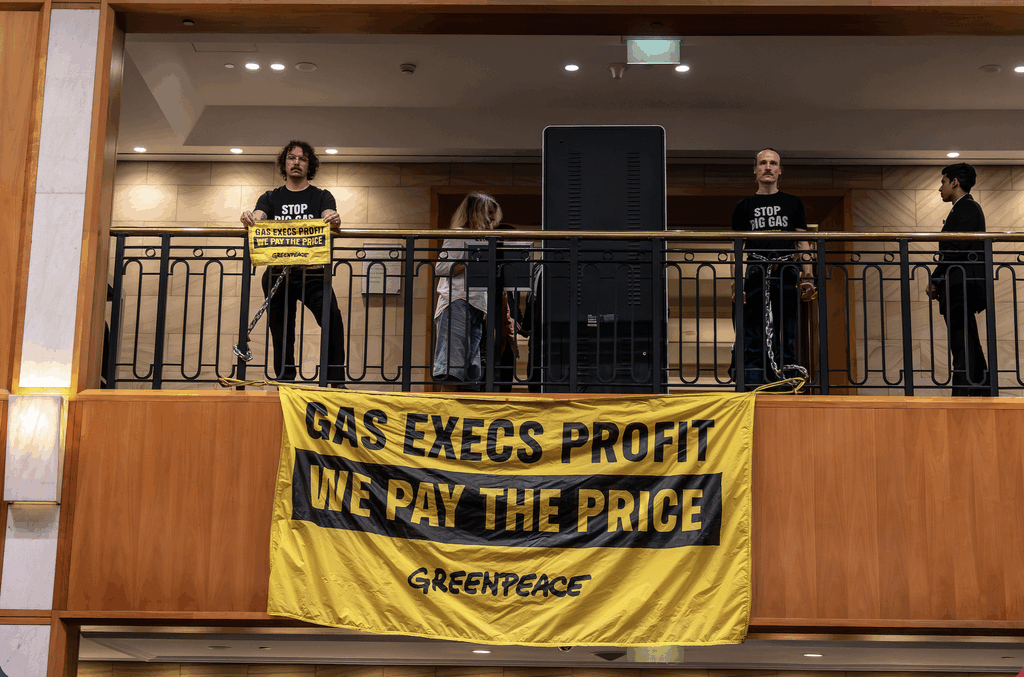
Right now, Greenpeace activists are standing up to Big Gas at a major gas conference in Sydney.
Inside the Sheraton Grand Hotel, executives from fossil fuel companies have gathered alongside lobbyists, investors and political allies to plan the future of gas in Australia – and how to maximise their profits.
So Greenpeace has stepped in to call it out. Activists have dropped a banner inside the venue with a clear message: Gas Execs Profit. We Pay The Price.
We need your help to spread the message that we won’t stand by and let this happen.
What’s really going on
Gas corporations are making billions in windfall profits from global conflicts – from Ukraine to Iran – while Australians pay the price with higher energy bills and climate damage.
And they want more.
More drilling. More exports. More profit.
Why Greenpeace took action today
This conference is where it all comes together. Behind closed doors, gas executives, lobbyists, investors and political allies are meeting to push for more gas expansion, no doubt using global instability as their justification.
That’s why Greenpeace couldn’t let this gathering go uninterrupted.
Big Gas is counting on people not paying attention. Let’s prove them wrong.
Share the video to call out Big Gas.
What needs to happen now
Gas is expensive. It’s volatile. And it ties our energy system to global instability.
But there is a better way. Renewable energy is already cheaper, more reliable, and made right here in Australia. It’s the fastest path to lower bills, real energy security and a safer climate.
To get there, we need to:
- properly tax the gas industry and its exports
- stop expanding gas
- and speed up the transition to homegrown renewable energy.
Share this video far and wide to show just how much support there is to tax Big Gas properly and speed up the transition to renewable energy.
This is just the beginning
This action is part of a growing movement to stand up to Big Gas and challenge the power it holds over our government and society. The Federal Government has a role to play – starting by taxing gas corporations properly and then accelerating the transition to homegrown renewable energy.
Together, we can show just how much support there is for change and make it impossible for decision-makers to ignore.
What you can do
- Follow along on our social channels.
- Share the video far and wide to show how much support there is.
- Sign the petition to tell Albo to stand up to Big Gas – because if we can, he can.
BREAKING: Greenpeace activists disrupt major gas conference in Sydney
SYDNEY, Tuesday 31 March 2026 — Two Greenpeace Australia Pacific activists have been arrested following a peaceful protest at the Australian Domestic Gas Outlook conference in Sydney, where they dropped a banner that said — “Gas Execs Profit. We Pay The Price” and held banners saying “Tax Gas Profits”.
Photos and B Roll video of the protest and arrests are available here
Live updates on Greenpeace Instagram
The two activists were arrested by police around 9:00am AEDT and taken to Day Street Police Station. Information on this morning’s gas conference disruption can be found here.
Solaye Snider, Campaigner at Greenpeace Australia Pacific, said: “Greenpeace activists have taken a strong stand today against profit hungry gas corporations and lobbyists, who see horrific global wars as an opportunity to price gouge and profiteer, while everyday people pay the price.
“Australians have had enough of gas corporations like Santos and ConocoPhillips ripping us off, leaving us with nothing but empty pockets and climate damage. The gas industry is aggressively lobbying against being fairly taxed and pushing to drill for more gas. Change requires showing up and speaking out, and that’s what these activists have done today.
“Greenpeace Australia Pacific stands by our activists, and stands with all communities who are peacefully fighting for a safe and clean energy future. The right to peaceful protest is a fundamental pillar of a healthy democracy and a basic right of all Australians.”
-ENDS-
Media contacts:
Lucy Keller: +61 491 135 308 or lkeller@greenpeace.org or Kate O’Callaghan: +61 406 231 892 or kate.ocallaghan@greenpeace.org
Greenpeace activists arrested after disrupting major gas conference in Sydney



-
Climate Change8 months ago
Guest post: Why China is still building new coal – and when it might stop
-
Greenhouse Gases8 months ago
Guest post: Why China is still building new coal – and when it might stop
-

 Greenhouse Gases2 years ago
嘉宾来稿:满足中国增长的用电需求 光伏加储能“比新建煤电更实惠”
-
Climate Change2 years ago
Bill Discounting Climate Change in Florida’s Energy Policy Awaits DeSantis’ Approval
-

 Climate Change2 years ago
嘉宾来稿:满足中国增长的用电需求 光伏加储能“比新建煤电更实惠”
-
Climate Change Videos2 years ago
The toxic gas flares fuelling Nigeria’s climate change – BBC News
-

 Renewable Energy5 months ago
Sending Progressive Philanthropist George Soros to Prison?
-

 Carbon Footprint2 years ago
US SEC’s Climate Disclosure Rules Spur Renewed Interest in Carbon Credits