

Published
1 year agoon
By
Alice RushGetting off the power grid isn’t as simple as placing a few solar panels on your rooftop and calling it a day. It’s about a full-on lifestyle change, one in which you take full responsibility for every watt of energy you use and the system that keeps your home running.
True energy independence means being prepared to power your home without blinking through snowstorms, scorching heat, and cloudy days when the sun refuses to shine.
But solar power is intermittent. It only works by generating energy from sunlight. So what happens when night falls, clouds gather, or storms roll in?
That’s where the battery steps in, keeping your lights on, your fridge running, and powering all your home appliances efficiently.
In Australia, choosing the right off-grid battery is more than a technical decision. It’s the heartbeat of your entire system, which needs to be reliable, resilient, and ready to store every drop of sunshine.
But not all batteries are built the same. To find the best fit for your property, you’ll need to understand a few key factors.
So, what’s the best battery for off-grid solar in Australia? Let’s find out.
In this blog post:
The Heart of Your Off-Grid System: Why Batteries Matter So Much?
Imagine a perfect sunny day, your solar panels are humming, generating power efficiently throughout the day.
But when the sun goes down or a week of heavy rain sets in, your solar battery is the silent workhorse, storing surplus energy generated during peak sunshine hours and discharging it when you need it most.
For off-grid systems, batteries are non-negotiable. They provide:
- Continuous Power: Ensuring an electricity supply 24/7, regardless of solar availability.
- Energy Independence: Eliminating reliance on the grid and its associated costs and vulnerabilities, ensuring energy freedom.
- Backup Power: Protects residents against blackouts or unexpected power outages, offering peace of mind.
- Optimized Solar Utilization: Maximizing the use of solar energy, reducing power wastage.
What Makes a Battery Truly “Off-Grid Ready”?
Not all batteries are built for off-grid use. While many hybrid batteries can operate in grid-connected homes, the best off-grid batteries must operate independently, store enough energy for multiple days, and withstand fluctuations in solar production.
Features like blackout protection, temperature regulation, and seamless integration with diesel generators or EV chargers become much more important in this setting.
Off-grid homes also need batteries that can handle deeper discharges and faster recharge times.
Most LFP batteries on the market today meet these needs, but ensuring your solar inverter is compatible is equally critical.
Pairing the right battery with a hybrid inverter from brands like Fronius, GoodWe, or Victron can make or break your system’s efficiency.
Different Types of Battery for Solar Energy Storage
When it comes to off-grid solar batteries, several key technologies dominate the Australian Energy market.
From lithium-ion batteries to lead-acid or flow batteries, each battery chemistry has its own set of strengths and weaknesses. Also, the best battery choice depends highly on your specific needs, budget, and priorities.
Lithium-Ion Batteries: The Modern Powerhouses
Lithium-ion batteries have revolutionized the energy storage landscape, and they are overwhelmingly the preferred choice for modern off-grid systems in Australia.
Within the lithium-ion family, Lithium Iron Phosphate (LiFePO4 or LFP) stands out as the champion for solar applications.
So, what makes a solar battery best for Australia’s Climate? Why are Lithium-ion batteries a popular choice for Off-Grid Solar in Australia?
Well, the reasons include:
- Exceptional Lifespan (Cycle Life):
LFP batteries boast an incredibly long cycle life, often exceeding 6,000 cycles and often coming with a 10-year warranty.
With proper maintenance and care, a battery’s lifespan can be extended. In most off-grid homes in Australia, this translates to 15+ years.
- High Depth of Discharge (DoD)
You can safely discharge LFP batteries to 80-100% of their capacity regularly without significantly impacting battery lifespan. So you can get more usable energy from a smaller battery bank.
- High Efficiency (Round-Trip Efficiency)
LFP batteries are incredibly efficient, typically achieving 95-96% round-trip efficiency. In this battery type, very little energy is lost during the charging and discharging process.
This ensures you get almost all of your generated solar power back out of the battery.
- Incredible Thermal Stability & Safety
LiFePO4 chemistry is inherently more stable and safer than other lithium-ion variants.
Their less prone to overheating and thermal runaway features, making them a critical consideration in Australia’s hot climate and for remote installations where safety is the main concern.
- Minimal Maintenance
LFP batteries are maintenance-free due to their integrated Battery Management Systems (BMS).
This system handles cell balancing, overcharge or discharge protection, and temperature regulation. This is a huge advantage for off-grid living, where convenience and reliability are key.
- Sleek, Compact & Lightweight
Compared to lead-acid batteries, LFP batteries are significantly smaller and lighter, making them easier to install and more space-efficient.
- Allow Fast Charging
LFP batteries can accept higher charge rates, allowing them to absorb more of your solar energy quickly, especially during peak generation periods.
Lead-Acid Batteries: A Traditional & Reliable Power Source
For decades, lead-acid batteries were the only viable option for off-grid solar. They are still available in the market and come in various types such as:
- Flooded Lead-Acid (FLA) systems are the oldest and most affordable type. They require regular maintenance, such as checking electrolyte levels, adding distilled water, and ensuring ventilation due to carbon dioxide emissions.
Due to maintenance and safety requirements, they are less popular for new off-grid systems.
- Sealed Lead-Acid batteries are maintenance-free because they don’t require water topping. They are categorized into two types:
- AGM (Absorbent Glass Mat): Better for higher discharge rates.
- Gel: Better for slower discharge rates and warmer temperatures.
Pros & Cons of Lead-Acid Batteries
The main advantages of using lead-acid batteries are their lower upfront cost and proven technology.
These batteries have dominated the industry for several decades, making them a reliable and well-understood choice, especially appealing to those with tight budgets.
Another key advantage is Australia’s well-developed recycling infrastructure, which allows batteries to be recycled or repurposed in an environmentally friendly way.
Here are the disadvantages of using lead-acid batteries
- Shorter Lifespan (Cycle Life): Typically offers 500-1,500 cycles, which is much lower than LFP.
- Limited Depth of Discharge (DoD): Lead-acid batteries should only be discharged to 50% DoD to keep the battery’s health good, extending their lifespan.
- Lower Efficiency: Round-trip efficiency is typically 80-85%, meaning more energy is lost as heat during charging and discharging.
- High Maintenance: Requires regular checks and watering. Incorrect maintenance can significantly reduce the lifespan of batteries and void warranties.
- Bulkier & Heavier: They require significantly more space and are much heavier than LFP batteries for the same usable capacity.
- Temperature Sensitivity: Performance degrades in extreme heat or cold.
- Safety Concerns: Emit hydrogen gas during charging, requiring proper ventilation and careful handling.
Best Off-Grid Solar Battery in Australia| What to Look For?
In order to find the best battery for your off-grid solar home, you will need to look for the following attributes in your battery of choice:
Depth of Discharge
DOD signifies a battery’s capacity or energy held in it. Manufacturers provide a number, a threshold below which the battery level should not drop if you want to extend its lifetime.
This is one of the most critical attributes you need to know about. Remember, the higher the DOD, the better the battery is, and it will serve you for a longer time.
Lithium-ion batteries usually provide a higher DOD than lead-acid batteries, which usually do not exceed 80%. They are more preferable in off-grid living scenarios.
Capacity
It is usually advised to upsize your off-grid solar system so that you can yield more energy and keep that at your disposal.
Also, to future proof the house, you must upsize your solar system. In this case, you must also consider the battery’s capacity. Your solar system’s electricity generation ability should be on par with the battery.
Review your previous bills and determine the average number of kilowatt hours of energy you use. This will give you an idea of the battery capacity you will need.
Remember to leave a little room when choosing a storage battery and estimate a bit higher than you need, just to be on the safe side.
Warranty
The official warranty on a typical solar system is almost 25 years, so the solar battery you choose must be sufficient.
Typically, solar batteries come with a 10 to 15-year warranty, depending on some criteria. You must be careful when choosing your battery for your off-grid home and abide by the manufacturer’s advice for prolonged battery life.
Exploring the Top Battery Brands in Australia
Australia’s solar storage market is booming rapidly, driven by a combination of government incentives and growing environmental awareness on reducing the carbon footprint.
The new 30% federal rebate introduced on July 1, 2025, under the Cheaper Home Batteries program has significantly boosted consumer interest.
Alongside this, additional renewable energy support measures, financial aids, and increasing concerns about energy prices and climate change are accelerating the shift toward sustainable home energy solutions.
So, what are the best batteries for an off-grid energy system?
Here’s a breakdown of the top-performing off-grid solar battery options:
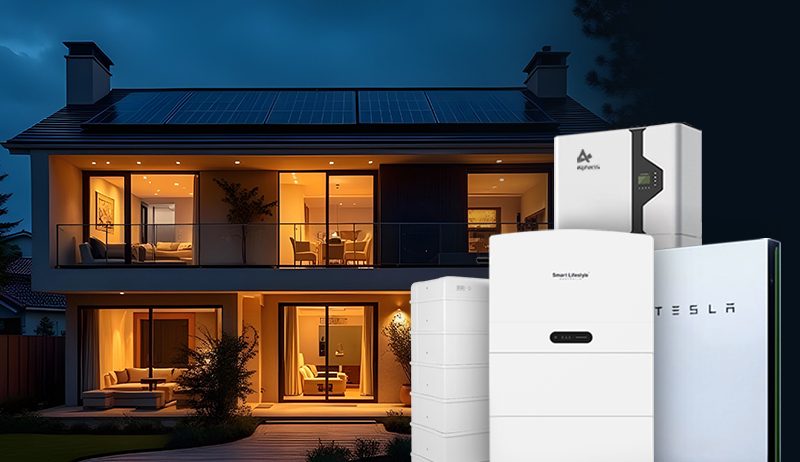
1. Tesla Powerwall 3
A premium, integrated solution with a sleek design and smart energy management. While primarily for grid-connected homes, Tesla Powerwall can be configured for off-grid use.
These batteries are simple to install and backup ready.
- Capacity: 13.5 kWh with an integrated inverter
- Chemistry: LFP (updated from earlier NMC models)
- Efficiency: 97% round‑trip
- Warranty: 10 years, stackable up to 10+ units
- Ideal for: Families want an efficient backup with sleek app control
2. SLA LIFE
SLA LIFE is a high-performance, all-in-one solar battery storage system featuring AC coupling for enhanced flexibility across multiple applications.
It is engineered for indoor and outdoor use and delivers reliable performance in diverse environmental conditions.
- Capacity: 5kWh to 30kWh
- Efficiency: nearly 97.6% efficient
- Type: All-in-one solar battery storage system
- Coupling: AC Coupled compatible with existing solar inverters
- Application: Residential, commercial, and off-grid energy storage
- Battery Technology: Lithium-ion batteries
- Modular Design: Scalable capacity options
- Warranty: Up to 10 years.
3. Sungrow SBR Series
A popular choice offering excellent value for money, high efficiency, and modular expansion, it is built for harsh Australian conditions. It’s also great for budget-conscious users who want to expand their system over time.
- Capacity: 3.2 kWh per module, but expandable to 9.6 to 25.6 kWh
- Efficiency & DoD: 100%, up to 30 A continual power
- Warranty: 10 years
4. BYD Battery‑Box Premium
Highly reputable, modular LFP systems are known for safety, performance, and scalability. They’re excellent for expanding your energy needs over time and ideal for large off-grid properties needing expandable storage.
- Capacity: 5kWh to 22 kWh per unit; stackable up to 256 kWh
- Battery Chemistry: Cobalt-free LFP
- Efficiency: Nearly 95% with 100% DoD
- Warranty: 10 years
5. Alpha‑ESS Smile5
The battery Alpha Ess has a flexible feature with integrated energy management. These all‑in‑one hybrid solutions are easy to install and ideal for small to medium off‑grid homes wanting hybrid ease at a lower cost.
- Capacity: Nearly 10kWh to 13 kWh
- Battery Chemistry: LFP battery
- Warranty: 10 years