

Dancliff Mbura is the advocacy and communications manager at Action Against Hunger Kenya. He works to influence policy and resource allocation and is an expert on multisectoral nutrition interventions.
Just four years since the last devastating drought, when five consecutive rainy seasons failed, 3.3 million people in Kenya’s arid and semi-arid counties are facing acute hunger as yet another drought crisis deepens. It is visible everywhere – in the parched riverbeds, weakened animals, and the children, who are too quiet.
Six months ago, the number of people facing acute hunger was 1.8 million. If nothing changes, by August, it will climb to 3.7 million, underscoring the need for urgent aid.
We know the answers. Cash transfers allow families to purchase food in markets that are still functioning. Mobile health and nutrition outreach teams must meet communities where they are, not where facilities happen to be located, which could make them inaccessible. Emergency water provision is essential.
But the resources are not there to address the growing needs. A coalition of humanitarian organisations working across Kenya’s drought-hit regions with the government has estimated the drought response would cost more than 30 billion Kenyan shillings ($232 million). Kenya’s government has released just 6 billion shillings so far.
Reducing the damage
Beyond the immediate response, however, we need to invest in systems that reduce the damage of future drought cycles in this climate-vulnerable region.
Kenya has systems that support the generation of early-warning systems, such as the National Drought Management Authority’s monthly county and national early-warning bulletins with detailed early-warning data. What we need is a means to ensure that information reaches communities in time for them to act on it and make sure they have the resources they need to do that.
One approach could be the establishment of village-level climate change and disaster hubs. These hubs would provide communities with simplified, actionable information, sometimes via dashboards on weather patterns and forecasts, and support them in generating locally relevant, cost-effective early actions.
By engaging communities in this process, the government and development partners can complement these efforts with additional resources where needed. This approach fosters community ownership while simultaneously enhancing resilience to climate-related risks.
-
Uganda cites contentious IEA fossil fuel scenario backed by Trump administration
Critics of the African nation’s oil ambitions say referencing the International Energy Agency’s most pessimistic scenario for climate action is a risky policy -
Earth blocks keep homes cool while cutting emissions in Kenya’s drylands
In an ever-warming climate, compressed earth blocks technology is helping communities stay cooler in hot highland regions of Kenya -
Southern Africa drought flags dilemma for loss and damage fund
Scientists blame the current drought on El Niño – which could exclude those affected from receiving aid for climate-change damage


With better technology, including AI-assisted climate modeling, we can generate precise early-warning information. When shared in a timely manner with communities and accompanied by support for early or anticipatory actions, this can help build resilience to frequent droughts and other crises.
For example, with access to early-warning information, vulnerable communities could store water ahead of droughts, switch to short-maturity crops when reduced rainfall is forecast, and move livestock and food stocks to higher ground before floods hit. They could also apply preventative treatments to protect crops and animals from pest or disease outbreaks, and make smarter market decisions, such as selling livestock early before prices drop, to safeguard their income.
Different in scale
I have spent 15 years working on humanitarian response in Kenya. I have seen drought cycles come and go. But what is happening right now across our arid and semi-arid lands – the ASAL counties that cover nearly 80% of the country – is different in scale and in the depth of suffering it is causing.
The October-December 2025 short rains delivered only 30 to 60% of the long-term average, making it one of the driest seasons since 1981. In some areas, rainfall failed almost entirely. More than 90% of open water sources have dried up in most parts of ASAL counties. Families are walking up to 20 km (12 miles) or more just to find water.

Now, as we approach Kenya’s more reliable rainy season from March to May, projections are well below average across the hardest-hit northern counties, and we may be heading into a fourth consecutive poor season. For communities who have already exhausted every coping mechanism they have, another failed season could be catastrophic.
More than 810,000 children between the ages of six months and five years are acutely malnourished. Nearly 117,000 pregnant and breastfeeding mothers are also acutely malnourished. The cycle of nutrition that healthy communities depend on is breaking down.
And yet approximately half of severe acute malnutrition cases are going untreated. Only 24% of the nutrition and health outreach sites mapped across the arid and semi-arid counties are currently functioning.
Impossible choices
The economic devastation compounds everything. Livestock is the backbone of life in these pastoral lands. But in Marsabit county alone, more than 50,000 sheep and goats have died. Mandera has lost nearly 30,000 animals. Milk production has plummeted by 55%. As animals grow weaker, families receive less and less when they sell them. Livelihoods are collapsing in slow motion, and families are running out of options.
That can lead to desperate decisions: more daughters are married off early in exchange for dowry like livestock, a practice that rises sharply in times of crisis. Girls are subjected to female genital mutilation so they can be considered ready for marriage. Children drop out of school as families are forced to move in search of better land.
Every week that passes without a scaled-up response is a week in which children go hungry, animals die, and families make impossible choices. We are at a point where, if we do not act, lives will be lost – preventably.
Not because we lacked the knowledge, not because we lacked the warning, but because we were not able to move fast enough.
The post We must invest in early-warning systems to tackle crises like Kenya’s drought appeared first on Climate Home News.
https://www.climatechangenews.com/2026/03/10/we-must-invest-in-early-warning-systems-to-tackle-crises-like-kenyas-drought/

Climate Change
Q&A: What can – and cannot – be said about global warming’s role in the 2026 Himalayan floods
On the morning of 26 August, flash floods surged through a Himalayan border region of Nepal and the Chinese region of Tibet, killing more than 1,300 people, with thousands still missing.
In the days since the floods, scientists have examined satellite imagery, drone footage and seismic data in order to understand and explain the forces behind the event.
While initial theories pinned the flood on a glacial collapse, scientists now understand the event as a “multi-hazard cascade”, which began with a bedrock collapse.
Some climate sceptics have tried to use this to falsely claim that human-caused climate change had no impact on the event.
Yet, scientists have noted that, while no formal attribution study has been carried out thus far, warming is making such ice-rock avalanches in the region more likely.
Researchers have highlighted how rapid warming is dramatically reshaping Asia’s high-mountain region – and identified rising temperatures, glacier retreat and permafrost thaw as factors that may have all contributed to the disaster.
Balendra Shah, Nepal’s prime minister, has called the floods a “serious signal that…the risks we must bear in the Himalayan region are increasing” due to climate change.
Here, Carbon Brief unpacks what scientists currently know about the causes of the catastrophic event and what they can – and cannot – say about the role of climate change.
What happened?
A report published on 28 August by the HiRisk scientific consortium of high mountain experts detailed the events that led to the flash floods.
It said that events were set in motion on 26 August when a mass of bedrock, as well as the glacier ice on top of it, broke off a slope of Langtang-Lirung mountain in the Nepalese Himalaya, plunging from approximately 5,200 metres above sea level to the valley floor at 3,000 metres.
The landslide shook the ground hard enough that, at 8:37am Nepal local time, the US Geological Survey (USGS) initially reported a magnitude 4.4 earthquake. Later that day, it clarified the shaking was caused by glacier collapse and debris flow, equivalent to a magnitude 5.2 earthquake.
On the valley floor, the melting ice, water and debris slammed into the Lhende Khola river, a high-altitude river that runs along Nepal’s border with China.
Known downstream as the Bhote Koshi river in Nepal and the Poiqu or Poqu in China, the Lhende Khole feeds a network of rivers across Nepal and the Chinese region of Tibet, including the Trishuli river. (In China, the Lhende Khola is known as the Donglin Tsangpo.)
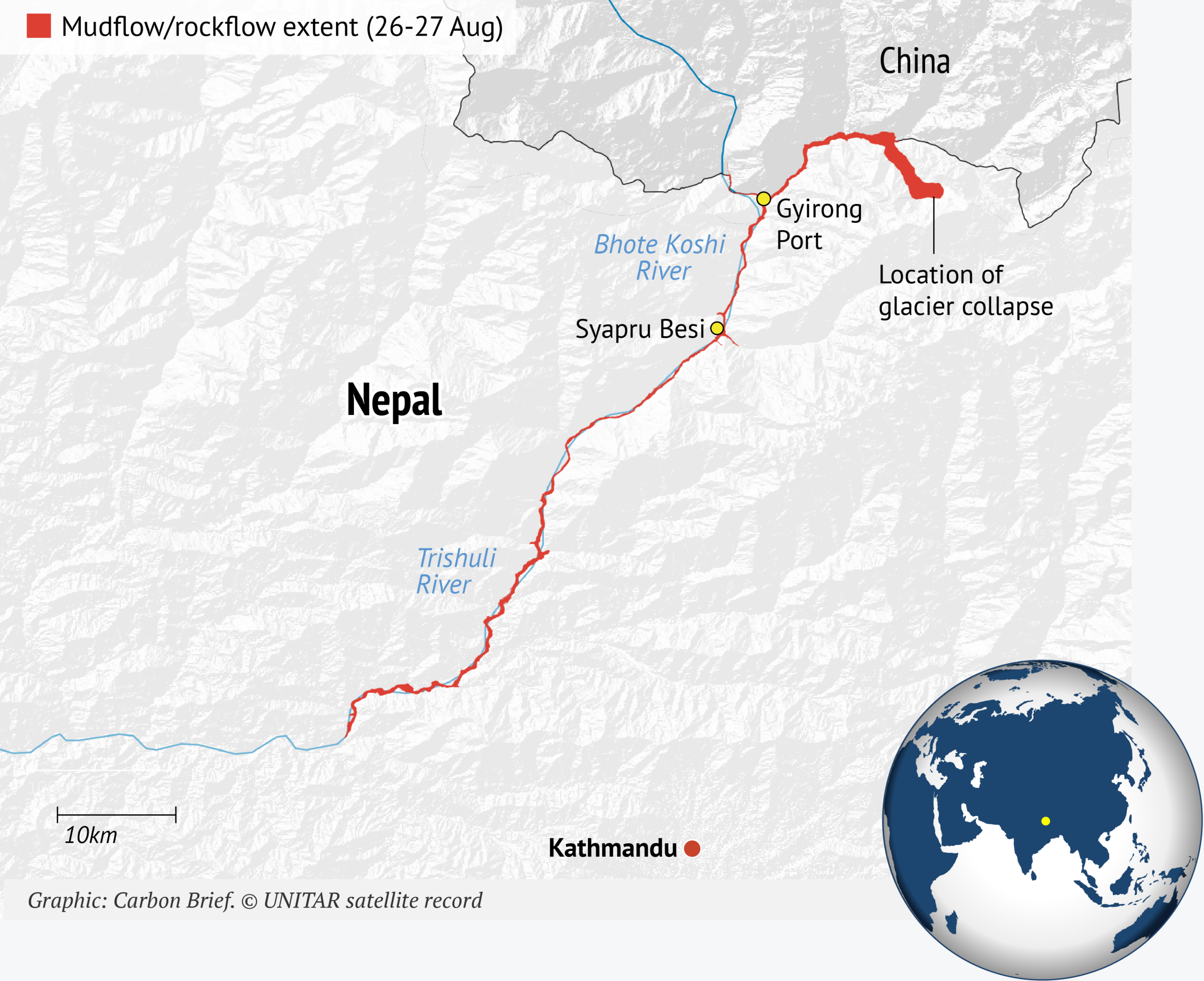
A large “debris” lake was briefly formed on the valley floor. When this lake burst, a wall of water and rock travelled downstream, killing more than a thousand people and destroying settlements, roads, bridges, hydropower plants and border posts across Nepal and Tibet.
HiRisk said that the floodwave travelled down rivers as fast as 30km an hour (around 19 miles per hour) and reached Mugling – a Nepalese town more than 130km downstream – at around 1pm local time.
A separate report from the Center for Land Surface Hazards in the US noted that the flood moved “exceptionally fast, was sediment-laden and extreme in scale”. For example, in the Nepalese municipality of Galchhi, the Trishuli river rose by nine metres in 30 minutes, it said.
Writing in the Conversation, Dr Umesh Haritashya, a glaciologist at the University of Dayton in Ohio, explained that the disaster “wasn’t finished when the first wall of water passed [on 26 August]”.
He continued that a new “barrier lake” – estimated to hold a few million cubic metres of water – had developed in a location where two rivers meet in Tibet before crossing into Nepal. This lake burst on 28 August and the river rose again, he said.
On 4 September, the chief of Nepal’s National Disaster Risk Reduction and Management Authority, told Reuters that property and infrastructure worth “at least” $2.5bn (£1.9bn) had been lost. Dharma Raj Upreti estimated the cost to build roads and temporary shelters, provide drinking water and restore power would be around $53m (£39m).
How did bedrock collapse trigger the flash floods?
In the immediate aftermath of the floods, initial reports suggested that the trigger was a collapsing glacier or earthquake in the high mountains of Nepal.
After confirming that a seismic tremor was as a result of falling rock and ice, the USGS said the trigger was likely a “glacial collapse and debris flow”. This was widely picked up by the media.
Subsequently, satellite imagery revealed that an “enormous chunk of the mountainous bedrock” beneath the glacier had also given way, reported the New York Times.
Dr Kristen Cook, a geomorphologist at the Université Grenoble Alpes in France, told the newspaper:
“The rock that the glacier was sitting on collapsed…It was a much larger collapse than we were initially able to see in the satellite imagery.”
The result was a “deluge of rock and ice, which pulverized into mud and water as it surged down the mountainside”, the newspaper said.
Dr Jakob Steiner a geoscientist at the University of Graz in Austria, tells Carbon Brief:
“It was not a glacier that collapsed. It was the mountain below the glacier that collapsed and the glacier had no other chance but to go with it because it was sitting on top of it.
“The trigger for that is something that we are not 100% certain about, but, in the end, it very much looks like simply a mechanical failure of the rock material because of stressors that have built up over a long period of time.”
Failures of “bedrock” – the hard, solid rock that sits below looser rocks and soil – are an “increasingly common occurrence”, says Prof Bethan Davies, a professor of glaciology at Newcastle University. She tells Carbon Brief:
“These massive landslides occur in mountain regions, commonly following rapid deglacierisation [the melting away of a glacier]. Similar events happened in the Chamoli event in 2021 [in the Indian Himalaya] and in the Blatten landslide last year in Switzerland. They’ve also occurred recently in Alaska.”
With a shift in focus from the failure of a glacier to the bedrock underneath, some climate sceptics seized on the development to falsely claim that climate change had not played any role in the disaster.
These include Dr Matthew Wielicki, recently appointed by the Trump administration to lead the US Global Change Research Program, on Twitter, as well as former Conservative peer and climate-sceptic commentator Matt Ridley in the Spectator.
However, scientists have highlighted the likely contribution of rapid warming in the region. These factors include the thawing of permafrost and glacier retreat. (For more, see sections below).
Fundamentally, “this would have been a much less significant tragedy if it had been just a rock-slope failure”, notes Davies.
The initial landslide took a mixture of rock and ice into a valley that “contains buried ice” as well, she says, providing the water that “resulted in the hyperconcentrated flow, which took so many lives”.
How have temperatures risen in the affected region?
Global temperatures have risen by roughly 1.4C since the pre-industrial period. However, this increase is not uniform across the planet, with some regions warming faster than others.
A study published in Global and Planetary Change in June 2026 investigated changes in the Langtang catchment – a river basin in central Nepal, in which the Langtang-Lirung mountain is located, which eventually drains into the Ganges. Around one-quarter of the area is made up of glaciers.
The paper found that glacial areas of the catchment – found at 4,000 metres above sea level – warmed at 0.31C per decade over 1960-2023. This was “more than three times” the rate observed at a lower elevation weather station, the authors said.
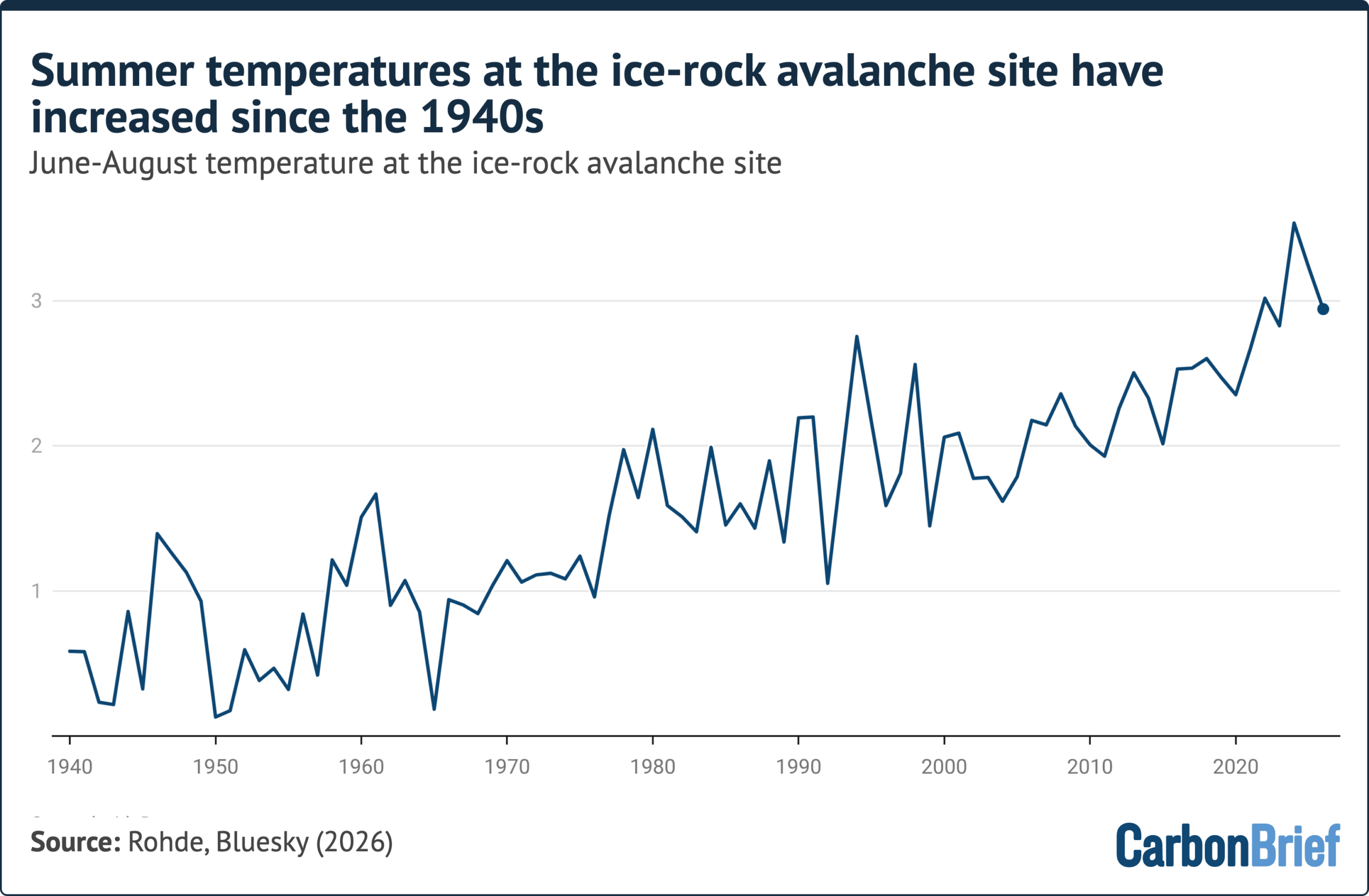
Looking in more detail at the site of the glacial collapse, Dr Robert Rohde, chief scientist for Berkeley Earth, used ERA5 reanalysis data to show how temperature has changed at the 5,200-metre elevation site where the mass of ice and rock broke loose.
Rohde’s analysis found that June-to-August temperatures have been rising at the site of the glacier collapse since the year 1940, with 2026’s summer the fourth warmest on record, behind 2024, 2025 and 2022. This is shown in the graph below.
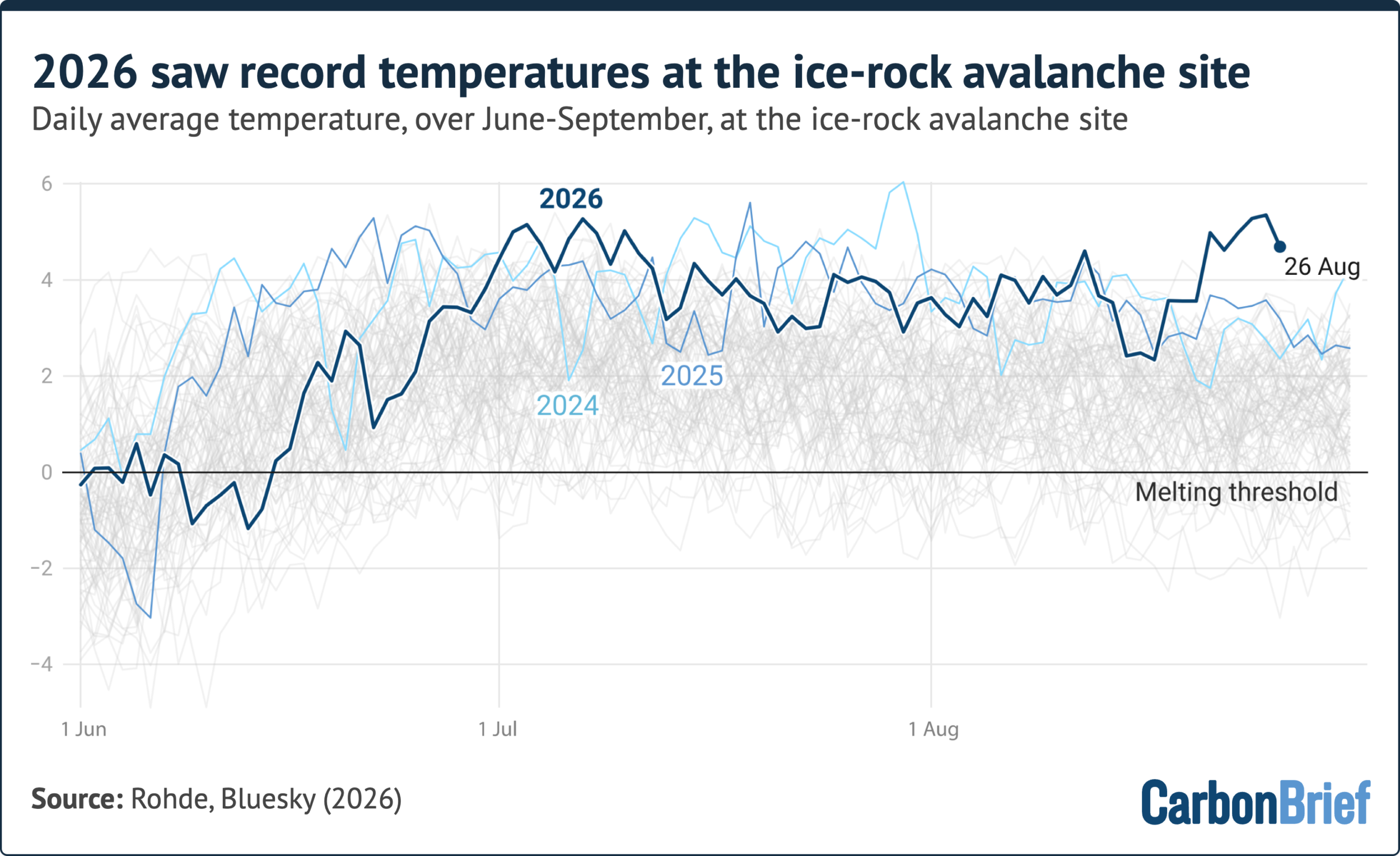
Rohde also found that the days leading up to the disaster recorded the hottest August temperatures ever experienced at the site. This is shown in the graph below.
On social media, Rohde stated:
“Given the warming trend, this Nepali glacier had probably been thinning and weakening for years, or even decades. But it ultimately failed during the warmest week in one of its warmest years on record. It would be a hell of a coincidence if global warming wasn’t at least partially to blame.”
How have rising temperatures affected mountain stability?
Many experts have linked warming temperatures in the region to thawing permafrost – ground that has been frozen for at least two consecutive years, whose thickness ranges from less than one metre to more than a kilometre.
Steiner is part of a research team that has been using sensors to monitor permafrost in the region since 2014. He tells Carbon Brief that it is “pretty clear” the permafrost has been thawing “very actively” at elevations as high as 5,200 metres above sea level “for many years”. He adds:
“This means that the ground has, over the last decades, moved from being in a solid state into – at least, periodically during the warm season – patchy ground where some is frozen and some isn’t…
“If you have frozen ground next to non-frozen ground, you have dynamics happening between that because there are different densities and there’s movement happening, which is conducive to interventional failure – and that we know from many other cases.”
Davies also points to the “degradation” of perennially frozen ground as a factor in the disaster:
“This permafrost acts as a glue to hold together the rocks and, as it melts, the rock can become weakened.”
Permafrost thaw can also result in saturated ground, says Davies, which adds “pressure in the joints” of rock and can “facilitate” failure. She continues:
“Sources of the water include melting permafrost and meltwater from the overlying glacier. We know that this event happened during a period of warmth, but in the absence of heavy precipitation, pointing to ice melt as the source of water.”
A 2025 study of rock and ice avalanches in High Mountain Asia found that more than two-thirds started in areas “where permafrost is probable”.
How have glaciers retreated in the affected region?
Glaciers – frozen rivers of ice holding three-quarters of the global freshwater supply – are extremely vulnerable to climate change.
In the Himalaya, the rate of glacier retreat has doubled since the late 20th century, according to a 2019 study in Science Advances.
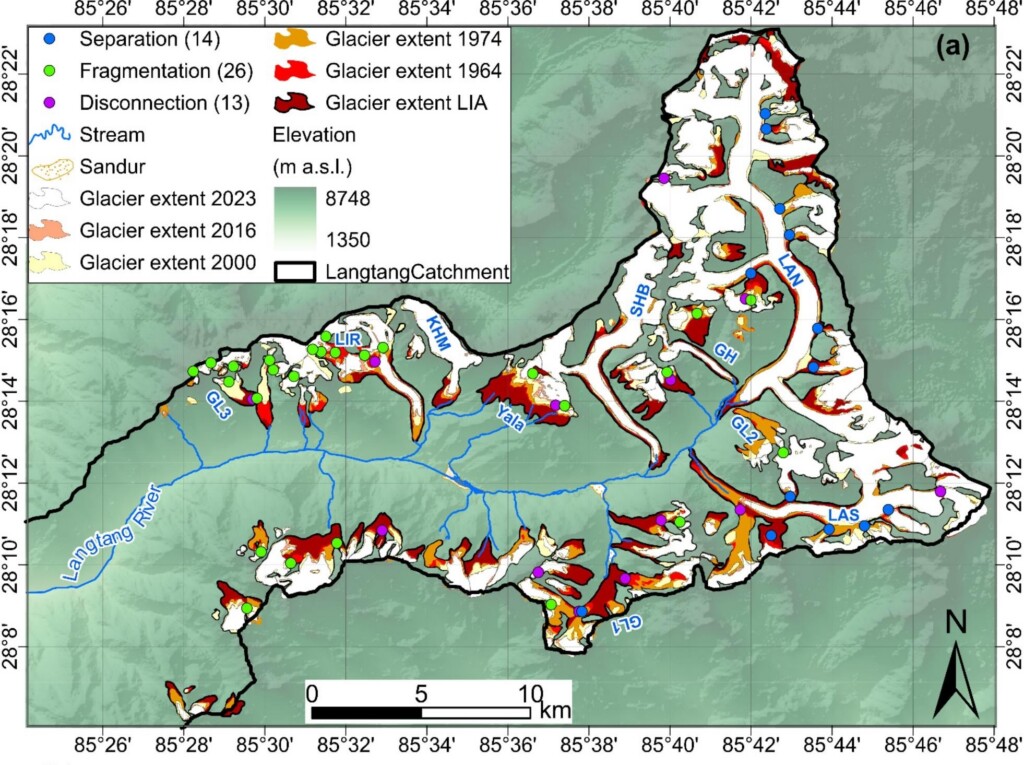
The Global and Planetary Change study found that glacier area loss rates in the Langtang catchment increased more than fourfold from 1964 to 2023 – with melting accelerating after 2000.
It added that glaciers in the region also experienced “fragmentation” and “widespread thinning” over this period.
The study noted that this loss “coincided with elevation dependent warming”.
The figure below provides an overview of glacier loss in the Langtang catchment over 1964-2023, with orange, red and dark red indicating areas of retreat.
In addition, green dots note points of glacier fragmentation, while blue dots show separation and pink show disconnection.
In comments released by the University of Reading, Prof Maria Shahgedanova, a climate scientist researching climate impacts on mountain glaciers, said that the glacier involved in the floods had “retreated by approximately 450 metres between 1990 and 2020”.
She adds that this “potentially reduce[d] the mechanical support provided by the glacier to the underlying rock slope”.
Speaking to Carbon Brief, Davies reiterates that the retreat of the glacier is “potentially a contributing factor” to the bedrock collapse and subsequent disaster.
This is because the removal of the glacier from the lower slopes leaves the “upper rock slopes less stable”, she says.
The most recent assessment by the International Centre for Integrated Mountain Development said that glaciers in the Hindu Kush Himalaya region are “rapidly shrinking” as a result of climate change. (This region extends 3,500km over Afghanistan, Bangladesh, Bhutan, China, India, Myanmar, Nepal and Pakistan.)
It said this loss is threatening the safety of the nearly two billion people, including by increasing the risk of “glacial lake outburst floods” (GLOFs). A GLOF is a sudden and catastrophic release of meltwater from a glacial lake.
Although this disaster was not caused by a GLOF, it is known that climate change is making such events more likely.
Can the event be attributed to climate change?
In the wake of the flash floods, climate campaigners, media outlets and Nepalese politicians have linked them to human-caused climate change.
However, many climate scientists have cautioned that it is too early to say precisely how climate change impacted the disaster.
Davies tells Carbon Brief:
“These events happen so quickly that the exact causes and drivers can take a little time to uncover, especially if the event was a surprise and there had been no monitoring system in place.”
When trying to determine the role human-caused climate change played in the intensity or likelihood of extreme weather, scientists turn to the field of “attribution science”.
To date, no formal rapid attribution study has been produced that attempts to quantify whether – and how – climate change contributed to the event.
Scientists have noted that climate attribution of ice-rock avalanches – which are typically driven by a variety of factors – remains limited, in part because of the lack of a long-term observational record of previous collapses in high mountain areas.
Meanwhile, the studies that do exist stop short of directly linking such disasters to climate change. For example, the authors of a 2021 study into the Chamoli ice-rock avalanche concluded that “we cannot attribute this individual disaster specifically to climate change”.
However, they added, the “possibly increasing frequency of high-mountain slope instabilities can likely be related to observed atmospheric warming and corresponding long-term changes in cryospheric conditions (glaciers and permafrost)”.
In the aftermath of the disaster, many researchers have similarly highlighted that climate change could not be singled out as the cause of the disaster, even if warming likely increased the probability of its occurrence.
On the Climate Brink substack, Carbon Brief’s climate science contributor Dr Zeke Hausfather noted that a “definitive single-event attribution” of the more recent disaster “may never be possible” due to the “messy causality of rock-ice avalanches”.
However, he added that both the existing scientific literature and “essentially every scientist working on these hazards point in the same direction” – namely, that warming is making such events more likely in the Himalaya.
Steiner tells Carbon Brief it might be possible to attribute different factors that played a role in the disasters to climate change – for instance, the recession of the glacier – but it would be more difficult to do so for the event as a whole.
Part of the reason for this, he says, is that rock failures in this region of the Himalaya have occurred for millennia, well before humans started altering the climate.
However, he continues:
“The physics of it is not something that has been made possible by climate change. This could have happened without it. But the chance of it happening – and the likelihood of it happening five years after a previous, similar event [in Chamoli] – we, as the scientific community, can be pretty confident about that [being increased because of a changing climate].
“This is because so many of the changes that we know are related to climate change can potentially drive the build-up to eventual failure.”
Ultimately, says Davies, a “careful attribution study is needed, but it is hard to argue that the rapidly warming climate is not having an effect in these regions”. She adds:
“A single event may have multiple drivers, but we are seeing an increase in these events and are likely to see more as the permafrost and glacier melt continues.”
Related
Explainer: The CMIP7 emissions scenarios – and how they explore future climate change

Climate change exposes 580 million children to 20 extra ‘heat-stress days’ every year
Explainer: How the ‘super El Niño’ will reshape the world’s weather
Analysis: The two largest reservoirs in the US have hit record-low levels
The post Q&A: What can – and cannot – be said about global warming’s role in the 2026 Himalayan floods appeared first on Carbon Brief.
Q&A: What can – and cannot – be said about global warming’s role in the 2026 Himalayan floods
Chinese industry is beginning to shift from fossil fuels to clean electricity, with wind, solar and batteries progressively displacing coal, oil and gas across the industrial sectors that made the country the world’s factory and largest carbon emitter, a new analysis shows.
Clean electricity met all of China’s demand growth in 2025 and coal generation fell for the first time in a decade, even as electricity demand rose by 5%, the report found.
Despite a rebound in coal power generation in the first half of 2026, the analysis by global energy think-tank Ember found the growth in clean electricity illustrates a longer-term shift: a massive build-out of wind, solar energy and battery storage and deepening electrification of the economy are starting to make a dent in the fossil-fuel energy system supporting China’s industrial base.
China keeps Indonesia’s battery dream afloat but future less certain
The research identifies early signs that a structural transformation of China’s industrial economy from coal, oil and gas to clean electricity is underway, even if changes on the ground are not yet reflected in national data.
“The energy foundation of the Chinese industrial economy is shifting,” Muyi Yang, a senior energy analyst at Ember and the report’s lead author, told Climate Home News.
“Fossil fuels are progressively being replaced in the many functions they have historically assumed. Because of that, fossil fuel peaking is increasingly coming into view,” he said.
Electrifying industry
Coal generation has stopped growing in 17 of the 26 provinces and regions analysed by Ember between 2021 and 2025. This includes industrial centres such as Hunan in southern China and Shandong – home to energy-intensive industries like cement production. Together, these regions are home to more than half of China’s thermal power capacity.
A greater share of the Chinese economy is now running on electricity than in other major economies, accounting for 29% of final energy consumption in 2024, compared with about 23% in Europe and 21% in the US. Less than half of China’s electricity was generated from coal in the first half of the year.
-
China’s coal power rebounds as record clean energy goes to waste
Long-term contracts guarantee coal plants buyers regardless of demand, crowding out renewables, report finds -
China’s coal-chemicals boom risks repeating the mistakes of the past
By reviving the problematic industry in the name of energy security, China runs the risk of higher emissions, stranded assets and setting back its ambitions as a clean energy leader -
China’s carbon emissions rise again as more clean power is wasted
The economic powerhouse burned more coal and gas in the first quarter of 2026, despite record wind and solar build-out


Meanwhile, fossil fuel use has fallen in eight of 11 tracked industrial sectors, declining between 26% and 71% from peak consumption levels across fossil fuel extraction, manufacturing industries such as textiles, machinery and food and beverages, transport equipment and chemical materials.
Earlier this year, German company BASF, the world’s largest chemical producer, opened a new facility in southern China, which is fully supplied by renewable energy. The company said emissions from the site could be 50% lower than conventional petrochemical facilities.

In easier-to-electrify sectors such as machinery, electronics and textiles, electricity now supplies about three-quarters of final energy consumption, Ember found.
Fossil fuel use is also showing signs of flattening in the metals smelting and processing sector – one of the most fossil-intensive parts of the economy – offering “encouraging signs” that the transformation is starting to take hold in harder-to-abate sectors, said Yang.
“If that is happening in more and more provinces, and more and more economic sectors that means that fossil fuels are progressively being squeezed out of the energy system,” he said.
“Growing by greening”
China’s vast cleantech manufacturing power has become an engine for growth in its own right, spurring investment, creating jobs and generating export revenues.
Yang described this “growing-by-greening” dynamic as “turning each step of the transition into a source of strength for the next”.
China and Brazil join pledge to triple global nuclear energy capacity
For Li Shuo, director of China Climate Hub at the Asia Society Policy Institute, this is part of what makes China’s lead in manufacturing clean energy equipment “irreversible”, comparing its growth with that of a rainforest, where different parts of the ecosystem thrive by reinforcing one another.
The early success of deploying wind and solar helped drive down electricity costs, which created favourable conditions for the rapid adoption of electric vehicles (EVs) and in turn boosted demand for batteries that are now critical to balance the grid.

An oversupply of renewable energy incentivised industrial players to benefit from cheap and readily available clean power generation, encouraging innovative solutions to electrify other parts of the economy. In the transport sector, for example, electrification is moving from passenger vehicles to harder-to-electrify trucks.
This abundance of cheap green energy is also making China competitive in what has long been seen as the anchor of Western competitiveness, Li said.
Stalling fossil fuel use
At the same time, China’s huge legacy fossil fuel generation capacity is still expanding, even as coal power plants are being used less intensively.
China brought 30 GW of new coal power capacity into operation in the first six months of the year and coal-fired generation rose 3% over the same period after local governments fast-tracked coal projects to prevent a repeat of severe power shortages in 2021.
Solar surge kept fossil electricity flat in 2025 as China and India made ‘historic’ shift
A further 274 GW of coal capacity is either under construction or has permits to be built while vast amounts of solar and wind power that could not be absorbed by the grid have gone to waste in the first half of the year.
“This doesn’t mean that the transition is losing steam,” said Yang, arguing that China is now grappling with some of the more complex aspects of the transition.
A recent analysis by the Centre for Research on Energy and Clean Air (CREA) for Carbon Brief found that China’s CO2 emissions from fossil fuels and cement have plateaued for more than two years following a peak in March 2024. Ember found that on a 12-month moving average, coal generation has been stalling since then, following years of continuous expansion.
-
EU, UK lead push for electrification as “powerful weapon” against fossil fuels
A group of dozens of countries seeks to build momentum for a COP31 pledge to electrify 35% of global energy use by 2035 as an alternative to fossil fuels -
COP31 leaders unveil global targets, with spotlight on electrification
Co-hosts Türkiye and Australia want countries to sign on to global targets in three of their priority areas for this year’s COP climate negotiations -
Africa can lead the Age of Electrification
The electrification agenda presents both an extraordinary opportunity for Africa and an immense challenge for the continent


In the second quarter of the year, CO2 emissions fell by 1% after China’s oil consumption plummeted 9% as the US-Iran war prevented the transport of oil cargoes from the Gulf through the Strait of Hormuz.
The electrification of the transport sector, particularly electric trucks, was the biggest driver in displacing oil demand as the conflict in the Middle East accelerated the transition.
A lesson in sequencing
China’s bumpy transition offers a useful lesson for other countries at an earlier stage of their transition, said Xunpeng Shi, president of the Sydney-based International Society of Energy Transition Studies (ISETS), a global network of professionals that shares research and fosters collaborations.
“Build quickly enough so that clean electricity can start taking over and prepare for the pressure on the fossil system before it arrives, because that is the part nobody has done easily,” he said.
For countries that are heavily reliant on revenue from fossil fuel exports, a peak in Chinese fossil fuel use weakens the assumption of rising demand on which investments have long been made.
“For them, the time to plan for that is now, while the revenues are still there,” he said.
The post China’s industrial engine starts to break its fossil fuel habit appeared first on Climate Home News.
China’s industrial engine starts to break its fossil fuel habit
Carbon credit developers, corporate buyers and some leading conservation NGOs are challenging new proposed rules to stop UN carbon credits being wiped out by fire, drought or logging, in what critics have called a “coordinated lobbying campaign” to weaken the nascent market’s push for greater integrity.
According to documents seen by Climate Home News – including a briefing given to government officials – companies, NGOs and the UN Environment Programme (UNEP) have contested the scientific basis for the move, arguing that stronger protection for carbon reductions could hike project costs and restrict the supply of credits to the market.
The climate benefit of credits that claim to reduce or avoid greenhouse gas emissions by storing carbon is undone if that carbon is released back into the atmosphere – something known as reversal risk. To protect against such losses and preserve the credibility of the credits’ carbon-offsetting claims, projects are generally required to set aside a reserve of credits that cannot be sold, as a form of insurance.
How these “buffer pools” are calculated has long been a source of contention, especially in forest conservation projects, which many experts say have historically underestimated the risk of carbon losses.
In July, the technical UN panel tasked with drafting rules for the Article 6.4 mechanism, which underpins the credits that countries and companies can use to meet their climate goals, proposed a new system. It would require project developers to size these insurance pools of credits based on local risk values derived from new research published by a group of independent scientists.
UK’s budget juggling trick with rainforest loan for bus-fare cap needs transparency
Its supporters have hailed it as a more rigorous approach than current practice in the voluntary carbon market, which largely relies on expert guesswork and, in some cases, gives significant leeway for project developers to come up with their own data.
“The decision on the reversal risk assessment tool will be crucial,” said Federica Dossi, an expert at Brussels-based advocacy group Carbon Market Watch. “It would bring a new paradigm for calculating the number of units forwarded to the buffer pool based on empirical data.”
The technical panel is due to discuss the reversal risk tool and its application to a specific set of projects at a five-day meeting in Bonn this week. It is then expected to forward new recommendations to the mechanism’s regulator, the Supervisory Body, for a decision on whether to approve them at a meeting in early October.
The rules are set to be applied initially only to clean cookstove projects, one of the market’s most popular and heavily criticised credit types. They could then be extended to other activities, including programmes to protect forests.
Copy and paste?
More than 30 organisations aired their views in lengthy public submissions to the Article 6.4 mechanism, responding to a call from the UN secretariat for external feedback.
A Climate Home News review of those submissions found that there was significant overlap in their messages and, in several cases, sections of the text, or even entire submissions, were copied and pasted by different organisations. This points to a coordinated effort to flag concerns regarding the new rules.
In one instance, tech giant Apple, a large buyer of nature-based carbon credits, warned against relying on one scientific model and called for rules that let project developers use a variety of risk mitigation tools, rather than surrendering buffer credits, to cover the risk of carbon losses.
Apple’s submission is a lightly-edited version of a separate input presented by the Beyond Alliance, a coalition of corporate buyers and NGOs that promote market-based climate investments. In an apparent oversight in one paragraph, the Beyond Alliance’s name appears in Apple’s submission instead of the tech giant’s.
-
Most “zombie credits” locked out of new UN carbon market after China and India snub
Fears of a flood of environmentally-dubious carbon credits have faded, with most old projects not able to transition to new UN market -
UN’s first Paris Agreement carbon credits face human rights and climate concerns
Civil society groups allege the cookstove project in Myanmar exaggerated its climate impact while maintaining ties with military junta


The Beyond Alliance told Climate Home News that, after receiving input from its members, it shared its final submission, leaving them to decide if and how they wanted to use it. The coalition rejected any characterisation that its submission advocates for a weaker tool and only reflects business concerns.
The Beyond Alliance added that its members received briefings by UNEP, which Climate Home News understands has played an important role in wider efforts to influence the development of the rules underpinning the UN carbon market.
Three experts and a European Union diplomat told Climate Home News that the interventions of the UN agency overwhelmingly supported the views of those with a financial interest in carbon markets.
UNEP’s head of mitigation Gabriel Labbate rejected this accusation. He told Climate Home News that the UN agency contributes technical inputs from a “politically-neutral, science-based perspective” and its positions are grounded in an assessment of environmental integrity and are not shaped by, or aligned with, the financial interests of any market participant.
UNEP, NGOs criticise scientific basis
In mid-July, representatives from UNEP, Conservation International and The Nature Conservancy (TNC) briefed government officials from Canada, the UK, Germany, Costa Rica, Belgium, Nigeria and Peru, according to a webinar readout seen by Climate Home News.
The online event was organised by the Forest & Climate Leaders Partnership (FCLP), an initiative that brings together 41 countries plus the EU.
The speakers voiced strong criticism of the new proposed rules. A technical advisor to Conservation International, a US-based NGO that runs several large-scale carbon offsetting programmes, told participants the Article 6 panel’s approach was “based on bad science”. This, he said, is because it relies on a single model that he claimed is not appropriate to determine buffer pool contributions, according to a presentation seen by Climate Home News.
During a high-level discussion led by UNEP’s Labbate, speakers said the application of measures to manage reversal risk on cookstove projects could “impose disproportionate costs and undermine the financial viability of these activities”, according to the readout.

Cookstove programmes issue credits by calculating the greenhouse gas emissions prevented by burning less fuel – usually wood or charcoal – through the use of more efficient stoves. With the new reversal risk tool, these activities would be expected to guard against future carbon losses for the first time under the UN carbon market.
But UNEP, as well as leading NGOs and carbon credit firms, have pushed back against the requirement, arguing this type of credit represents a “flow” of avoided emissions rather than a “stock” of stored carbon that can be released. Scientists reject that distinction, noting that the wood left unburned is still standing in a forest exposed to the same risks as any other.
At the online briefing, speakers also raised concerns that the tighter approach would be replicated for nature-based carbon projects with a direct impact on the future of large-scale forest conservation credits. The Conservation International advisor called it a “bad precedent”.
Both Conservation International and TNC run carbon credit programmes that aim to protect trees from being cut down. Labbate leads the UN-REDD programme, which supports countries developing forest protection initiatives including through carbon credits, and is co-chair of the expert panel advising the Integrity Council for the Voluntary Carbon Market (ICVCM).
After the webinar, the organisers shared by email a series of “key messages” and draft submissions produced by the three organisations, which participants were invited to consider and adapt in their own inputs to the Article 6.4 consultation process.
Getting the rules ‘right’
In a statement to Climate Home News, Ghana, Paraguay and the UK – which are FCLP co-leads for its work on forest carbon credits – said members of the coalition welcomed expert views from a range of partners to help them understand the potential impact of Article 6.4 rules on the eligibility of forest carbon credits in international markets.
They added that the FCLP does not have a common position on the rules and its members are free to choose whether to attend webinars and use any of the materials circulated.
In a statement to Climate Home News, Conservation International said “getting these rules right is important to the environmental integrity of the carbon market, while ensuring all sectors have a place in it”. It added that the NGO does not dispute the validity of the scientific research underlying the proposed buffer pool, but recommends a broader approach including multiple models and datasets.
A spokesperson for TNC said the organisation had helped clarify complex materials and their potential implications, while decisions on how to respond remained entirely with participating countries.
‘Inconvenient science’
The scientific basis for the disputed reversal risk tool rests on two pieces of research. A peer-reviewed study, published in Nature in May and led by scientists at several US universities, modelled forest carbon-loss risk across the United States and found existing buffer pools there are undersized by an average factor of six.
To extend that approach worldwide, the Article 6.4 panel also drew on a second, global analysis by the same research team, which has not yet completed peer review. That study used satellite images, weather records and computer modelling to estimate a 31-42% chance of forests worldwide losing stored carbon within 100 years, depending on the scenario.
The panel picked one of these scenarios and turned its estimates into fixed risk percentages for individual countries, and in some cases provinces, which projects in those locations would need to apply.
Palestine: Israel’s bombing has left Gaza vulnerable to climate change
Critics say the peer-reviewed portion of the research was calibrated on North American forests, and that applying the same approach to other regions relies on a global study that is still going through academic checks.
But, for William Anderegg, professor of biological sciences at the University of Utah and one of the authors of that research, it is the best science currently available. He described it as “light-years better” than assumptions underlying the voluntary carbon market, where risk numbers are not generally based on independent evidence and tend to be incredibly low.
Scientific research, including by Anderegg, has found that buffer pools in forestry projects in the voluntary carbon market are substantially smaller than they should be to adequately protect against future releases of carbon.
“There really seems to be a fairly coordinated campaign to try to weaken the strength of these [Article 6.4] tools and their scientific underpinning,” he told Climate Home News. “It’s a little dispiriting to see folks attack science that’s inconvenient.”
Regulators under pressure?
An EU diplomat told Climate Home News that experts and negotiators working on the Article 6.4 mechanism have faced intense pressure from big carbon credit developers and large parts of the nature-based solutions community.
“It is very clear that they are lobbying against strong rules, and they want to align the Paris Agreement mechanism with the standards of the voluntary carbon market,” the diplomat said. “They have influence, time and money, even more than some governments, so they can be very effective in their efforts.”
Last year, the Article 6.4 Supervisory Body, the new market’s regulator, approved rules on the permanence of credits aiming to remove carbon from the atmosphere which critics said were watered down compared to the technical panel’s recommendations. This followed feedback from carbon market firms and conservation NGOs, which submitted dozens of critical views.
EU carbon credits could supercharge world’s clean cooking push, France says
Carbon Market Watch’s Dossi said decisions that strengthen environmental integrity are targeted in particular as they tend to reduce the number of credits that can be issued.
Then, as now, those who opposed tighter rules argued that overly strict safeguards would make some projects too expensive to carry out, with a negative impact on local communities and the climate.
But proponents argue that higher-integrity programmes will drive up market prices, ultimately benefiting everyone.
“If rules ensuring better-quality credits make them somewhat more expensive than they are today, that’s an acceptable consequence, not a reason to weaken the rules, especially since these credits will be used to offset continued emissions,” said Dossi.
Efforts to pull the rule-makers in different directions are expected to intensify in the coming weeks as a decision on the new credit protection system nears.
“I really don’t know how this will turn out in the end,” one veteran carbon market expert said. “What I am sure about is that it will be quite a battle.”
The post Industry and NGOs lobby to weaken UN carbon credit rules in “coordinated” push appeared first on Climate Home News.
Industry and NGOs lobby to weaken UN carbon credit rules in “coordinated” push



-
Climate Change1 year ago
Guest post: Why China is still building new coal – and when it might stop
-

 Greenhouse Gases2 years ago
嘉宾来稿:满足中国增长的用电需求 光伏加储能“比新建煤电更实惠”
-
Greenhouse Gases1 year ago
Guest post: Why China is still building new coal – and when it might stop
-

 Climate Change2 years ago
嘉宾来稿:满足中国增长的用电需求 光伏加储能“比新建煤电更实惠”
-

 Renewable Energy11 months ago
Sending Progressive Philanthropist George Soros to Prison?
-
Climate Change2 years ago
Bill Discounting Climate Change in Florida’s Energy Policy Awaits DeSantis’ Approval
-
Greenhouse Gases1 year ago
嘉宾来稿:探究火山喷发如何影响气候预测
-

 Carbon Footprint2 years ago
US SEC’s Climate Disclosure Rules Spur Renewed Interest in Carbon Credits