

Dancliff Mbura is the advocacy and communications manager at Action Against Hunger Kenya. He works to influence policy and resource allocation and is an expert on multisectoral nutrition interventions.
Just four years since the last devastating drought, when five consecutive rainy seasons failed, 3.3 million people in Kenya’s arid and semi-arid counties are facing acute hunger as yet another drought crisis deepens. It is visible everywhere – in the parched riverbeds, weakened animals, and the children, who are too quiet.
Six months ago, the number of people facing acute hunger was 1.8 million. If nothing changes, by August, it will climb to 3.7 million, underscoring the need for urgent aid.
We know the answers. Cash transfers allow families to purchase food in markets that are still functioning. Mobile health and nutrition outreach teams must meet communities where they are, not where facilities happen to be located, which could make them inaccessible. Emergency water provision is essential.
But the resources are not there to address the growing needs. A coalition of humanitarian organisations working across Kenya’s drought-hit regions with the government has estimated the drought response would cost more than 30 billion Kenyan shillings ($232 million). Kenya’s government has released just 6 billion shillings so far.
Reducing the damage
Beyond the immediate response, however, we need to invest in systems that reduce the damage of future drought cycles in this climate-vulnerable region.
Kenya has systems that support the generation of early-warning systems, such as the National Drought Management Authority’s monthly county and national early-warning bulletins with detailed early-warning data. What we need is a means to ensure that information reaches communities in time for them to act on it and make sure they have the resources they need to do that.
One approach could be the establishment of village-level climate change and disaster hubs. These hubs would provide communities with simplified, actionable information, sometimes via dashboards on weather patterns and forecasts, and support them in generating locally relevant, cost-effective early actions.
By engaging communities in this process, the government and development partners can complement these efforts with additional resources where needed. This approach fosters community ownership while simultaneously enhancing resilience to climate-related risks.
-
Uganda cites contentious IEA fossil fuel scenario backed by Trump administration
Critics of the African nation’s oil ambitions say referencing the International Energy Agency’s most pessimistic scenario for climate action is a risky policy -
Earth blocks keep homes cool while cutting emissions in Kenya’s drylands
In an ever-warming climate, compressed earth blocks technology is helping communities stay cooler in hot highland regions of Kenya -
Southern Africa drought flags dilemma for loss and damage fund
Scientists blame the current drought on El Niño – which could exclude those affected from receiving aid for climate-change damage


With better technology, including AI-assisted climate modeling, we can generate precise early-warning information. When shared in a timely manner with communities and accompanied by support for early or anticipatory actions, this can help build resilience to frequent droughts and other crises.
For example, with access to early-warning information, vulnerable communities could store water ahead of droughts, switch to short-maturity crops when reduced rainfall is forecast, and move livestock and food stocks to higher ground before floods hit. They could also apply preventative treatments to protect crops and animals from pest or disease outbreaks, and make smarter market decisions, such as selling livestock early before prices drop, to safeguard their income.
Different in scale
I have spent 15 years working on humanitarian response in Kenya. I have seen drought cycles come and go. But what is happening right now across our arid and semi-arid lands – the ASAL counties that cover nearly 80% of the country – is different in scale and in the depth of suffering it is causing.
The October-December 2025 short rains delivered only 30 to 60% of the long-term average, making it one of the driest seasons since 1981. In some areas, rainfall failed almost entirely. More than 90% of open water sources have dried up in most parts of ASAL counties. Families are walking up to 20 km (12 miles) or more just to find water.

Now, as we approach Kenya’s more reliable rainy season from March to May, projections are well below average across the hardest-hit northern counties, and we may be heading into a fourth consecutive poor season. For communities who have already exhausted every coping mechanism they have, another failed season could be catastrophic.
More than 810,000 children between the ages of six months and five years are acutely malnourished. Nearly 117,000 pregnant and breastfeeding mothers are also acutely malnourished. The cycle of nutrition that healthy communities depend on is breaking down.
And yet approximately half of severe acute malnutrition cases are going untreated. Only 24% of the nutrition and health outreach sites mapped across the arid and semi-arid counties are currently functioning.
Impossible choices
The economic devastation compounds everything. Livestock is the backbone of life in these pastoral lands. But in Marsabit county alone, more than 50,000 sheep and goats have died. Mandera has lost nearly 30,000 animals. Milk production has plummeted by 55%. As animals grow weaker, families receive less and less when they sell them. Livelihoods are collapsing in slow motion, and families are running out of options.
That can lead to desperate decisions: more daughters are married off early in exchange for dowry like livestock, a practice that rises sharply in times of crisis. Girls are subjected to female genital mutilation so they can be considered ready for marriage. Children drop out of school as families are forced to move in search of better land.
Every week that passes without a scaled-up response is a week in which children go hungry, animals die, and families make impossible choices. We are at a point where, if we do not act, lives will be lost – preventably.
Not because we lacked the knowledge, not because we lacked the warning, but because we were not able to move fast enough.
The post We must invest in early-warning systems to tackle crises like Kenya’s drought appeared first on Climate Home News.
https://www.climatechangenews.com/2026/03/10/we-must-invest-in-early-warning-systems-to-tackle-crises-like-kenyas-drought/

The conference is one of the largest aimed at preparing for hurricane season, which begins June 1. A task force report on potential reforms to the agency also remains on hold.
ORLANDO, Fla.—A major conference to help communities prepare for hurricane season kicked off Monday without the agency that coordinates federal disaster response.
Right now, Greenpeace activists are standing up to Big Gas at a major gas conference in Sydney.
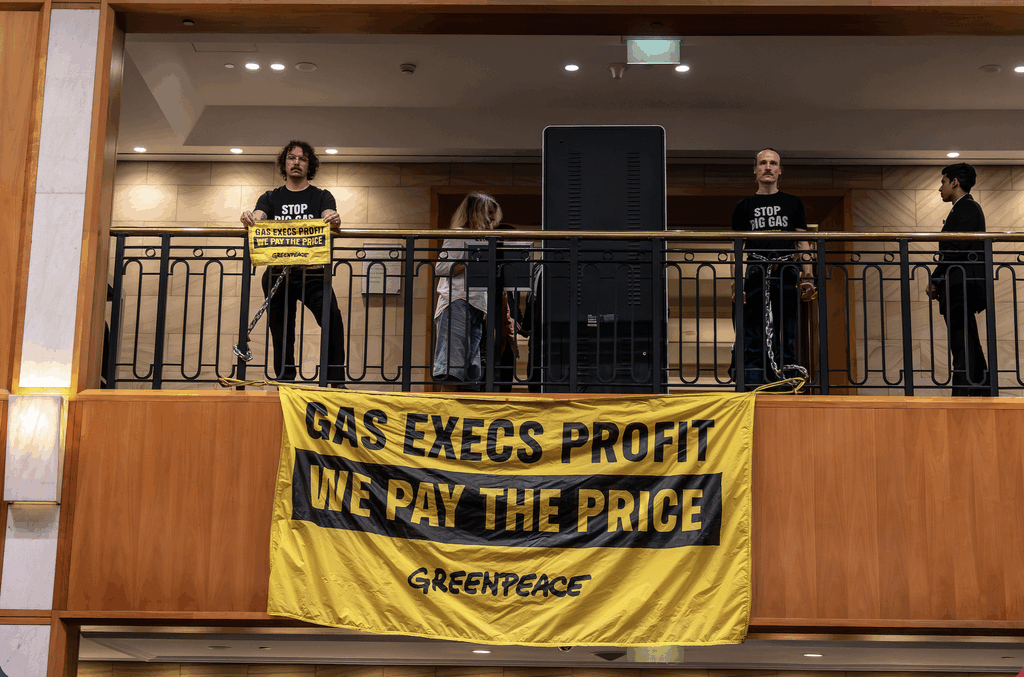
Inside the Sheraton Grand Hotel, executives from fossil fuel companies have gathered alongside lobbyists, investors and political allies to plan the future of gas in Australia – and how to maximise their profits.
So Greenpeace has stepped in to call it out. Activists have dropped a banner inside the venue with a clear message: Gas Execs Profit. We Pay The Price.
We need your help to spread the message that we won’t stand by and let this happen.
What’s really going on
Gas corporations are making billions in windfall profits from global conflicts – from Ukraine to Iran – while Australians pay the price with higher energy bills and climate damage.
And they want more.
More drilling. More exports. More profit.
Why Greenpeace took action today
This conference is where it all comes together. Behind closed doors, gas executives, lobbyists, investors and political allies are meeting to push for more gas expansion, no doubt using global instability as their justification.
That’s why Greenpeace couldn’t let this gathering go uninterrupted.
Big Gas is counting on people not paying attention. Let’s prove them wrong.
Share the video to call out Big Gas.
What needs to happen now
Gas is expensive. It’s volatile. And it ties our energy system to global instability.
But there is a better way. Renewable energy is already cheaper, more reliable, and made right here in Australia. It’s the fastest path to lower bills, real energy security and a safer climate.
To get there, we need to:
- properly tax the gas industry and its exports
- stop expanding gas
- and speed up the transition to homegrown renewable energy.
Share this video far and wide to show just how much support there is to tax Big Gas properly and speed up the transition to renewable energy.
This is just the beginning
This action is part of a growing movement to stand up to Big Gas and challenge the power it holds over our government and society. The Federal Government has a role to play – starting by taxing gas corporations properly and then accelerating the transition to homegrown renewable energy.
Together, we can show just how much support there is for change and make it impossible for decision-makers to ignore.
What you can do
- Follow along on our social channels.
- Share the video far and wide to show how much support there is.
- Sign the petition to tell Albo to stand up to Big Gas – because if we can, he can.
BREAKING: Greenpeace activists disrupt major gas conference in Sydney
SYDNEY, Tuesday 31 March 2026 — Two Greenpeace Australia Pacific activists have been arrested following a peaceful protest at the Australian Domestic Gas Outlook conference in Sydney, where they dropped a banner that said — “Gas Execs Profit. We Pay The Price” and held banners saying “Tax Gas Profits”.
Photos and B Roll video of the protest and arrests are available here
Live updates on Greenpeace Instagram
The two activists were arrested by police around 9:00am AEDT and taken to Day Street Police Station. Information on this morning’s gas conference disruption can be found here.
Solaye Snider, Campaigner at Greenpeace Australia Pacific, said: “Greenpeace activists have taken a strong stand today against profit hungry gas corporations and lobbyists, who see horrific global wars as an opportunity to price gouge and profiteer, while everyday people pay the price.
“Australians have had enough of gas corporations like Santos and ConocoPhillips ripping us off, leaving us with nothing but empty pockets and climate damage. The gas industry is aggressively lobbying against being fairly taxed and pushing to drill for more gas. Change requires showing up and speaking out, and that’s what these activists have done today.
“Greenpeace Australia Pacific stands by our activists, and stands with all communities who are peacefully fighting for a safe and clean energy future. The right to peaceful protest is a fundamental pillar of a healthy democracy and a basic right of all Australians.”
-ENDS-
Media contacts:
Lucy Keller: +61 491 135 308 or lkeller@greenpeace.org or Kate O’Callaghan: +61 406 231 892 or kate.ocallaghan@greenpeace.org
Greenpeace activists arrested after disrupting major gas conference in Sydney



-
Climate Change8 months ago
Guest post: Why China is still building new coal – and when it might stop
-
Greenhouse Gases8 months ago
Guest post: Why China is still building new coal – and when it might stop
-

 Greenhouse Gases2 years ago
嘉宾来稿:满足中国增长的用电需求 光伏加储能“比新建煤电更实惠”
-
Climate Change2 years ago
Bill Discounting Climate Change in Florida’s Energy Policy Awaits DeSantis’ Approval
-

 Climate Change2 years ago
嘉宾来稿:满足中国增长的用电需求 光伏加储能“比新建煤电更实惠”
-
Climate Change Videos2 years ago
The toxic gas flares fuelling Nigeria’s climate change – BBC News
-

 Renewable Energy5 months ago
Sending Progressive Philanthropist George Soros to Prison?
-

 Carbon Footprint2 years ago
US SEC’s Climate Disclosure Rules Spur Renewed Interest in Carbon Credits