

Wealthy nations in the G7 have agreed to work more closely together to secure the minerals they need for the energy transition, AI and defence, and to diversify supply chains away from China, calling for more cooperation with “like-minded partners”.
But the agreement adopted at this week’s G7 leaders’ summit in France is vague on what co-operation with resource-rich developing countries could look like, with critics warning against creating a consumer club of powerful nations that excludes others from shaping standards and building green supply chains.
“The G7 communiqué reaffirms our suspicion that, for the G7, it is all about resource security, not just energy transition,” Claude Kabemba, executive director of Southern Africa Resource Watch, told Climate Home News.
-
After another battery startup bankruptcy, can Europe ever cut reliance on China?
Norway’s Morrow Batteries set out to challenge Chinese producers, but a cash crunch forced it to file for bankruptcy in a setback for European ambitions for clean energy sovereignty -
The scramble to stockpile critical minerals could drive up energy transition costs
Researchers warn that uncoordinated stockpiling could push up prices of minerals needed for clean energy technologies and delay their roll out -
Brazil jostles for rare earths share as US-China rivalry heats up
With the world’s second-largest reserves of rare earths after China, Brazil is catching the eye of US and Chinese companies – spurring the government’s critical minerals policy push


In a joint communique, the leaders of some of the world’s largest economies said they would step up coordination within the group and with partner countries to establish mineral processing and industrial capacity, support local value addition, promote innovation, develop standards, improve mineral traceability and share information on stockpiling systems.
They agreed to create a joint crisis-prevention mechanism with the support of the International Energy Agency to monitor mineral supply and demand disruptions, as well as establish harmonised platforms to provide information about the origin of minerals, starting with lithium and nickel.
The statement was endorsed by France, the UK, Canada, Germany, Italy, Japan, the US and the European Union at the end of the three-day summit in Evian, on the French shores of Lake Geneva. Australia, which isn’t a G7 member, also supported the declaration.
Breaking dependency on China
Western governments have been scrambling to secure the minerals they need to produce clean energy technologies such as batteries, electric vehicles and wind turbines, as well as hardware for artificial intelligence and military equipment while breaking their dependence on China.
China controls most supply chains for the strategic minerals they need, dominating the processing of 19 out of 20 critical minerals. The only exception is nickel, where Indonesia leads on supply and processing. Last year, Beijing spooked governments in Europe and the US when it imposed restrictions on rare earths exports, signalling its willingness to use its industrial clout to achieve its geopolitical objectives.
“We are all faced with risks of over-dependence and therefore vulnerability in our value chains,” French President Emmanuel Macron told a press conference, citing the “risks of divisions” among the group on how to respond to China’s control over strategic resources. “We have decided to move forward together,” he said.
Leaders agreed to aggregate demand to support the development of minerals projects and set targets for reducing dependencies on any single country outside the G7 by the end of the year.
A US proposal to regulate mineral prices and a French push to establish a permanent secretariat to track G7 initiatives on minerals failed to reach consensus among the group, according to Reuters.
Who has a seat at the table?
The declaration recognises the need for “mutually beneficial partnerships” and “plurilateral trade agreements” between G7 countries and “like-minded” and “trusted” partners to build diversified supply chains. Other parts of the text refer to “developing countries” and “emerging economies”.
A separate G7 statement on “mutually beneficial international partnerships” mentions the need for international cooperation along the whole of mineral supply chains.
“Who is going to be part of this conversation is unclear,” said Sébastien Treyer, executive director of France think-tank IDDRI, citing the ambiguity of the language and calling for developing countries to be part of the conversation.
Trade agreements that support green industrialisation can be “an entry point” for investment into value-addition projects in developing countries, said Treyer, but “how this is going to be operationalised is the key question”.
Moving beyond a ‘consumer club’
Resource-rich developing countries, particularly in Africa, have called for investment to build their industrial capacity to turn raw materials into high-value components for clean energy technologies such as batteries, capturing more domestic value and creating jobs.
But Kabemba, whose organisation is based in South Africa, said the declaration says “nothing about transferring industrial capacity to previously exploited regions such Africa”.
“Africa needs to react with its own coalition of the willing to put Africa’s interests first, otherwise, Africa risks being locked into a role as a raw material supplier in a new economic order it is not helping to build,” he said.
-
Kenya seeks regional coordination to build African mineral value chains
Kenyan President William Ruto is the latest African leader to announce an end to raw mineral exports as governments want to add more value to their resources -
Recycling could meet half of Europe’s critical mineral needs by 2050
A new report by an EU-funded research project says the bloc could harness its “urban mines” to reduce its dependence on China for energy transition minerals -
Ukraine can help Europe meet its battery material needs, experts say
The country could contribute to the European Union’s efforts to reduce its dependence on China for graphite but the war poses major challenges


Patrick Schröder, a resource governance expert at Chatham House, agreed that the G7 remains overwhelmingly focused on securing minerals supplies and reducing its dependence on China. “The benefits for developing country producers are only marginal in the G7 discussions,” he said.
Brazil, which is rich in rare earths, graphite and copper, was invited to attend the G7 meeting but did not endorse the minerals declaration – highlighting the need for future minerals framework to be more inclusive and responsive to producer-country concerns, said Schröder.
For Luc Tezenas, head of policy and advocacy at the Resource Justice Network, “the answer to rising geopolitical fragmentation cannot be to shrink multilateralism into a smaller club of ‘like-minded’ consumer economies”.
Instead, a non-binding minerals framework put forward by South Africa during its presidency of the G20 last year “shows more promise as a pathway forward because it attempts to link supply resilience with regional value chains and economic justice,” he said. The UK, which is presiding over the G20 next year, has the opportunity to build a more inclusive way forward, he added.
Circularity: another way to capture value
G7 nations also described the circular economy and the substitution of minerals in designing technologies as “key” to meet growing demand and secure sufficient supplies.
This, they said, includes increasing recycling capacity by setting targets, combatting the illegal transfer of used products and components, and promoting the recovery of minerals from secondary sources such as mining waste.
“We also recognise the opportunity for emerging market and developing economies to benefit from capturing added value through the recycling and secondary processing of their mining waste, as well as from circular economy innovations,” they said.
Schröder, of Chatham House, said the challenge now lies in demonstrating that intentions can be turned into creating a circular economy for minerals through investments, business support and a favourable policy environment.
The post Warning against ‘consumer club’ as G7 forms critical minerals alliance appeared first on Climate Home News.
Warning against ‘consumer club’ as G7 forms critical minerals alliance

For the first time, new-energy vehicles (NEVs) made up 67% of new car sales in China in September, according to the latest data from the China Passenger Car Association (CPCA).
The figures show that NEVs, which include battery electric cars and plug-in hybrids, captured a record share of sales, even though fewer were sold than last year.
This is because sales of combustion-engine cars are falling steeply, a trend that the CPCA has attributed to rising petrol prices following the start of the Hormuz crisis.
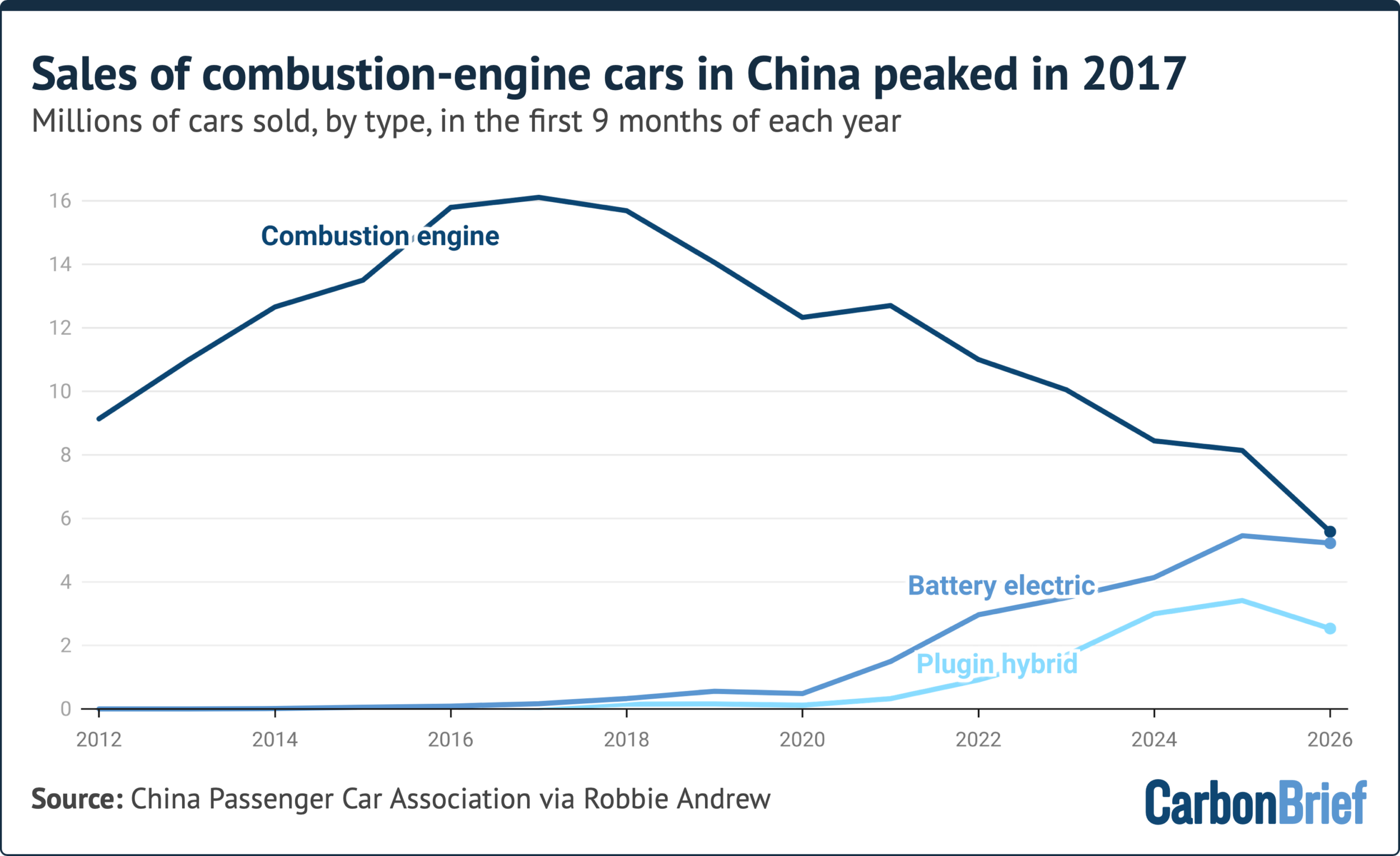
Indeed, sales of fuel-only cars were down 31% year-on-year in the first nine months of 2026, with plug-in hybrid sales down 26% – whereas battery EV sales were only down 4%.
One analyst tells Carbon Brief that China’s rapidly growing EV fleet has offset demand for 143m barrels of oil since the start of the Hormuz crisis.
Another says that the crisis is “reinforcing China’s electrification of road transport”.
Meanwhile, amid slowing domestic sales, Chinese carmakers’ exports of NEVs more than doubled [in 2026 to date / in September] from a year earlier.
NEV record
A record two out of every three cars sold in September in China were NEVs, according to CPCA data, as shown in the figure below.
(NEVs predominantly include battery electric vehicles – BEVs – and plug-in hybrids – PHEVs. BEVs only run on electricity, whereas PHEVs also have a combustion engine.)
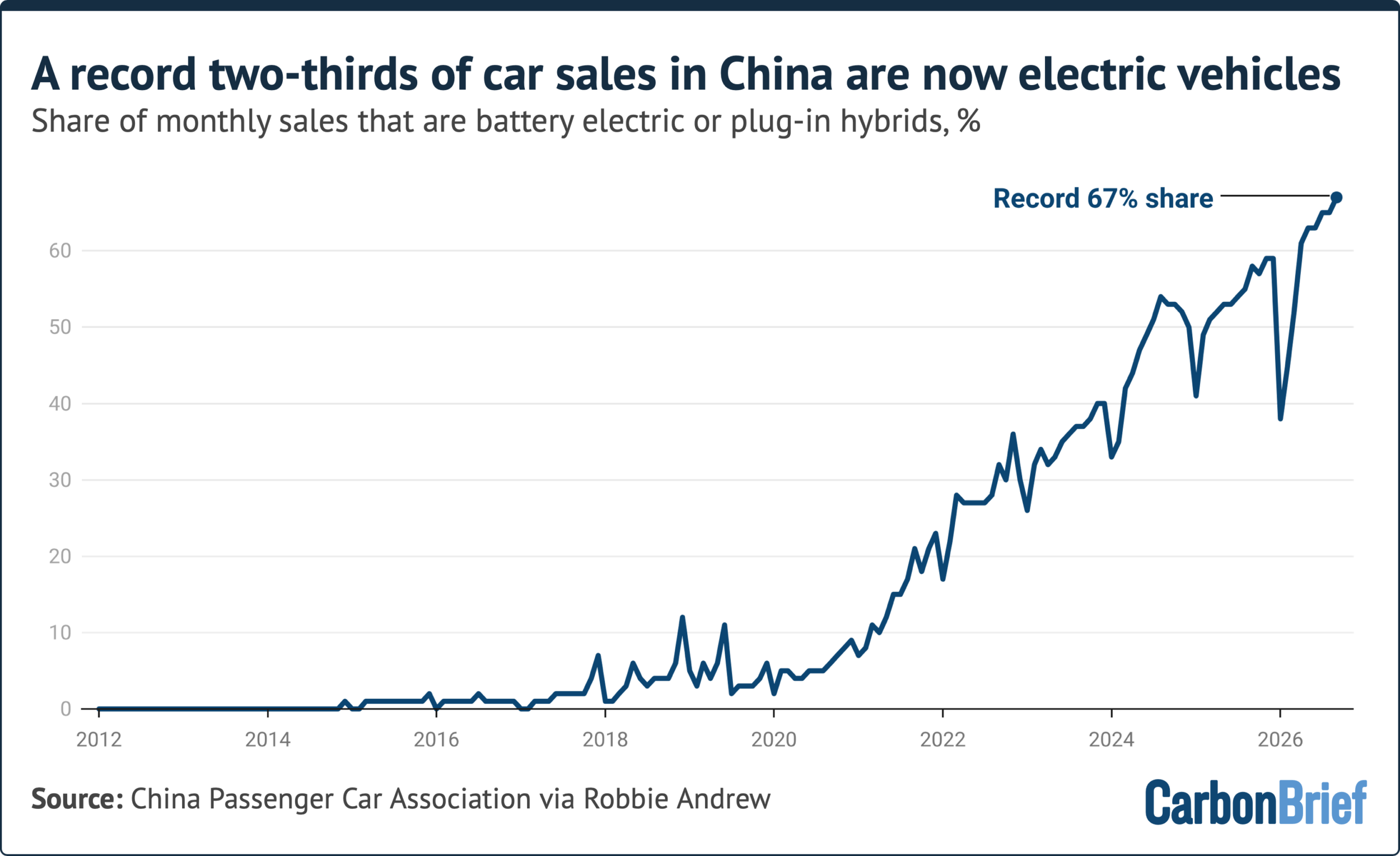
This marks a rapid rise for NEVs from just 6% of new car sales in 2020 up to 58% in 2026 to date – and a record 67% in the month of September.
This year, NEVs’ share of sales has also bounced back from a low of 39% in January, after the full purchase tax exemption that had been in place for more than a decade came to an end in December 2025.
The gain in NEV share in 2026 has come amid a slowdown across the wider domestic passenger-car market, which has hit sales of combustion-engine vehicles particularly hard.
This September, passenger-car retail sales across all categories declined, with overall sales volumes falling 28% year-on-year.
The contraction was led by combustion-engine vehicles, which saw sales fall 43% year-on-year in September and 31% in 2026 to date.
However, sales of PHEVs also fell by 36% year-on-year in September and by 26% in 2026 to date. By comparison, BEVs performed better, although sales still declined 8.5% from a year earlier in September and 4% in 2026 to date.
As a result, NEV sales overall fell by 17% in September and 13% in 2026 to date.
While the market changes in 2026 to date were particularly dramatic, they reflect a broad continuation of trends seen over the past decade.
Indeed, sales of combustion-engine cars in China peaked in 2017 and they have been declining ever since, shown in the figure below.
Impact of Hormuz
Part of the reason for the advance of NEVs in 2026, said Chinese technology news outlet OFweek, was petrol cars “giving up market share” as they were outperformed by electric alternatives.
Cui Dongshu, secretary-general of the CPCA, cited higher petrol prices as an explanation for September’s weak combustion-car sales, in comments to financial news outlet National Business Daily.
Imports of oil into China in January-September have fallen 15% compared to 2025, equivalent to 470m barrels, as ongoing conflict tightened supply and drove up prices.
China’s passenger-car NEV fleet has displaced 143m barrels of oil so far during the strait of Hormuz crisis, Euan Graham, senior energy analyst at thinktank Ember, tells Carbon Brief.
EVs “accounted for 12% of the decrease in China’s oil use post-Hormuz”, according to an estimate provided to thinktank the Brookings Institute by an unnamed analyst.