
Connect with us

Published

on

Installing a solar panel system can be a significant investment. A solar panel system can cost Australian homeowners around $5,000 to $14,000. Government and state rebates and incentive programs can help reduce this cost.   

But homeowners still pay a substantial amount to enjoy lower electricity bills. Fortunately, there are various options available to make solar energy more affordable.  

Knowing about all types of solar panels will give you the freedom to choose from a variety of options.   

Solar panel solutions fit every budget, from cost-effective polycrystalline panels to premium and elegant monocrystalline cells.  

Here is the ultimate guide to all types of solar panels in Australia, helping you find the most suitable panels for your home and financial needs.

What Are Solar Panels?

Solar panels are devices that capture and convert sunlight into usable electricity. They use two semi-conductive materials. Usually, silicon is sandwiched between a metal or glass.  

As sunlight passes through the semiconductive material, electrons get dislodged from the atoms. And it results in a small electrical current. The current is captured and used to power your home or stored in a solar battery. This process is also known as the photovoltaic effect.

Looking Back on Solar Panels

The history of solar panels dates back to 1839, when French scientist Edmond Becquerel first observed the photovoltaic effect. In 1883, Charles Fritts developed the first solar cell, leading to further experimentation with solar-capturing technology by scientists worldwide.   

The breakthrough came in the 1950s when Bell Labs discovered silicon was a far more efficient semiconductor than the previously common selenium used in solar panels. Since then, solar panels have undergone continuous improvements with remarkable innovations.

What Are The Main Types of Solar Panels?

Solar panel technology has seen many advancements. And now it’s available for all average Australian households. Nowadays, a wide range of more budget-friendly panels are available. Let’s get to know all of them today!

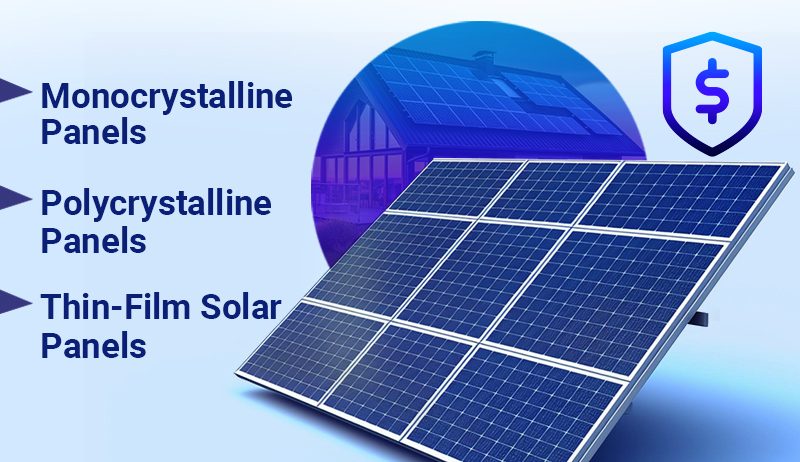
Monocrystalline Solar Panels

Monocrystalline solar cells are also known as modules. These represent the top tier in solar technology. They are made from a single sheet of monocrystalline silicon crystal using an expensive manufacturing process.   

These panels are created from a single bar of pure silicon, then cut and shaped into 32 to 96 silicon wafers. And these wafers are solar panels. However, due to the cutting process, a massive amount of silicon is wasted. And it makes production costly but efficient.  

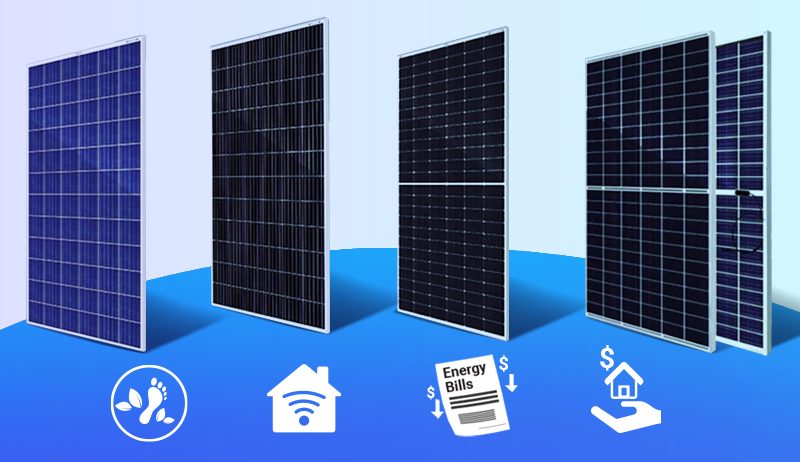
Monocrystalline panels are black. These panels are highly efficient, have higher wattage, longer lifespan, and are the most expensive option. They can capture about 19% to 22% of incoming photons.   

There are various options among monocrystalline panels, including Passivated Emitter/Rear Cell (PERC) panels, Heterojunction Solar Cells, and Bifacial Panels.  

Passivated Emitter and Rear Cell Panels  

PERC panels represent an improvement over standard monocrystalline panel technology. They add a layer of reflective material to the back of the panel, which allows the silicon to capture more photons.   

This design has various minor benefits. They reduce electron recombination and heat. PERC cells are slightly more efficient and have a longer lifespan. These panels absorb around 21% to 23% of incoming photons.  

solar panels

Heterojunction Solar Cells  

Heterojunction cells combine two solar panel technologies to increase efficiency. These panels add a layer of amorphous silicon that absorbs more wave frequency and complements the crystalline silicon to boost efficiency.  

However, these cells require unique manufacturing and are considerably expensive. Nevertheless, the extra cost comes with a significant efficiency boost, as they absorb between 23% to 26% of incoming photons.  

Bifacial Panels  

Bifacial panels are more efficient than standard monocrystalline panels but require more effort. They have two solar-absorbing faces. The second face is positioned at the back of the panel to absorb reflected light. Otherwise, that would be wasted.  

However, they are not suitable for flat surfaces, such as roofs. Homeowners can install these panels on a section of their property, typically on the ground. When used properly, these panels can achieve an efficiency of up to 27%.   

The most efficient bifacial panels are made from monocrystalline materials. However, polycrystalline bifacial panels are also available in the solar market.

Polycrystalline Solar Panels

Polycrystalline solar cells, also known as multicrystalline panels, offer a more budget-friendly approach.  

These solar cells are created from multiple shards of silicon fragments that are melted down and poured into small square wafer moulds. The panels are dark blue, speckled in colour.  

Polycrystalline panels have a lower price tag because the production process creates less silicon waste. Consequently, it makes them more accessible and cheaper to manufacture.   

However, these silicon solar cells have a shorter lifespan and lower heat tolerance. They also have a lower efficiency rating. These can capture only between 13% and 17% of photons. 

Thin-Film Solar Panels

Thin-film solar cells are an umbrella term encompassing several types of solar panels. These panels are typically thin, flexible, affordable, and commonly used in industrial or commercial applications.   

Some homes may also use thin-film solar panels on their roofs if they have unusual shapes or cannot support the weight of standard panels. Thin-film solar panels typically have an energy efficiency rating of 7% to 18%. However, it depends on the specific type.  

Cadmium Telluride (CdTe) Panels  

Cadmium telluride is the most common thin-film panel on the market, accounting for approximately 5% of the global solar panel market. These panels can achieve an efficiency rating of 9% to 15%.   

They are made from cheaper materials such as cadmium telluride, cadmium sulphide, or magnesium sulphide. Unfortunately, these low-cost materials are also toxic and can harm the environment and human health.  

Amorphous Silicon (A-Si) Panels  

Amorphous silicon panels utilise a technology similar to that of standard silicon panels, but with greater flexibility. Instead of using crystalline silicon wafers, these panels use a thin silicon strip with a texture resembling rubber.   

These are incredibly lightweight, versatile, non-toxic, and cheap, but have low efficiency. These panels typically have an efficiency rating of about 7%.   

Copper Indium Gallium Selenide (CIGS) Panels  

CIGS panels are the most efficient thin-film panels available. They are composed of copper, gallium, indium, and selenide layers placed on top of a base of steel, glass, plastic, and other materials.   

They can be installed where standard panels cannot fit. CIGS panels are also used in solar shingles and similar rooftop solar technologies. They have an efficiency rating of 12% to 15%. Ideal lab conditions can be as high as 20%.

Which solar panels are considered the best?

Monocrystalline solar panels are more popular for rooftop solar installations due to their higher efficiency than polycrystalline or thin-film solar panels. However, some buyers may need clarification about their increased costs.  

Selecting the best panel type for your home primarily depends on personal preferences, particularly in terms of visual aesthetics. Some may prefer sleek, uniformly coloured panels, while others may opt for colourful, patchy panels with smaller gaps between cells.

Different Types of Solar Panel Efficiency Ratings

  • Crystalline solar panels stand out as the most efficient among all panel types.  
  • Monocrystalline panels boast an efficiency rating of over 20%.  
  • PERC panels achieve an extra 5% efficiency due to their passivation layer.  
  • Polycrystalline panels typically have an efficiency range of 15% to 17%.  
  • On the other hand, thin-film panels usually exhibit 2% to 3% lower efficiency than crystalline silicon. On average:  
  • CIGS panels have an efficiency range of 13% to 15%.  
  • CdTe falls between 9% and 11%.  
  • A-Si has an efficiency range of 6% to 8%.   

The capacity of Different Solar Panels

Monocrystalline cells offer the highest energy capacity because of their single-crystal form. This form enables a higher output rating in a smaller size. Most monocrystalline panels can generate up to 300 watts of power capacity.  

Recent advancements in solar technology have allowed polycrystalline panels to narrow the gap. A standard 60-cell polycrystalline panel can now produce between 240 and 300 watts of power.   

Due to their uneven sizes, thin-film panels still require a standardised measure of power capacity. The efficiency of one thin-film panel may differ from that of another based on its physical size. 

How to Select the Right Solar Panel for Your Home?

Selecting the best solar panel for your home can seem overwhelming. However, here are some tips and tricks you can follow when choosing the types of solar panels:  

Efficiency: Look for solar panels with higher efficiency ratings as they generate more electricity from the same amount of sunlight. Understand the different types of solar cells and their efficiency levels.  

Cost: Consider your budget while choosing solar panels, but remember that a higher upfront cost may result in more significant long-term energy bill savings. Polycrystalline panels offer a more budget-friendly option for cost-conscious buyers than monocrystalline panels.  

Warranty: Ensure the solar panel has a reliable warranty, ideally at least 25 years, to cover any potential defects or malfunctions.  

Durability: Select panels that can withstand harsh weather conditions, including hail, wind, and snow. Solar panels with tempered glass and aluminium frames are more durable than those with plastic components.   

Certification: Look for installers and sellers certified by recognised authorities, such as the Clean Energy Council (CEC), to ensure they meet quality and safety standards.   

Seek Professional Advice: Research thoroughly and consult Cyanergy We are a certified solar panel installer. With the guidance of many solar experts, we can help you save money and effectively reduce your carbon footprint. Get a free solar quote now!  

By carefully considering these factors, you can select the most suitable solar panel type for your home, ensuring optimal energy generation and long-term sustainability.

What Are The Best Solar Panel Brands In Australia?

rooftop solar

When considering solar panel brands, you might think of the concept of “tiers.” Tier 1 represents the highest-rated panels, and Tier 3 indicates low-quality products.  

There is no universal ranking system. Various organisations, like financial analysis firms, independently rank solar panel brands.   

Examining the source that claims to offer “tier 1” panels is essential because these organisations often have similar assessments.  

The tier system generally reflects the investment potential of a solar panel brand rather than the actual quality of its panels.   

The rankings take into consideration factors such as the company’s involvement in large-scale projects, manufacturing capacity, research, and development.   

Here are some commonly featured Tier-1 solar panel brands in Australia 

  • Canadian Solar  
  • Jinko  
  • LONGi  
  • QCells  
  • REC Group  
  • Sunpower  
  • Trina Solar  

Contact Cyanergy to explore our affordable solar packages and discover our selection of Tier-1 solar panels.  

Your Solution Is Just a Click Away

The post Ultimate Guide On All Types of Solar Panels In Australia appeared first on Cyanergy.

Ultimate Guide On All Types of Solar Panels In Australia

Continue Reading

Renewable Energy

Danish Data Center Heats a Town, Vestas Breaks UK Record

Published

on

Weather Guard Lightning Tech

Danish Data Center Heats a Town, Vestas Breaks UK Record

A Danish data center will heat a town with its waste heat, Sumitomo buys into Celtic Sea floating wind, and Cadeler orders two more vessels.

The Uptime Wind Energy Podcast is brought to you by Weather Guard Lightning Tech, creators of the StrikeTape Ultra LPS retrofit. Subscribe to Uptime’s Substack newsletter. And check out Rosemary’s “Engineering with Rosie” Youtube channel. Have a question we can answer on the show? Email us!

Good Monday everyone.

A data center broke ground in Denmark this week … and the plan is for it to help heat the town. Not a slogan. But a pipe. Let me explain.

The project is called Dansk Data Center 1. They put shovels in the ground on August thirteenth at the Port of Esbjerg in southern Denmark. The owners are the pension fund PensionDanmark … the real estate firm Thylander … and Copenhagen Infrastructure Partners. That last name should sound familiar. Copenhagen Infrastructure Partners has raised about forty-three billion euros across fifteen funds … and builds energy projects in more than thirty countries. This time it is building a data center.

Eleven and a half megawatts. By the standards of this business … that is small. But watch how they built it. The waste heat will go into the town’s district heating system … in partnership with the local utility … Din Forsyning. The cooling water runs in a closed loop and gets used again. And the plant can raise or lower its power draw to match whatever the Danish grid has to spare that hour.

The chief technology officer put it plainly. The goal is for the data center not to be a burden … but an active part of a balanced energy system. Commissioning is set for October of twenty twenty-seven.

Now … hold that model in your head. Because on the other side of the world … they are still doing it the old way.

Centuria Industrial is a warehouse landlord. Australia’s largest pure-play industrial property trust. This week … in its full-year results … it told investors it is chasing more than two hundred and fifty megawatts of data center capacity.

Some of that is expansion at sites it already owns. A twelve-megawatt building in Melbourne bought from Telstra back in twenty twenty. A small center in Toowoomba, Queensland. Another in Perth … leased to Fujitsu. But the rest of that plan is warehouses. Old industrial yards in Victoria and Western Australia that Centuria wants to turn into data halls.

And here is the tell. For three of those sites … the company has already filed power applications. Not planning applications. Power applications. Because in this business … the grid connection is the product. Centuria’s head of funds management says Australian demand is now outpacing supply. He is not wrong. And he is not alone.

So … two continents. Two data center stories. One built as a part of the power system. The other waiting in line for it. Either way … the load is coming. Which brings us to the people building the supply.

Start in the Celtic Sea … about forty kilometers off the British coast. There is a floating wind project out there called Gwynt Glas. That is Welsh for blue wind. Up to one and a half gigawatts. This week … Japan’s Sumitomo Corporation bought a third of it. The other two thirds are held by EDF … and by Ireland’s Electricity Supply Board. Three equal partners.

Now … Sumitomo has been investing in European offshore wind since twenty fourteen. But this is its first floating project anywhere in the world. And the timeline will test your patience. Consent applications do not even begin until twenty twenty-eight. Commercial operation is targeted for the late twenty thirties. That is a Japanese trading house writing a check today for electricity that shows up in fifteen years.

The deal sits under a memorandum signed with the British government last year. Britain wants the Celtic Sea built. Japan just volunteered to help pay for it.

Now up to Scotland. Vestas has installed the most powerful onshore wind turbine in Britain. It stands at Sanquhar II … between Dumfries and Galloway and East Ayrshire. The machine comes off the EnVentus platform … a bigger rotor married to a higher-rated generator. More energy out of the same wind. That project spent ten years in planning. And Vestas has more than six hundred megawatts of these machines under construction across Britain.

But here is the argument going on inside the industry. Everybody is building bigger turbines. And yet a Vestas executive said this week … quote … we firmly believe bigger does not automatically mean better. Project economics are under pressure. In Germany and the Netherlands … you cannot get a blade that size under a bridge or through a village. Scotland is empty enough to try it.

Britain now has about thirty-three gigawatts of wind … split about evenly between onshore and offshore. Onshore space is running out. So every new turbine has to do more work than the one before it.

And then … there are the ships. Cadeler runs the largest fleet of jack-up wind turbine installation vessels in the world. This week … it ordered two more. The yard is COSCO Shipping Offshore in Qidong, China. The price … about eight hundred and five million euros. Call it nine hundred and thirty million dollars. Delivery … twenty thirty and twenty thirty-one. That will bring the fleet to fourteen vessels.

And understand what these things are. The current class carries a deck of five thousand six hundred square meters … a payload over eighteen thousand tonnes … and a crane that lifts more than three thousand three hundred tonnes. Six extra-large monopile foundations per trip. The new class … they say … will be bigger still.

Meanwhile the newest ship … the Wind Ace … is finishing commissioning right now. Its first job is East Anglia Two for ScottishPower Renewables … starting in twenty twenty-seven.

And here is the number that tells you the most. Cadeler’s order backlog stands above three billion dollars. Eighty-two percent of that work is on projects where the customer has already taken a final investment decision. Nobody orders a nine-hundred-million-dollar ship for twenty thirty-one on a hunch.

So … here is what to watch. For years this industry has fought one bottleneck at a time. Permits. Then supply chain. Then vessels. Now the bottleneck is the grid connection itself. Centuria filed power applications before planning applications. Because in twenty twenty-six … the scarce resource is not land or steel or capital. It is a slot on the transmission network.

That changes the game for wind developers. The projects that win will not be the ones with the biggest turbines or the cheapest blades. They will be the ones that show up with a grid solution already in hand. Denmark just showed what that looks like. A data center that flexes its load … feeds heat back to the community … and makes the grid operator’s job easier.

If you are developing a wind farm today … and you are not thinking about who will consume your electrons and how … you are already behind. The old pitch was … we generate clean power. The new pitch is … we solve a grid problem. That is the difference between a project that gets built and one that sits in a queue for five years.

And that is the state of the wind industry for the 18th of August … twenty twenty-six. Join us for the Uptime Wind Energy Podcast tomorrow.

Danish Data Center Heats a Town, Vestas Breaks UK Record

Continue Reading

Renewable Energy

Preferences for Musical Genre and Political Demographics

Published

on

The following is simply raw speculation on my part.  I’ll be interested in your comments.

There are musical styles that align themselves with left- and right-wing politics, though none of these, with the possible exception of one, has 100% of its audience–more on this below.

Here are a few musical genre, where they seem to be pro- or anti-Trump. and why:

Classical.  Largely but not exclusively anti-Trump.  Classical appeals to the mind and the emotions that surround the perception of beauty.  There are exceptions, in that there are plenty of billionaires and weirdo intellectuals, e.g., the “objectivists” of Ayn Rand fame many of whom adore classical music.

Country.  Pro-Trump.  Most of it appeals to people whose most nuanced thinking is getting drunk and laid.  Preferably at the same time.

HipHop: Pro-Trump.  The opposite of classical, this is music that appeals to the genitalia as opposed to the mind.

Rock.  Mixed bag.  Heavy metal probably favors Trump; prog-rock fans of bands like Yes and Pink Floyd have too much going on in their minds and hearts to be Trump supporters.

Folk: Mostly anti-Trump.  Pete Seeger and Bob Dylan fans aren’t big fans of stupidity and fascism.  I’m sure there are exceptions.

Reggae: Distinctly anti-Trump.  Black folks’ songs of love, peace, weed, and escape from enslavement aren’t going to resonate with the hate of the White supremacists.

The Grateful Dead.  I’ll leave you with this.  If you can find me a single Dead Head Trumper, I’ll be astounded.  Now, I know that essentially no one sits on the fence about the Dead, but there is essentially zero intersection of Dead Heads and those who favor war, corruption, hate, greed, and ignorance.

Preferences for Musical Genre and Political Demographics

Continue Reading

Renewable Energy

Did God Assign Your Gender?

Published

on

Religious statements fly in the teeth of science, but even the most ardent believers in God are going to have trouble with the meme here.

The reason men have nipples is that their gender isn’t assigned until about six weeks after conception, when chromosomes trigger hormonal changes that differentiate male and female anatomy.

Did God Assign Your Gender?

Continue Reading

Trending

Copyright © 2022 BreakingClimateChange.com