

Mads Christensen is Executive Director of Greenpeace International.
As the military and diplomatic establishment gather for the annual Munich Security Conference, the air will be thick with talk of “strategic autonomy” and “energy security.” But there is little autonomy to talk of when sovereignty is for sale, and security is a hollow promise while regional stability depends on the weaponized resources of a rival power.
We are witnessing the unmasking of a 19th-century worldview: Resource Colonialism. In Venezuela, the mask slipped quickly; the world watched as the United States Navy deployed off the coast, reviving gunboat diplomacy for the 21st century. This was confirmed by President Trump’s declaration that the U.S. would exercise ‘de facto control’ over Venezuela’s oil industry.
In Greenland, the ‘prize’ is territorial expansion, and minerals, coveted for economic gain and military security. The rush for Greenland’s minerals threatens to replicate every abuse of the oil age: building on the same colonial mindset, displacing Indigenous communities, poisoning local water, and overriding democracy. Rhetoric toward Greenland has shifted from pressure to hostility, then manifesting in the ‘framework of a future deal’ as announced by VP Vance.
-
After disappointing COP30, EU mulls “less naive” strategy for climate talks
EU environment ministers are discussing how to show more “realism” and “pragmatism” in international climate negotiations -
COP31 chief slams climate backsliding, but rejects priority focus on fossil fuels
After a first COP31 strategy meeting, Türkiye’s environment minister says he will “safeguard the development priorities” of developing countries


Emboldened by his bestseller ‘The Art of the Deal’, and the myth that he is the world’s ultimate businessman, Trump has replaced diplomacy with acquisition. His administration is treating sovereign territories and Indigenous homelands as if they were a real estate portfolio in Manhattan.
Global liquidation sale
The fact of the matter is that Trump’s transactional worldview, where everything has a price tag, is not leadership but a global liquidation sale. Backed by a cabal of fossil-fuel billionaires, this circle of autocrats is treating the 21st century like a distressed asset to be stripped bare, regardless of the costs to the rest of us.
But growing up in Denmark and working in the Arctic for many years, there is one thing I know for certain: Greenland is not a deal to be made. It is not a place to be defined or controlled by anyone other than the people of Greenland.
And this is not just an American problem. Look East, and you see the mirror image. As Greenpeace has documented, Russia has transformed into a total “fossil fuel war economy.” The Kremlin’s aggression is funded almost entirely by oil and gas exports, creating a feedback loop where extraction finances its war of aggression against Ukraine, as well as internal oppression.
In response, European leaders have finally agreed to end Russian gas imports, but are blindly rushing headlong into a dependency on American liquefied fossil gas. Trading dependency on Putin for dependency on Trump, however, is not a security strategy: it’s a high-stakes game with very poor cards.
This is a message European diplomats need to bear in mind in Munich this week as they gather to discuss urgent issues such as energy security: the more Europe depends on the US for energy, the greater the vulnerability to pressure by Trump.
Climate action is “weapon” for security in unstable world, UN climate chief says
Every euro spent on US oil and gas strengthens Trump’s authoritarian agenda at home and colonialist ambitions abroad, threatening Europe’s independence and security. The only way for Europe to achieve true energy security is to phase out fossil gas and accelerate the shift to a fully renewable energy system.
The ‘Art of the Deal’ mindset treats the world like a chessboard and uses the fact that the board is burning to advance its interests. To Trump, the melting ice in Greenland isn’t a global catastrophe but just a door opening to get to the minerals underneath. But when we treat the climate crisis as just another ‘variable’ in a trade war, we lose the ability to cooperate.
Path to peace and security lies in clean energy
True security is not trading Russian gas for American fracking. It means phasing out fossil fuels and accelerating the shift to a fully renewable energy system that makes no dictator or president the master of Europe’s lights, whether they sit in Moscow, Mar-a-Lago or elsewhere.
True security is a just transition away from fossil fuels, not a military scramble to burn them faster. Expanding oil extraction anywhere undermines global climate goals and increases climate risks everywhere. A fossil-free, peaceful future requires breaking the link between energy systems, militarisation and exploitation.
Explainer: What is the petrodollar and why is it under pressure?
The leaders gathering in Munich have a stark choice. They can acquiesce to the dogma that might make right and that sovereignty is for sale, or they can recognise that true security requires charting another path entirely with a rules-based global order at its heart.
Rejecting resource colonialism needs to go hand in hand with boldly displaying different leadership: one that reclaims the moral compass. True leadership is built on solidarity, not threats. A healthy society isn’t measured by the profits of a few, but by the wellbeing of the many. Success isn’t about who wins; it’s about who thrives.
We are defined by what we save, not what we take.
The post The more Europe relies on the US for energy, the more it’s vulnerable to pressure by Trump appeared first on Climate Home News.
The more Europe relies on the US for energy, the more it’s vulnerable to pressure by Trump

For the first time, new-energy vehicles (NEVs) made up 67% of new car sales in China in September, according to the latest data from the China Passenger Car Association (CPCA).
The figures show that NEVs, which include battery electric cars and plug-in hybrids, captured a record share of sales, even though fewer were sold than last year.
This is because sales of combustion-engine cars are falling steeply, a trend that the CPCA has attributed to rising petrol prices following the start of the Hormuz crisis.
Indeed, sales of fuel-only cars were down 31% year-on-year in the first nine months of 2026, with plug-in hybrid sales down 26% – whereas battery EV sales were only down 4%.
One analyst tells Carbon Brief that China’s rapidly growing EV fleet has offset demand for 143m barrels of oil since the start of the Hormuz crisis.
Another says that the crisis is “reinforcing China’s electrification of road transport”.
Meanwhile, amid slowing domestic sales, Chinese carmakers’ exports of NEVs more than doubled [in 2026 to date / in September] from a year earlier.
NEV record
A record two out of every three cars sold in September in China were NEVs, according to CPCA data, as shown in the figure below.
(NEVs predominantly include battery electric vehicles – BEVs – and plug-in hybrids – PHEVs. BEVs only run on electricity, whereas PHEVs also have a combustion engine.)
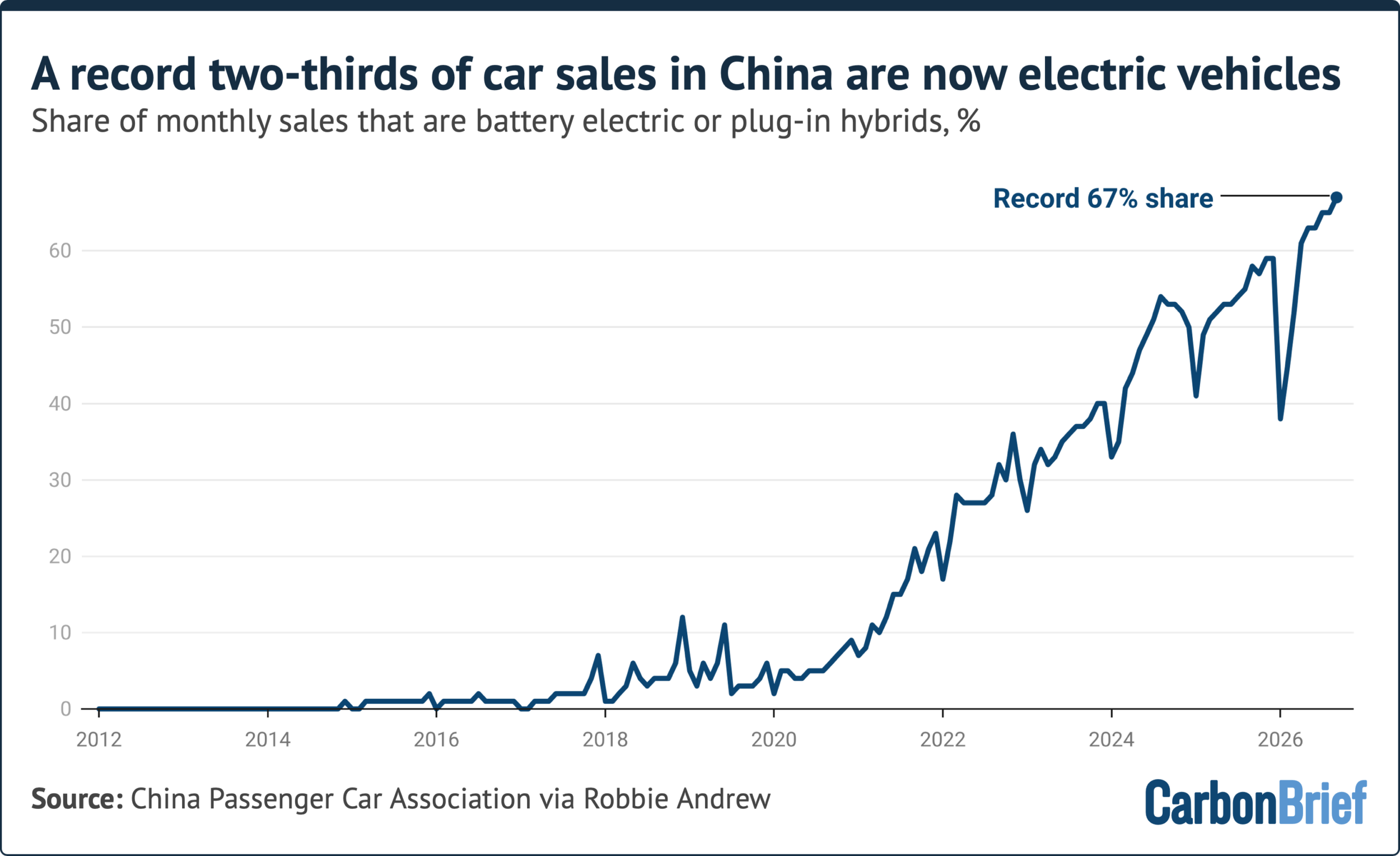
This marks a rapid rise for NEVs from just 6% of new car sales in 2020 up to 58% in 2026 to date – and a record 67% in the month of September.
This year, NEVs’ share of sales has also bounced back from a low of 39% in January, after the full purchase tax exemption that had been in place for more than a decade came to an end in December 2025.
The gain in NEV share in 2026 has come amid a slowdown across the wider domestic passenger-car market, which has hit sales of combustion-engine vehicles particularly hard.
This September, passenger-car retail sales across all categories declined, with overall sales volumes falling 28% year-on-year.
The contraction was led by combustion-engine vehicles, which saw sales fall 43% year-on-year in September and 31% in 2026 to date.
However, sales of PHEVs also fell by 36% year-on-year in September and by 26% in 2026 to date. By comparison, BEVs performed better, although sales still declined 8.5% from a year earlier in September and 4% in 2026 to date.
As a result, NEV sales overall fell by 17% in September and 13% in 2026 to date.
While the market changes in 2026 to date were particularly dramatic, they reflect a broad continuation of trends seen over the past decade.
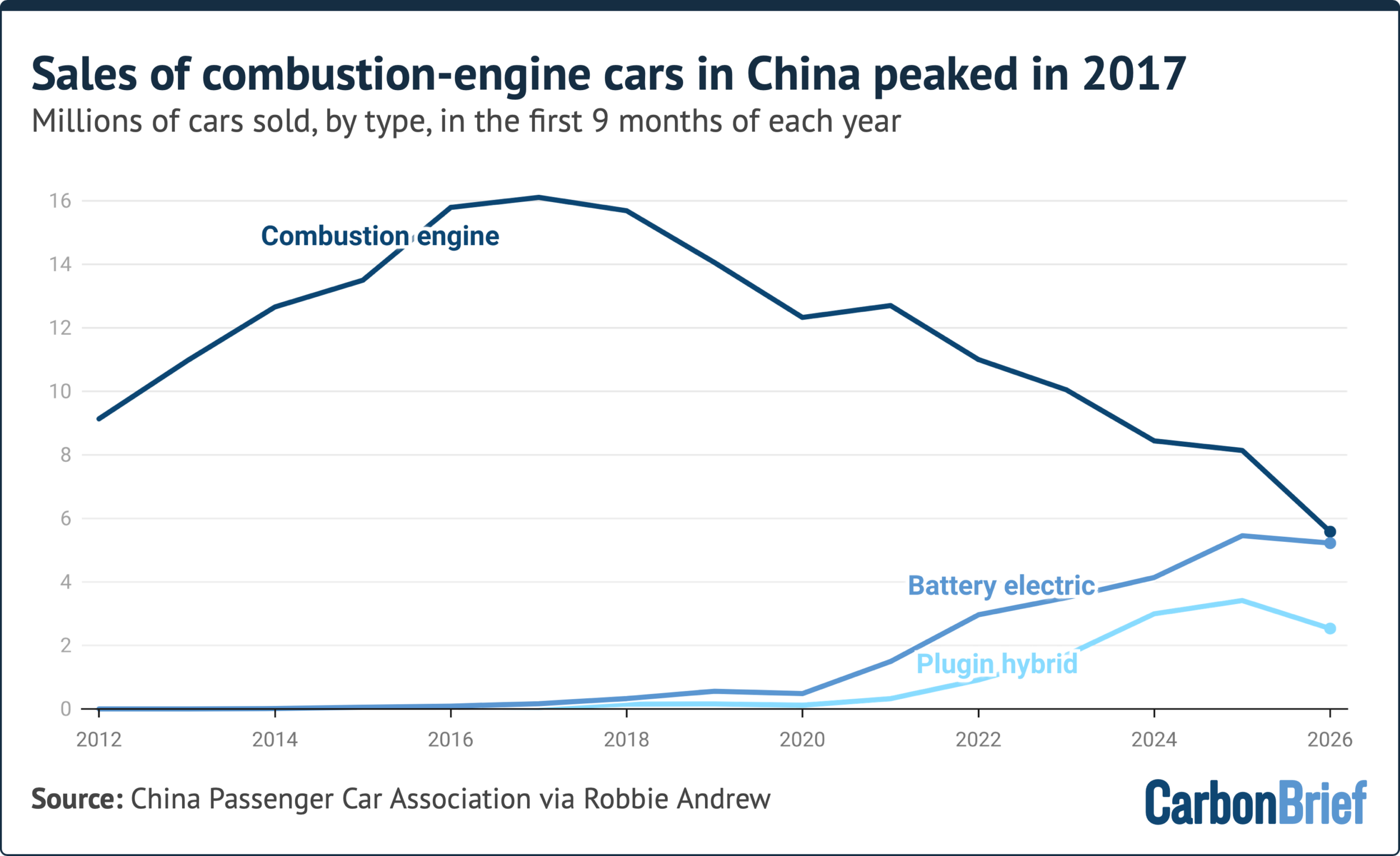
Indeed, sales of combustion-engine cars in China peaked in 2017 and they have been declining ever since, shown in the figure below.
Impact of Hormuz
Part of the reason for the advance of NEVs in 2026, said Chinese technology news outlet OFweek, was petrol cars “giving up market share” as they were outperformed by electric alternatives.
Cui Dongshu, secretary-general of the CPCA, cited higher petrol prices as an explanation for September’s weak combustion-car sales, in comments to financial news outlet National Business Daily.
Imports of oil into China in January-September have fallen 15% compared to 2025, equivalent to 470m barrels, as ongoing conflict tightened supply and drove up prices.
China’s passenger-car NEV fleet has displaced 143m barrels of oil so far during the strait of Hormuz crisis, Euan Graham, senior energy analyst at thinktank Ember, tells Carbon Brief.
EVs “accounted for 12% of the decrease in China’s oil use post-Hormuz”, according to an estimate provided to thinktank the Brookings Institute by an unnamed analyst.
Erica Downs, a senior research scholar at Columbia University’s Center on Global Energy Policy, tells Carbon Brief that the strait of Hormuz crisis and higher oil prices are “reinforcing China’s electrification of road transport”.
She says the “world’s largest oil supply disruption” vindicates China’s early bet on EVs, which was partly driven by concerns about oil-supply security.
NEV demand down
Nevertheless, NEV sales have fallen year-on-year, albeit at a slower rate than overall car sales. The growth in NEV market share has also been decelerating.
Zhang Yichao, a partner at consulting firm AlixPartners, tells Carbon Brief that NEVs benefit from government trade-in policies and a “strong pipeline” of new models, particularly those involving innovation.
He says these factors help explain why NEVs sales have fallen at a slower rate to their combustion-car counterparts.
Cui told the state-run China National Radio that the fall for NEVs and for cars overall in September 2026, is also due to a high baseline of sales from the same month in 2025, as well as changes to trade-in policies and disruptions from the holiday period.
Other factors, says consulting firm Wood Mackenzie, are the weakened demand due to “demand pull-forward” in 2025 caused by the end of subsidies, as well as “tighter financing conditions”.
Zhang tells Carbon Brief he does not “see much more room ahead” for further growth in NEVs’ market share.
He adds that, in his view, their share in China is unlikely to exceed 80%, as some premium-market segments and specific use cases will continue to require combustion-engine vehicles.
Exports surge
Meanwhile, while domestic NEV retail sales fell 17% in September 2026, exports more than doubled, increasing 164% year-on-year, according to the CPCA.
This extends the decline in domestic sales and very strong growth in exports seen across 2026 to date, as shown in the figure below.