

What’s not to love about a solid dress in your wardrobe? A dress can be dressed up (or down), layered (or not) and when topped with the right top, can even transform into a skirt. Plus a dress is arguably the easiest outfit to put together that still looks put together. The right sustainable dress is a closet staple you’ll reach for when you *no idea* what to wear or you just want something breathable.
From casual t-shirt dresses and house dresses to chic midi frocks and fun mini’s for a night out, this roundup of sustainable dresses has just about everything.
So if you’re looking for that perfect eco-friendly dress to complement your wardrobe this year, I’ve got you covered with this guide to sustainably and ethically-made dresses. This guide has brands with both casual and fancier dresses, but if you’re shopping for exclusively special occasion dresses, I would recommend checking out this guide to ethical formal dresses.
What Qualifies As (More) Sustainable Dresses?
Wearing what we have in our closets is the most sustainable approach! But if you’re here, you probably already evaluated that option and you’re looking to add something to your closet for whatever reason.
Secondhand Dresses are Sustainable Dresses
The second most sustainable option is to look secondhand. ThredUp is a solid option for lower priced items and The RealReal is my favorite choice for premium and more luxury brands.
Online secondhand marketplaces like Poshmark or Depop are also good options — just something to watch out for peer-led secondhand marketplaces, is that they can contain new fast fashion disguised as “vintage” sometimes too so it can require some additional digging or questioning.
Find my full guide to secondhand clothing retailers in this post.
If you’re looking for a new sustainably-made dress, here are some considerations:
- Materials: what is it made from? Is it made with a natural fabric like hemp, linen, or organic cotton? Perhaps made from deadstock or upcycled materials?
- Production Practices: does the brand take efforts to not overproduce? (no matter how “eco” the material is, if a brand is throwing away 30% of their stock, that’s not sustainable!)
- Timelessness Over Trends: this doesn’t mean boring! it just means: does the brand constantly hop on every single trend and push you to buy more and more? or do they encourage slow mindful consumption with well-designed dresses?
- Manufacturing: most brands do not produce their own clothing, but are they sourcing from facilities that use renewable energy? how about their shipping emissions?
- Quality: is the sustainable dress made to last? (fashion instructor Zoe Hong shared some tips for spotting high quality clothing on the podcast)
- Ethical Production: who made the dress? were they paid fairly and were they working in safe conditions? do they have worker’s rights, such as the right to organize? how does the brand ensure this?
- Ownership: is it a small sustainable business or big fashion brand owned by billionaires? is the brand marginalized owned? what are your values when it comes to where your money is going?
I know that’s a lot of questions! But these are just things to start looking for as you browse through brands. This isn’t about perfection — it’s just about learning and doing the best we can.
My Top Picks for Ethical and Sustainable Dresses
To help you out (because I get it — it’s complicated!) I’ve curated retailers and brands with sustainable and ethical dresses. These brands aren’t necessarily perfect, but they’re doing things better for people and the planet. I’ve included “Conscious Qualities” by each brand or retailer, so you can get an idea about why the brand is on the list and which sustainability criteria they meet.
This Guide’s Price Range Key:
- $ = Dresses under $100
- $$ = Dresses $100 – $200
- $$$ = Dresses $200+
This article features affiliates and partners. As always, we only feature brands that meet high standards for sustainability that we love — and that we think you’ll love too!
1. Christy Dawn
Crafting “dresses you want to live in”, Christy Dawn’s pieces are a fairytale come true with their flowy fit and dreamy prints. The sustainably-minded brand sources organic cotton as well as regenerative organic cotton grown in India by their partners Oshadi Collective. This “Farm-to-Closet” collection is also vegetable-dyed and block-printed in India using traditional time-honored practices.
Conscious Qualities: Organic & Regenerative Fabrics, Local & Ethical Production
Size Range: XS-3XL
Price Range: $$$
2. Whimsy + Row
Los Angeles-based sustainable fashion brand Whimsy + Row manufacturers their clothing in limited batches just a few miles away from their office. The brand sources upcycled fabrics (i.e. deadstock) and eco-minded materials (such as linen and organic cotton) for their flirty, feminine clothing.
Conscious Qualities: Eco Fabrics, Local & Ethical Production
Size Range: XS-XL
Price Range: $$-$$$

3. Tradlands
Created out of co-founder Sadie’s desire for classic, high-quality pieces, Tradlands is designed with longevity and versatility top of mind. And their effortless dresses are just as simple to care for — Tradlands uses natural — but washable! — fibers like cotton and linen.
The 100% cotton tiered dress I have from Tradlands (this one’s similar) is one of my summer go-to’s — breathable, flattering, and easy to dress up or down. I can wear it as a house dress working from home, or paired with jewelry and elegant sandals to dinner.
Conscious Qualities: Natural Fibers, Small Batch Production, Extended Sizing
Size Range: XS-4XL
Price Range: $$

4. Magic Linen
Versatile, breezy, and perfect for simmering temps, Magic Linen’s relaxed styles offer everything you need to feel calm and collected all summer long. Crafted from pure linen that has been stone-washed to provide unparalleled softness against your skin, these relaxed fits are the ideal intersection between vacation chic and functional style.
All of Magic Linen’s summer-ready pieces are created on a made-to-order basis, ensuring their garments are not overproduced. The brand also minimizes wastage by repurposing most of its fabric offcuts to create smaller items.
Conscious Qualities: Lower Impact Natural Materials, Woman-Owned, Made-To-Order
Size Range: US 2–18
Price Range: $$-$$$

5. Rare & Fair
Made thoughtfully with time-honored practices by master artisans and craftspeople in small batches, Rare & Fair has truly exceptional sustainable dresses. Each piece is made in a fully transparent, traceable process from fiber to final stitch.
Conscious Qualities: Sustainable Fabrics & Processes, Artisan Made, Cultural Preservation
Size Range: XXS-XL
Price Range: $$$

6. tentree
When warm weather approaches, all you want is a dress you can throw on. And if your style skews minimalist, all you desire is a dress that has interesting details but doesn’t make too much of a fuss or song and dance about itself. Lucky for you, tentree has an array of simple dresses that fit the bill.
Button-down, wrap, cami, or even hooded, these pieces make everyday dressing feel like a breeze. Made from breathable materials like modal, hemp, TENCEL Lyocell, linen, and organic cotton, these dresses are an ideal investment for the long haul.
Conscious Qualities: Eco Materials, Supply Chain Transparency, Plants Trees, Circularity Programs
Size Range: XS–XL
Price Range: $$-$$$

7. MATE
There’s nothing more satisfying than finding summer dresses that make you look instantly put together without much effort – and MATE’s curation checks every box.
From breezy maxi dresses to functional dresses that come with a removable belt bag, their styles are made using GOTS Certified Organic Linen, ideal for keeping the heat at bay when the mercury rises to unbearable temperatures.
What’s more? You can work up a sweat feeling relieved knowing that all of their pieces are made using non-toxic dyes that don’t rely on harmful chemicals like pesticides, BPA, PFAS, and formaldehyde.
Size Range: XS – XL
Price Range: $ – $$$
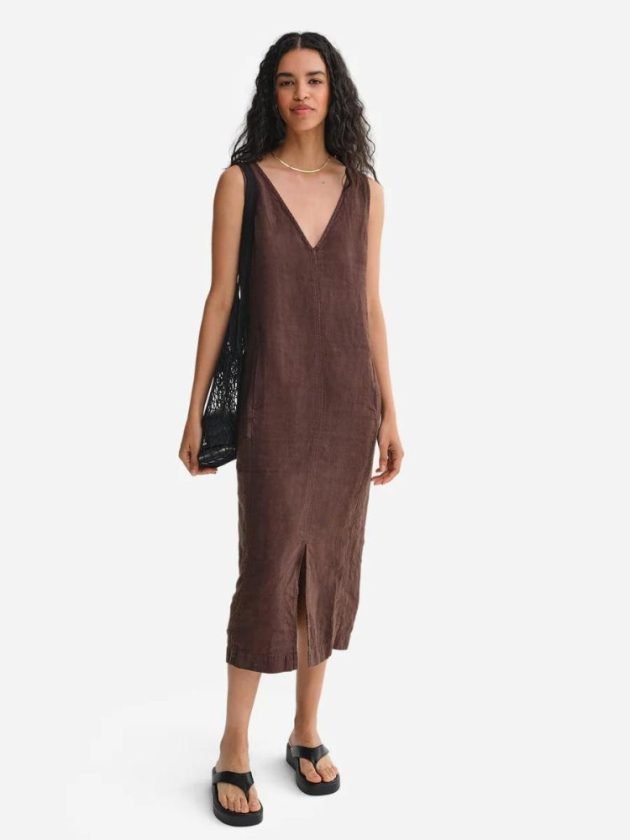
8. OhSevenDays
All of OhSevenDays’ dreamy sustainable dresses are made from deadstock fabrics sourced from Istanbul, Turkey. The slow fashion brand also offers a transparent behind the scenes look at their production process, all done in-house by a team of four tailors.
Conscious Qualities: Reclaimed Fabrics, Transparent Production
Size Range: S-L + custom sizing
Price Range: $
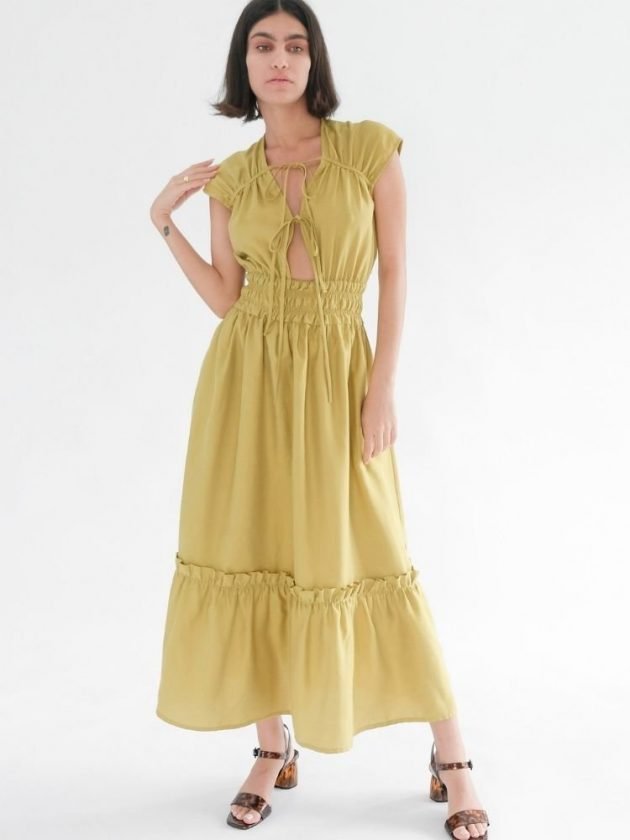
9. No Nasties
No Nasties creates 100% organic cotton fair trade dresses perfect for wearing to the beach with flip flops or pairing with heeled sandals for date night. Their versatile sustainable dresses are comfy, organic, and affordable with most pieces priced at under $100.
Conscious Qualities: Organic Fabrics, Traceable Supply Chain, Fair Trade
Size Range: XS-L
Price Range: $

10. LOUD BODIES
Crafting pieces in small batches using natural fibers in 15 different sizes, LOUD BODIES’ creates some of the best eco-friendly size inclusive dresses.
The brand will even produce pieces in custom sizes at no extra charge.
Conscious Qualities: Lower Impact Fabrics, Size Inclusive, Small Batch
Size Range: XXS-10XL
Price Range: $$

11. Míe
Defying typical design boundaries, Míe’s ethical dresses have a loose, comfortable fit but feature unique design elements like off-the-shoulder puff sleeves, making them the ultimate summer staples. And every dress is crafted responsibly in Nigeria using breathable, natural fibers like linen.
Conscious Qualities: Natural Fibers, Black Woman-Owned
Size Range: XS-3XL
Price Range: $$$

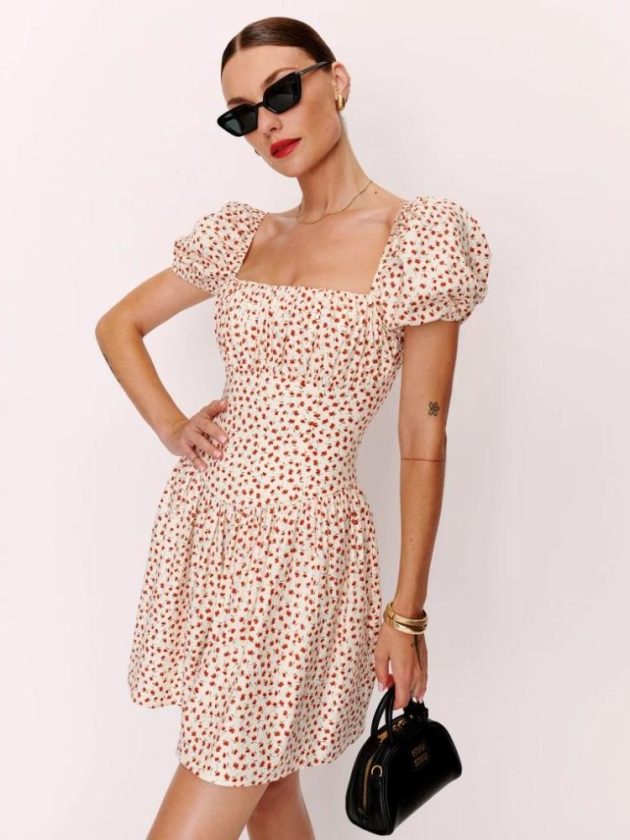
12. Reformation
Fun and flirty, Reformation has fashion-forward dresses for day or night and everything in between.
A leader in fashion for setting sustainability standards, Reformation used 97% recycled, regenerative, or renewable materials in 2023 and nearly 1 in 5 of their sales were resale, vintage, or rental. They also have partnerships with repair company Hemster and resale site thredUP. (Find more details in their sustainability report.)
Conscious Qualities: Responsible Material Sourcing, Circularity Initiatives, Traceability
Size Range: 0 – 12 and 14 – 24 in select styles
Price Range: $$$
Looking for accessories to go with that sustainable dress?
15 Brands with Ethical and Sustainable Sandals
The Best Eco-Friendly Vegan Bag Brands
Beautiful Fair Trade Artisan Jewelry Brands That Shine
The post The 12 Best Sustainable Dresses of 2026 for Any Budget appeared first on Conscious Life & Style.

Green Living
Sustainability In Your Ear: Schneider Electric’s Steve Wilhite Maps the Renewable Energy Transition
The global energy system is changing in two big ways: it is moving from centralized fossil-fuel generation to distributed renewables, and it is becoming more digital in how energy is measured, traded, and optimized. Steve Wilhite, Executive Vice President of Advisory Services at Schneider Electric, works at the intersection of these complementary yet challenging transitions. Schneider supports more than 40% of the Fortune 500 with energy procurement and sustainability strategies, managing over $50 billion in annual energy spending. His experience shows something that pledges and press releases often miss: the biggest challenge for corporate sustainability is not money, technology, or political will. The real issue is the gap between ambition and the ability to deliver. Companies are making Science-Based Targets commitments faster than they are building the infrastructure to meet them. Scope one and two emissions are being managed better, but scope three emissions, which come from a company’s supply chain, still present a systems problem that no single company can solve alone. Schneider’s zero-carbon supplier program suggests what it takes to close this gap. When the company started its own effort to cut emissions from its top 1,000 suppliers by 50% in five years, all 1,000 signed up within two weeks. However, about 84% of them did not fully understand what they had agreed to. Achieving success meant creating measurement tools, education programs, and action plans to help the whole ecosystem, not just individual companies.

This critical conversation explores how renewable energy is bought, including the difference between physical and virtual power purchase agreements. Steve also explains why the Power Purchase Agreement (PPA) market became more complex as it grew, and why 10% fewer renewable deals closed in 2025 compared to 2024, as tech companies used up available clean energy. He also addresses a key question in clean energy: is AI helping the environment overall, or do its energy needs still outweigh its efficiency benefits? Schneider processes over a million energy invoices each month, and about 50,000 of them had issues that took 10 to 15 business days to resolve. Now, a team of AI systems can handle these in seconds. Accurate energy consumption and billing data directly affect emissions reporting, energy efficiency, and money-saving market decisions. He describes Schnieder’s approach as “frugal AI”: using the right-sized models for each task, running them on clean energy, and choosing simple solutions over complex ones. Looking ahead, electrification is building a global digital energy network in which every meter and adjustment contributes to a new system independent of central plants. As intelligence spreads, power can shift to consumers, communities, and businesses. Schneider is enabling this shift by building a mesh grid in which each point both produces and consumes energy, coordinated by AI. These changes fundamentally reshape the global energy landscape. The central question: will we intentionally build this new, distributed system, or will we repeat centralized patterns digitally?
To learn more about Schneider Electric’s sustainability efforts, visit se.com.
- Subscribe to Sustainability In Your Ear on iTunes
- Follow Sustainability In Your Ear on Spreaker, iHeartRadio, or YouTube
Interview Transcript
The post Sustainability In Your Ear: Schneider Electric’s Steve Wilhite Maps the Renewable Energy Transition appeared first on Earth911.
https://earth911.com/podcast/sustainability-in-your-ear-schneider-electrics-steve-wilhite-maps-the-renewable-energy-transition/
Nevada just shattered its March statewide high temperature record by 6 degrees, which is a ‘72 miles per hour in a school zone’ kind of margin. And it happened during the hottest 11-year stretch in 176 years of recorded temperature tracking.
A mid-March heat wave in the American West pushed temperatures in Laughlin, Nevada, to 106°F, far above the previous March record of 100°F. The fact that this happened in March is alarming, especially since it coincided with a near-total collapse of the region’s snowpack. This sets the stage for an early and possibly severe wildfire season. The heat also fits a troubling trend confirmed by the World Meteorological Organization last week: 2015 through 2025 have been the 11 warmest years ever recorded on Earth.
Usually, temperature records are broken by small amounts. What happened in Nevada last month was very different. Some places broke monthly high temperature records by as much as 8 degrees. Reno had seven days above 80°F in March, compared to the previous record of just two days. “It’s not just that we broke monthly records,” said Nevada State Climatologist Baker Perry, “but it’s by how much we broke the monthly records, and not just in one place.”
A Snow Drought That Wasn’t in the Forecast
The heat wave didn’t hit a typical winter landscape. Nevada was already experiencing what Perry calls an unprecedented snow drought. Even though winter precipitation was close to normal and there were big storms in mid-February, warm, moist air arrived soon after. This caused what the National Weather Service called the second-highest single-day snowmelt ever recorded in the eastern Sierra, only surpassed by flooding in 1997.
Normally, snow melts slowly through April and May, but this year it happened all at once in late February and early March. SNOTEL monitoring stations across Nevada show the impact clearly: 70% of sites in northern and central Nevada now report zero inches of snowpack. That’s not just low—it’s gone. The incidence of drought is closely correlated with rising atmospheric CO2 levels recorded at the Mauna Loa Observatory in Hawaii, which is threatened with defunding by the Trump Administration.

What worries scientists most is the combination of these events. “To have these two unprecedented, exceptional events happening at once is a combination that is particularly concerning,” Perry said.
What This Means for Fire Season
Wildfire risk isn’t only about heat. It depends on the sequence of conditions leading up to fire season, and this year’s setup is especially dangerous.
The snowmelt and early rains caused plants to grow weeks ahead of schedule. This early growth creates lots of fine fuels. As these plants dry out over the spring—now with less moisture from snowpack—they become the kindling that can fuel fast-moving fires.
Truckee Meadows Fire Protection District Division Chief August Isernhagen said the early green-up could lead to conditions we haven’t seen before as fire season approaches. He urged people to be even more careful than in recent drought years.
“The majority of our starts, and nearly all of our catastrophic fires are human caused,” Isernhagen said in a statement from the University of Nevada, Reno.
Mountain forests face another challenge. Dawn Johnson, Warning Coordination Meteorologist at the NWS in Reno, explained that losing snowpack this early means heavy timber can become drought-stressed much sooner than usual, turning it into a fire hazard months earlier than normal. A cooler storm pattern expected in early April might bring some relief, but experts warn it may be too little, too late to make a real difference.
Eleven Years. No Exceptions.
The Nevada heat wave wasn’t an isolated event. It happened during the longest stretch of global heat ever recorded.
The WMO’s State of the Global Climate 2025 report, released on March 23, confirmed that every year from 2015 to 2025 is among the hottest ever recorded. Depending on the data, 2025 was either the second- or third-warmest year since records began, with temperatures about 1.43°C above pre-industrial levels. Atmospheric CO₂ reached its highest level in 2 million years, and ocean temperatures set a new record for the ninth year in a row.
UN Secretary-General António Guterres put the streak in stark terms: “When history repeats itself eleven times, it is no longer a coincidence. It is a call to act.”
The report also introduced a new measure called Earth’s energy imbalance (EEI). This tracks the difference between the energy the planet receives from the sun and the energy it sends back into space. In 2025, EEI was at its highest since records began in 1960. Surface temperatures, which get most of the attention, only show about 1% of the planet’s extra heat. Over 91% is absorbed by the oceans, which have taken in the equivalent of about 18 times the world’s total annual energy use each year for the past 20 years. EEI gives a clearer picture, showing that the planet is becoming more out of balance.
“In 2025, heatwaves, wildfires, drought, tropical cyclones, storms and flooding caused thousands of deaths, impacted millions of people and caused billions in economic losses,” said WMO Secretary-General Celeste Saulo. She added that the changes driven by human activities “will have harmful repercussions for hundreds — and potentially thousands — of years.”
What’s happening in the Western U.S. matches the WMO’s global findings perfectly. The report highlighted major glacier loss in 2025 along North America’s Pacific coast. These events aren’t separate—they’re both signs of the same warming trend, just showing up in different ways and times.
“We seem to be entering this new era where temperatures will be significantly higher than what they were ten years ago,” said climate scientist Sarah Perkins-Kirkpatrick of Australian National University. She explained that the changes of the past three years can only be explained by climate change.
What About the Cold in the East?
This is where things get both surprising and important.
If you live in the Northeast, Midwest, or Southeast, 2025 might not seem like a record-warm year. Some parts of the eastern U.S. have had cold snaps and severe winter weather that made national news. So how does that fit with 11 straight years of record global heat?
This actually makes sense in climate science. Climate change doesn’t warm every place at the same time. Instead, it disrupts atmospheric patterns like the polar vortex, which usually keeps cold air over the Arctic. As the Arctic warms much faster than the rest of the planet—about four times the global average, according to NOAA—the polar vortex weakens and shifts, letting cold air move into areas that don’t usually get it.
In other words, the same forces causing record heat in Nevada are also behind the unusual cold in the eastern U.S. These aren’t opposites—they’re both results of a destabilized climate system. Weather feels local, but our climate is shared. When the West is hot in March and the East is cold, both are signs of the same disrupted system.
What You Can Do
- If you live in the West, check current wildfire risk conditions through the National Interagency Fire Center and understand your local evacuation routes and readiness steps before fire season peaks.
- Lower the risk of starting fires. Most wildfires are caused by people, so be extra careful during high-risk times. Don’t have campfires during bans, avoid dragging chains on your vehicle or trailer, and make sure your equipment doesn’t create sparks.
- Support climate policy at both the state and federal levels. Reach out to your Congressional representatives. The WMO data shows the trend is clear. The decisions we make now will shape how severe fire seasons are in the future.
- Cut your home’s carbon footprint by using energy efficiently, choosing cleaner transportation, and making changes to your diet. One person’s actions won’t solve the global problem, but when many people make changes, it can have a real impact on emissions.
- If you live in the eastern U.S., don’t let cold winters make you ignore climate data. Pay attention to what’s happening across the country—the same atmosphere connects us all.
Related Reading on Earth911
How to Prepare Your Home for Wildfire Season
The post The West Is Burning Before Summer Even Starts, and It’s No Accident appeared first on Earth911.
https://earth911.com/earth-watch/the-west-is-burning-before-summer-even-starts-and-its-no-accident/
Today’s inspiration and photo come from Earth911’s Mitch Ratcliffe: “The first step to sustainability is seeing that there is no boundary between you and nature.” This early morning shot of Waughop Lake in Western Washington caught ground fog between a cloudy sky and a perfect reflection in the water below. There is no difference between us and nature, except for the artificial ones we create by imagining boundaries. When we see this essential connection and reverse the artificial disconnections created over millennia, people can imagine a future where we all thrive with a regenerated ecosystem.
Post and share Earth911 posters to help people think of the planet first, every day. Click the poster to get a larger image.

The post Earth911 Inspiration: The First Step To Sustainability appeared first on Earth911.
https://earth911.com/inspire/earth911-inspiration-the-first-step-to-sustainability/



-
Greenhouse Gases8 months ago
Guest post: Why China is still building new coal – and when it might stop
-
Climate Change8 months ago
Guest post: Why China is still building new coal – and when it might stop
-

 Greenhouse Gases2 years ago
嘉宾来稿:满足中国增长的用电需求 光伏加储能“比新建煤电更实惠”
-
Climate Change2 years ago
Bill Discounting Climate Change in Florida’s Energy Policy Awaits DeSantis’ Approval
-

 Climate Change2 years ago
嘉宾来稿:满足中国增长的用电需求 光伏加储能“比新建煤电更实惠”
-
Climate Change Videos2 years ago
The toxic gas flares fuelling Nigeria’s climate change – BBC News
-

 Renewable Energy5 months ago
Sending Progressive Philanthropist George Soros to Prison?
-

 Carbon Footprint2 years ago
US SEC’s Climate Disclosure Rules Spur Renewed Interest in Carbon Credits