Weather Guard Lightning Tech

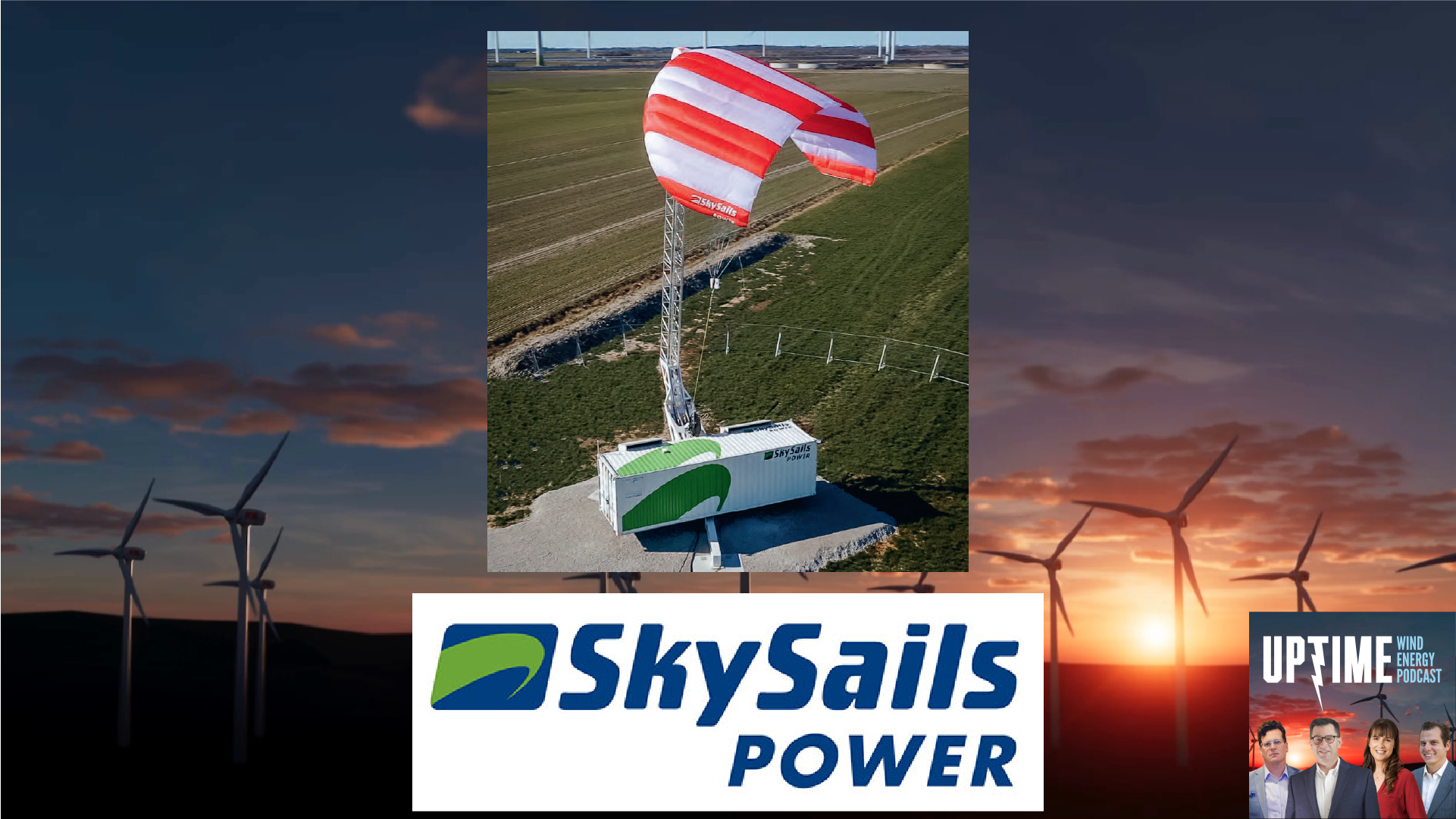
SkySails Power’s Innovative Airborne Wind Systems
Mark Hoppe, VP of Public Affairs & Business Development at SkySails Power, discusses their containerized airborne wind energy system. The innovative technology captures high-altitude winds with kite-based systems, producing up to 50% more yield than traditional turbines. Mark delves into the operational mechanics, deployment in remote and island nations, and future market expansion.
Sign up now for Uptime Tech News, our weekly email update on all things wind technology. This episode is sponsored by Weather Guard Lightning Tech. Learn more about Weather Guard’s StrikeTape Wind Turbine LPS retrofit. Follow the show on Facebook, YouTube, Twitter, Linkedin and visit Weather Guard on the web. And subscribe to Rosemary Barnes’ YouTube channel here. Have a question we can answer on the show? Email us!
Allen Hall: With traditional wind turbines, limited by location and high material costs, the industry needs innovative solutions for clean energy in remote areas. This week we speak with Mark Hoppe at SkySails Power. SkySails has developed a containerized airborne wind energy system that captures high altitude winds with unique kite technology producing up to 50% more yield than conventional turbines while being deployable nearly anywhere on the planet.
Stay tuned.
Welcome to Uptime Spotlight, shining Light on Wind. Energy’s brightest innovators. This is the Progress Powering tomorrow.
Allen Hall: Mark, welcome to the podcast.
Mark Hoppe: Yeah, thanks, man. Nice to be here.
Allen Hall: I’ve been looking to talk to you for. Ooh, going on at least two years because I saw SkySails in Hamburg at the Hamburg Wind Energy Show, and I thought, wow, this is really cool. And then, and the display was [00:01:00] good and the information was good.
I just didn’t know how much effort had gone into it at that point. And, and we’re two years further along, obviously. The SkySails technology and the problem you’re solving is really fascinating because there’s a lot of places on the planet that could use wind energy, but a standard horizontal axis wind turbine is probably the not the right approach, and diesel ends up being the winner on a lot of these places.
Mark Hoppe: That’s a problem. Definitely, definitely. So yeah, our technology solves a lot of these problems, but of course our technology is not just meant for these kind of places. So this is the entry point where we go in as, these places, they’ve faced a lot of issues when it comes to logistics, prices of the diesel because of the transport costs.
That also includes in, in the diesel prices, which then makes the diesel even, even pricier. So, and due to, they have to spend a lot, a lot of money on the diesel. Then they have the issue that they don’t have [00:02:00] the money for social development, for example. ‘Cause they have to subsidize their power prices and all this comes along.
So what we have as a solution for that problem is that we have a containerized wind power system. It’s so-called airborne wind energy system which uses the high altitude wind, which is more powerful. So we fly in heights between two and 400 meters, sometimes even higher. It depends on the width direction and everything.
And due to that we can use the higher wind and then produce 50% more yield than the typical wind turbine at the same size. So that’s crazy.
Allen Hall: Yes, that’s, that’s really good. I think the technology and the approach is innovative. So the, the solution to get rid of all the dependence on diesel and some of these electric grids that are very unreliable is to put in basically electric [00:03:00] generation through a, a kite in the sense the technology seems.
Relatively simple, but I’ve looked at this up close. There’s actually a lot of technology here because the system itself is really containerized. It’s like dropping a diesel generator on site somewhere, but except it’s a kite. Instead, you wanna explain basically how the system operates and what someone would see if they’re watching it work?
Mark Hoppe: Yeah, sure, sure, sure. So basically we, we always divide it into two subsystems more or less. So we have the ground station, which is a container. It’s a 30 feet container, so you can ship everywhere and just need one truck to to, to actually transport it somewhere. So this is really easy. And then you have the flying system. And the flying system at the ground station,
they’re connected via the start and landing mass. And the start and landing mast, so in, in the front of the start and landing mast, you have the kites. So when the start and landing mast goes up, [00:04:00] the in floating wind unfolds the kite and then the, the, the wind takes the kite upwards. And underneath the kite you have a robota, you can call it, we call it the control po.
It’s, you can compare it to a paraglide pilot more or less. And there you have an autopilot who steers to the whole system. Then what does is, I don’t know, have you, have you ever been kite surfing before?
Allen Hall: Yeah, I’ve seen it, yes.
Mark Hoppe: Yeah, so, so when you have kite surfing, you, you try to fly your kite in, in the so-called power zone, ’cause you have the wind window, so in the middle of it you have the power zone there, you have the most force and the autopilot does the same.
So it actually tries to fly inside the power zone all the time. So you have a lot of force on the, on the tether. And when the tether is unwind from the, from the winch inside the ground station, the rotational energy is converted into electricity, [00:05:00] and then you have 800 meter long tether on the drum.
And then when, when the 800 meters gone all the way out, the autopilot takes back the kite in nose dive, so it actually pitches the kite and then it falls down from the sky, and then it has, yeah, nearly no force. Then the generator X as a motor wheels in the, the tether again. And then when the autopilot is at a hundred meter, it starts all over.
So you can compare it to a yo-yo, you know.
Allen Hall: That’s a very good analogy. So the kite deploys out several hundred meters, 800 meters. Providing energy because of that pull force, turning a generator. And then in, when it reaches this extended length, it basically simplifies itself, lowers the drag, comes back in and repeats it.
So does, does that create continuous power then, or how does it handle the, the inward time in terms of. Power production? Is there a battery involved? What does that [00:06:00] look like?
Mark Hoppe: Yeah, so we always deliver our system in different configurations. So a little bit depends on this site conditions. So of course you can use it off-grid.
So what we would do then is we always deliver. So our system comes in a 30 feet container, and then you have another smaller container where you have a grid converter or a battery pack inside. And then so what we do with this solution is that we can always comply to the grid code but also of course can deliver an off grid system.
So you can either store the energy produced or use it direct or grid connect the whole system and then feed it into the grid. So that’s, that’s up to our customers on this side.
Joel Saxum: I think that one of the important things here to think about, like in the beginning of this conversation of how this thing looks, how it operates in the field, is that it [00:07:00] is modularized, right?
Like you’ve guys have taken the smart approach of putting this in a container because a lot of the places that this technology can be used can be on demand. Hey, I, in my mind, I’m thinking disaster response. I’m thinking military uses, remote microgrids. Like we have, we’ve had on the podcast before Hatch. Hatch works with a lot of First Nations up in Canada where they’re in these really remote places.
It’s hard to get infrastructure in there, but if you can bring this in on a truck, great. Right, so there’s a lot of places around the world, and I know this is, that’s just one use case, right? These remote, these Caribbean islands, like Allen was saying. Diesel generators, but they’re paying exorbitant amounts of cost for fuel.
So this thing, this and, and the fact that you can switch over to different grids right. So different her hertz ratings and voltages coming out. Really important. So where have you guys been able to deploy the system so far?
Mark Hoppe: So, so [00:08:00] far, and, and so far we have been installing systems. So we have one system in, in northern Germany, which is our research development side also.
And that one has also been grid connected now for five years. More or less and also been operating since then, but we use it for short durations in our the research development cycle. Then we have another system which has been installed Mauritius for now, also two and a half, three years, something.
Also grid connection, which has been operated all the time because of duration tests. So we actually get some figures about, okay, how last. How lasting are materials and what do we need to do to make them even last longer? So we learned a lot in the, in the past years on that.
And now we take all this into our product development cycles, and now we have another two systems [00:09:00] which are now being delivered to Taiwan. So the next installations will be in Taiwan, and then. We have some projects going on in the Philippines, Cape Words Hawaii. So all, all of these like island states and island nations, they, they, we were really active in these spaces right now.
French Polynesia is also really interesting so far remote places. And all these island states, they have a bigger issue. They have a really big issue ’cause they’re feeling the, the climate crisis first. So they need to solve it. And also, and, and also what, what we are look also looking into, which is a really interesting market, is the Caribbean.
Because there you have the same issues. You have hurricane region. So what they have to do is that they have to rebuild more or less the whole infrastructure every five to 10 years because everything has been destroyed. So they can’t even install any wind turbines because they’ve just been blown away.
And [00:10:00] in Mauritius we have proven that our system actually is feasible to withstand a typhoon many times.
Joel Saxum: Well, and these are good places to do installs too, I suppose from a business perspective. You get to go to the Caribbean, French Polynesia, like that. That sounds amazing. So one, one of the questions I’d ask you is kind of reviewing your technology here.
Do you, do you have a special kind of parachute material and a tether material that you guys use because it’s, you know, it’s long duration. In my mind, I think a parachute is, you know, down, repack put away. But this thing is gonna be out there for a long time. So throughout these great that you guys have had five year tests and it, you know, a two, three year test, have you developed those…or how have those technologies developed?
Mark Hoppe: So well, it has developed a lot and, and there’s still a lot to do. So because we still do a lot of material tests and now we extend them by far what we have done [00:11:00] before. So when you look at the materials, what we use now is for the tether we use Dyneema which is even used in, in, in shooting rests, I think.
And, and it’s like it’s. It’s, it’s better than steel. So it, it’s makes you made for a lot of force. And, and so you can think of, so we, we use a 40 millimeter tether. diameter 40 millimeter. And it, it, it withdraw. It’s, it’s made for I think six tons design load. And and yeah, so, so it withstands a lot.
Then what we use for the kites it’s actually the same kind of materials which we use in sailing, nowadays. And also what they do in development. When you look at the, the sales nowadays also, especially for the performance sail, you know, for the races, what they use there. This is these kind of materials we also [00:12:00] kind of use and also will extend because they are made to last for a lot of force, but they’re in light and all what we need.
And then for example, what we have done now, so we just bought the biggest tether bending machine in the world to actually do the tether testing and to extend all this knowledge, you know, because this is really important, you know, it’s also for the safetyness of our system because everything is built around the tether.
Well,
Allen Hall: Dyneema is the right choice there. That material has been proven over and over and over again in aerospace and in sailing. It is an extremely tough material. Yeah, and you’re only using the, a line that’s about a 10th of an inch wide diameter. That’s actually really small, but it does make sense because that’s the right choice.
Now, in terms of operational aspects one of the things I get ask about SkySails, well, how many hours a day [00:13:00] does it operate? Is it up there 24 hours a day? Is it up there five hours a day? What do you typically see in some of these installations?
Mark Hoppe: Our systems, they, so. Like looking over a year. I think it, it, it’s, it’s good to compare also the different technologies when you look at how many operational hours you have over one year.
And there you always call it full-load hours that you can have over one year. So if you have installed one megawatt then you have 5,000 full-load hours, and then you have 5,000 megawatt hours a yield per year. It’s pretty easy. So, and one year has 8,700 something hours, I think. So and our system has up to 5,000, full-load hours, depending on the size.
Allen Hall: That’s a lot.
Joel Saxum: That’s a, that’s a high capacity factor. Yeah. That’s higher than a, like a horizontal access. Yeah.
Mark Hoppe: Yeah. So if you, for example, compare a coal-fire plan t they have [00:14:00] coal power, power plant, they have ’cause of the service cycles and everything like this.
You have 4,500 full-load hours if you have a offshore winter turbine buying Europe. Depending on the site, 4,000 full-load hours. So what we do is we have offshore wind on onshore sites.
Joel Saxum: And, and what’s the output?
Mark Hoppe: Yeah, so for now now the systems is really small because also because of the sites we want to go into.
So they now have a, we call it cycle power because this is it’s not like what we know from conventional wind turbines. We, we call, we, we always talk about installed power. But we, in our industry, talk about cycle power. So what’s you have in a one power cycle? Yeah. And this is a 200 kilowatt system that we have now in the market.
Allen Hall: Okay. That’s a lot larger than I thought you were at right now. So that a 200 kilowatt sheen can help a lot of people, particularly in rural communities or whether it’s been through a hurricane. Just getting back up [00:15:00] and running is huge because the, the, the load is really simplistic. Lights, maybe cooking those kind of things, air conditioning.
Mark Hoppe: Yes. So the year would be 780 megawatt hours a year depending on the site, of course again. But that would be enough power for I think so just talking in German households. ‘Cause I have the number in my mind. So that would be something between two and 400 households. For one with one transmission..
Allen Hall: Yeah. It seems like a, the proper solution in, in a lot of cases. So what’s the deployment plan then? If you have a larger community, would you deploy two SkySails systems? Would you install a larger system? What does that look like in terms of the, the right approach and the units and to the community?
Mark Hoppe: So what can see now, so looking at our, how, how we go into the market now. So now we have this 200 kilowatt system which is actually meant for like all these [00:16:00] remote places where we have diesel hybridization with PV hybridization. All these places like remote off-grid solutions mostly and mini grids, micro grids. And then next step would be, and this what we are already have the pipeline is to develop the next bigger system.
Which is then also meant for more developed countries because you have a different load so which you can match. Then of course you match better the needs of, of these specific markets. And then also already planned is next step after that one. So first step would be now something between four and 500 kilowatt, and then the next step is already megawatt system.
And this is already planned to do. So this is already in project plans and everything.
Allen Hall: So what does a megawatt system look like in terms of the kite size? Does it expand? I, I don’t know what the math is. There is by, is it square function? How, how big does kite get versus a 200 kilowatt system to a [00:17:00] megawatt?
Mark Hoppe: Yes. So the 200 kilowatt system uses kites up to 180 square meters. Also depending on the wind distribution. So if you have a high wind site, you use a smaller kite. If you have a low wind site you use a bigger kite. So you can use the same system, but you just exchange kite, which is also really great.
When it comes to material intensity. Then if you look into the megawatt system. The kite size would probably be something between 700 square meter up to a thousand.
Joel Saxum: How do you, okay, so I’m thinking, I’m thinking in my this is my traditional mind thinking about wind, wind farm, siting and these other things.
So of course, like if you, Hey, we’re gonna build a wind farm here. You know, a year before that we put a mast tower out there. We measure the wind resource. We have a general idea of what it looks like at 10 meters above the surface and sometimes, you know, 50 or a hundred. How do you measure the [00:18:00] wind resource at 400 meters of, of height?
Like what does that look like? Because I don’t, I’ve, I don’t think I’ve ever seen a map that says, here’s the wind resource at 400 meters.
Mark Hoppe: So actually there is no, so this is why you’ve never seen one probably. Yeah, and this is a really interesting question actually, because, yeah. How do you measure the wind?
So nowadays we have what we do, we do kind of the same. So when we do project development so what we do is first, okay, our customers come to us and they, okay, we have an idea of a site which would work for us. And then what we do, we, we have, internal developed tool chain, which we use then do a small, like, like a really fast site scouting to get an idea of, okay, if this is this site actually feasible. With weather data, which we can just get from databases, everything is calculated.
Like is there a business case? Like pretty, pretty, pretty easy stuff. And then after that next step would be that we go there [00:19:00] and then we actually put a lidar on, on the site. And then we do a lidar measurement campaign. So also wind measurement campaign, but by, by using a lidar we can use we can measure the wind power up
far higher. And that’s, that’s it.
Allen Hall: All right. So this sounds really doable. I just did a quick Google search to see what the square meter area of an Airbus A380 is. It, it’s about, it’s about 850 square meters. So you’re talking about a kite that has the wingspan roughly as an Airbus A380, which is, it’s big, but doable. I mean, obviously those airplanes are flying around, so it is not particularly hard to, to make something of that size, particularly in, in a kite form. So this seems relatively straightforward. Once you cross that megawatt threshold, then your market expands dramatically. Correct?
Mark Hoppe: Yeah, it expands dramatically.
And then and, and, [00:20:00] and even for what, what, what then is the steps do is actually to put them offshore. To put them on the floor because then it expands even wider because what, what we, what we can do with this technology compared also to conventional technologies, which we have on the market nowadays.
Is that also there the floater can be much, much smaller because if you compare it to wind turbine. So the, the wind turbine has all the weight up in the sky and what does it do with the float? So the float must be really big because. Take care of the binding moments up in the ocean. And if you not have these binding moments, you don’t even need a floor, which is that big because if you look at our system, all the weight is on the ground.
So the only thing you need is actually an anchor, so it doesn’t swim away because of the kite.
Allen Hall: Alright, so let’s, let’s walk through the, the math of that for a second. So instead of putting out a 15 megawatt turbine and all the, [00:21:00] as Joel has pointed out on the podcast numerous times, the complexities of doing that, the ships, the pounding, the monopile, all the regulatory aspects.
Mark Hoppe: The material intensity.
Joel Saxum: Pure cost. Yeah.
Allen Hall: Pure cost, right? So you’re cutting out all the steel. Pretty much out of a wind turbine.
Mark Hoppe: Even the rare earth, because like if you, if you look at the wind turbines because they need to take care of the weight they need the rare earth is because otherwise the generator and, and, and the mag magnet inside for the, for the gear would be too to, to, to, would, would have too much weight, you know?
And since we don’t have that issue, we can use other materials like yeah, other materials, which is, which are not that easy, which are much more easy to get, you know. So because we don’t have the weight issue.
Allen Hall: Okay, so the cost would come way down. The simplicity would be there, the deployment would be easier. Are you seeing [00:22:00] interest in this and on offshore applications? I’m thinking Joel, I’m thinking California.
Joel Saxum: I’m thinking Gulf of Mexico. Because now, now you’ve, now you’ve solved the hurricane problem. Hurricane’s coming, wheel ’em in, shut ’em down for a second. Hurricane blows through, put ’em back up. So you remove that blade problem that we have in the Gulf of Mexico.
Mark Hoppe: That would be, that would be great. That would be a great site to actually, to, to develop such systems. And then yeah, and even though, even, even even sites like the, the coast of Japan, because in Japan you have the deep sea really deep sea coast, which means that it’s really hard to install any other wind turbines ’cause it’s deep, you know.
Allen Hall: As this technology develops over the, the next roughly year or so, you must be ramping up on the factories and the scale and to be able to produce these units. But that does seem like. There’s a lot of advantage here, particularly on the cost side. Man, even in like UAE, saudi Arabia, places like that, where there, there is wind, [00:23:00] just deploy it, boom, boom, boom.
Right? So what does that look like? Are you scaling up at the minute to, to take some of these orders because the math works out it looks like.
Mark Hoppe: Yeah, so actually we talk in the right moment. So what we do now is actually, so. We have, we have taken the step to develop the technology and we have proven the technology also by having the first, also being the first company in our industry to have a verified power curve last year.
So we, we made the proof for the technology that it actually works and produces power. And this year’s all about to go into the market. And we do this making big steps forward. So as we have a lot of customer inquiries and we’ve not done any. Any outreach from our side, so it’s all inbound.
Which is great. But now, so, so now we say now our customers are actually [00:24:00] ready to reserve their production slots. This is what we do now. So they can reserve the production slots and then we will deliver the system when they need them.
Allen Hall: So where can they see a system today? Like if, if I wanted to see a system in action, would I, would I just go to YouTube?
Would I, would I travel over to Germany? I. Where would, where I go to Mauritius, where would, where would I go to go see this live?
Mark Hoppe: So to see them live, of course it’s always good to go to Northern Germany or to Mauritius. But then of course in the near future, where you will see some flying in Taiwan.
And then we will extend to the Philippines. And then probably will be next or French, we will see, which is faster. And hopefully also Hawaii.
Allen Hall: I love Hawaii.
Joel Saxum: There we go. That’s where we want to go.
Mark Hoppe: Yeah, yeah, of course. I, I’m happy to invite you when, when you, when you’re ready to, to, to run, we take another podcast there I would say.
Allen Hall: That would be terrific.
Mark Hoppe: Yeah. We, so we actually, we are just ramping up, huh? We just ramping up this [00:25:00] whole, this whole market and, and this is really exciting to us.
Joel Saxum: Every country is different with airspace laws. Now there’s some, there’s some global stuff, general guidelines, right? But there’s every country’s different.
Like there’s these, you can’t fly a kite over 500 feet in the United States. Then you run into airspace and you have issues. How have you guys circumvented or dealt with some of those local airspace regulations?
Mark Hoppe: In our industry. There are different approaches right now. Because some of them, if you, if you compare the technologies they’re two different concepts.
So the one we use is the textile kit, and then you have other companies which uses rigid wing which, okay, we have our, why we use textile kite. We have a lot of yeah, issues why we do that and not do the other approach. But if you compare them, then the rigid wing companies, they claim that they’re kind of a drone [00:26:00] because of course they kind of look like a drone, a tether drone, more or less.
It looks like an airplane like a small airplane. But if you compare our kites with them then our kite is not an airplane.. Sorry. It, it’s not as immovable. And it so what we classify as is an obstacle.
Joel Saxum: Like a tower.
Mark Hoppe: Yeah, like a tower. Yeah. Like a structure. And then because of that we of course we need some marking, which means we now also have developed an integration concept, which comes with different kind of
yeah, safety measures. So, ’cause what we always have to take care of in, in using the airspace is that you have to take care about the safeness, of course. So all the other airspace users, they need to be aware of what you’re using as an airspace. Which means that you need marking. And the marking could [00:27:00] be that you have lighting.
It’s like a wind turbine. You have every 50 meters. You have some, some lighting on the tower flashing. And then, then, and what we use, we use kind of the same. So we have a lighting on the ground station, on the, on the mass, and then at the controlled part. And then the kite is also a white and red color.
And then what we also want to implement is a a map mark for the for the aerospace maps. For like a symbol for, for, so, so that, you know, okay, there’s an obstacle. And then you of course need some awareness campaigns to to, to make all them aware of the technology. And like, this also comes with more installations, of course.
And then for now, what we, what we try to get is a solution where we use EDDs danger zones. So like they, all the pilots are aware of, okay, there’s something, [00:28:00] but you can fly in, you can fly through. So it’s not a restricted zone, but it’s like a danger zone. So they even use these danger zones for, in Europe, they use them also in other countries for drones, for example for drone use spaces and stuff.
So yeah, that’s the way to go now.
Joel Saxum: In the States, it would be covered under a. I think right, Allen? A certificate of authorization for use, then that’s filed. Filed with the FAA, then they can go from there but.
Allen Hall: ‘Cause there are buildings that are operate, that exist, that are taller than what you’re flying at today in the world.
So you’re, you’re not the tallest object on the planet at the minute. And obviously there’s hills and mountains and things that are much taller. So I, this makes a ton of sense. So anybody who wants to find out about SkySails, you need to go to the website because there’s a ton of great information. They, yeah.
And the website is skysails-power.com. but they’re also on LinkedIn. You can see a lot of SkySails information there and their [00:29:00] YouTube channel. Yeah, YouTube is, the YouTube channel is really good. And, and check it out there. Mark, how do people get ahold of you if they want to acquire one of your systems or see a demo?
How do they do that?
Mark Hoppe: So it’s actually the easiest way would be just to visit our website and, and file us an inquiry. Or you can just send us a yeah a message on LinkedIn.
Allen Hall: Great technology. Fascinating. And the, the growth of this technology is astounding. One megawatt kites or sails does seem like a way to make more wind energy pretty slick. So check out skysails-power.com. Mark, thank you so much for being on the podcast and keep us up to date as things progress, especially if you go to Hawaii.
Mark Hoppe: Yeah, we will do that. Thank you Joel and thank you Allen
https://weatherguardwind.com/skysails-airborne-wind-system/
Renewable Energy
Blade Breaks at He Dreiht, Suzlon Posts Record Quarter
Weather Guard Lightning Tech
Blade Breaks at He Dreiht, Suzlon Posts Record Quarter
A V236 blade fails during construction at He Dreiht. Plus a 53 GW US wind forecast, Suzlon’s record quarter, and what turbine noise really measures.
Sign up now for Uptime Tech News, our weekly newsletter on all things wind technology. This episode is sponsored by Weather Guard Lightning Tech. Learn more about Weather Guard’s StrikeTape Wind Turbine LPS retrofit. Follow the show on YouTube, Linkedin and visit Weather Guard on the web. And subscribe to Rosemary’s “Engineering with Rosie” YouTube channel here. Have a question we can answer on the show? Email us!

The Uptime Wind Energy podcast, brought to you by StrikeTape. Protecting thousands of wind turbines from lightning damage worldwide. Visit striketape.com. And now your hosts
Allen Hall: Welcome to the “Uptime Wind Energy” podcast. I’m your host, Allen Hall, and I’m here with Matthew Stead, Yolanda Padron, and Rosemary Barnes. And to lead off this week, s- there’s been some trouble in the North Sea. On July 22nd, a blade failed on one of the turbines at EnBW’s 960-megawatt He Dreiht offshore wind farm.
Uh, EnBW spokesperson said there were no injuries, thank goodness, and that the authorities were notified immediately, which is generally the case in Europe. They’re very safety conscious, of course. But the machine was a Vestas V236, which is a– that 15-megawatt offshore turbine that Vestas is offering. And He Dreiht is where the platform [00:01:00] has made its debut.
So Vestas and EnBW are working together on an investigation, an RCA, a- along, uh, looking at the environmental impact because parts of the blade landed in the water. And the, the images I saw online were like a sheer web that was being pulled in onto a ship, so big pieces of blade. Uh, there’s gonna be 64 of these turbines going into that wind farm, but this is probably a little bit of a weird thing because it does seem like that the wind farm is under construction when the blade broke, which is not the first time this has happened, right?
That we’ve seen blade breaks at, uh, Vineyard Wind and at Dogger Bank on the GE side. Is this just a construction issue, Yolanda, you think? Or is it some sort of, uh, vibration that’s happening during construction that’s putting extra stress on the blades?
Yolanda Padron: We were talking about it a little bit offline and how it might be a loading [00:02:00] issue because it’s not, uh, it’s not in the optimal operating, uh, conditions, right?
Uh, but this is– It’s– I don’t like that it’s becoming a trend more than an anomaly from what we’ve seen on this podcast. Uh, Matt, I know you work a lot in solutions, right? What, what would you recommend people start doing?
Matthew Stead: Yeah. I think, um, more and more there’s ways of just checking out, you know, pre-construction, um, you know, some of the vibration modes, some of the unusual, um, wind loading when it’s in standstill, you know, different yaw angles and so forth.
So there, there’s more and more ways of, um, checking out what the blade is doing when it’s in those unusual, um, sort of pre-con, pre-operation phases. So, um, you know, for instance, um, we do know that there is some sort of sometimes edgewise or flatwise vibration, which, um, you know, maybe is not normal, um, and maybe could be, be [00:03:00] thought about in a bit more detail.
Um, certainly I know there are some research organizations which are looking into this and also, you know, things like blade twists. Um, so what is actually happening in terms of the, um, the twisting of the blade along, along its axis.
Allen Hall: I think the last time this happened, I remember going back and looking at patents about how to protect the blades during this construction phase.
So you wanna prevent the blade from generating lift from sideways winds pretty much. So the designs that I saw were like putting like a, a netting across the blade to disrupt the airflow so that it wouldn’t generate lift. But I haven’t really seen that implemented. Maybe it is being implemented, but these loads are a little odd, right?
I, I, I’m wondering if there’s any IEC certification test that looks into them, uh, just because it’s, it’s happened a couple of times now, more than a handful.
Matthew Stead: We, we saw, um, we saw that picture of some blades on the ground. [00:04:00] You remember they were in storage. Um, there was a, a strong wind that came across them when they were in storage, and there was some, some flutter and, you know, some, some damage it caused, uh, even when they were on the ground.
Um, yeah, I think just thinking out loud, you know how on some, you know, wind stacks and, or, you know, turbine stacks and, um, you know, poles, you know, exhaust stacks. Sorry, that’s the word I’m looking for. Exhaust stacks. They have the, the spiral around it. You know, it’s for around vortex shedding. So maybe it’s an opportunity for, for Rosie to jump in here and, uh, and comment.
But, um, maybe we can put like vortex, uh, spiral vortex, um, you know, dissipators on the, on the blades before they’re fully commissioned.
Rosemary Barnes: So it’s cer- certainly not a, a matter of the design just being a little bit wrong, right? That would mean that it would last for a, for a while and then And then break. But it, it also, it could be several things.
It could [00:05:00] have been a manufacturing defect, a bad one. It could have been transport damage. Tho- those are two other things. It could have been, yeah, you know, like a, a new design feature or material that performed massively differently under real loads than what it did, um, you know, in their computer models and in their coupon tests and in their, um, static tests, fatigue tests that they did.
It could be any of those things. Sometimes you do see problems where technically you’re not supposed to leave the rotor locked out for any period of time because it is not designed for the off, off-axis weird loads that you can get when the blade is oriented in a suboptimal way compared to the wind.
And there have been instances where it’s like technically, you know, that was in the instruction manual, however, nobody ever followed it, and it’s only under extreme circumstances where that actually is severe enough to break it. There, there can be instances like that [00:06:00] where I would say that it- it’s pretty difficult/impossible to actually design s- for safety during any conceivable series of events during installation.
The way that you would do it would be to make sure that the blade can handle any wind load and, you know, up to the maximum gust at any, at any time in any position. But having, you know, done a little bit of work, um, on blade design in my past, it is massive. That is just a massive, massive load that is y- it will never see in its lifetime.
You would have such heavy, expensive blades if you actually designed it like that. Um, and so yeah, the That, that would be probably the most charitable reason for a failure where nobody really did their job wrong. It’s just kind of like some bad luck that happens every now and then.
Allen Hall: Well, it does seem like there’s a trend there between Dogger Bank, Vineyard Wind, [00:07:00] some of the things we’ve seen in China.
During the construction phase, those turbines are very vulnerable and the, the blades can break. Aren’t there extra precautions that could be put in place? Like, you, you could obviously do weather forecasting, and I know that that’s done, but it does seem like it’s, uh, such a consequential problem to have a blade break on a turbine in the North Sea, near Germany.
Like, that, that’s just bad PR. Even if you have all the engineering precautions in the world there, you would still maybe play it a little bit safer so this wouldn’t happen?
Rosemary Barnes: It’s really hard. Like I said, if you want to design it so that a blade won’t break under these, like, really unusual set of operating conditions that happen during construction, not during– Like, during operation it has to be able to handle whatever is thrown at it, like, no doubt.
Um, everybody agrees on that, including, you know, certification bodies. But during installation, yeah, if you want your blade to be able to handle anything that [00:08:00] that area can throw at it, even, you know, one in 50, one in 100 year storm that comes up unexpectedly, I personally think I haven’t done the optimization.
I wouldn’t be surprised if people had. In fact, I would be surprised if they hadn’t. But I bet that it will cost more to design every blade to withstand that than it would to lose the occasional one, you know, one out of What is it? Like one out of 500 blades or something this happens to, one out of 1,000?
I, I, I don’t know, maybe even less, less than that. Um, you know, so it’s, I don’t know how much these blades cost new, but, you know, say a few hundred thousand. Uh, it’s just, it’s gonna be it, it’ll be more cost-effective to lose the odd one every now and then. And like you say, it’s bad PR, but, um, I don’t know.
Is it that, like- It- … things, things happen, things break sometimes. Um, yeah, I don’t know. Is the PR that bad? I’m not sure.
Matthew Stead: So [00:09:00] I, I’ve got a question and, um, you know, on LinkedIn, you know, you see whenever there’s a, um, whenever there’s a failure on L- um, e- everyone posts about it.
Rosemary Barnes: Condition monitoring would’ve stopped this.
If there had only been condition monitoring that, that turbine, then they wouldn’t have had a blade break during construction. That’s why I’m so hesitant to, to, you know, make any calls now ’cause I don’t wanna sound like one of those
Allen Hall: LinkedIn losers. LinkedIn loser.
Rosemary Barnes: I learned that the last, um, root cause analysis, like, you know, catastrophic blade failure, um, the last one that I, uh, yeah, got approached to work on, I was told y- you know, like half a dozen different companies have approached us after they saw this in the news.
So people are ambulance chasing. I’m like, “Oh my goodness, should I, should I be ambulance chasing? Is this a new, a new thing that I should be doing?”
Allen Hall: Let’s take a quick break and when we come back, a fresh forecast says the United States is building more wind than anyone expected As wind energy professionals, staying [00:10:00] informed is crucial, and let’s face it, difficult.
That’s why the Uptime podcast recommends PES Wind magazine. PES Wind offers a diverse range of in-depth articles and expert insights that dive into the most pressing issues facing our energy future. Whether you’re an industry veteran or new to wind, PES Wind has the high-quality content you need. Don’t miss out.
Visit peswind.com today. Well, here’s a number that runs against the mood of the industry. Wood Mackenzie now expects the United States wind industry to add more than 53 gigawatts of capacity by 2030. That is a 5% increase over the previous quarter’s five-year forecast, and the reason is really straightforward.
Shovels are in the ground. Developers pushed to start construction ahead of the July safe harbor deadline, and firm turbine orders reached 1.1 gigawatts, five times the level of a year earlier. So demand is holding up too, [00:11:00] led by a 1.9 gigawatt deal between Google and Xcel Energy. So the One Big Beautiful Bill, or OB3 as I’ve heard it called more recently, is driving wind energy installations up for the time being.
This is somewhat of a positive measure. Does it demonstrate in, in sort of uncertain terms that wind is still a choice for a lot of energy developers?
Yolanda Padron: I mean, we’ve still seen a lot of wind developers continue on, right? And just maybe put something further back down the timeline than they initially would for, for a new project.
Uh, but I, I don’t know. I kind of equate this to, like, you know when there’s, like, a massive sale or something on a, at a store where it’s like, “Everything must go”? And I feel like everybody was just kind of leaning towards that in the short term, and then there’s probably gonna be a lull, [00:12:00] and then just go back to, things will probably just go back to normal, I think.
Matthew Stead: My, my take is that if I had a spare few billion dollars, um, and I was in the energy market I would be building wind solar and battery. And so I would see it continuing
Allen Hall: The existing Department of War review, this is that are not being completed, so it’s holding up a number of projects. That’s gonna eventually hit the courts.
I know it’s in the courts right now. I’m– At least that seems to be some of the news about it, and my guess is based on previous history in the courts is that they’re gonna force the Department of War to either finish the analyses and make some sort of proclamation or to allow them all to pass through.
Uh, just put a stay on the, in the Department of War. I’m not sure how that works because I’ve never heard of that happening in the past, but w- you know, we’re in new times [00:13:00] obviously. But if they, if the courts were able to tell the Department of War to stand down and let the developers go, that would be very interesting.
I think you may see some more activity in wind and that was, you know, off the table just a couple of weeks ago. Is, is that the feeling? I, I know that there’s also some larger discussions. I was listening to this discussion from an MIT analysis about how wind is gonna suffer because solar is so cool and battery is the hot thing.
But in reality, good luck, right? I think you have to have all of the above scenario to get your projects done. If you can’t rely on gas turbines, you better be looking for every possible electricity-generating piece of equipment you can get your hands on right now.
Yolanda Padron: Do you guys think it’s gonna be one of those things where the US kind of turns away from its traditional cowboy-like way of approaching wind [00:14:00] turbines?
Or at least like blades, you know? Because there’s gonna– there seems to be a lot more I, I don’t know if a lot more restrictions, but a lot more implementation of those restrictions on the operation of wind turbines, um, just like from bird monitoring and just a lot of issues that you might see on a wind site that maybe people didn’t care too much to look at before.
Allen Hall: Well, the argument that MIT was making was operating wind turbines is harder than running a solar farm, which generically is true early on. I think that’s probably true. But from what I see from solar farms and hear from operators, solar farms are not easy either. They have their own problems like fire, hail, uh, yeah, bad inverters, electrical problems, animals eating the wires.
Like, everything comes with this set of issues that it has to work through. But wind’s been going a little bit longer. I feel [00:15:00] like there’s an infrastructure there that solar is just now developing, and the history from large solar developments like in, in Spain has not been great over time. And Australia’s sort of a little bit of a different case, Rosemary, where most of the solar in Australia is put on top of people’s roofs.
But is there a real advantage to solar and battery over wind?
Rosemary Barnes: I think yes. I think it’s, it, like, it’s not The scale is, yeah, there, it, there is maintenance and management to be done on a solar farm, but it’s not like on a wind farm, uh, in my opinion.
Allen Hall: Why? Why do you say that?
Rosemary Barnes: So when I talk with asset managers for solar farms, their number one challenge, at least in Australia, is, is grass, managing the grass.
And in fact, there were some solar farms in Victoria that got shut down briefly by the safety regulator because the grass levels were not s- not safe in terms of, you know, being a fire hazard. You know, like basically it’s mowing the grass, and it’s once a year driving some drones around that are doing [00:16:00]thermal imaging and seeing if there’s any faults there, and then replacing them.
So there’s stuff to do, but it’s not like as much stuff as there is in a wind farm. I’ve always thought that it’s wrong to have wind and solar competing against each other, and it’ll be, you know, like one renewable generation to rule them all. I think it’s definitely true that solar is cheaper and simpler than wind energy.
It had a big disadvantage up until recently because it turns out that the sun sets every single night. I’m not sure if you guys were all aware of that, but, um, yeah, people, people have gotten in touch with me on LinkedIn comments to let me know that that’s true, that the sun sets every night, and sometimes it’s not windy.
Are these two… You know, mind absolutely blown from the, um, YouTube commenters.
Matthew Stead: LinkedIn losers. Yeah.
Rosemary Barnes: Not so much LinkedIn losers, like YouTube, YouTube, um, I don’t know, Y- YouTube enthusiasts. But then batteries came along and started getting cheap enough that you can quite easily cover, you know, at least the evening peak with, um, by adding [00:17:00] batteries to a solar farm.
So I think that that together has reduced how much wind energy we need by a bit. But what it hasn’t touched is, um, the times when there isn’t solar available. So wind can step in for that, wind can step in for cloudy weeks and, you know, that’s somewhere like Australia, which is, you know, the most favorable place for solar plus batteries.
But then when you head to somewhere more northern, somewhere with a more severe winter, less sun, uh, and more, you know, demand for heating, et cetera, then y- you know, you just can’t do without wind. It’s, it’s, it’s doing a different thing than what solar is. So I do think that it’s wrong to think solar or wind.
We have to be better than solar. Um, we need to be better for sure. We being wind energy. Wind energy does need to be better, but not because it’s in a competition with solar, but because it’s in a competition with, you know, fossil fuels and y- just being able to [00:18:00] do the transition, energy transition at all.
Allen Hall: We’ll be right back after a short break, and when we return, a turbine maker having a very good year, and it may not be one that you would guess
Delamination and bondline failures in blades are difficult problems to detect early. These hidden issues can cost you millions in repairs and lost energy production. CIC NDT are specialists to detect these critical flaws before they become expensive burdens. Their nondestructive test technology penetrates deep into blade materials to find voids and cracks traditional inspections completely miss.
CIC NDT maps every critical defect, delivers actionable reports, and provides support to get your blades back in service. So visit cicndt.com because catching blade problems early will save you millions.
Well, not [00:19:00] every wind turbine maker is having a hard year. Suzlon Energy has posted its highest ever first quarter deliveries, 506 megawatts of wind turbine generators. Revenue for the first quarter of the fiscal year came in at 3– 38.19 billion rupees, or roughly $398 million. That is up 22 and a half percent from a year ago.
506 megawatts delivered in a single first quarter says the machines are not just being ordered, they are going up. So there’s a, a big demand in India. India is trying to get into a lot of solar and wind and some battery storage to improve the electricity grid there. S-Suzlon is gonna be a, a winner in that race.
At least there’s just a handful of companies that can really participate because of the way that India has structured the market there. But the Suzlon stock dropped, uh, a couple of percentage points on this news as the net profit was a little tighter than analysts would have [00:20:00] preferred, so there was a lot of profit-taking earlier in the day.
But the long-term forecasts have to be very positive for Suzlon, right? It, it’s just been a long-term player in India and elsewhere even, United States being one of those places, um, Australia being another Is it a positive sign that they’re just seeing more orders, more deliveries, that eventually the profit margin will jump up and that Suzlon will be extremely profitable, kinda like Vestas is now?
Matthew Stead: Yeah, I mean, they’re a, you know, great, great company. They’ve got great product. Um, they’ve got a great market in India. You know, India is growing. Um, I think they’ll continue to improve. I, I would’ve thought it’d be a great stock.
Allen Hall: It’s, it does seem to be a little bit of a rough ride just because there’s now a lot of competitors within India, Adani being one of them.
There’s o- other wind turbine manufacturers in India. Uh, not a lot of European participation. And was it GE Vernova is essentially out. [00:21:00] Is that right, Rosemary? GE Vernova is out of India altogether at the moment.
Matthew Stead: And Siemens Gamesa as well?
Allen Hall: Oh, that would be Omtera. I’m not sure if Omtera is in India at the minute.
Yeah.
Matthew Stead: Thanks for the reminder.
Allen Hall: Do you think it’s gonna be a little bit of a rough ride? I think that’s my take on it. And even though the demand will be there and the, the government is making a huge push for it, it, it… Nothing is easy in wind is when you’re trying to scale up because it’s such a huge industry.
Everything’s big. Everything’s expensive. You’re trying to expand your capacity. It doesn’t go smooth, and you’re gonna spend more than you would’ve spent because you gotta get new people in, and you need more equipment, you need more tooling. Everything gets more expensive as you’re doing it. I would expect the profits to drop down a little bit as you’re growing.
That’s normal.
Matthew Stead: I disagree. I, I think, you know, that they know what they’re doing. They’ve been doing it for a long time. You know, the market is growing, uh, but, you know, they’ve done it before. So I, you know, apart from their little wobble a while ago, um, I, I think it’s, it’s optimistic for [00:22:00] Suzlon.
Allen Hall: The growth of Suzlon and all the Indian wind turbine manufacturers internally allow them to, uh, do much more work outside of India.
Do you think that will help their order book, just because they’re successful in India and have that baseline of a marketplace that they can reach out to other parts of the world?
Matthew Stead: Yeah, I think that one’s– That’s gonna be harder , ’cause there’s a whole lot more competition.
Allen Hall: Right. That’s the real question.
How are they gonna compete against the Chinese in, in places where they don’t have a foothold yet?
Matthew Stead: Yeah, I mean, that one’s tricky. And, you know, I think, you know, while Suzlon has done well in Australia, they haven’t necessarily maintained their, their lead in Australia. So yeah, outside of India, it’s probably a different story.
Allen Hall: Isn’t Europe the next marketplace just because it won’t be banned like China has essentially been with- within Europe, the greater Europe? That Suzlon would be that one place, that one company that would be allowed in to, to make some onshore turbines?
Matthew Stead: I think we spoke about that probably about two months ago, and that was definitely in the news that, you know, Suzlon were looking at expanding into, into [00:23:00] Europe and, uh, exactly making the most of that.
Um, yeah. So that, maybe that’s their, their golden, um, export market.
Allen Hall: Well, a project in Queensland just got cut in half, and for two reasons at once. Alinta Energy has dropped the southern portion of its Mount Challenger wind farm in the Whitsunday Hinterlands. Six months of LiDAR monitoring showed that the wind resource at Kelsey Creek was not as strong enough to really to support the turbines, and the company also heard from residents opposed to turbines in that area, and a local action group gathered more than 6,000 signatures.
And for developers, it’s, it’s really a case study in wind data and the community arriving at the same result. But we’ve seen a lot of action up in Queensland more recently. Uh, I’m not sure what’s driving all the opposition to wind turbines, but I’ve seen news stories about it in the United States. [00:24:00] It’s great to have Matthew here because he’s an acoustician.
Uh, some of the discussion in the community, uh, event that I saw was just discussing 40 decibels of wind turbine noise, and which didn’t sound like a lot. And when I looked it up online, 40 decibels was like a library, which I think is being fairly quiet.
Rosemary Barnes: Yeah. Imagine if something got built near your property that was so noisy it was as bad as being inside a library or having a refrigerator in your home.
Easy to see how your life could be ruined.
Allen Hall: Matthew, what’s the, what’s the amount of noise from a, a road going by? Like a truck going by on a road, what is, roughly what is that?
Matthew Stead: I mean, that can quite easily get well above 60, 70, um, sometimes 80. I mean, the analogy, um, that I like to use is that each turbine has the sound emission which is similar to a truck.
[00:25:00] You know, a reasonable sized truck. Okay? So each– imagine each turbine is a truck. Um, but those trucks are a kilometer away. So, you know, the noise level decays in a logarithmic way. Um, and so by the time you’re a kilometer away, the noise from that truck is quite low. An individual turbine is gonna be way, way, way, way, way less than 40 But, you know, there’s more than one turbine, so you need to add them up and it’s n- it’s not a, it’s not a, you know, 20 plus 20 equals 40.
It’s a logarithmic addition. There are many, many, many people that live on busy roads with not 100 trucks, but thousands of trucks. So, you know, the noise exposure from a road can be way, way, way more than from a, you know, a wind farm.
Rosemary Barnes: That’s one of the things that strikes me when I have a, a look at, um, yeah, like Twitter comments for this particular post and everyone’s like, “Oh my God, that’s so terrible, 40 decibels.”
Like, yeah, I can see [00:26:00] why you’re ruining– that’s ruining your life. And yeah, I, um, I, you know, said that sarcastically at the start, but there’s, there’s plenty of, you know, hundreds of people that are, um, you know, thinking along the same lines, but the majority of them are like, “It should be legislated. You know, there should be rules around this.
They can just do whatever they want.” But, uh, the, it is legislated, right? Like, we all accept that wind turbines make noise. It is legislated. You can measure it, right? And so if you h- uh, have a property and you think it’s too noisy for the wind turbines two or three kilometers away, there’s something you can do, right, Matt?
Can you maybe tell us what is the process that, that happens when somebody thinks that a wind farm is too noisy?
Matthew Stead: So a few things. So, um, normally at a house, um, where you’re, say you’re a kilometer away, normally the ambient environment can be louder than the wind farm. The first challenge is to actually measure the noise from the wind farm and not from the ambient environment.
So what that means is that normally, um, measurements are taken around a wind [00:27:00] farm before the wind farm’s even built, and so that way we actually know, well, how much is the ambient noise. Um, and you know, the ambient noise is probably above 40 for a good proportion of the time. So th- that’s the first thing.
You need to understand what the noise environment is like before the wind farm. And then, um, using highly sensitive, highly calibrated, um, sound level meters, which can be, you know, 0.1 decibel accuracy, um, you can then monitor the sound before and after And then compare the two. But what happens is, um, as I said, it’s normally very difficult to separate out the sound from the wind turbine from the general environment.
So then what, um, there are different methods then to, um, either measure in like, um, halfway. So if you measure halfway between the wind turbine and the house, then you can start to separate out the wind turbine noise from the general environment and then do a, you know, propagation or a [00:28:00] prediction or extrapolation of what it’d be at the house.
Um, the other way of doing it is actually measuring at the turbines. So you can measure the individual turbine sound and compare that to what was expected, um, and then sort of validate, um, the initial, you know, source levels. You know, is it really a truck or is it, um, quieter or, or louder than a truck?
Rosemary Barnes: And if they do, it, it– I mean, I’m sure on occasion that people do get it wrong in terms of the noise.
They are able to do stuff about that. That’s partly what the, um, serrations on a blade are, are there to make a, um, a blade quieter. And you can also just do something as simple as turning down the turbine when, um, wind conditions are such that you know that it’s gonna be particularly noisy. No one wants to do that because you get less power output, but certainly you can do something about it if it turns out to violate the conditions of the, um, y- you know, the noise that they promised it when the turbine was, when the wind farm was developed.
Matthew Stead: Yeah. And, um, you know, in the past, it’s [00:29:00]improved a lot, but in the past there were some unusual sounds that came from some turbines, which came from like the gearboxes and, you know, you know, the drivetrain and so forth. Um, but, you know, those things are– they’re, they’re mechanical machines as we spoke about, you know, and they can be addressed, and they can be dealt with through, through design and good engineering, and also, also fixed, you know, retrospectively as well.
And like you say, Rosie, um, if there’s too– if there’s more aerodynamic noise than expected, um, there are serrations and, and lower noise add-ons that can be added. Um, but also many of the turbines also have noise modes, uh, so it can be slightly derated y- with, with certain sectors of wind, um, wind direction and wind speeds to, you know, reduce the noise further.
It is an absolute science. It’s really well understood. It’s, it’s measurable. I mean, there is some uncertainty in the measurements, but it’s, it’s, yeah, there is a lot of knowledge about this topic.
Allen Hall: Well, I just had a math question. If they want to reduce the decibels by like three [00:30:00] dB, what kind of power reduction are we talking about?
Is it like a 5% decrease or 50% decrease in power output to achieve that three dB reduction in noise
Matthew Stead: Yeah. Uh, I don’t have the maths in front of me, but it would depend on the power curve and the actual make model, but I, I… It’s not, it’s not half the power. It’s, it’s, it’s, it’s, um, less tweaks to the power output than, than that much.
Allen Hall: So i- it’s not a massive number. It’s, it’s a reduction of course, but it’s not, you’re not losing a, a ton of revenue.
Matthew Stead: No, no. I mean, obviously it depends, but yeah, it’s not necessarily a ton of revenue loss.
Rosemary Barnes: But I think it’s a real shame, ’cause like when I look at, you know, social media posts where, um, people are up- upset about noise, like they are clearly not aware that there is a very mundane process to go through.
Like, you know, it is not… You don’t, you don’t have to get so worked up. If you’ve got noise at your house and, um, you know, it’s upsetting you, [00:31:00]there is a very established process that you can go through and it can be, it can be fixed. And I know from, you know, the asset managers that I, I work with, um, that are some of my friends, like I, I know that they want to help you.
They do not want people living around the wind farm to hate the wind farm. So y- you need to get in touch and let them know, and, and I… They’re gonna be able to fix your problem. If it’s, if it’s detectable y- you know, with the methods that Matt said, then they are gonna be able to, um, fix it. I know that sometimes people say that they can hear noise, and you just cannot find any evidence of it, and therefore you cannot, there is nothing you can do to that wind farm operation to be able to solve that problem.
So I’m not saying in every case if you think you’ve got a problem they’re gonna be able to solve it, but if they can pick it up with a, what is it called? A noise meter? A decibel meter? Yeah, whatever that doodad’s called. If they can pick it up on that, then they can, they can fix the problem for you. And yeah, it’s just, uh, it, it upsets me that, you know, people are really, are really getting worked up [00:32:00] about this issue, but there’s a, a process to go through.
Matt’s holding it now for everyone just listening in. It’s like the size of, I don’t know, a liter of milk. It’s just not it’s not, not a complicated thing.
Matthew Stead: I think one of the big challenges that we’ve had is that there’s been a lot of negativity around noise, and then people get sensitized. And so, um, the, you know, what I’ve, um, what I, what I’ve heard many times is, um, the sensitivity to noise can be communicated Um, so, you know, like Rosie, if I tell you you’re gonna be really annoyed by this thing, this thing is coming, you’re not gonna like it, you’re gonna hate it, and then you’re sensitized to it, and then you’ll tend to have more of a, you know, a, a response
Rosemary Barnes: If we’d gone on a nationwide campaign to, you know, visit every house that’s within 600 meters of a y- you know, of a road and, um, you know, given impassioned speeches to them about [00:33:00] how it would ruin their life, then yeah, it is easy to see how we would be so fixated on it that our lives would really be ruined.
Allen Hall: Meanwhile, the Australian band AC/DC came to Charlotte the other day to a sold-out concert at the huge football stadium, and I guarantee you that concert was way above the noise level of a wind farm.
Rosemary Barnes: I hope so. Imagine if imagine if a, a bunch of whingers in the audience are like, “Excuse me, I’ve got my little noise measuring doodad and it’s over 40 decibels.”
Allen Hall: Well, that wraps up another episode of the Uptime Wind Energy podcast, and thank God for that. If today’s discussion sparked any questions or ideas, we’d love to hear from you. Reach out to us on LinkedIn, and if you found some value in today’s conversation, please leave us a review. It really helps other wind energy professionals discover the show.
And don’t forget to subscribe so you never miss an episode. And so for Rosie, Yolanda, and Matthew, I’m Allen Hall, and we’ll see you here next week on the Uptime Wind Energy [00:34:00] podcast.
Renewable Energy
The Latest Chapter in Trump’s Depravity
About 40% of Americans are proud to have a president who would commit the act of cowardice described at left.
Renewable Energy
Rick Steves Understands World History, and Doesn’t Like What He Sees Here in the U.S.
Well-educated people see what’s happening here in Trump’s America, and they’re calling out a warning. Are we listening?
Congressional Republicans seem to be OK with their legacy: I helped destroy the United States of America.
Rick Steves Understands World History, and Doesn’t Like What He Sees Here in the U.S.
-
Climate Change12 months ago
Guest post: Why China is still building new coal – and when it might stop
-
Greenhouse Gases12 months ago
Guest post: Why China is still building new coal – and when it might stop
-
Greenhouse Gases2 years ago嘉宾来稿:满足中国增长的用电需求 光伏加储能“比新建煤电更实惠”
-
Climate Change2 years ago嘉宾来稿:满足中国增长的用电需求 光伏加储能“比新建煤电更实惠”
-
Climate Change2 years ago
Bill Discounting Climate Change in Florida’s Energy Policy Awaits DeSantis’ Approval
-
Renewable Energy9 months agoSending Progressive Philanthropist George Soros to Prison?
-
Carbon Footprint2 years agoUS SEC’s Climate Disclosure Rules Spur Renewed Interest in Carbon Credits
-
Greenhouse Gases1 year ago
嘉宾来稿:探究火山喷发如何影响气候预测