



- What timeline options were delegates debating?
- How did the timeline discussions unfold?
- What were the main points of disagreement?
- Why is the IPCC in a ‘serious funding crisis’?
- How have scientists reacted?
- What other issues remain unresolved?
- How are the IPCC AR7 reports progressing?
- How might the IPCC use AI and enhance gender inclusivity?

Nature is not only mother to us all, but our shared witness. Because truly, we are never alone when in the hallowed company of the elements, and life of the earth.
Sometimes, it is the immensity of things which reaches inside you—oceans, sky and sun, or the curve of the terrestrial distance—while at other moments it is the intensity of intimate association at a smaller scale, like a single tree you know as a friend, or a specific combination of scent, stone, water and light, felt uniquely in situ.
In both great and small manifestations, the natural world solemnly and playfully attends our lives as we go about our business on this, our singular living planet.
I felt this sense of nature incarnated as an attentive companion acutely this week, when walking between meetings along the Swan River.
If you grow up in Perth, even in one of the outer suburbs as I did, the Swan River, or Derbal Yerrigan in the language of the Whadjuk Noongar People, is always there as a presence.
The bits I know best feel like a kind of emotional map of the journey through the years, as evocative as any diary. This patch, where I threw a cricket ball around with my best mate in the early evening, laughing at the joy of being alive as the spinning pill arced against the twilight; that slight bend in the path, imprinted with the ambivalent tension of being about to sit university exams; there, the site years ago, of running around at the feet of my Dad, as young as I can remember him; here, a spot that summons the sense of exhausting exhilaration when fecklessly going for a run in the mid-day western heat; and above all that cherished place, I will always associate with love, newly declared and found to be returned.
And other things too, inchoate layers of pleating fragments; thoughts and feelings without number, that will always be evoked in my mind by the sweep of the Swan
What is most evocative or sacred to us is always bound to feeling, rather than the product of any rational calculus. It is also true, though, that geography as memory is complicated by change—something that is a constant in nature; wildly accelerated by human intervention; and now spiralling into the violently unpredictable, because of global heating.
Derbal Yerrigan has no doubt always been changing, in the countless days that the river has flowed since time immemorial; but never altered or transformed in the way has occured since colonisation and industrialisation; nor in the way that is happening now.
I troubled about this while making my way along the Swan this week, and watched as an Australasian darter (Anhinga novaehollandiae) perched on the river wall and spread its wings interstitially, as if gesturing to signify the bonds between the land, water and sky. At that moment, I abruptly remembered that my gaze was not solitary, because far and high in the air behind me were the lidless eyes of the city skyscrapers, including the dark towers of the fossil fuel giants, Woodside and Chevron, staring down with abject contempt for the future.
I suspect like many of us, I feel a perpetual mental struggle between the dissonance of the everyday, which, even despite spring temperatures soaring 15 degrees Celsius above average, still has a normalcy to it that is discordant with what we know about the realities of global warming, and the forecasts of what is to come. The Swan, like all rivers, now faces its most violent test yet of rising temperatures and extreme unnatural events.
The attendance of nature to our lives is not passive. If we think only of ‘the environment’ just as subject, we miss the point of both our own embeddedness in this world, and of the agency of life itself. Every species on earth has an innate energy to flourish and reproduce. The Swan River will keep on rolling, with all of the intense hydrological power at its command. Given half a chance nature will resurge and rebound in wood and feather, tooth and maw.
Our conscious task, I think to myself, but mentally addressing both the bird and the river, is to purposefully draw on the power of this meaning; an internal strength derived from the preciousness of our memories imbricated in place.
I pause and offer a silent pledge to the River: you’ve always been there for us. And in the activism, ingenuity, campaigning and commitment of millions of determined people across Australia and the world, all of whom are dedicated to stopping the destruction of nature and the climate and of securing a return to flourishing, so we will be there for you.

Q & A
Greenpeace campaigns are always solution-led, and one of the questions I have been asked a lot over the years is about our systemic solution for Western Australia to reduce emissions at an emergency speed and scale, and get off gas.
This week, it was terrific to be in Perth, joining colleagues to help launch a comprehensive decarbonisation plan for the state, Power Shift: WA’s Electrified Future written in collaboration with Springmount Advisory.
This report comprehensively shows how WA’s economy can be aligned with the global goal of limiting warming to 1.5°C, and breaks down the transition pathway WA can take across energy, industry, transport and agriculture to achieve this. It highlights the challenges and opportunities across each sector, and provides policy level solutions to achieve these ambitions using only already-existing technologies. You can check out the report here.
Continue Reading
Three countries have been named by the Paris Agreement’s compliance committee for failing to submit a nationally determined contribution (NDC) and repeatedly snubbing offers of help with their climate plans.
After months of internal debate over whether to identify serial non-responders, the Paris Agreement’s Implementation and Compliance Committee (PAICC) named the three countries which have failed to engage with it over their NDCs on Friday.
It named Democratic Republic of Congo, Senegal and North Korea in a footnote of its annual report, adding that it decided to name them “with a view to facilitating engagement”, adding that representatives of the three nations had been invited to its meeting in early 2027 “with the purpose of identifying any challenges and constraints”.
“The Committee noted the importance of Parties engaging with the Committee in a timely manner, while noting that some delays may be due to the national capabilities and circumstances of the Parties”, the report said.
-
Under US pressure, World Bank says it will back gas “where appropriate”
The US wants the World Bank to expand its gas support while climate campaigners are pushing for it to end – its head spoke this week of limited backing for the fossil fuel -
IPCC scientists vow to press on with climate reports despite political deadlock
After governments again failed to agree a timeline, nearly 120 IPCC authors pledged to complete their assessment on time and with full scientific rigour -
Paris Agreement committee snubbed over missing NDC climate plans
Many governments have still not submitted a nationally determined contribution to the UN, breaching a key requirement of the Paris Agreement
In July, PAICC said 12 countries had ignored its repeated attempts to discuss why they had not published an NDC as required every five years under the 2015 Paris accord.
Members of the committee had been divided over whether to name them, but at a September meeting decided to do so in their annual report to the annual climate COP summit.
By the time the report was published on Friday, only Congo, Senegal and North Korea “had not communicated an NDC or submitted a [Biennial Transparency Report] and had not yet responded to any of the Committee’s notifications, despite several reminders issued by the Committee in this regard”.
Rainforest and renewable energy ambitions
The silence from Congo and Senegal is notable because the former is home to much of the Congo Basin rainforest while the latter has sought billions of dollars in climate finance to support its renewable energy ambitions.
After Brazil, Congo has more rainforest than any country in the world. This forest, and the country’s peatlands, absorb huge amounts of greenhouse gas but are fast being lost to expanding farmland, charcoal production, logging and mining.
Senegal signed a Just Energy Transition Partnership with Canada and wealthy European nations in 2023, to help it meet its renewable energy targets under the-then government of Macky Sall. It was chair of the Least Developed Countries group between January 2022 and December 2023.

Tejas Rao, who is researching the PAICC as part of a doctoral thesis at Cambridge University, said the governments of the three countries should engage with the committee.
“Engagement costs these governments very little and the committee has shown it will listen,” he said.
“Silence leaves the committee with no basis to help, and it leaves the [governments] exposed to the narrative that they are simply disengaged,” he told Climate Home News.
Paris Agreement requirement
The 2015 Paris Agreement requires all parties to publish an NDC every five years outlining their emissions reduction targets, with each plan meant to be more ambitious than the country’s last NDC.
The latest set – the third round of plans, with new targets for 2035 – was due in February 2025. While most countries missed this deadline, all but around 30 – mostly small emitters but including Egypt, Vietnam and Argentina – have now submitted them.
Over the year, the PAICC – which is made up of government climate officials from developed and developing countries – has been communicating with governments that have not submitted NDCs and trying to overcome barriers to them doing so.
Some nations have cited exceptional circumstances as the reason for not submitting an NDC, a process that requires a significant amount of work in tracking emissions and consulting on how to curb them across the economy. For example, a letter from a Sudanese official to the PAICC, seen by Climate Home News, said that the country’s civil war had led to the suspension of its NDC preparation.
-
IPCC scientists vow to press on with climate reports despite political deadlock
After governments again failed to agree a timeline, nearly 120 IPCC authors pledged to complete their assessment on time and with full scientific rigour -
Under US pressure, World Bank says it will back gas “where appropriate”
The US wants the World Bank to expand its gas support while climate campaigners are pushing for it to end – its head spoke this week of limited backing for the fossil fuel -
Who shapes climate science? The equity question facing the IPCC
Early completion of the next global climate science assessment reports risks excluding research from the Global South, which is key to ensuring the findings are fair
The US and Iran are not signed up to the Paris Agreement and so do not have active NDCs, nor does Taiwan, which is not a UN member state.
Rao said that because the PAICC is “facilitative and non-punitive”, naming the countries “is meant to open a door, not close one – the invited consultation is the point”.
“In recent months, governments that explained their constraints, whether capacity, finance or domestic process, have been met with follow-up and support rather than sanction, and the number of silent governments has fallen sharply,” Rao said.
The post Paris Agreement committee names three countries snubbing it over NDCs appeared first on Climate Home News.
Paris Agreement committee names three countries snubbing it over NDCs
Countries have failed – for the sixth time running – to agree on the timeline for publishing the Intergovernmental Panel on Climate Change’s (IPCC) next set of influential reports.
The IPCC’s 65th session (IPCC-65) was seen by many to be the final opportunity for countries to agree on a schedule where its seventh assessment report (AR7) would be published in time for the UN’s second “global stocktake” of climate action.
Before last week’s meeting in Addis Ababa, Ethiopia, IPCC chair Prof Sir Jim Skea had warned that releasing the reports in time for the stocktake in 2028 would depend on a timelines being agreed by the end of 2026.
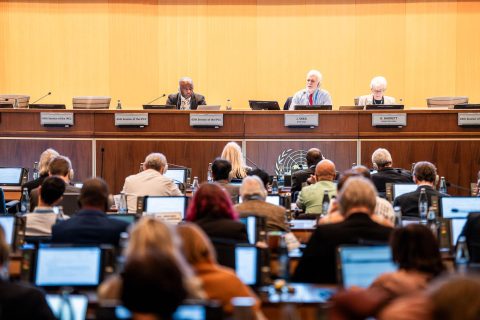
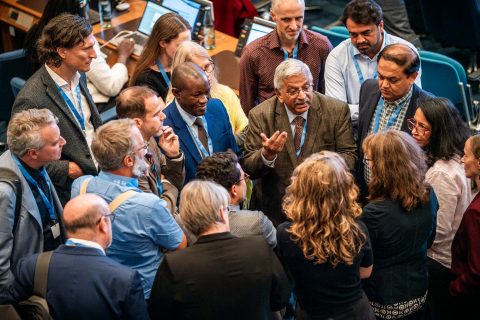
But the week-long meeting descended into fraught disagreements between governments, resulting in Skea “suspending” the talks on Friday evening with no decision made.
Countries were also unable to agree on the IPCC’s budget for the rest of the AR7 cycle, leaving the body with a “serious funding crisis”.
The IPCC has pledged to reconvene the meeting at the “earliest opportunity”; however, it has not yet given an indication of when this will be.
In his concluding remarks, Skea described the Addis Ababa summit as a “profound disappointment” and “among the most difficult IPCC meetings”, according to reporting from the Earth Negotiations Bulletin (ENB).
Some countries have reacted with dismay to the breakdown of negotiations, warning that a failure to have the IPCC’s latest assessments on climate adaptation and mitigation ready for the UN stocktaking exercise would undermine global climate action.
A climate envoy from a Pacific island state said it was a “travesty that a handful of countries continue to delay the IPCC’s reports – the science we need back home to help us save lives and livelihoods”.
Below, Carbon Brief explores the key developments, debates and disagreements at the IPCC meeting.
- What timeline options were delegates debating?
- How did the timeline discussions unfold?
- What were the main points of disagreement?
- Why is the IPCC in a ‘serious funding crisis’?
- How have scientists reacted?
- What other issues remain unresolved?
- How are the IPCC AR7 reports progressing?
- How might the IPCC use AI and enhance gender inclusivity?
What timeline options were delegates debating?
Top of the agenda during the Addis Ababa meeting was a decision on the timeline of the publication of AR7’s three working group reports – also known as the “work plan”. The three reports cover climate science (WG1), impacts and adaptation (WG2) and mitigation (WG3).
Countries failed to reach a resolution on the scheduling of the influential reports at five consecutive IPCC meetings since 2024 – despite drafting being well underway.
(For more, see Carbon Brief’s write-up of discussions in Istanbul, Sofia, Hangzhou, Lima and Bangkok.)
Reporting from the ENB from inside these meetings has highlighted that countries are split, broadly, into two groups – those that want all three reports to be published in time for the UN’s second “global stocktake” in 2028, and those that one, or more, to be published afterwards.
A key pillar of the Paris Agreement, the global stocktake is a formal assessment of the world’s collective progress on tackling climate change. The exercise is designed to guide future global climate action, including decisions on national emissions targets and climate finance.
The second global stocktake is due to culminate in late 2028 at the COP33 c