

This year’s record-breaking typhoon season in the Philippines – which saw six consecutive storm systems hit the country in under a month – was “supercharged” by climate change, according to a rapid attribution study.
The Philippines is one of the most vulnerable countries in the world to extreme weather. Between late October and mid November 2024, the country was hit by a barrage of storms, starting with severe Tropical Storm Trami on 22 October, and ending with Tropical Storm Man-Yi which made landfall on 16 November.
“Typhoon” is the term used to describe a tropical cyclone – a tropical storm with wind speeds of at least 33 metres per second – that forms in the north-west Pacific. (If a tropical cyclone forms in the Atlantic Ocean or north-eastern Pacific Ocean, it is called a hurricane.)
Even for a disaster-prone country, such rapid “clustering” of typhoons was “unprecedented”, one Filipino expert told a press briefing.
By the end of November 200,000 individuals were displaced across six regions – many of whom had been forced from their homes multiple times in just one month.
The World Weather Attribution (WWA) service finds that climate change has exacerbated the conditions that enabled these powerful storms to form in the Philippine Sea, such as warm seas and high humidity.
Of the six major storms that hit the Philippines between the end of October and middle of November this year, three made landfall as “major typhoons” with wind speeds above 50 metres per second (112 miles per hour). This is 25% more likely to happen in today’s climate than it would have been in a pre-industrial world without human-caused warming, the study finds.
The typhoons “highlight the challenges of adapting to back-to-back extreme weather events”, the study says. The authors add that “repeated storms have created a constant state of insecurity, worsening the region’s vulnerability and exposure”.
‘Unprecedented’ typhoon season
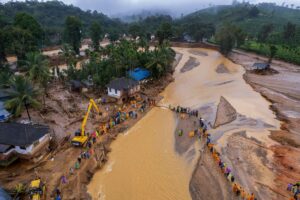
On 22 October 2024, severe Tropical Storm Trami made landfall on the Filipino island of Luzon – the country’s largest and populous island. The storm rapidly dumped one month’s worth of rain over parts of the island, with floods sweeping the country.
However, the residents were given little time to recover. Just days after Storm Trami subsided, the Philippines was hit by Super Typhoon Kong-Rey. More than nine million people were affected by the two storms and almost 300,000 displaced.
As the weeks progressed, the Philippines was hit by Typhoon Yinxing, Typhoon Toraji and Typhoon Usagi. Finally, Tropical Storm Man-Yi made landfall on 16 November, marking the end of the record-breaking month.
Afrhill Rances works at the Asia-Pacific regional office of the International Federation of Red Cross and Red Crescent Societies, and is an author on the WWA study. She told a press briefing that, even for a disaster-prone country, the rapid “clustering” of typhoons in 2024 was “unprecedented”.
Dr Claire Barnes – a research associate at Imperial College London’s Grantham Institute and an author on the study – added that in the Philippines, “in November we would expect to see only three named storms in the entire basin at any point, with only one of those reaching super typhoon status”. A super typhoon is defined as any typhoon with winds above 58 metres per second (130 miles per hour).
The back-to-back storms formed so rapidly that November saw four named storms forming in the Pacific basin simultaneously. Japan’s meteorological agency said this was the first time in seven years – and the first November in recorded history – where four named storms have formed in the Pacific at the same time.
Typhoon intensity
Typhoons are complex events, which can be intensified by climate change in many different ways, including their rainfall intensity, storm surge height and wind speed.
The authors of this study focus on a metric called “potential intensity”, which looks at temperature, humidity levels and sea level pressure over the Philippine Sea where the typhoons formed.
Ben Clarke, a study author from the Centre for Environmental Policy at Imperial College London, told the press briefing that potential intensity indicates the “theoretical maximum intensity for a tropical cyclone”. He explains that the metric is “based on the conditions in the atmosphere and the ocean which are crucial for cyclone development”.
The map below shows the average potential intensity of the Philippine Sea between September and November 2024, where red indicates high potential intensity and blue indicates low potential intensity.
The dotted lines show the tracks of different storms. The black square indicates the study area. Potential intensity is calculated as the potential wind speed of the typhoon in metres per second.

To put this year’s record-breaking typhoon season into its historical context, the authors analysed a time series of average potential intensity in the Philippine Sea, using an observational reanalysis dataset stretching back to the year 1940.
The study says:
“Our best estimate is that the observed potential intensity has become about 7 times more likely and the maximum intensity of a potential typhoon has increased by about 4 metres per second.”
The authors also carried out attribution analysis to assess whether the increase in potential intensity can be linked to human-caused climate change.
Attribution is a fast-growing field of climate science that aims to identify the “fingerprint” of climate change on extreme-weather events, such as heatwaves and droughts. To conduct attribution studies, scientists use models to compare the world as it is today to a “counterfactual” world without human-caused climate change.
The authors find that the potential intensity in the Philippine Sea in 2024 was 1.7 times higher than it would have been in a world without climate change. They add that the maximum potential intensity of a typhoon has increased by about 2 metres per second due to climate change.
(These findings are yet to be published in a peer-reviewed journal. However, the methods used in the analysis have been published in previous attribution studies.)
Landfall
Climate change is exacerbating the conditions needed for tropical cyclones to form. However, tropical cyclones are still fairly infrequent and there is a “short period of reliable observations” of tropical cyclones that make landfall, according to the study.
This can make it challenging for scientists to assess the impact of climate change on the frequency of tropical cyclones using traditional methods.
To address this problem, researchers from Imperial College London developed a “synthetic tropical cyclone dataset” called IRIS earlier this year. This dataset uses observations from 42 years of observed tropical cyclones to create a “10,000-year synthetic dataset of wind speed”.
The database includes millions of synthetic tropical cyclone tracks. Each track maps the wind speed of the tropical cyclone from its formation to its landfall, to describe how its power changes throughout its lifetime.
The team has already used this method to attribute the extreme winds of Typhoon Geami and Hurricane Beryl, which hit China and Jamaica, respectively, earlier this year.
Of the six major storms that affected the Philippines in the month-long period, three made landfall as “major typhoons”, according to the WWA. The authors define a major typhoon as a category three or above, indicating sustained wind speeds above 50 metres per second.
Using the IRIS dataset, the authors assessed how likely it is for three typhoons to make landfall in the Philippines in a single year under different warming levels. They find that in today’s climate – which has already warmed by 1.3C as a result of climate change – the Philippines could expect three major typhoons to make landfall in a single month roughly once every 15 years. This is 25% more frequent than in a world without climate change.
They add that if the planet warms to 2C above pre-industrial temperatures, “we expect at least three major typhoons hitting in a single year every 12 years”.
‘Supermarket of disasters’
The Philippines is one of the most vulnerable countries in the world to extreme weather events and natural disasters, and is already facing deadly impacts from climate change.
The country’s location in the Pacific ocean makes it highly vulnerable to typhoons, volcanoes and earthquakes. The WWA study adds that the country “is experiencing sea level rise more than three times faster than the global average”. And the Philippines is facing deadly heatwaves, which have been made more intense as a result of climate change.
Rances told the press briefing:
“In the Red Cross we call the Philippines a ‘supermarket of disasters’, because you name it – we have it.”
The Philippines is struck by more typhoons every year than almost any other country in the world. It has “gradually shifted its approach from reactive to proactive risk management with a significant focus on preparedness and resilience building”, according to the World Bank.
For example, warning and pre-emptive evacuation orders were sent out ahead of many of the typhoons this year. Schools, ports and airports were closed in many regions. And disaster response teams were mobilised.

However, the unrelenting barrage of typhoons this year overwhelmed many of the country’s disaster preparedness systems, exhausting supplies and overstretching emergency responders. It also left communities with little time between storms to recover and prepare.
The United Nations Office for the Coordination of Humanitarian Affairs estimates that, at the end of November 2024, more than 200,000 individuals were displaced across six regions, hundreds of fatalities and injuries had been reported and more than 250,000 homes had been damaged. The damage to livestock, agriculture and infrastructure was estimated to be around $47m at the end of November.
The Filipino government spent more than $17m on food and other aid for the hundreds of thousands of storm victims. It has also sought help from neighbouring countries, the US and the United Nations.
The consecutive typhoons “highlight the challenges of adapting to back-to-back extreme weather events”, the study says. It adds:
“With 13 million people impacted and some areas hit at least three times, repeated storms have created a constant state of insecurity, worsening the region’s vulnerability and exposure.”
The authors warn that “major investment is needed to help the Philippines adapt to extreme weather”.



The post Record-breaking Philippines typhoon season was ‘supercharged’ by climate change appeared first on Carbon Brief.
Record-breaking Philippines typhoon season was ‘supercharged’ by climate change

Climate Change
“Sink or swim”: WA Gov hugely underestimating decline in regional gas demand while sleeping on green exports, new report finds
PERTH, Tuesday 13 October 2026 — A new report from Greenpeace Australia Pacific and Springmount Advisory reveals green commodity exports are an untapped economic opportunity for Western Australia in a declining Asian gas market, while offering a genuine solution for decarbonising Asia.
From Gas to Green: Building Western Australia’s Future State is a comprehensive analysis of the declining gas market in Asia, and the untapped economic opportunity for WA to become a global leader in green commodity exports while driving the regional shift away from fossil fuels.
The report offers key recommendations for the WA Government to support regional decarbonisation through an orderly phase out of gas exports in favour of green iron and other green exports. It comes as global climate leaders from across business, politics and advocacy prepare to meet for the Global Citizen Now: Perth event focused on decarbonising WA.
Key findings:
- Gas demand is falling across WA’s core markets in Asia: Gas demand fell in 2025 and is projected to continue to decline, driven by a combination of global geopolitical factors and domestic concerns.
- Policy shifts in key markets since the war on Iran now prioritise renewables and nuclear over gas: Japan, South Korea and China have legislated energy plans that prioritise renewables and nuclear over gas.
- New WA gas would arrive in a saturated, uncertain Asian market filled with cheaper gas: The US is now the world’s largest liquefied gas producer and plans to double its capacity as it also targets Asian markets.
- Green commodities offer a real solution to sustain WA’s economy: WA can lead Australia’s green commodity exports, which by 2060 could be worth almost a trillion dollars.
- Exporting more WA gas is likely to delay or impede Asia decarbonisation: Despite claims by the gas industry, there is no evidence that WA gas is displacing coal in Asia, and in fact diverts resources from genuine decarbonisation options.
Geoff Bice, WA Campaign Lead at Greenpeace Australia Pacific said: “As our export partners in Asia shift away from expensive and polluting gas, the WA Government has a golden opportunity to pivot our economy to green exports, like green iron, which is the most effective way to help our region to decarbonise.
“The writing is on the wall: gas is in decline, renewables are our future. In this context, it makes zero sense for the government to encourage high risk projects like Woodside’s reckless Browse gas proposal at Scott Reef.
“This report clearly shows that the WA Government faces a choice: sink or swim. They can either allow the gas industry to keep ripping off West Australians and continue propping up its decline, or choose the path that will deliver enormous benefits to the state and the world by becoming a leader in the rapidly expanding green economy.”
Tom Quinn, Managing Director of Springmount Advisory: “Western Australia prospers when it looks to the future and builds for future demand. Twenty years from now, what the world needs is green commodities made using WAs abundant renewable resources. Just like it did with iron ore in the 1950s and gas in the 1970s, WA should look to the future and build what the world will need, not sunsetting industries like gas that are already past their peak.”
-ENDS-
Media contact
Kate O’Callaghan on 0406 231 892 or kate.ocallaghan@greenpeace.org
Lucy Keller on 0491 135 308 or lucy.keller@greenpeace.org
A report from Greenpeace Australia Pacific and Springmount Advisory reveals the untapped green economic opportunity for Western Australia in a declining Asian gas market, which also offers a genuine solution for decarbonisation in Asia.
Is Western Australia clinging to a fading gas industry while a thriving green future passes it by? As major Asian trading partners rapidly pivot away from volatile gas imports toward cheap solar and battery storage, this report exposes a high-stakes choice: risk becoming stranded in an oversupplied fossil fuel market, or harness WA’s unmatched sun and wind to lead the global clean energy transition.
Summary
From Gas to Green: Building Western Australia’s Future State reveals that Western Australia (WA) faces a critical juncture as falling Asian gas demand, geopolitical gas supply volatility and accelerating renewable energy deployment undermine the long-term economic viability of gas exports. By harnessing its world-class wind and solar resources, the report demonstrates that WA can execute an orderly phase-out of gas and pioneer a green commodity export economy that could generate $987 billion in economic value by 2060, create 24,000 ongoing jobs, and drive a 9.6% reduction in global greenhouse gas emissions.
Key Findings
- Gas demand is falling in Asia – WA can no longer rely on gas exports: Gas demand in core Asian markets fell in 2025 and is projected to continue to decline in 2026. Legislated energy plans in Japan, South Korea, and China now prioritise renewables and nuclear over gas.
- Asia is increasing renewables, importing gas just gets in the way: Evidence from markets like Thailand suggests that gas imports are increasingly crowding out cheaper renewable energy investments and battery storage rather than displacing coal, locking in more emissions over time.
- Green commodities offer a real solution to decarbonise Asia – this is a major win for WA: With world-class renewables, WA can lead Australia’s green commodity exports, which by 2060 could be worth almost a trillion dollars ($987 billion) and support a genuine 9.6% reduction in global emissions.
Recommendations to WA government
Recommendation 1: Plan an orderly gas phase-out aligned with a trading partner pivot plan
Implement a managed, orderly phase-out of gas exports aligned with trading partners’ decarbonisation pathways, rather than waiting for demand to collapse, by:
- Developing and implementing a staged phase-out of gas facilities aligned with feedstock supply expiry or typical end of facility lifespans.
- Committing to no new gas development for gas expansion, including Browse and Kimberley fields.
- Developing new, reciprocal trade relationships with existing gas trade partners, structured to progressively replace gas exports with green commodities – integrated with recommendation 2.
Recommendation 2: Develop an integrated green commodity export strategy, positioning WA as a global green iron manufacturing hub
Establish an integrated green commodity export strategy that immediately prioritises green iron development, positioning WA as a global green iron manufacturing hub, by:
- Committing to green commodity export targets to give industry and investors a clear demand signal.
- Prioritising green iron as the lead sector within the broader green commodity strategy, given WA’s iron ore endowment and first-mover potential.
Recommendation 3: Reject false solutions such as carbon dumping (CCS) and blue hydrogen
Reject carbon dumping (also described as carbon capture and storage, or CCS) and blue hydrogen as viable decarbonisation technologies, and prioritise green hydrogen and proven renewables for clean energy and fuel production by:
- Excluding blue hydrogen projects (and CCS-dependent projects) from all government support programs.
- Requiring existing hydrogen-based production (including ammonia, methanol, synthetic fuels) to have clear, near-term transition timelines to switch to green hydrogen production.

What you can do
Together, we can push for a prosperous green future.
You can help by:
- Sending an email to Environment Minister Murray Watt and Prime Minister Anthony Albanese, calling on them to reject Browse.
- Sharing this story to help more Australians understand what’s at stake.
- Encouraging your friends and family to take action.
REPORT: “From Gas to Green” Building Western Australia’s Future State