


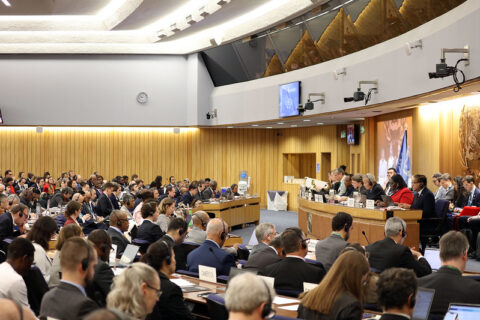
- What happened at COP31?
- What has the reaction to the presidency been?
- How has the role of oil-rich nations been portrayed?
- How has the role of developed nations been portrayed?
- How has the role of developing nations been portrayed?
- How has the role of China been portrayed?
- What does this mean for the consensus process and reform?
- Could COP31 send a ‘positive signal’?

I am a descendent of the Mdewakanton Oyate, the Dakota people in Minnesota, and an enrolled member of the Sicangu Oyate in South Dakota. My lifework has emerged from weaving together my cultural identity, my writing, and my work in food sovereignty, helping to reclaim and protect our Indigenous seeds and food traditions.
My mother was Lakota, enrolled on the Rosebud reservation, but her experience in boarding school disconnected her from her community. I grew up focusing instead on early social justice issues with the environment.
In April 1970, before there was an Environmental Protection Agency, or a Clean Air Act, or a Clean Water Act, the first Earth Day was created to spark what would become a national environmental movement. As a sophomore in high school, I celebrated this first-ever event with a group of teenagers assigned to pick up trash alongside the road. For many of us, this occasion was another opportunity to protest the gas-guzzling, war mongering, materialistic, misogynistic, racist society that we were part of. Protecting the environment seemed like an extension of many parallel movements to challenge social injustice, including the American Indian Movement, civil rights, and protests against the Vietnam War.
In college, I began working for the Minnesota Public Interest Research Group, my dream job working to change the world. I researched and lobbied against the use of hydrofluorocarbons, and met my hero, Ralph Nader. I believed, as did many of my generation, that we had the passion and commitment to create a more just and equitable world while protecting the environment.
Through my early work as a writer, I explored issues of cultural identity, assimilation and historical trauma. I encountered a profound turning point in 2000, when I first heard of the old, rare, tribal seeds that were being grown out in Farmington by a tiny, bare-bones Native program called Dream of Wild Health. As both a writer and a gardener, this was the moment in which my passion for cultural recovery and environmental work came together.

On a ½ acre garden, they were growing Cherokee Trail of Tears corn that was descended from the original removal of the Cherokee people, Hopi black turtle beans, and traditional tobacco that was said to be hundreds of years old. These seeds carried stories of the land, the seasons that had formed them, the hands that planted them, as well as the turbulent histories of the people who protected them over many generations. For some of these seeds, there were only a handful remaining.
When I was hired by Dream of Wild Health in 2008, I was blessed to work with Native elders, farmers, youth and their families, and the seeds themselves, relearning an Indigenous relationship with the land that was intrinsic to my identity as a Dakota/Lakota person. Being a good relative to all living beings is one of the most important teachings for Dakota people. We say, Mitakuye Owasin, We Are All Related, as a way of claiming kinship with our seeds, water, land, plants and animals, that is rooted in reciprocity, or caring for each other. Indigenous peoples of the Americas developed 3/5 of the world’s foods that we rely on today, establishing the original organic, local, and sustainable food systems.
I also learned the hard history around our Indigenous seeds and foods, and the ways in which they have been used to coerce Native people. Arapaho elder, Ernie Whiteman, once said to me, “If you can control the food, you can control the people.” In the late 1800s and early 1900s, tribes were forced onto reservations where they lost access to their traditional foods from hunting and gathering, and became dependent instead on commodity foods that were high in starch and fat. This had a profound cultural impact as well. The ceremonies and prayers that were part of planting and harvesting were not needed when food came in sacks and cans.
In place of traditional gardens and foodways came a new relationship with the land that treated plants and animals as commodities. This new agricultural system relied on intensive chemical fertilizers and pesticides and introduced genetically modified seeds, seemingly without regard for the long term health of our soil, water and food. How our food is grown is intimately connected to the environmental issues we face, contributing to our current climate crisis. And yet despite the marketing claims that an industrialized food system is needed in order to feed the world, an estimated 10% of our global population is now hungry, many of them children. The same is true for the United States, while diet-related diseases are reaching epidemic levels that disproportionately affect low-income communities of color.
Through my writing and education work, as well as participation at COP28, I am committed to helping restore our relationship with the earth that recognizes how we are all connected down to the smallest bacteria. Rebuilding sovereign food systems that are framed with principles of justice and equity will help heal the health of our communities as well as the earth. When seeds are planted with prayers and songs, tended with love, and shared with our community, then our food once again becomes our medicine.
Portions of this story were adapted from an essay, Seeds for Seven Generations, that was first published in the anthology, “A Good Time for the Truth.”

Diane Wilson is a Dakota writer, educator, and bog steward, who has published four award-winning books as well as numerous essays. Her novel, The Seed Keeper, received the 2022 Minnesota Book Award for Fiction, and her memoir, Spirit Car: Journey to a Dakota Past, won a 2006 Minnesota Book Award and was selected for the 2012 One Minneapolis One Read program. She has also published a nonfiction book, Beloved Child: A Dakota Way of Life, a middle-grade biography, Ella Cara Deloria: Dakota Language Protector, and co-authored a picture book—Where We Come From. Wilson is a Mdewakanton descendant, enrolled on the Rosebud Reservation. She is the former Executive Director for Dream of Wild Health, an Indigenous non-profit farm, and the Native American Food Sovereignty Alliance, a national coalition of tribes and organizations working to create sovereign food systems for Native people.
Diane is a Climate Generation Window Into COP delegate for COP28. To learn more, we encourage you to meet the full delegation and subscribe to the Window Into COP digest.
The post Reclaiming Food as Medicine appeared first on Climate Generation.
Continue Reading
Dan Ioschpe is the Climate High-Level Champion for COP30.
A year ago at COP30 in Belém, we said this would be the decade of implementation for climate action. Simply put, implementation is the fastest way to promote sustainable socio-economic development. But implementation is not about words. It is about action, on the ground, at speed and scale.
COP31 in Antalya demonstrated why the implementation of the Paris Agreement must extend well beyond the two weeks of a climate conference. Despite political divisions, businesses, investors, governments, cities and communities came with results and remained committed to scaling climate action, showing that the real economy does not wait.
That is why continuity matters. In Belém, the Global Climate Action Agenda was given a new structure, with six thematic axes, and Plans to Accelerate Solutions (PAS). Because that structure carries work from one COP to the next, progress can compound. And progress is now something we can measure.
This year’s Yearbook of Global Climate Action shows that 87% of PAS reported progress, while 38% of the 40 with quantitative targets are on track or ahead of their goals. It highlights where the gaps remain.
Grids stretching halfway around the world
The strongest signal from Antalya came from electrification. The Electrification Delivery Package brings together more than 200 actions from over 180 organisations, involving over 150 countries plus the European Union – together over two-thirds of global GDP – and more than 260 businesses with over $4 trillion in annual revenue.
The results are already visible on the ground. Members of the Utilities for Net Zero Alliance built more than 21,000 kilometres of grid in 2025, up from 14,000 km the year before – enough to stretch halfway around the world. From grids, storage and renewable power to energy access, the foundations of a modern, interconnected system are coming together at speed and scale.
-
Australia and South Korea’s clean energy deal could boost low-carbon trade
The deal aims to connect Australia’s renewable resources with Korean industries’ clean energy demand, potentially transforming a relationship built on coal and gas -
After COP31, our chance to save climate diplomacy lies in global shipping
If COP31’s high ambition countries can show the same resolve at London shipping talks, a climate breakthrough is possible next week
The Global Climate Action Agenda is helping connect these investments and shift from individual solutions to economy-wide transformation. Electrification is simply the fastest way to foster sustainable socioeconomic development – efficiently, affordably, and securely.
On transport, 13 zero-emission freight corridors are now in development across six continents, covering more than 29,000 km of roads. That is already ahead of the Global Green Road Corridors Initiative’s goal of ten corridors by 2026.
Sustainable aviation fuel starts to take off
Progress is also visible on sustainable aviation fuel (SAF), a solution approaching a positive tipping point. One in three new sustainable industry investment decisions this year was for SAF, a sign of how quickly the market is developing, including through an Action Agenda plan to decarbonise aviation.
Projects that have reached final investment decision represent around 7 million tonnes of SAF a year, or 3% of today’s jet fuel use. But the wider pipeline stands at 31 million tonnes – around 11% of the existing market. Once sustainable solutions capture 5-10% of an established market, growth can become self-reinforcing as costs fall, supply chains mature and investors gain confidence. Across heavy industry more broadly, 36 deep decarbonisation projects reached final investment decision this year – a record.

On nature, the Tropical Forest Forever Facility has reached $8.3 billion in commitments towards its $10-billion initial target, and the Global Fund for Coral Reefs announced $30 million in new reef financing across 22 developing countries.
With the launch of the Rio Synergies Group for Action, implementation will be at the centre of the three Rio Conventions on climate, biodiversity and land, and 17 governments are now backing the Intergovernmental Land Tenure Commitment to strengthen the rights of Indigenous Peoples and local communities.
On food and agriculture, solutions range from methane-reducing practices reaching more than 5,000 smallholders to food recovery initiatives now reaching 40.5 million people, cutting food waste and emissions at the same time. Some 66 million hectares are now under regenerative landscape projects.
Accelerator to support two solutions per year
Antalya also laid the groundwork for progress. Mandated by the Mutirão Decision in Belém, the Global Implementation Accelerator established its governance and operational framework at COP31. Each year, two solutions – one on mitigation and one on adaptation – will be selected for coordinated support, informed by independent expert assessment and mobilising the capabilities of a dedicated partner network.
The Accelerator builds on the Action Agenda, bringing governments, businesses, finance and technical expertise together to accelerate solutions with the potential to reach positive tipping points.
None of this happened by accident. It was possible because a structure is in place that allows progress to compound – connecting political guidelines with investments, infrastructure and sustainable socio-economic development.
This is the Global Climate Action Agenda at work: a multi-year engine for the implementation of the Paris Agreement, guided by a shared vision towards 2030. And I am optimistic about what comes next.
In Belém, we collectively revamped its structure and strengthened its foundations. In Antalya, we demonstrated the value of continuity. The opportunity now is to deepen its reach across regions, strengthening implementation on the ground with speed and scale.
From Antalya to Addis Ababa and beyond, the work continues 365 days a year, 24 hours a day.
The post Despite political divisions, COP31 showed the real economy does not wait appeared first on Climate Home News.
https://www.climatechangenews.com/2026/11/26/despite-political-divisions-cop31-showed-the-real-economy-does-not-wait/
COP31 came to a dramatic close last weekend when a coalition of nations rejected the proposed “Antalya pact”, citing its failure to mention fossil fuels.
The tense final moments and lack of a much-anticipated “pact” have sparked extensive media coverage around the world.
Many commentators have rushed to label the COP31 outcome a “failure”, questioning what it means for the future of the UN climate process and a “divided world”.
There has been much finger-pointing, with some outlets attributing COP31’s “collapse” to “oil-rich nations”, while others blame Europe’s “reluctance” to provide more climate finance.
While it is not accurate to say there was “no agreement” at COP31, the media response demonstrates the complexity of the divergent views on display at the Antalya conference.
In this article, Carbon Brief draws together media reactions from around the world to show the diversity of responses to the COP31 outcome.
- What happened at COP31?
- What has the reaction to the presidency been?
- How has the role of oil-rich nations been portrayed?
- How has the role of developed nations been portrayed?
- How has the role of developing nations been portrayed?
- How has the role of China been portrayed?
- What does this mean for the consensus process and reform?
- Could COP31 send a ‘positive signal’?
What happened at COP31?
COP31 ended without agreement on a proposed “Antalya pact”, which had been pushed by the Turkey-Australia presidency.
The final text was rejected by at least 32 countries, including the EU, the UK and some climate-vulnerable countries, in chaotic scenes as the talks overran by two days.
An Irish Times editorial said the outcome was an “unprecedented ending of a COP without any agreement or roadmap forward”.
This view, while commonly expressed in the media, is incorrect.
As veteran “COP-watchers” explained for an article on CB Connect, the summit reached agreement on many decisions, even though the presidency’s “cover decision” failed.
Referring to the rejection of the cover decision, Melbourne University climate researchers Prof Jacqueline Peel and Prof Kathryn Bowen wrote in the Conversation that “these texts have always been add-ons to the formal negotiation process”.

They noted that there was “progress in a few areas” at COP31, including negotiations on supporting a just transition via a “phased approach” and “improving alignment in climate adaptation”.
For a full overview of what happened at COP31 – both inside and outside the negotiations – see Carbon Brief’s “key outcomes” article.
What has the reaction to the presidency been?
In the aftermath of COP31, commentators have critiqued decisions made by the presidency. An editorial in the Hindu noted that “usually, cover texts evolve as a final synthesis of deliberations”, but said the COP31 leadership “thought it fit to push for a cover text early in the proceedings”.
Australian “president of negotiations” Chris Bowen has also faced criticism over how he managed competing interests at the summit. An editorial in the climate-sceptic Australian said:
“One thing is clear: Chris Bowen, who presided over Australia’s $150m investment in the conference, has some explaining to do. International reporting has raised questions about Australia and Turkey, the two nations that co-hosted the summit. Some negotiators have criticised their handling of the talks.”