

The UK government has released its long-awaited “warm homes plan”, detailing support to help people install electric heat pumps, rooftop solar panels and insulation in their homes.
It says up to 5m households could benefit from £15bn of grants and loans earmarked by the government for these upgrades by 2030.
Electrified heating and energy-efficient homes are vital for the UK’s net-zero goals, but the plan also stresses that these measures will cut people’s bills by “hundreds of pounds” a year.
The plan shifts efforts to tackle fuel poverty away from a “fabric-first” approach that starts with insulation, towards the use of electric technologies to lower bills and emissions.
Much of the funding will support people buying heat pumps, but the government has still significantly scaled back its expectations for heat-pump installations in the coming years.
Beyond new funding, there are also new efficiency standards for landlords that could result in nearly 3m rental properties being upgraded over the next four years.
In addition, the government has set out its ambition for scaling up “heat networks”, where many homes and offices are served by communal heating systems.
Carbon Brief has identified the key policies laid out in the warm homes plan, as well as what they mean for the UK’s climate targets and energy bills.
- Why do homes matter for UK climate goals?
- What is the warm homes plan?
- What is included in the warm homes plan?
- What does the warm homes plan mean for energy bills?
- What has been the reaction to the plan?
Why do homes matter for UK climate goals?
Buildings are the second-largest source of emissions in the UK, after transport. This is largely due to the gas boilers that keep around 85% of UK homes warm.
Residential buildings produced 52.8m tonnes of carbon dioxide equivalent (MtCO2e) in 2024, around 14% of the nation’s total, according to the latest government figures.
Fossil-fuel heating is by far the largest contributor to building emissions. There are roughly 24m gas boilers and 1.4m oil boilers on the island of Great Britain, according to the National Energy System Operator (NESO).
This has left the UK particularly exposed – along with its gas-reliant power system – to the impact of the global energy crisis, which caused gas prices – and energy bills – to soar.
At the same time, the UK’s old housing stock is often described as among the least energy efficient in Europe. A third of UK households live in “poorly insulated homes” and cannot afford to make improvements, according to University College London research.
This situation leads to more energy being wasted, meaning higher bills and more emissions.
Given their contribution to UK emissions, buildings are “expected to be central” in the nation’s near-term climate goals, delivering 20% of the cuts required to achieve the UK’s 2030 target, according to government adviser the Climate Change Committee (CCC).
(Residential buildings account for roughly 70% of the emissions in the buildings sector, with the rest coming from commercial and public-sector buildings.)
Over recent years, Conservative and Labour governments have announced various measures to cut emissions from homes, including schemes to support people buying electric heat pumps and retrofitting their homes.
However, implementation has been slow. While heat-pump installations have increased, they are not on track to meet the target set by the previous government of 600,000 a year by 2028.
Meanwhile, successive schemes to help households install loft and wall insulation have been launched and then abandoned, meaning installation rates have been slow.
At the same time, the main government-backed scheme designed to lift homes out of fuel poverty, the “energy company obligation” (ECO), has been mired in controversy over low standards, botched installations and – according to a parliamentary inquiry – even fraud.
(The government announced at the latest budget that it was scrapping ECO.)
The CCC noted in its most recent progress report to parliament that “falling behind on buildings decarbonisation will have severe implications for longer-term decarbonisation”.
What is the warm homes plan?
The warm homes plan was part of the Labour party’s election-winning manifesto in 2024, sold at the time as a way to “cut bills for families” through insulation, solar and heat pumps, while creating “tens of thousands of good jobs” and lifting “millions out of fuel poverty”.
It replaces ECO, introduces new support for clean technologies and wraps together various other ongoing policies, such as the “boiler upgrade scheme” (BUS) grants for heat pumps.
The warm homes plan was officially announced by the government in November 2024, stating that up to 300,000 households would benefit from home upgrades in the coming year. However, the plan itself was repeatedly delayed.
In the spending review in June 2025, the government confirmed the £13.2bn in funding for the scheme pledged in the Labour manifesto, covering spending between 2025-26 and 2029-30.
The government said this investment would help cut bills by up to £600 per household through efficiency measures and clean technologies such as heat pumps, solar panels and batteries.
After scrapping ECO at the 2025 budget, the treasury earmarked an extra £1.5bn of funding for the warm homes plan over five years. This is less than the £1bn annual budget for ECO, which was funded via energy bills, but is expected to have lower administrative overheads.
In the foreword to the new plan, secretary of state Ed Miliband says that it will deliver the “biggest public investment in home upgrades in British history”. He adds:
“The warm homes plan [will]…cut bills, tackle fuel poverty, create good jobs and get us off the rollercoaster of international fossil fuel markets.”
Miliband argues in his foreword that the plan will “spread the benefits” of technologies such as solar to households that would otherwise be unable to afford them. He writes: “This historic investment will help millions seize the benefits of electrification.” Miliband concludes:
“This is a landmark plan to make the British people better off, secure our energy independence and tackle the climate crisis.”
What is included in the warm homes plan?
The warm homes plan sets out £15bn of investment over the course of the current parliament to drive uptake of low-carbon technologies and upgrade “up to” 5m homes.
A key focus of the plan is energy security and cost savings for UK households.
The government says its plan will “prioritise” investment in electrification measures, such as heat pumps, solar panels and battery storage. This is where most of the funding is targeted.
However, it also includes new energy-efficiency standards to encourage landlords to improve conditions for renters.
Some policies were notable due to their absence, such as the lack of a target to end gas boiler sales. The plan also states that, while it will consult on the use of hydrogen in heating homes, this is “not yet a proven technology” and therefore any future role would be “limited”.
New funding
Technologies such as heat pumps and rooftop solar panels are essential for the UK to achieve its net-zero goals, but they carry significant up-front costs for households. Plans for expanding their uptake therefore rely on government support.
Following the end of ECO in March, the warm homes plan will help fill the gap in funding for energy-efficiency measures that it is expected to leave.
As the chart below shows, a range of new measures under the warm homes plan – including a mix of grants and loans – as well as more funding for existing schemes, leads to an increase in support out to 2030.
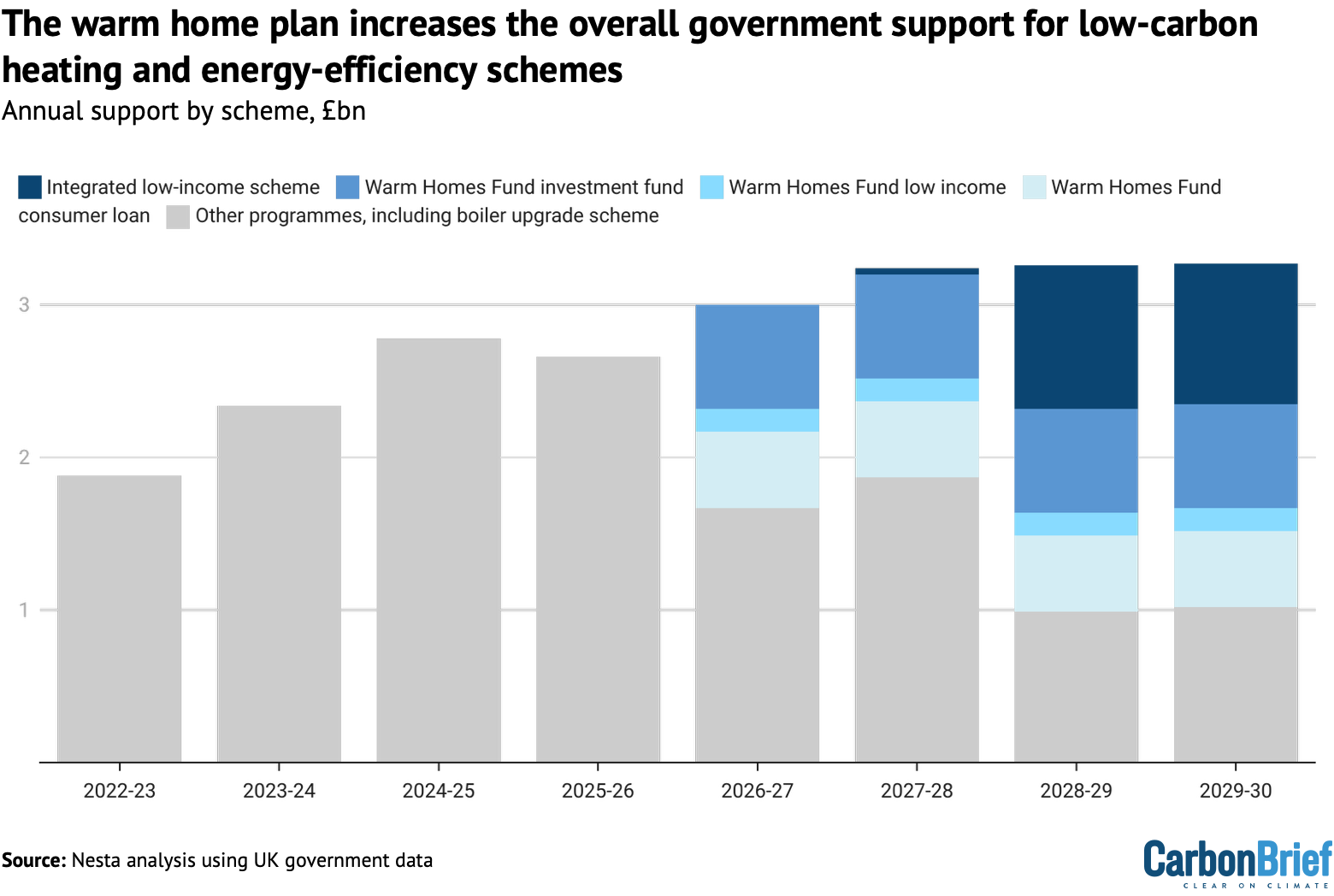
One third of the total funding – £5bn in total – is aimed at low-income households, including social housing tenants. This money will be delivered in the form of grants that could cover the full cost of upgrades.
The plan highlights solar panels, batteries and “cost-effective insulation” for the least energy-efficient homes as priority measures for this funding, with a view to lowering bills.
There is also £2.7bn for the existing boiler upgrade scheme, which will see its annual allocation increase gradually from £295m in 2025-26 to £709m in 2029-30.
This is the government’s measure to encourage better-off “able to pay” households to buy heat pumps, with grants of £7,500 towards the cost of replacing a gas or oil-fired boiler. For the first time, there will also be new £2,500 grants from the scheme for air-to-air heat pumps (See: Heat pumps.)
A key new measure in the plan is £2bn for low- and zero-interest consumer loans, to help with the cost of various home upgrades, including solar panels, batteries and heat pumps.
Previous efforts to support home upgrades with loans have not been successful. However, innovation agency Nesta says the government’s new scheme could play a central role, with the potential for households buying heat pumps to save hundreds of pounds a year, compared to purchases made using regular loans.
The remaining funding over the next four years includes money assigned to heat networks and devolved administrations in Scotland, Wales and Northern Ireland, which are responsible for their own plans to tackle fuel poverty and household emissions.
Heat pumps
Heat pumps are described in the plan as the “best and cheapest form of electrified heating for the majority of our homes”.
The government’s goal is for heat pumps to “increasingly become the desirable and natural choice” for those replacing old boilers. At the same time, it says that new home standards will ensure that new-build homes have low-carbon heating systems installed by default.
Despite this, the warm homes plan scales back the previous government’s target for heat-pump installations in the coming years, reflecting the relatively slow increase in heat-pump sales. It also does not include a set date to end the sale of gas boilers.
The plan’s central target is for 450,000 heat pumps to be installed annually by 2030, including 200,000 in new-build homes and 250,000 in existing homes.
This is significantly lower than the previous target – originally set in 2021 under Boris Johnson’s Conservative government – to install 600,000 heat pumps annually by 2028.
Meeting that target would have meant installations increasing seven-fold in just four years, between 2024 and 2028. Now, installations only need to increase five-fold in six years.
As the chart below shows, the new target is also considerably lower than the heat-pump installation rate set out in the CCC’s central net-zero pathway. That involved 450,000 installations in existing homes alone by 2030 – excluding new-build properties.
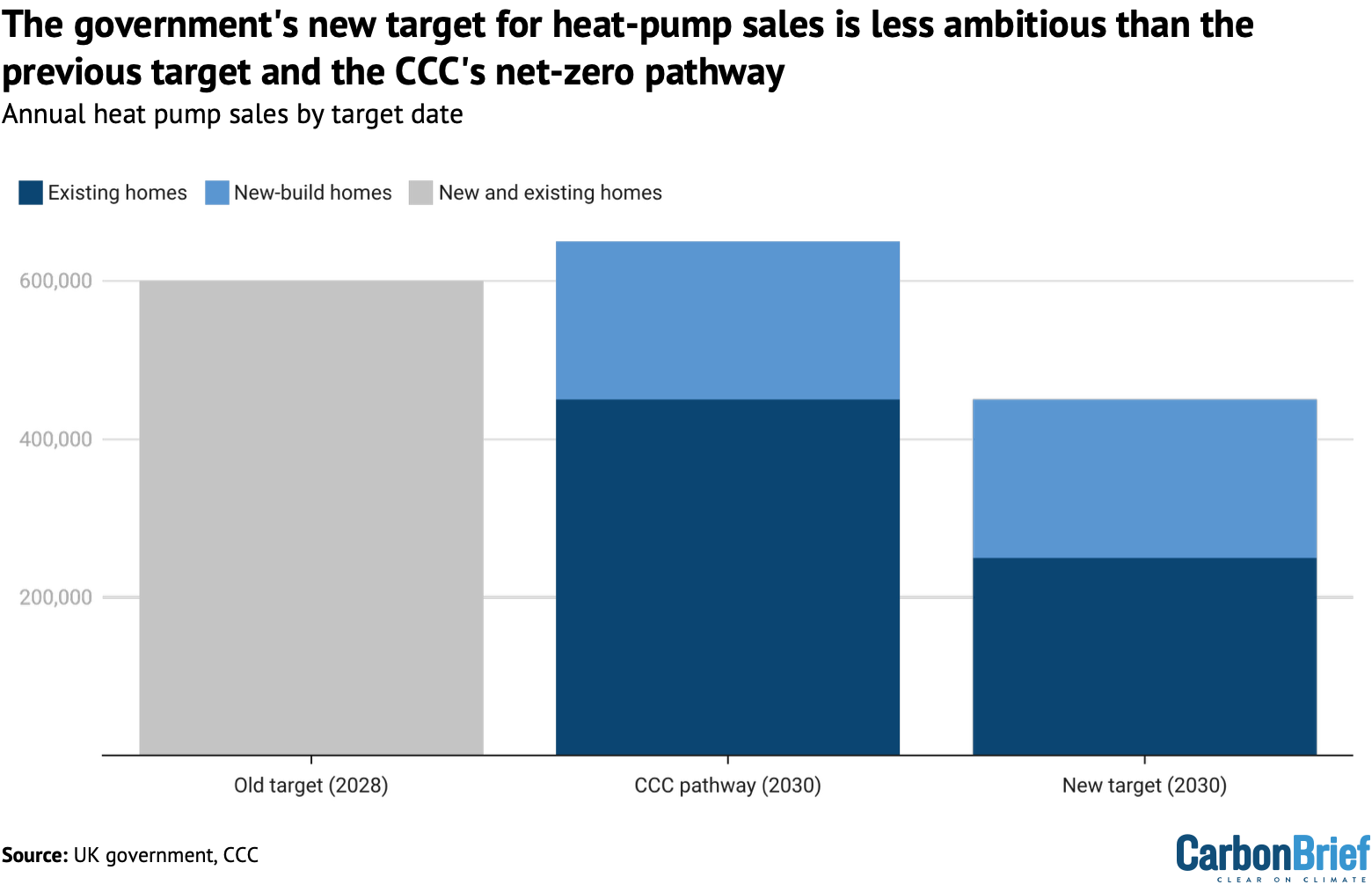
Some experts and campaigners questioned how the UK would remain on track for its legally binding climate goals given this scaled-back rate of heat-pump installations.
Additionally, Adam Bell, policy director at the thinktank Stonehaven, writes on LinkedIn that the “headline numbers for heat pump installs do not stack up”.
Heat pumps in existing homes are set to be supported primarily via the boiler upgrade scheme and – according to Bell – there is not enough funding for the 250,000 installations that are planned, despite an increased budget.
The government’s plan relies in part on the up-front costs of heat pump installation “fall[ing] significantly”. According to Bell, it may be that the government will reduce the size of boiler upgrade scheme grants in the future, hoping that costs will fall sufficiently.
Alternatively, the government may rely on driving uptake through its planned low-cost loans and the clean heat market mechanism, which requires heating-system suppliers to sell a growing share of heat pumps.
Rooftop solar
Rooftop solar panels are highlighted in the plan as “central to cutting energy bills”, by allowing households to generate their own electricity to power their homes and sell it back to the grid.
At the same time, rooftop solar is expected to make a “significant contribution” to the government’s target of hitting 45-47 gigawatts (GW) of solar capacity by 2030.
As it stands, there is roughly 5.2GW of solar capacity on residential rooftops.
Taken together, the government says the grants and loans set out in the warm homes plan could triple the number of homes with rooftop solar from 1.6m to 4.6m by 2030.
It says that this is “in addition” to homes that decide to install rooftop solar independently.
Efficiency standards
The warm homes plan says that the government will publish its “future homes standard” for new-build properties, alongside necessary regulations, in the first quarter of 2026.
On the same day, the government also published its intention to reform “energy performance certificates” (EPCs), the ratings that are supposed to inform prospective buyers and renters about how much their new homes will cost to keep warm.
The current approach to measuring performance for EPCs is “unreliable” and thought to inadvertently discourage heat pumps. It has faced long-standing calls for reform.
As well as funding low-carbon technologies, the warm homes plan says it is “standing up for renters” with new energy-efficiency standards for privately and socially rented homes.
Currently, private renters – who rely on landlords to invest in home improvements – are the most likely to experience fuel poverty and to live in cold, damp homes.
Landlords will now need to upgrade their properties to meet EPC ratings B and C across two new-style EPC metrics by October 2030. There are “reasonable exemptions” to this rule that will limit the amount landlords have to spend per property to £10,000.
In total, the government expects “up to” 1.6m homes in the private-rental sector to benefit from these improvements and “up to” 1.3m social-rent homes.
These new efficiency standards therefore cover three-fifths of the “up to” 5m homes helped by the plan.
The government also published a separate fuel poverty strategy for England.
Heat networks
The warm homes plan sets out a new target to more than double the amount of heating provided using low-carbon heat networks – up to 7% of England’s heating demand by 2035 and a fifth by 2050.
This involves an injection of £1.1bn for heat networks, including £195m per year out to 2030 via the green heat network fund, as well as “mobilising” the National Wealth Fund.
The plan explains that this will primarily benefit urban centres, noting that heat networks are “well suited” to serving large, multi-occupancy buildings and those with limited space.
Alongside the plan, the government published a series of technical standards for heat networks, including for consumer protection.
What does the warm homes plan mean for energy bills?
The warm homes plan could save households “hundreds on energy bills” for those whose homes are upgraded, according to the UK government.
This is in addition to two changes announced in the budget in 2025, which are expected to cut energy bills for all homes by an average of £150 a year.
This included the decisions to bring ECO to an end when the current programme of work wraps up at the end of the financial year and for the treasury to cover three-quarters of the cost of the “renewables obligation” (RO) for three years from April 2026.
Beyond this, households that take advantage of the measures outlined in the plan can expect their energy bills to fall by varying amounts, the government says.
The warm homes plan includes a number of case studies that detail how upgrades could impact energy bills for a range of households. For example, it notes that a social-rented two-bedroom semi-detached home that got insulation and solar panels could save £350 annually.
An owner-occupier three-bedroom home could save £450 annually if it gets solar panels and a battery through consumer loans offered under the warm homes plan, it adds.
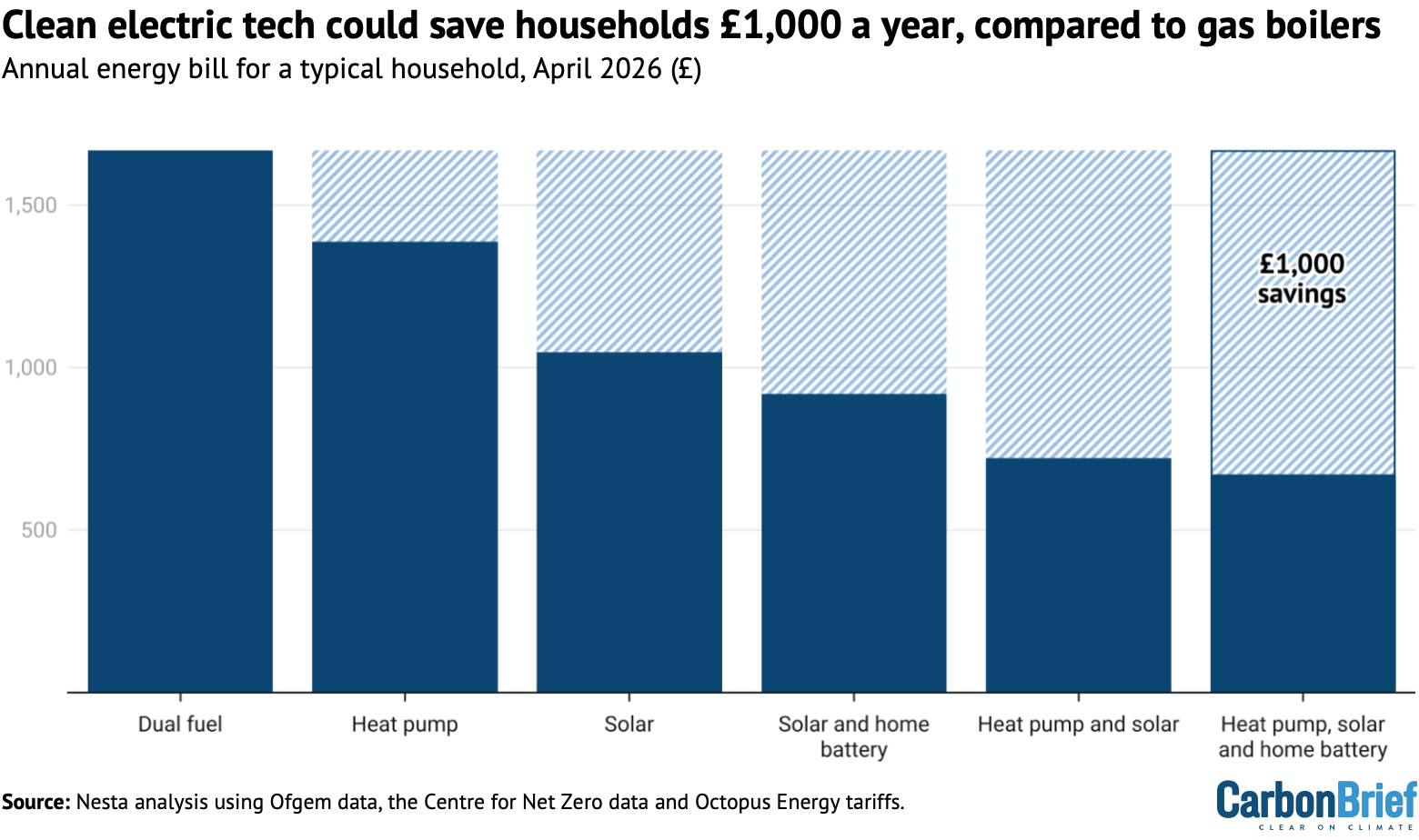
Similar analysis published by Nesta says that a typical household that invests in home upgrades under the plan could save £1,000 a year on its energy bill.
It finds that a household with a heat pump, solar panels and a battery, which uses a solar and “time of use tariff”, could see its annual energy bill fall by as much as £1,000 compared with continuing to use a gas boiler, from around £1,670 per year to £670, as shown in the chart below.
Ahead of the plan being published, there were rumours of further “rebalancing” energy bills to bring down the cost of electricity relative to gas. However, this idea failed to come to fruition in the warm homes plan.
This would have involved reducing or removing some or all of the policy costs currently funded via electricity bills, by shifting them onto gas bills or into general taxation.
This would have made it relatively cheaper to use electric technologies such as heat pumps, acting as a further incentive to adopt them.
Nesta highlights that in the absence of further action with regard to policy costs, the electricity-to-gas price ratio is likely to stay at around 4.1 from April 2026.
What has been the reaction to the plan?
Many of the commitments in the warm homes plan were welcomed by a broad range of energy industry experts, union representatives and thinktanks.
Greg Jackson, the founder of Octopus Energy, described it as a “really important step forward”, adding:
“Electrifying homes is the best way to cut bills for good and escape the yoyo of fossil fuel costs.”
Dhara Vyas, chief executive of the trade body Energy UK, said the government’s commitment to spend £15bn on upgrading home heating was “substantial” and would “provide certainty to investors and businesses in the energy market”.
On LinkedIn, Camilla Born, head of the campaign group Electrify Britain, said the plan was a “good step towards backing electrification as the future of Britain, but it must go hand in hand with bringing down the costs of electricity”.
However, right-leaning publications and politicians were critical of the plan, focusing on how a proportion of solar panels sold in the UK are manufactured in China.
According to BBC News, two-thirds (68%) of the solar panels imported to the UK came from China in 2024.
In an analysis of the plan, the Guardian’s environment editor Fiona Harvey and energy correspondent Jillian Ambrose argued that the strategy is “all carrot and no stick”, given that the “longstanding proposal” to ban the installation of gas boilers beyond 2035 has been “quietly dropped”.
Christopher Hammond, chief executive of UK100, a cross-party network of more than 120 local authorities, welcomed the plan, but urged the government to extend it to include public buildings.
The government’s £3.5bn public sector decarbonisation scheme, which aimed to electrify schools, hospitals and council buildings, ended in June 2025 and no replacement has been announced, according to the network.



The post Q&A: What UK’s ‘warm homes plan’ means for climate change and energy bills appeared first on Carbon Brief.
Q&A: What UK’s ‘warm homes plan’ means for climate change and energy bills

Climate Change
Cropped 25 March 2026: Seabed mining talks stall | ‘Blueprint’ for land use | India feels Iran war impacts
We handpick and explain the most important stories at the intersection of climate, land, food and nature over the past fortnight.
This is an online version of Carbon Brief’s fortnightly Cropped email newsletter.
Subscribe for free here.
Key developments
Seabed mining talks stall
UNFINISHED BUSINESS: The International Seabed Authority (ISA) ended a two-week meeting in Kingston, Jamaica, without agreement on the “long-delayed” code for deep-sea mining, which “remains both unfinished and deeply contested”, said Oceanographic. Several countries raised “fundamental scientific, environmental and governance gaps” in the draft regulations, it added. CBC News reported that although the ISA’s executive secretary, Leticia Carvalho, had previously said she “hoped a mining code could be finalised this year”, she “did not provide a new timeline” following the most recent talks.
DOUBLE TROUBLE: Meanwhile, federal regulators in the US have announced that they have identified nearly 70m acres (283,000 square kilometres) of seabed off the Northern Mariana Islands “that could be open to mineral leasing”, reported E&E News. The outlet noted that this recommendation was nearly double the government’s initial area under consideration, announced last autumn.
-
Sign up to Carbon Brief’s free “Cropped” email newsletter. A fortnightly digest of food, land and nature news and views. Sent to your inbox every other Wednesday.
PROCESS PROBLEMS: The CBC News article noted that 40 member countries now support a moratorium on deep-sea mining, but the ISA has “faced mounting pressure in recent months after the US…moved to begin approving mining outside the ISA process”. In the Conversation, an international-law expert from Duke University wrote: “The Trump administration’s attempt to unilaterally exploit the seabed resources of the global commons will severely undermine part of the rules-based international order that the US built and of which it has been the main beneficiary.”
England’s new ‘blueprint’ for land use
‘BLUEPRINT’: The UK government released its “long-awaited and much-delayed” land-use framework, detailing how England can optimise its land for food, housing, climate and nature, reported Carbon Brief. The “blueprint” found that “England has enough land to meet all of its objectives, if land is used efficiently”, the outlet added. The Guardian said that “farmers and campaigners broadly welcomed the framework”, with the president of the National Farmers’ Union saying that implementation “will require clear guidance, the right policy framework and incentives to avoid unintended outcomes”.
PRACTICAL MATTERS: Alongside the framework, the Environment, food and rural affairs committee of the UK parliament “launched a major inquiry into how England’s land is used”, reported FarmingUK. The inquiry will focus on how the land-use framework “works in practice”, it added. The outlet said: “Looking ahead, the committee will scrutinise how government policy [on land use] is coordinated across departments.”
SLOW PROGRESS: Meanwhile, the National Audit Office found that nature-restoration progress across England has “slowed due to ‘recent funding uncertainty’”, reported Agriland. The office examined the Nature for Climate Fund, a programme under the Department for Environment, Food & Rural Affairs, which was established in 2020 and “led to a substantial increase in tree-planting and peatland restoration”, the outlet said. However, the report also found that “targets in England will continue to be missed” without substantial changes, said the Forestry Journal.
News and views
- PROTECTED WATERS: On 10 March, outgoing Chilean president Gabriel Boric signed a decree to expand and “fully protect” two marine protected areas that “harbour the highest concentration of marine species found nowhere else on Earth”, Island Conservation reported. The new administration told the Guardian that its “intention is not to eliminate protections” and, barring legal and technical issues, it will allow the areas “to go forward as planned”.
- BUSINESS CLASH: Following “clashes” with the agribusiness sector, Brazil launched its new climate plan, which calls for a 49-58% reduction in greenhouse gas emissions from 2022 levels by 2035, reported Folha de Sao Paolo. Meanwhile, Climate Home News wrote that the “Tropical Forest Forever Facility” – which Brazil championed – is “unlikely to make payments to rainforest countries until at least 2028”.
- SAVE THE FISHES: A new UN report identified 325 freshwater fish species “requiring coordinated international conservation action” to address declining populations due to overexploitation, habitat degradation and other compounding pressures, said Down to Earth. The report was launched at the 15th Conference of the Parties to the UN Convention on the Conservation of Migratory Species of Wild Animals, which began on Monday in Campo Grande, Brazil.
- FACE PALM: A Climate Home News and SVT investigation found that Neste – the world’s largest producer of sustainable aviation fuel (SAF) – was sourcing “key ingredients from an opaque supply chain” that allowed “fresh palm oil to be passed off as waste”. Neste said it would look into the outlets’ findings, adding that it was “currently not aware of any verified cases of fraud” in its raw-materials sourcing.
- CRITICAL HABITAT: The US government plans to approve the country’s first critical-minerals mine in Patagonia, Arizona, even as locals warn of potential water and biodiversity impacts, Inside Climate News reported. The project site – which holds “one of the largest undeveloped zinc resources in the world” – borders “one of the most important biodiversity hotspots in North America”, which is home to 12 endangered species, including jaguars and Mexican spotted owls, the outlet added.
- RE-PEAT OFFENDERS: More than 370,000 tonnes of peat were exported from Ireland in 2025, with revenues totalling around €40m – “despite there being no known legal commercial peat extraction operation in the country”, said the Irish Times. This represents a higher volume than was exported in 2023 or 2024, but a decrease from the nearly one million tonnes exported in 2020, it added.
- ‘FIELDS OF IRON’: Rural voters in Denmark have begun to “sour” on solar power, with one populist leader in 2024 saying “no to fields of iron!”, said the Guardian. Danish PM Mette Frederiksen “failed to secure a majority” in the country’s general election on Tuesday, where the climate footprint of agriculture has been a concern for voters, reported BBC News.
Spotlight
Plate half full
This week, Carbon Brief looks at the impact of the US-Israel-Iran war on India’s kitchens, restaurants, workers and farmers – and what it means for the climate.
On 23 March, two Indian-flagged tankers made their way through the mine-laden Strait of Hormuz, hugging Iran’s coastline.
The ships are carrying more than 90,000 tonnes of liquefied petroleum gas (LPG), equivalent to roughly one day of the country’s cooking gas consumption.
In India – the world’s second-largest LPG importer – gas is intrinsically tied to food security.
With 60% of these imports sourced from Gulf countries, the war’s immediate impacts have been acutely visible in India’s kitchens and restaurants.
Lunch on the move
Since 10 March, many Indian cities and towns have seen snaking queues and skirmishes breaking out as India’s poor rushed to refill gas cylinders in the heat of an early summer.
As the government prioritised the 340m households that use LPG over commercial establishments, restaurants have faced “catastrophic closures”.
Ashok Vada Pav – birthplace of Mumbai’s vada pav, or potato burger, which has been described as the “soul of the [city’s] working class” – has shut its doors. Ramashraya – serving south Indian breakfasts since 1939 – had to turn away customers who have been coming there for decades.
However, hot lunches – cooked at home or purchased from the city’s many canteens – continue to travel the length of Mumbai in tiered steel tiffins carried by the iconic dabbawallahs.

Ramdas Karwande, president of the Mumbai Tiffin Box Suppliers Association, told Carbon Brief that, of the 80,000 lunches that dabbawallahs carry across the city each day, 40% are typically from caterers. That number has halved in the past weeks, he said.
Karwande explained:
“People who come to this city from places far away have no choice but to eat canteen food. But home food is still on the move, because everyone needs to eat somehow.”
Fuel to firewood
In an address to parliament on Monday, India’s prime minister Narendra Modi likened the fallout of the war to that of the Covid-19 pandemic – a comparison that has drawn criticism.
The cooking gas shortages have prompted an exodus of migrant workers leaving cities for their home states, where biomass cooking remains accessible.
Cities, such as Delhi and Mumbai, have put a pause on emissions curbs for dirtier fuels since 14 March, as poorer families facing soaring black-market gas prices turn to wood, kerosene and coal.
While government gas and biogas schemes have led to a decrease in firewood usage in many states over many years, analysts have said the current crisis “offers a critical moment to rethink India’s cooking energy mix”.
In Mumbai’s wealthy suburb of Khar, induction stoves have been “flying off shelves”, Jaffair Sheikh, who sells appliances at an upmarket electronic retail store, told Carbon Brief. He added:
“We’re selling 20 units a day, when we used to sell almost zero before this war.”
However, only 5% of India’s households have access to electric cooking devices and the country’s grid is still largely powered by coal.
Away from the cities, there is a looming fear of the war’s impact on agriculture, given India’s dependence on the Gulf for fertiliser imports.
Siraj Hussain, India’s former agriculture secretary, told Carbon Brief:
“Gas is the main raw material for urea – and urea stocks are grossly insufficient to meet even kharif season (May to July) demand. But if the government can reduce supply to states where excessive fertiliser is used and increase supply to states where consumption is low, to some extent, this deficit will not be as harmful as it would be otherwise.”
Crop stock and biofuel fears
Punjab’s farmers, meanwhile, were already worried about the impact of an early summer on wheat production.
However, Hussain told Carbon Brief that India’s food security in terms of wheat and rice “will not be affected too much” because the country is “sitting on” excessive stocks. He added that he hopes the war will “persuade the government” to reduce its use of rice for ethanol production.
Still, food inflation is already being felt across the country. Karwande added:
“Everyone is tense. The monthly payments we get are going down and running a house is now difficult: the same problems we had during lockdown are back. Oil, sugar, everything has become expensive. This is not just our problem; this is everybody’s problem. The government has to do something.”
Watch, read, listen
FARMERS’ FUTURES: High Country News explored how farmers in the Colorado River basin are dealing with water shortages “amid deep political divisions about the river’s future”.
FOOD SHOCK: Experts on Al Jazeera’s Counting the Cost podcast looked at whether the US-Israel war on Iran could “trigger the next global food shock”.
LYNX IN BIO: BBC News featured the winning images from the Wildlife Photographer of the Year People’s Choice Award. The photos will be on display at London’s Natural History Museum until 12 July.
ECO BREAKDOWN: Mongabay detailed the causes of the “mental health crisis” impacting conservationists, including biodiversity decline, climate change, low wages and burnout.
New science
- Less than half of the Amazon rainforest that was affected by the 2023-24 drought is “expected to recover to pre-drought conditions” within seven years | Proceedings of the National Academy of Sciences
- Beavers can turn the ecosystems surrounding streams into “persistent” sinks of carbon that can sequester an order of magnitude more than non-beaver-modified ecosystems can store | Communications Earth & Environment
- Climate change-induced heat could result in half a trillion hours of lost productivity by 2055 in a low-emissions scenario, disproportionately impacting low-income countries and agricultural workers | GeoHealth
In the diary
- 23 March-2 April: Third meeting of the preparatory commission for the High Seas Treaty, New York
- 24-27 March: 64th session of the Intergovernmental Panel on Climate Change, Bangkok
- 26-29 March: 14th ministerial conference of the World Trade Organization, Yaoundé, Cameroon
Cropped is researched and written by Dr Giuliana Viglione, Aruna Chandrasekhar, Daisy Dunne, Orla Dwyer and Yanine Quiroz. Please send tips and feedback to cropped@carbonbrief.org

The post Cropped 25 March 2026: Seabed mining talks stall | ‘Blueprint’ for land use | India feels Iran war impacts appeared first on Carbon Brief.
The global energy shock triggered by the Iran war could give countries the chance to build a “new geopolitical balance” by forging a coalition committed to phasing out fossil fuels, Colombian Environment Minister Irene Vélez Torres said.
Delegates from about 45 nations are set to meet next month in Colombia’s Caribbean city of Santa Marta for the first conference on the transition away from fossil fuels, after a drive by 80 countries at COP30 failed to deliver a roadmap to phase out planet-heating coal, oil and gas.
Vélez Torres told an online press briefing her “maximum aspiration” for the summit was to “incline geopolitics towards a coalition of countries willing to eliminate fossil fuels” that can start taking action without having to negotiate agreements by consensus at UN talks.
“Ever since COP30 there has been growing momentum. The current crisis only gives us more relevance. We have a possibility to materialise a new geopolitical balance,” she said.
She added “it’s not the moment” to formalise this coalition or give it a name, but said that “as conversations move forward, and we can meet at a second conference to consolidate shared visions, something more formal can be created”.
-
Pressure builds for fossil fuel transition plan at COP30
More than 80 countries issue a call for the summit outcome to include a commitment to develop a roadmap for the world to shift away from oil, gas and coal -
New summit in Colombia seeks to revive stalled UN talks on fossil fuel transition
Colombia will host the first conference on transitioning away from fossil fuels, after more than 80 countries pushed at COP30 for an end to coal, oil and gas -
Colombia aims to launch fossil fuel transition platform at first global conference
The landmark summit aims to build the political and economic foundations to fast-track the shift away from coal, oil and gas, one of its organisers said


The conflict in the Middle East has disrupted about a fifth of the world’s gas passing through the Strait of Hormuz, particularly heading towards Asia. This has led to growing calls for investment in renewables as a way to strengthen energy security and economic stability, as oil and gas prices skyrocket.
COP30 president André Corrêa do Lago, Brazil’s top climate diplomat, told the online briefing that building a parallel process on phasing out fossil fuels outside the UN climate regime – which requires slow negotiations with oil and gas producers to reach consensus – can be “extremely useful”.
COP30 new roadmap proposal
After governments failed to kickstart the creation of a roadmap away from fossil fuels at COP30, Corrêa do Lago proposed to draft a voluntary proposal instead, which he said would be launched towards the second half of the year.
He added that, because it is not a formal document under the UN process, the voluntary roadmap was not meant to be adopted by countries at COP31 later this year, but to contribute to continued debate.
“The more that we create a document that incorporates the positions, figures and concerns of various countries, the more influence it will have on debates at the UNFCCC and the Paris Agreement,” he said.
UN head calls for platform for “honest dialogue” on fossil fuel transition
Countries have been asked to submit inputs to the Brazil-led roadmap. Meanwhile, the Australian COP31 “president of negotiations” Chris Bowen has vowed to continue debates on the fossil fuel transition, while Turkish COP president Murat Kurum rejected it as a major focus and said he will “safeguard the development priorities of the countries”.
Vélez Torres added that both the Santa Marta conference and Brazil’s roadmap were “deeply complementary”, with the summit focusing more on channelling technical support, finance and “creating an honest space where we can put all the cards on the table”.
Carlos Nobre, a veteran Brazilian climate scientist, said the push for a transition away from fossil fuels was “essential”, and added that countries must focus on accelerating a “super-rapid” energy transition at COP31 to prevent global temperatures from crossing dangerous climate tipping points such as melting permafrost or the collapse of the Amazon rainforest.
Colombia and Brazil head to polls
While both Colombia and Brazil have led the push for a global phase-out of fossil fuels, the two South American countries are heading to the polls later this year. Both countries face anti-climate movements promising to change course if elected.
Vélez Torres warned of “great political risks of a relapse”, referring to a potential new government reversing the current government’s halt on all new coal, oil and gas exploration. Far-right candidate Abelardo de la Espriella has proposed to resume production, particularly venturing into shale gas fracking.
“However, we think we are building a bloc that is bigger than a country. The sense of continuity and sense of progress that we are giving to this discussion, I think are going to be difficult to relapse,” she said.
Corrêa do Lago said “this year we have to show the world what alternatives are viable”.
“We have to work together and not let that those who are betting on a general disaster divide those who are searching for solutions,” he added.
The post Iran war could boost fossil fuel phase-out push, says Colombian minister appeared first on Climate Home News.
Iran war could boost fossil fuel phase-out push, says Colombian minister
The new head of the Global Center on Adaptation (GCA) faces a formidable task: raise urgent funding to get the organisation back on track following damaging revelations about its former management, just as tight budgets prompt many donors to rethink their climate spending.
Rindra Rabarinirinarison, who served as Madagascar’s economy and finance minister from 2021-2025, said the change of leadership at the Rotterdam-based GCA was “an opportunity to reset things”, pledging to repair the centre’s reputation after its founding CEO left under a cloud.
“I plan to strengthen partnerships and rebuild this trust. Why? Because people only give you money if they trust you – and they only trust you if they know you well,” she told Climate Home News in her first interview since taking over at the GCA’s floating office in the Netherlands this month.
During her first weeks in the job, she plans “to meet with all our partners to correct the communication challenges that have emerged” – a reference to the revelations about the centre’s workplace culture that emerged in a series of investigative articles published by Dutch broadcaster NOS last year.
-
COP30 fails to land deal on fossil fuel transition but triples finance for climate adaptation
Instead of a global agreement to create roadmaps to shift away from fossil fuels and end deforestation, Brazil announces voluntary initiatives -
Business-as-usual: Donors pour climate adaptation finance into big infrastructure, neglecting local needs
A deep-sea port project in Bangladesh highlights how some major donor nations are labelling funds for industry-friendly transport and energy projects as adaptation finance, reporting by Climate Home News shows -
Tripling adaptation finance is just the start – delivery is what matters
The COP30 decision on adaptation finance was a rare moment of hope. We must build on it by prioritising grants, streamlining access and ensuring funding meets country needs


When the GCA was launched to considerable fanfare in 2018, climate adaptation was largely neglected by politicians, development banks and investors, who were more focused on efforts to cut planet-heating emissions than on helping people cope with their effects. The GCA’s plan, together with the high-powered Global Commission on Adaptation which it co-hosted, was to correct that imbalance.
Former UN Secretary-General Ban Ki-moon, who served as founding chair of the GCA and is now its emeritus chair, said back then that the commission, of which he was a member, would “play a vital role in elevating the political importance of adaptation, and also in making the case that greater resilience is achievable”.
Today, most experts agree that adaptation – and the increasingly urgent need to invest in it – have won far more prominence on the international agenda, even if dollars have yet to flow on the scale required.
Richard Klein, director of science and innovation at the GCA between September 2018 and December 2019, said the centre had helped propel that progress, alongside other organisations like the United Nations Development Programme and the World Bank.
But Klein, now an independent adaptation expert, told Climate Home News the GCA had squandered the opportunity to generate innovative research and had become “a mid-sized consultancy … that lives way beyond its means”.
“High-pressure” environment
The reporting by NOS portrayed a toxic workplace culture in which staff were expected to put furthering the high-profile advocacy of the GCA’s dynamic ex-boss Patrick Verkooijen ahead of their research to help vulnerable communities adapt to worsening extreme weather and rising seas.
Verkooijen recently stepped down from the GCA after two four-year terms during which he was appointed as chancellor of the University of Nairobi, where the centre planned to set up a dual headquarters.
Asked about the criticism of his leadership, Verkooijen said the GCA had been created as a startup organisation at a time when there was “a very great sense of urgency that adaptation needed to be scaled up – all leading to a huge amount of pressure for delivery”.
“I believe managers and staff did their best, though certainly not every system was perfect – there could be tense and high-pressure moments,” he told Climate Home News in emailed responses.
Conversations with ex-GCA employees, as well as an unpublished editorial authored by several former staffers and shared with Climate Home News, supported the NOS reports about an atmosphere of conflict in which operations were focused on advancing Verkooijen’s efforts to promote adaptation and the centre’s work to leaders, especially in Africa.
“It was painful, how, in the end, just everything was about visibility around him,” Klein said.
Verkooijen said that while he would not discount employees’ personal experiences, the GCA had not received official complaints about its leadership and “did not recognise the environment as it was characterised in media”. The GCA has invested in building up staff systems and safeguards, especially in the last three years, he added.
“Significant” downsizing underway
Rabarinirinarison takes over as the organisation faces tough decisions about its size and capacity going forward. It is being forced to downsize from 60-plus employees because of financial uncertainty following an end to funding from the British government and a question-mark over whether other countries – including the Netherlands, Denmark and Norway – will renew their support.
Other key funders, including France and the Gates Foundation, have agreed to provide continued backing, the GCA said. It denied a report by NOS that it is facing imminent bankruptcy, which Climate Home News understands was based on a confidential internal document outlining a range of scenarios in line with different funding outcomes.
Rabarinirinarison said she could not comment on potential layoffs, which are being discussed as part of a “significant resizing to adjust the head count with the contracted resources available to us”.
But she conceded that the centre’s current financial situation is “very serious right now”. Funding from the Dutch government – which was instrumental in setting up the GCA – is due to run out in May, and earlier efforts to win a new commitment must now be revived after a minority centrist government took office in February. Prime Minister Rob Jetten is a former climate minister and supports the clean energy transition.
“We are hopeful the new government’s approaches to our work will be favourable – and this is the advantages to have a new management, new face, new hope and new explanations,” said Rabarinirinarison, adding that the Netherlands will be her first port of call, followed by other key partners that have backed the GCA up to now.
She is also planning to seek potential new sources of funding in the Middle East and Asia, where the GCA has offices in Bangladesh and China.
The centre’s work so far has been heavily focused on supporting large adaptation projects carried out by the African Development Bank (AfDB) and the World Bank across Africa, to which it has provided consulting services and technical advice.
Flagship Africa investment programme
The GCA threw its weight behind the Africa Adaptation Acceleration Program (AAAP), which launched its second phase last September at the Africa Climate Summit in Ethiopia and the United Nations General Assembly.
The AAAP investment initiative for climate adaptation on the continent began in 2021 and was implemented through a partnership involving the African Union Commission, the AfDB and the GCA.
According to the GCA’s website, its first phase embedded “climate adaptation solutions” into more than $20 billion of development investments across some 40 African nations.
Global South’s climate adaptation bill to top $300 billion a year by 2035: UN
An article by NOS, published last October, accused the centre of misleading donors by overstating its role in the AAAP and other projects, saying documentation examined by NOS did not back up the extent of GCA’s claimed contributions to the work.
The GCA, for its part, put out a statement rejecting the NOS findings, which it said “provide an inaccurate representation of the Center’s work and achievements, as well as our relationships with partners”.
A GCA spokesperson told Climate Home News that, after sharing information with NOS and requesting corrections from the outlet which were not made, it recently filed a complaint about the coverage with the Dutch ombudsman.
In emailed comments, Verkooijen defended the achievements of the centre under his stewardship, saying it had made a “substantial contribution” to developing knowledge including through its co-management of the Global Commission on Adaptation and its “State and Trends on Adaptation series” of reports. He said that, at the advocacy level, GCA had made “clear-cut contributions to elevating the level of political priority for adaptation” and had participated in embedding climate considerations into around 100 large development projects delivered by international financial institutions.
In most cases, he wrote, “these projects … would not have factored in climate risks and adaptation without the GCA’s contribution – or not to the same degree”.
Pitching adaptation as a “driver for growth”
In the future, Rabarinirinarison thinks the GCA can continue to act as a “solutions broker” on adaptation, while facilitating access to international climate finance for Global South governments and communities which have limited capacity to develop bankable adaptation projects and navigate complex processes.
The GCA can use its expertise to help countries understand the significant risks of failing to protect their economies from extreme weather and serve as a strong proponent of adaptation as a “driver for growth”, she said.
The centre still has “room to grow”, she added, by delivering more “technical expertise reports” and “technical advocacy”, ensuring that adaptation is “effectively included in large-scale financial institutional lending” and bridging the gap between discussions and implementation at scale.
Climate adaptation can’t be just for the rich, COP30 president says
Some in the sector question the need for a Global North-based organisation to be doing such work for the benefit of Global South countries, despite its shift to African leadership. The GCA board also has a new chair, with Mauritius President Ameenah Gurib-Fakim this month taking over the role from Senegal’s former leader, Macky Sall, who is bidding to become the next UN chief.
Finding a USP in a maturing sector
Sander Chan, who was a senior researcher at the GCA from 2020 to 2022, criticised the organisation for focusing too heavily on building the business case for adaptation, mobilising money and seeking private-sector involvement, while doing too little to include or strengthen the perspectives and voices of local and Indigenous communities.
The centre has, however, developed a training and advocacy network for some 35,000 youth supporters of adaptation across the Global South, as well as hosting an online platform for locally led adaptation intended to showcase and connect community groups and practitioners.
Klein and Chan, now an associate professor at Radboud University in the Netherlands, also questioned the value added by the centre beyond its awareness-raising and brokering roles, which they argue are now less important and can be fulfilled by other better-established institutions.
Klein said it will be tough for the GCA’s new leadership to develop a unique selling point unless it goes beyond its current activities, given that more organisations today are offering similar services and looking for a larger share of the pie.
“I think it’s more than just a matter of rebuilding trust in how [the centre] used to operate,” he said. “It’s also: is there still a need for what they’re doing?”
Rabarinirinarison’s strategy, if the GCA can procure funding to get itself back on course, is to expand its work and knowledge base to pitch adaptation as key to economic growth and “selling this product as our main asset”.
“I do believe that GCA is able to perform essential services, and its partners are able to notice its value and continue to support us if we communicate well,” she said.
The post Can new CEO steer Global Center on Adaptation back on course? appeared first on Climate Home News.
https://www.climatechangenews.com/2026/03/25/can-new-ceo-steer-global-center-on-adaptation-back-on-course/

Cropped 25 March 2026: Seabed mining talks stall | ‘Blueprint’ for land use | India feels Iran war impacts
From Air to Ale: Introducing the First-of-its-Kind Beer Made with Captured Carbon

Iran war could boost fossil fuel phase-out push, says Colombian minister
-
Greenhouse Gases8 months ago
Guest post: Why China is still building new coal – and when it might stop
-
Climate Change8 months ago
Guest post: Why China is still building new coal – and when it might stop
-

 Greenhouse Gases2 years ago
嘉宾来稿:满足中国增长的用电需求 光伏加储能“比新建煤电更实惠”
-
Climate Change2 years ago
Bill Discounting Climate Change in Florida’s Energy Policy Awaits DeSantis’ Approval
-

 Climate Change2 years ago
嘉宾来稿:满足中国增长的用电需求 光伏加储能“比新建煤电更实惠”
-
Climate Change Videos2 years ago
The toxic gas flares fuelling Nigeria’s climate change – BBC News
-

 Carbon Footprint2 years ago
US SEC’s Climate Disclosure Rules Spur Renewed Interest in Carbon Credits
-

 Renewable Energy5 months ago
Sending Progressive Philanthropist George Soros to Prison?