

Dozens of the survivors of a devastating 2021 typhoon in the Philippines said on Thursday they would seek damages from Shell in a UK court over the oil giant’s role in climate change.
The landmark case, being brought by 67 people who were injured or lost relatives and property in Typhoon Odette and supported by Greenpeace Philippines, alleges that Shell’s actions contributed to anthropogenic climate change, making the tropical cyclone significantly more likely and more severe.
“With fossil fuel emissions being linked to stronger tropical storms like Odette, vulnerable communities like ours are struggling to keep their head above water,” said Trixy Elle, one of the claimants. “This is not acceptable, this is not just and we must fight.”
Typhoon Rai’s trail of destruction in the Philippines reignites loss and damage calls
Their case is the first civil claim to directly link oil and gas companies to death and personal injury in past climate disasters in the Global South, the group said, although other cases are in the pipeline.
Earlier this year, in another pioneering climate case, a German court threw out a Peruvian farmer’s lawsuit seeking damages from German utility RWE for allegedly putting his home at risk from floods due to melting glaciers caused by global warming.
Despite the dismissal of the case, experts said the judge’s ruling confirmed that climate science can establish legal liability for damage caused by emissions.
Right to a healthy environment
The filing of the lawsuit comes three years after the publication of a major report by the Philippines Commission on Human Rights, which concluded that polluters could potentially be held liable for climate change.
The case will be filed in Britain because that is where Shell is headquartered, but the ruling will apply the law of the Philippines, where the alleged harm occurred.
The claimants have sent the company an initial letter before action and plan to file a formal claim before the High Court in London later in December.
-
Philippines inquiry finds polluters liable for rights violations, urging litigation
The national human rights commission found 47 “carbon majors” acted “immorally” and could be sued – giving fresh impetus to legal challenges -
Peruvian farmer loses climate case against RWE – but paves way for future action
Experts say that despite dismissing the lawsuit, the ruling sets a precedent by confirming that climate science can establish legal liability for the damage caused by emissions -
Typhoon Rai’s trail of destruction in the Philippines reignites loss and damage calls
More than 400 people were killed and seven million lost homes or livelihoods to the category 5 storm that hit the Philippines in December


Lawyers will argue that Shell violated the claimants’ rights under the Philippine constitution, including their right to a balanced and healthy environment, and that the company acted with negligence because it had the opportunity to mitigate climate harm and an obligation to refrain from obfuscating climate science, but failed to do either.
They will also argue that Shell has profited enormously and unjustly from its business activities at the cost of the claimants.
A Shell spokesperson told Climate Home News the company had received the claimants’ letter, acknowledging that more global action was needed on climate change but rejecting the suggestion that Shell had unique knowledge about the problem.
“The issue of climate change and how to tackle it has been part of public discussion and scientific research for decades,” the spokesperson said.
Climate science advances
Typhoon Odette – known internationally as Typhoon Rai – struck the Philippines in December 2021, killing more than 400 people, severely injuring 1,000 more and destroying 1.4 million homes. It cost the Southeast Asian country millions of dollars.
The lawsuit draws on recent advances in climate attribution science, in particular a recent study which found that anthropogenic climate change – climate change caused by humans – more than doubled the risk of such an extreme event.
So far, no oil and gas company has been found legally liable for damages associated with climate change. But a growing number of lawsuits are trying to do so, with potential liabilities for the 25 largest oil and gas firms estimated at more than $20 trillion.

According to the Carbon Majors database, Shell was responsible for more than 2.5% of global fossil fuel emissions since the beginning of the industrial revolution, making it one of the world’s largest corporate emitters. By contrast, the Philippines has contributed just 0.2% of global carbon emissions.
Greg Lascelles, a partner at global law firm Hausfeld who is leading the legal team in the Odette case, said the lawsuit aimed to hold Shell accountable.
“By proving in court that Shell was at fault for this climate change-driven extreme weather event and the suffering it caused, the case highlights the far-reaching and direct impacts on vulnerable communities worldwide of oil and gas company activities,” Lascelles said.
Climate justice campaigner Tessa Khan, executive director of the UK-based organisation Uplift, called it a “genuinely unprecedented case”.
“It’s a new milestone in climate litigation and corporate accountability for the impact of climate change,” she said. “But it’s also really significant in the wider political context in which we’re seeing oil and gas companies, investors in the energy sector, all starting to roll back on their commitments to transition away from fossil fuels.”
The post Philippines storm victims to seek damages from Shell in “unprecedented” climate claim appeared first on Climate Home News.
Philippines storm victims to seek damages from Shell in “unprecedented” climate claim

Continue Reading
Three countries have been named by the Paris Agreement’s compliance committee for failing to submit a nationally determined contribution (NDC) and repeatedly snubbing offers of help with their climate plans.
After months of internal debate over whether to identify serial non-responders, the Paris Agreement’s Implementation and Compliance Committee (PAICC) named the three countries which have failed to engage with it over their NDCs on Friday.
It named Democratic Republic of Congo, Senegal and North Korea in a footnote of its annual report, adding that it decided to name them “with a view to facilitating engagement”, adding that representatives of the three nations had been invited to its meeting in early 2027 “with the purpose of identifying any challenges and constraints”.
“The Committee noted the importance of Parties engaging with the Committee in a timely manner, while noting that some delays may be due to the national capabilities and circumstances of the Parties”, the report said.
-
Under US pressure, World Bank says it will back gas “where appropriate”
The US wants the World Bank to expand its gas support while climate campaigners are pushing for it to end – its head spoke this week of limited backing for the fossil fuel -
IPCC scientists vow to press on with climate reports despite political deadlock
After governments again failed to agree a timeline, nearly 120 IPCC authors pledged to complete their assessment on time and with full scientific rigour -
Paris Agreement committee snubbed over missing NDC climate plans
Many governments have still not submitted a nationally determined contribution to the UN, breaching a key requirement of the Paris Agreement

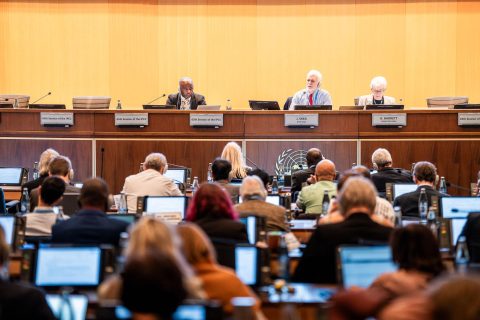

In July, PAICC said 12 countries had ignored its repeated attempts to discuss why they had not published an NDC as required every five years under the 2015 Paris accord.
Members of the committee had been divided over whether to name them, but at a September meeting decided to do so in their annual report to the annual climate COP summit.
By the time the report was published on Friday, only Congo, Senegal and North Korea “had not communicated an NDC or submitted a [Biennial Transparency Report] and had not yet responded to any of the Committee’s notifications, despite several reminders issued by the Committee in this regard”.
Rainforest and renewable energy ambitions
The silence from Congo and Senegal is notable because the former is home to much of the Congo Basin rainforest while the latter has sought billions of dollars in climate finance to support its renewable energy ambitions.
After Brazil, Congo has more rainforest than any country in the world. This forest, and the country’s peatlands, absorb huge amounts of greenhouse gas but are fast being lost to expanding farmland, charcoal production, logging and mining.
Senegal signed a Just Energy Transition Partnership with Canada and wealthy European nations in 2023, to help it meet its renewable energy targets under the-then government of Macky Sall. It was chair of the Least Developed Countries group between January 2022 and December 2023.

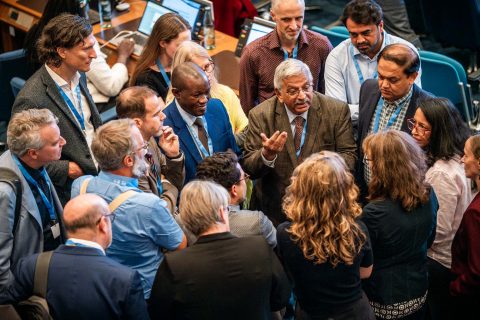
Tejas Rao, who is researching the PAICC as part of a doctoral thesis at Cambridge University, said the governments of the three countries should engage with the committee.
“Engagement costs these governments very little and the committee has shown it will listen,” he said.
“Silence leaves the committee with no basis to help, and it leaves the [governments] exposed to the narrative that they are simply disengaged,” he told Climate Home News.
Paris Agreement requirement
The 2015 Paris Agreement requires all parties to publish an NDC every five years outlining their emissions reduction targets, with each plan meant to be more ambitious than the country’s last NDC.
The latest set – the third round of plans, with new targets for 2035 – was due in February 2025. While most countries missed this deadline, all but around 30 – mostly small emitters but including Egypt, Vietnam and Argentina – have now submitted them.
Over the year, the PAICC – which is made up of government climate officials from developed and developing countries – has been communicating with governments that have not submitted NDCs and trying to overcome barriers to them doing so.
Some nations have cited exceptional circumstances as the reason for not submitting an NDC, a process that requires a significant amount of work in tracking emissions and consulting on how to curb them across the economy. For example, a letter from a Sudanese official to the PAICC, seen by Climate Home News, said that the country’s civil war had led to the suspension of its NDC preparation.
-
IPCC scientists vow to press on with climate reports despite political deadlock
After governments again failed to agree a timeline, nearly 120 IPCC authors pledged to complete their assessment on time and with full scientific rigour -
Under US pressure, World Bank says it will back gas “where appropriate”
The US wants the World Bank to expand its gas support while climate campaigners are pushing for it to end – its head spoke this week of limited backing for the fossil fuel -
Who shapes climate science? The equity question facing the IPCC
Early completion of the next global climate science assessment reports risks excluding research from the Global South, which is key to ensuring the findings are fair
The US and Iran are not signed up to the Paris Agreement and so do not have active NDCs, nor does Taiwan, which is not a UN member state.
Rao said that because the PAICC is “facilitative and non-punitive”, naming the countries “is meant to open a door, not close one – the invited consultation is the point”.
“In recent months, governments that explained their constraints, whether capacity, finance or domestic process, have been met with follow-up and support rather than sanction, and the number of silent governments has fallen sharply,” Rao said.
The post Paris Agreement committee names three countries snubbing it over NDCs appeared first on Climate Home News.
Paris Agreement committee names three countries snubbing it over NDCs