

- Formal negotiations
- Turkish and Australian leadership
- Cover decision
- COP reform
- Adaptation
- Finance
- Just transition work programme
- Loss and damage
- Gender
- Article 6
- Agriculture and food security
- Mitigation work programme
- Response measures
- Action for climate empowerment
- Trade
- Second global stocktake
- Long-term goal review
- Around the COP
- Fossil fuels
- Action agenda
- Global leaders
- Electrification
- China at COP31
- Ocean
- Deforestation
- Methane
- New climate science
- Food and water
- NDCs
- Protests and access
- Road to COP32 and beyond

In many Indigenous cultures, the natural world is not simply a resource or a backdrop to human existence—it is a network of living relations. Mountains, rivers, lakes, and forests are Ancestors, Teachers, and Knowledge Holders. They are conscious, interconnected beings with roles, responsibilities, and ways of knowing. They exist with agency, autonomy, and spirit.
In recent years, we have seen essential movements led by Indigenous Peoples to protect these living relations through the legal concept of personhood. While this concept reflects strategic and visionary leadership, it also invites us to reflect on how legal systems can evolve to honour natural law and relational responsibilities fully.
Personhood as Protection: Reclaiming Relationship in Law
Indigenous Nations have led efforts to grant legal personhood to places and spaces to reassert relationships with lands and waters through recognition, stewardship, and care.
Here are three well-known examples:
- The Whanganui River, Aotearoa (New Zealand). In 2017, the river was granted legal personhood through the Te Awa Tupua Act, affirming its identity as a living and indivisible being. Whanganui iwi (tribes) had long maintained the relationship expressed in the phrase “Ko au te awa, ko te awa ko au”—I am the river, and the river is me.
- The Magpie River (Muteshekau-shipu), Quebec, Canada. In 2021, the Innu Council of Ekuanitshit and the Municipality of Minganie recognized the Magpie River as a legal person, granting it the right to flow freely and maintain its biodiversity. This step blended Innu relational values with legal innovation.
- Te Urewera, Aotearoa (New Zealand). Once a national park, Te Urewera is now recognized as its own legal entity. No longer owned by the Crown, it is governed by a board rooted in Tūhoe knowledge and law. The act marked a return to Indigenous stewardship based on belonging, not ownership.
These examples show how personhood can shift power, reassert Indigenous relationships to land, and reframe governance. They are not about control—they are about honouring the relational nature of land.
Expanding the Conversation: Are There Other Ways to Relate?
While personhood is a valuable and strategic legal tool, some Indigenous thinkers and Knowledge Holders are asking more profound questions: Is personhood the only or best way to express the agency and autonomy of land, water, and ecosystems? Or is it simply one way—among many—that humans are trying to re-learn how to live in a relationship with the natural world?
Legal personhood is rooted in human systems of law. It translates nature’s being into a framework designed for humans to understand and work with. In doing so, it can unintentionally reinforce anthropocentric norms—even as it tries to disrupt them. It can create situations where humans still speak for the land, even when the intent is to honour it.
So perhaps the question isn’t whether personhood is “right” or “wrong,” but how we continue to evolve our systems from recognition to relationship, from ownership to responsibility, and from control to care.
Listening to the Land: Mother Earth as the Decision-Maker
In Indigenous philosophies, Mother Earth is not passive. She is the ultimate knowledge holder and discretionary decision-maker. Her movements—through storms, regeneration, and seasonal shifts—demonstrate her agency. She knows how to maintain balance. Sometimes, that balance comes with fire, drought, or flood.
We risk forgetting this truth when humanity positions itself as the sole decision-maker. We must remember that we are not the stewards of nature; we are part of nature. Good stewardship is not about imposing control—it’s about listening, learning, and following the laws already in place.
Relational Governance: Beyond Legal Recognition
The future of protecting land and water may lie in legal personhood and the resurgence of relational governance—governance guided by natural law and responsibilities, not just rights.
This means:
- Protocols of consent and relationship-building with land, not just legal agreements.
- Ceremonial and cultural practices that connect us to place and teach humility.
- Indigenous place names that encode ecological knowledge and spirit.
- Community economies that work within the capacity of the land are not in opposition to it.
These frameworks honour the land as a relation—not as an entity to be interpreted through legal terms alone.
Speaking With, Not For
Indigenous-led personhood efforts are potent steps in reclaiming the relationship between land and law. But we must also remain mindful that speaking for land—even with good intentions—can sometimes reproduce colonial habits of thought.
Let us instead learn to speak with the land, remembering that the land has always spoken—our role is to listen, support, and respond kindly. When we move from human-centred protection to land-centred relationships, we begin to embody what it truly means to live in good relations.
Mother Earth is not ours to define. She is our relation to honour.
By Rye Karonhiowanen Barberstock
(Image Credit: James Shook, “Whanganui River,” Wikimedia Commons)
The post Naming, Knowing, and Listening: Deepening Our Understanding of Personhood in Place and Space appeared first on Indigenous Climate Hub.
Naming, Knowing, and Listening: Deepening Our Understanding of Personhood in Place and Space
Continue Reading
The COP31 climate talks in Antalya, Turkey, have failed to reach agreement on a “pact” that lacked clear references to curbing fossil fuels or scaling up climate finance.
The “Antalya pact”, proposed by the joint Turkish-Australian presidency, was rejected in the final hours by the EU, the UK and several climate-vulnerable nations.
Meanwhile, many developing countries criticised the lack of progress on climate finance and indecision on a proposed $120bn target for funding climate adaptation.
With stark divisions preventing agreement on the presidency-led pact, UNFCCC chief Simon Stiell expressed “deep disappointment”, speaking of “scope to improve, modernise and reform” the UN climate process.
Despite a chaotic endgame that saw the overrunning COP become the longest in history, it did not end in complete failure, with many items adopted in the closing plenary.
These included fairly limited or procedural outcomes on a new “mechanism” for global “just transitions”, plus support for countries struck by climate disasters.
There was some progress beyond the negotiations, though, with growing coalitions of nations championing “roadmaps” for “transitioning away” from fossil fuels.
With the presidency promoting “electrification” as a key theme, around 80 nations also signed up to a global target of securing 35% of final energy consumption from electricity by 2035.
Here, Carbon Brief provides in-depth analysis of all the key outcomes from Antalya, both inside and outside the COP31 negotiations.
(See Carbon Brief’s coverage of COP30, COP29, COP28, COP27, COP26, COP25, COP24, COP23, COP22, COP21 and COP20.)
- Formal negotiations
- Turkish and Australian leadership
- Cover decision
- COP reform
- Adaptation
- Finance
- Just transition work programme
- Loss and damage
- Gender
- Article 6
- Agriculture and food security
- Mitigation work programme
- Response measures
- Action for climate empowerment
- Trade
- Second global stocktake
- Long-term goal review
- Guidance on NDCs
- Rio synergies
- Around the COP
- Road to COP32 and beyond
Formal negotiations
Turkish and Australian leadership
Turkey and Australia presided over the longest COP in history – and failed to find consensus on their proposed “cover decision”, exposing deep fractures between countries on key issues such as fossil fuels and the need for developed nations to meet climate-finance pledges.
Experts told Carbon Brief that, strictly, the talks did not “collapse” as several negotiated items were still adopted.
Rather, the rejection of the cover decision represented, for the first time, “those who want a higher level of ambition actively reject[ing] the lowest common denominator on offer”, said one veteran observer.
Dispute over who would host COP31 – representing the “western Europe and other states” region – had gone on for three years.
In the end, the two main rivals, Turkey and Australia, agreed to a deal last year at COP30 that the summit would take place in Antalya, Turkey, with Australia acting as “president of negotiations”.
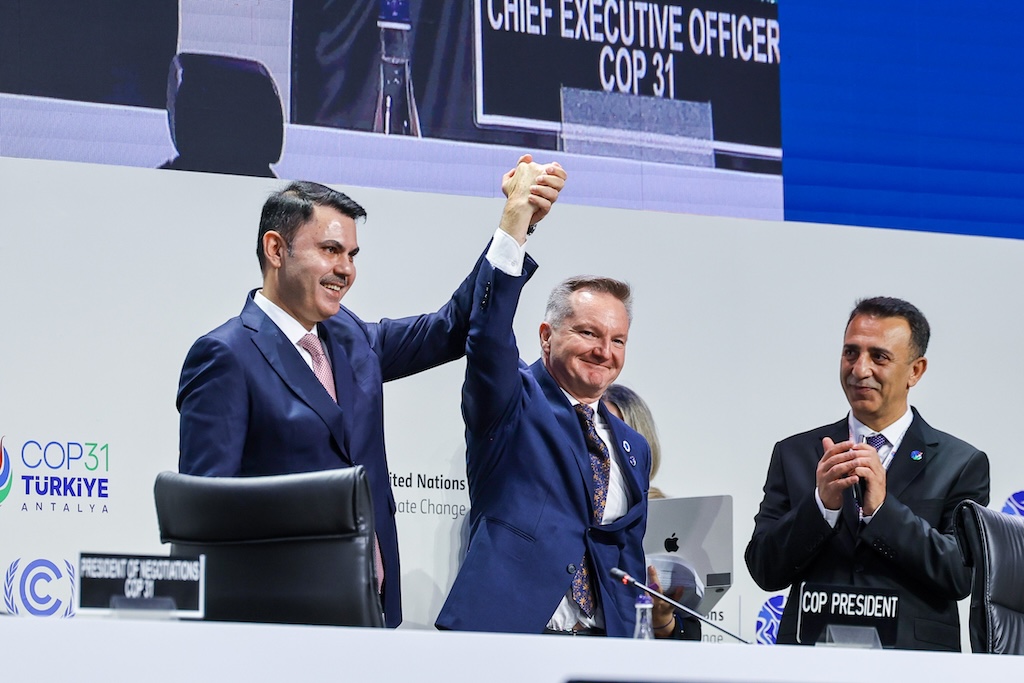
Critics questioned whether either country was well-placed to host, given their ongoing fossil-fuel expansion.
Turkey faced criticism for announcing the discovery of two new oil fields on the eve of the summit, while recent Carbon Brief analysis found that Australia is the third-largest CO2 exporter in history because of its fossil-fuel production.
Ahead of the summit, the presidency released four official letters outlining a vision for COP31.
The first letter, written by COP31 president Murat Kurum in April 2026, confirmed the appointment of Australian climate minister Chris Bowen as “president of the negotiations” and announced that a pre-COP would be held in Fiji in October.
The second letter, authored by both Kurum and Bowen from the Copenhagen climate ministerial in May, said that “COP31 presents a vital opportunity to further accelerate…in the areas of clean energy, electrification and resilient infrastructure”.
The third letter, published in August 2026, gave more details on the presidency’s plans for the “action agenda” – the part of the UN process that mobilises coalitions of nations and non-state actors to push climate action further.
This letter also introduced a key aim from the presidency to get countries to agree to increase electricity’s share of final energy consumption to 35% by 2035 (often referred to as “35 by 35”). (See: Electrification.)
The final letter, published in October ahead of the pre-COP in Fiji, said that the presidency would centre on “delivering a COP focused on accelerating implementation, electrification and resilience in an uncertain world”.
It added that “many parties have emphasised the importance of reviewing and continuously improving UNFCCC processes, to ensure it remains fit for purpose, sustainable and focused as negotiations evolve over time”, adding:
“At COP31, we will hold presidency consultations to hear parties’ views on how to strengthen UNFCCC processes, to ensure growing demands are met and to effectively deploy resources.”
The pre-COP in Fiji was held from 5-8 October and was attended by 3,000 people.
In this somewhat intimate setting, Bowen announced that Turkey and Australia had agreed to negotiate a “presidency-led” cover decision at COP31.
He added that revealing this before COP was part of the presidency’s “upfront, transparent and consultative approach”.
Later that month, the presidency named the five ministerial pairs from developed and developing countries that would take key negotiation issues forward at COP31. These issues were mitigation, adaptation, finance, just transition and oceans.
COP31 kicked off on 9 November, with climate negotiations scholar (and Carbon Brief contributing editor) Dr Joanna Depledge noting that it was clear from the summit’s opening ceremony that “Australia [was] the junior partner” in the presidency.
COP’s opening day ran late into the night as the presidency worked to avert a fight over proposed changes to the summit’s negotiations agenda.
Agenda adopted! Moments ago in Antalya, Turkey, COP31 president Murat Kurum outlined how an “agenda fight” has been averted, despite various proposals for additions to proceedings. This came after a short delay, while a series of huddles took place on…
 Simon Evans
COP31: Agenda adopted!


The next day, in plenary, Kurum announced that a resolution had been found.
He said that calls for new agenda items on adaptation finance and trade were rejected, whereas an item on a new climate finance “work programme” had been added. (The EU expressed “deep concern” about the addition.)
Kurum added that two extra proposed items on mountains and climate change – made more poignant by recent catastrophic floods in Nepal – were also not added to the agenda. However, he said that the presidency would instead hold consultations on the topic.
Though an early scrap over the agenda was avoided, the summit’s opening days were plagued with logistical problems.
Attendees were forced to spend hours navigating traffic and queues just to get into the venue – sparking serious access concerns.
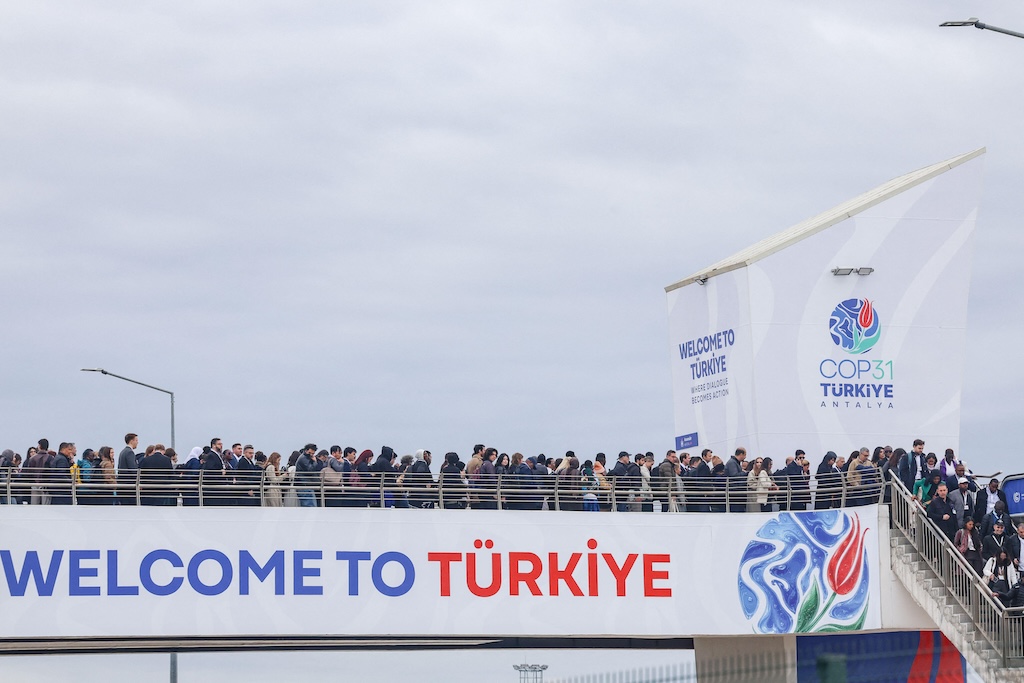
The problems persisted into the first day of the world leaders’ summit on 11 November, when delegates were informed that they should travel between the hours of 5-7am to secure access to the venue. Ire only grew when security staff still let people in after this time.
On Friday morning, the presidency released a “reflections” text from its consultations with countries on what they would like to see in a cover decision. This was an “informal note” with a bullet-pointed list of topics that might be included.
On Saturday evening, Kurum told a press conference that “around 30 countries” had indicated support for the 35 by 35 pledge.
However, he had little to share on progress in the negotiations and eluded questions on how he planned to include “fossil fuels” in the cover decision.
In the small hours of Sunday morning, half-way through the summit, Kurum announced presidency and ministerial consultations on “outstanding political issues”.
He also invited ministers to a “divan” – a group meeting, not a daybed – to discuss cross-cutting issues.
On Monday afternoon, the presidency dropped an 18-page first draft of its proposed cover decision – along with a short “presidency note” explaining that all elements were still in play, including whether or not they should appear in a final text. (See: Cover decision.)
At a press conference, Bowen told journalists that the presidency decided to release the text “early” to allow parties to debate on it for as long as possible and acknowledged that it would need to be “refined” down.
On Wednesday evening, the presidency held its divan, where delegation heads sat in a circle and were asked to share their priorities for finding consensus in the negotiations.
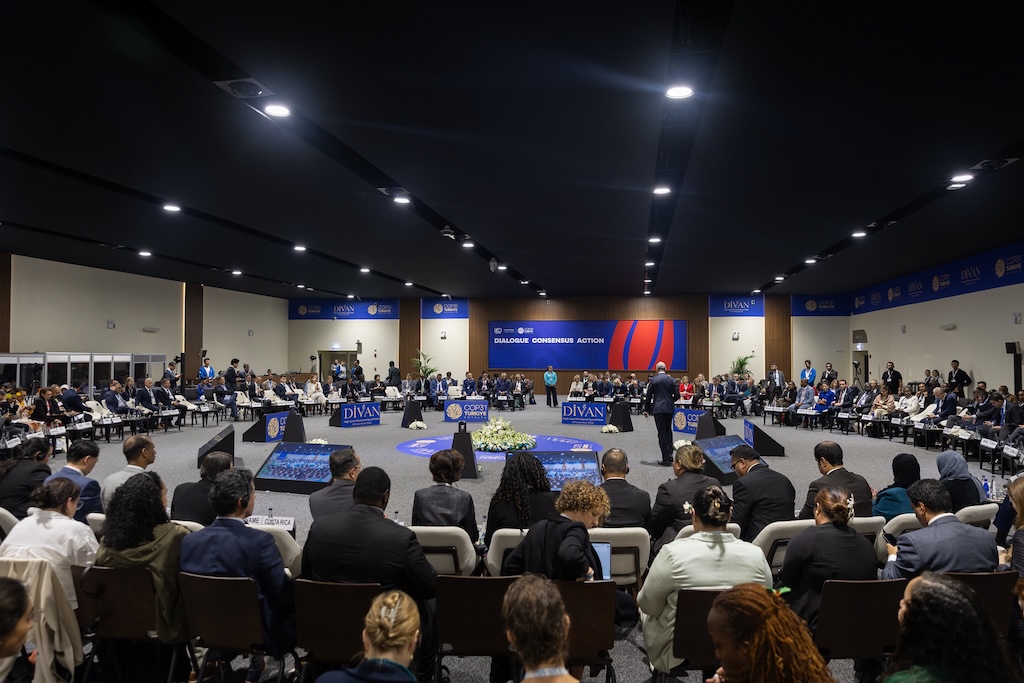
Speaking at the divan, Kurum told parties that the second draft cover decision would be published that evening.
In the end, the