

Journalists covering a major climate report in 2022 broke with a “historical tradition” of focusing on the negative impacts of climate change, shifting instead to “positive, solutions-based reporting”, a study has found.
The research, published in Climatic Change, looks at the way US and UK news outlets covered the Intergovernmental Panel on Climate Change’s (IPCC) 2022 report on the mitigation of climate change.
The findings “strongly suggest a shift in emphasis” to climate solutions in climate-change reporting, the authors say.
They note that previous IPCC reports “did not receive such an overwhelmingly positive, and at times even optimistic, message”.
However, the response to the report was significantly less optimistic on social media, where popular posts were more likely to focus on a “sense of hopelessness” and the “dire” nature of the climate threat, the authors say.
The findings contribute to the growing literature on the changing nature of media coverage as climate impacts become more frequent and severe, and groups opposed to climate action shift tactics.
Priority messages
The research looks at the media response to the report published in April 2022 by the IPCC’s Working Group III (WG3), as part of the influential body’s sixth assessment report cycle (AR6). (See Carbon Brief’s in-depth coverage.)
The report provides an overview of the world’s progress on tackling greenhouse emissions, while also examining the different sources of emissions. It is one of three comprehensive scientific assessments published each five-to-seven year IPCC assessment cycle, alongside reports on the physical science basis for climate change and its impacts.
To assess the media’s response to the WG3 report, the researchers identify 12 “official priority messages” promoted by the IPCC around its launch.
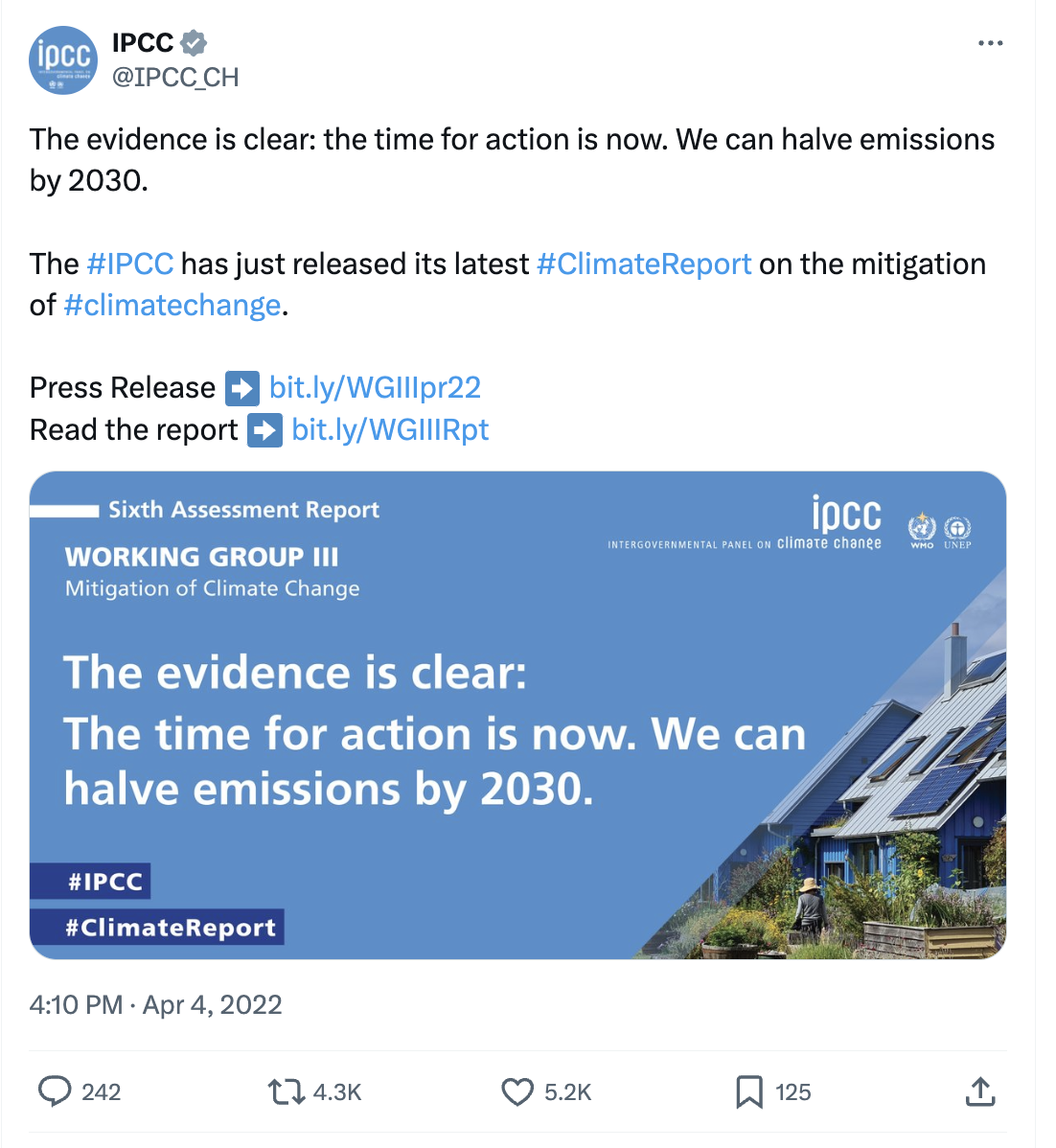
These are based on the news release, the press conference, headline statements in the report’s summary for policymakers section, and social-media posts sent out by the IPCC’s communication team.
The table below sets out the IPCC’s key messages, as identified by the researchers, ranging from the headline “there are options available now in all sectors” to more specific messages around the need to decarbonise buildings and industry, and ramp up finance to developing countries.
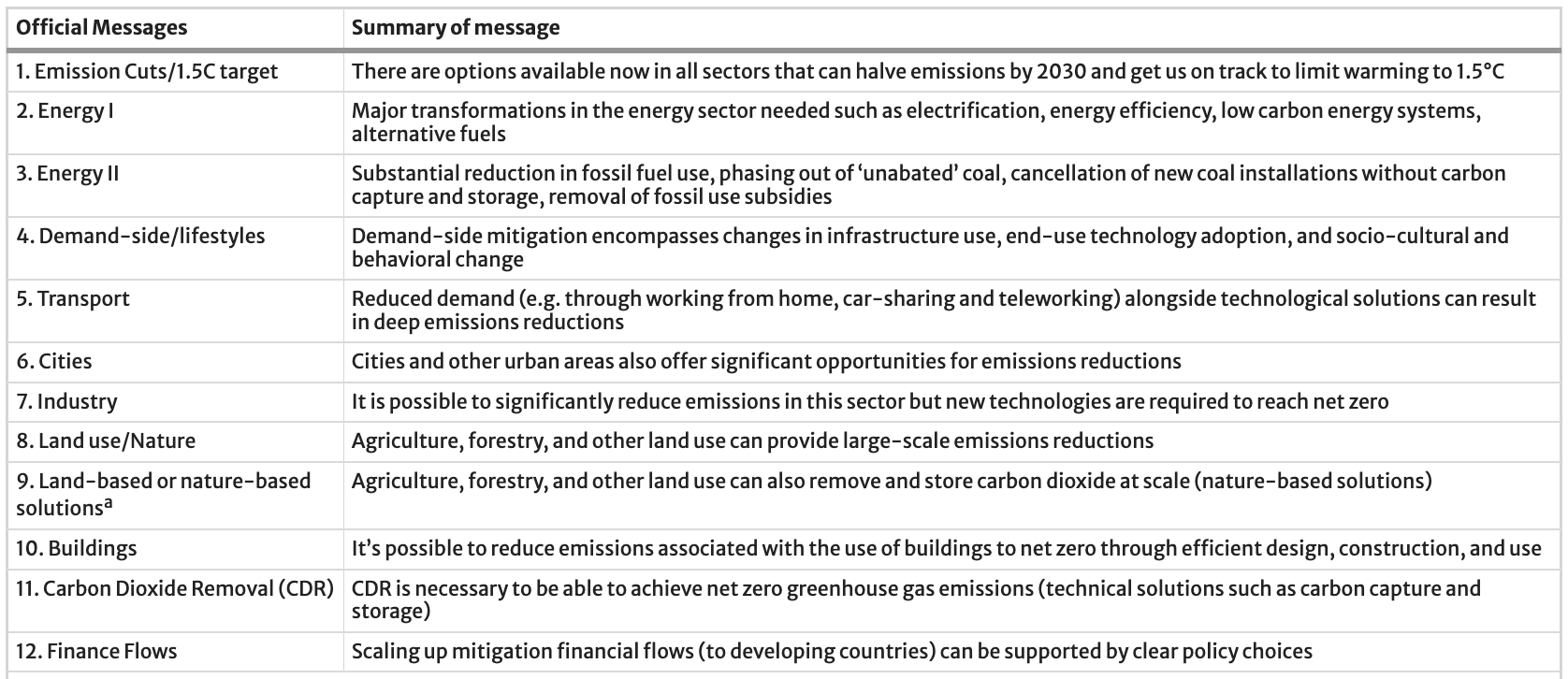
The researchers then assess the presence (mentions) and dominance (inclusion in headline, top five sentences, or as a strong narrative throughout) of these “key messages” in 66 articles published over 4-6 April on more than 20 popular UK and US news websites.
They also look at how the 12 main messages aligned with 56 of the most popular social media posts about the report on Facebook and Twitter.
A small sample
The study’s media sample focuses on articles published by the top 12 most popular online news sites in the UK and US, as identified by Reuters Institute’s 2021 digital news report, with a few exceptions.
The sample features left-leaning publications, such as the Guardian and the New York Times, centre-right outlets, including the Times and the Financial Times, and right-leaning titles, such as the Daily Mail and the Wall Street Journal.
Regional newspapers and local television websites were missed due to a lack of coverage of the report.
The authors say they chose to focus on news media in the UK and US because the two countries are host to “legacy media organisations” that have a “strong worldwide presence in English (particularly online), host sceptical voices and are influential amongst policymakers outside of their home countries”.
The social-media sample includes posts by authors, news organisations, scientists, journalists and pro- and anti-climate action groups.
Dr James Painter – an author of the study and research associate at the University of Oxford’s Reuters Institute for the Study of Journalism – tells Carbon Brief the sample size was relatively small largely due to a muted media response to the report. He adds:
“Sixty six [articles] isn’t a huge sample compared to other studies, but it is big enough to be robust and broad enough in terms of a spectrum of types of media outlets and political leaning.”
Solutions-focused coverage
The study notes that coverage “seldom deviated from the main messages the IPCC was promoting”.
The three most mentioned messages are:
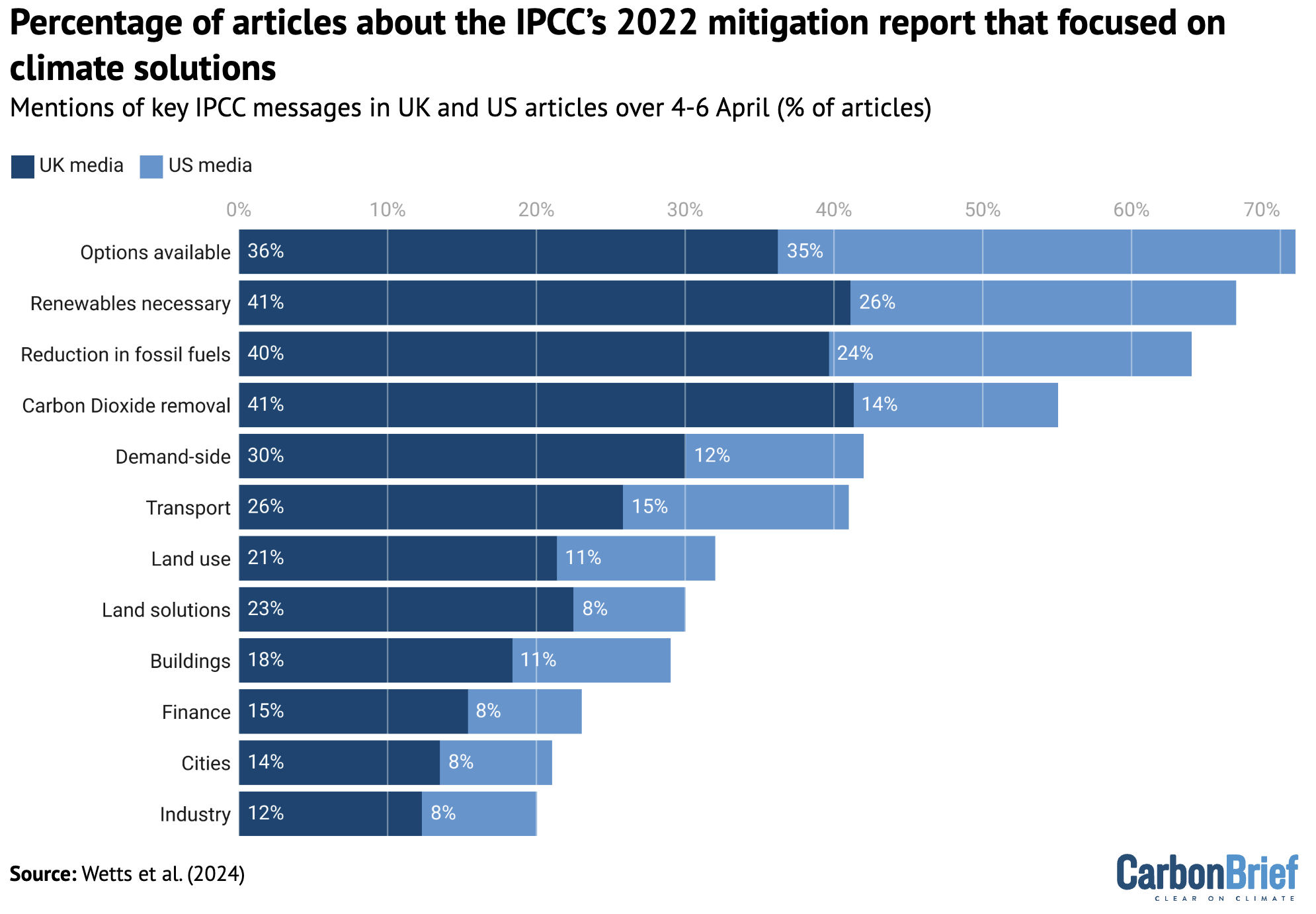
- “There are options available to reduce greenhouse gas emissions” (70%)
- “Major transformations in the energy sector are needed into renewables” (67%)
- “A substantial reduction in fossil fuels is needed” (63%)
A majority of articles (54%) also mention the IPCC’s recommendation that carbon dioxide removal (CDR) solutions are necessary to bring down emissions.
The bar chart below shows the percentage of UK and US media coverage that included the IPCC’s key messages, with UK media represented in dark blue and US media in light blue.
The authors say the paper provides a “detailed case study of which solutions get the most traction – and most critiques – in the media coverage of a policy event”.
For example, it notes how the least-mentioned solutions were sectoral measures focused on reducing the climate impact of industry, cities and buildings, and ramping up finance to poorer nations.
Painter says he believes the downgrading of these particular messages was a product of the space constraints of online journalism, which led journalists to prioritise “key findings” and “controversial” topics, such as CDR.
Break from the past
The research acknowledges that solutions-focused media coverage of the WG3 report is “to be expected”, given the document’s focus on climate mitigation options.
However, the researchers note that media coverage of the previous iteration of the WG3 report – published in 2014 – did not focus on solutions.
They point to a 2015 study that found the dominant frames of coverage were “settled science” and “political and ideological struggle”.
They also highlight analysis published in 2016 that finds a “low presence of the opportunity of action frame compared to disaster and uncertainty framing” in the response to all three key reports of the fifth IPCC assessment cycle.
As a result, the study authors argue the news media’s focus on solutions in reporting of the latest WG3 report “confirms a trend to more solutions coverage” observed by other researchers.
The research also notes the response to the 2022 WG3 report “to a large extent may have been prompted by the IPCC’s communication approach”.
However, Sigourney Luz, digital media and communications manager at Imperial College London and communications manager for the WG3 report, tells Carbon Brief that this is “difficult to determine”.
This shift could also be down to the nature of the report or “part of a broader trend in climate reporting”, she says, adding that “both media coverage of climate change and the scope of IPCC reports have evolved” between 2014 and 2022.
Dr Jill E Hopke, an associate professor of journalism at DePaul University, who was not involved in the study, says it is “encouraging” to see traditional media reflect the IPCC’s priorities. However, she adds that reporting of solutions remains scarce in reporting on climate impacts:
“The link is missing in that type of coverage, which is discouraging. As audiences and as people living on this planet, when we see extreme weather events driven by climate change, it is important to have media coverage that talks about the solutions relative, or links those things together.”
Dr Antal Wozniak, senior lecturer in media, politics and society at the University of Liverpool, who was also not involved in the study, adds that his research suggests that “solutions coverage now is actually shifting more towards adaptation [as opposed to mitigation], especially when you leave the politics beat”.
The pair are working on a number of studies which look at the media’s response to climate impacts, from heatwaves to soil degradation.
Social media
While traditional media narratives about the WG3 report largely dovetailed with the solutions-orientated messages promoted by the IPCC, social media posts did not.
The study finds that 60% of the social-media posts contained themes that did not reiterate any of the IPCC’s “official” or “unofficial” messages. Around half made no mention of solutions at all.
(On top of the 12 “official” IPCC messages, the researchers also looked at dominance and prevalence of three “unofficial messages” promoted by the IPCC and UN secretary general Antonio Guterres around the report launch – for instance, a warning that it was “now or never”.)
Instead, social-media posts focused on the “dire nature of the climate threat, the need for urgent action and a sense of hopelessness”, the study notes.
Painter says “strong” divergence between social media and news media responses holds implications for efforts to build momentum behind climate action:
“If there is an increasingly fractured debate where there isn’t consensus about responses to the climate challenge, then that is important. How do you build a sort of multi-sectoral alliance to do something about climate change if that is the case?”
Equity and justice
The study notes that the concepts of equity and justice “do not seem to have been given priority” by IPCC messaging, beyond a recommendation for more finance to go to poorer nations.
The message around financial flows was among the least covered by news media: it was the third-least prevalent message in mainstream media, and the fifth least dominant.
However, the research says that journalists highlighted issues of equity and justice that were not explicitly promoted by the IPCC. For example, it finds that 22% and 14% of articles, respectively, included messaging that either richer nations or wealthier individuals “should do more”.
The study also notes discussions of equity were “lacking” on social media, with just one social-media post – from Carbon Brief’s Simon Evans – focusing on the unequal distribution of greenhouse gas emissions within and between nations.
Climate obstructionism
Another notable finding of the media analysis was the absence of a response to WG3 from what the report authors dub the “organised climate counter-movement”.
This was contrary to expectations that the analysis might confirm a trend of changing tactics of climate-sceptic groups away from outright climate denial and towards questioning climate solutions.
In fact, the paper notes that the most common source cited in critiques of climate solutions in articles was the IPCC itself.
CDR technology was the most critiqued solution, with more than a third (35%) of articles raising some form of concern.
The authors note that the UK news media was “noticeably more critical of CDR and land-based solutions than the US sample”. The US media, on the other hand, was more critical of messaging around “options being available” and the need to phase out fossil fuels.
Overall, the study finds that the IPCC was the source for 57% of all critiques of solutions in the media studied, followed by the article authors themselves (23%), IPCC-affiliated and other scientists (15%), and pro-climate action campaign groups (5%).
In contrast, the research finds “only very limited presence of organised or individual scepticism on social media” and “no presence of evidence scepticism…nor any presence of organised scepticism or individual scepticism” in articles.
The researchers argue the relative lack of a response from sceptics could be a result of the study’s small sample size and a lack of specific country-level policy recommendations for groups to critique.
Dr Max Boykoff, a professor in the University of Colorado Boulder’s environmental studies department, who was not involved in the study, says the findings chime with his research into the evolving strategies of the Heartland Institute, which found the influential US conservative thinktank was increasingly preoccupied with opposing climate action at a state-level. He tells Carbon Brief:
“There was less of a focus on the international and national scene, and more of a focus on state level, local level engagements. In baseball lingo…it’s thinking about ‘small ball’, instead of trying to hit a home run.”
Boykoff adds that the study forms “part of a larger set of efforts that take place across research communities that add value to how we understand how the world is changing around us and what we can do to influence positive change”.




The post Media response to 2022 IPCC report suggests shift to ‘solutions-based reporting’ appeared first on Carbon Brief.
Media response to 2022 IPCC report suggests shift to ‘solutions-based reporting’

Drought and heatwaves occurring together – known as “compound” events – have “surged” across the world since the early 2000s, a new study shows.
Compound drought and heat events (CDHEs) can have devastating effects, creating the ideal conditions for intense wildfires, such as Australia’s “Black Summer” of 2019-20 where bushfires burned 24m hectares and killed 33 people.
The research, published in Science Advances, finds that the increase in CDHEs is predominantly being driven by events that start with a heatwave.
The global area affected by such “heatwave-led” compound events has more than doubled between 1980-2001 and 2002-23, the study says.
The rapid increase in these events over the last 23 years cannot be explained solely by global warming, the authors note.
Since the late 1990s, feedbacks between the land and the atmosphere have become stronger, making heatwaves more likely to trigger drought conditions, they explain.
One of the study authors tells Carbon Brief that societies must pay greater attention to compound events, which can “cause severe impacts on ecosystems, agriculture and society”.
Compound events
CDHEs are extreme weather events where drought and heatwave conditions occur simultaneously – or shortly after each other – in the same region.
These events are often triggered by large-scale weather patterns, such as “blocking” highs, which can produce “prolonged” hot and dry conditions, according to the study.
Prof Sang-Wook Yeh is one of the study authors and a professor at the Ewha Womans University in South Korea. He tells Carbon Brief:
“When heatwaves and droughts occur together, the two hazards reinforce each other through land-atmosphere interactions. This amplifies surface heating and soil moisture deficits, making compound events more intense and damaging than single hazards.”
CDHEs can begin with either a heatwave or a drought.
The sequence of these extremes is important, the study says, as they have different drivers and impacts.
For example, in a CDHE where the heatwave was the precursor, increased direct sunshine causes more moisture loss from soils and plants, leading to a drought.
Conversely, in an event where the drought was the precursor, the lack of soil moisture means that less of the sun’s energy goes into evaporation and more goes into warming the Earth’s surface. This produces favourable conditions for heatwaves.
The study shows that the majority of CDHEs globally start out as a drought.
In recent years, there has been increasing focus on these events due to the devastating impact they have on agriculture, ecosystems and public health.
In Russia in the summer of 2010, a compound drought-heatwave event – and the associated wildfires – caused the death of nearly 55,000 people, the study notes.

The record-breaking Pacific north-west “heat dome” in 2021 triggered extreme drought conditions that caused “significant declines” in wheat yields, as well as in barley, canola and fruit production in British Columbia and Alberta, Canada, says the study.
Increasing events
To assess how CDHEs are changing, the researchers use daily reanalysis data to identify droughts and heatwaves events. (Reanalysis data combines past observations with climate models to create a historical climate record.) Then, using an algorithm, they analyse how these events overlap in both time and space.
The study covers the period from 1980 to 2023 and the world’s land surface, excluding polar regions where CDHEs are rare.
The research finds that the area of land affected by CDHEs has “increased substantially” since the early 2000s.
Heatwave-led events have been the main contributor to this increase, the study says, with their spatial extent rising 110% between 1980-2001 and 2002-23, compared to a 59% increase for drought-led events.
The map below shows the global distribution of CDHEs over 1980-2023. The charts show the percentage of the land surface affected by a heatwave-led CDHE (red) or a drought-led CDHE (yellow) in a given year (left) and relative increase in each CDHE type (right).
The study finds that CDHEs have occurred most frequently in northern South America, the southern US, eastern Europe, central Africa and south Asia.

Threshold passed
The authors explain that the increase in heatwave-led CDHEs is related to rising global temperatures, but that this does not tell the whole story.
In the earlier 22-year period of 1980-2001, the study finds that the spatial extent of heatwave-led CDHEs rises by 1.6% per 1C of global temperature rise. For the more-recent period of 2022-23, this increases “nearly eightfold” to 13.1%.
The change suggests that the rapid increase in the heatwave-led CDHEs occurred after the global average temperature “surpasse[d] a certain temperature threshold”, the paper says.
This threshold is an absolute global average temperature of 14.3C, the authors estimate (based on an 11-year average), which the world passed around the year 2000.
Investigating the recent surge in heatwave-leading CDHEs further, the researchers find a “regime shift” in land-atmosphere dynamics “toward a persistently intensified state after the late 1990s”.
In other words, the way that drier soils drive higher surface temperatures, and vice versa, is becoming stronger, resulting in more heatwave-led compound events.
Daily data
The research has some advantages over other previous studies, Yeh says. For instance, the new work uses daily estimations of CDHEs, compared to monthly data used in past research. This is “important for capturing the detailed occurrence” of these events, says Yeh.
He adds that another advantage of their study is that it distinguishes the sequence of droughts and heatwaves, which allows them to “better understand the differences” in the characteristics of CDHEs.
Dr Meryem Tanarhte is a climate scientist at the University Hassan II in Morocco, and Dr Ruth Cerezo Mota is a climatologist and a researcher at the National Autonomous University of Mexico. Both scientists, who were not involved in the study, agree that the daily estimations give a clearer picture of how CDHEs are changing.
Cerezo-Mota adds that another major contribution of the study is its global focus. She tells Carbon Brief that in some regions, such as Mexico and Africa, there is a lack of studies on CDHEs:
“Not because the events do not occur, but perhaps because [these regions] do not have all the data or the expertise to do so.”
However, she notes that the reanalysis data used by the study does have limitations with how it represents rainfall in some parts of the world.
Compound impacts
The study notes that if CDHEs continue to intensify – particularly events where heatwaves are the precursors – they could drive declining crop productivity, increased wildfire frequency and severe public health crises.
These impacts could be “much more rapid and severe as global warming continues”, Yeh tells Carbon Brief.
Tanarhte notes that these events can be forecasted up to 10 days ahead in many regions. Furthermore, she says, the strongest impacts can be prevented “through preparedness and adaptation”, including through “water management for agriculture, heatwave mitigation measures and wildfire mitigation”.
The study recommends reassessing current risk management strategies for these compound events. It also suggests incorporating the sequences of drought and heatwaves into compound event analysis frameworks “to enhance climate risk management”.
Cerezo-Mota says that it is clear that the world needs to be prepared for the increased occurrence of these events. She tells Carbon Brief:
“These [risk assessments and strategies] need to be carried out at the local level to understand the complexities of each region.”



The post Heatwaves driving recent ‘surge’ in compound drought and heat extremes appeared first on Carbon Brief.
Heatwaves driving recent ‘surge’ in compound drought and heat extremes
Greenhouse Gases
DeBriefed 6 March 2026: Iran energy crisis | China climate plan | Bristol’s ‘pioneering’ wind turbine
Welcome to Carbon Brief’s DeBriefed.
An essential guide to the week’s key developments relating to climate change.
This week
Energy crisis
ENERGY SPIKE: US-Israeli attacks on Iran and subsequent counterattacks across the Middle East have sent energy prices “soaring”, according to Reuters. The newswire reported that the region “accounts for just under a third of global oil production and almost a fifth of gas”. The Guardian noted that shipping traffic through the strait of Hormuz, which normally ferries 20% of the world’s oil, “all but ground to a halt”. The Financial Times reported that attacks by Iran on Middle East energy facilities – notably in Qatar – triggered the “biggest rise in gas prices since Russia’s full-scale invasion of Ukraine”.
‘RISK’ AND ‘BENEFITS’: Bloomberg reported on increases in diesel prices in Europe and the US, speculating that rising fuel costs could be “a risk for president Donald Trump”. US gas producers are “poised to benefit from the big disruption in global supply”, according to CNBC. Indian government sources told the Economic Times that Russia is prepared to “fulfil India’s energy demands”. China Daily quoted experts who said “China’s energy security remains fundamentally unshaken”, thanks to “emergency stockpiles and a wide array of import channels”.
‘ESSENTIAL’ RENEWABLES: Energy analysts said governments should cut their fossil-fuel reliance by investing in renewables, “rather than just seeking non-Gulf oil and gas suppliers”, reported Climate Home News. This message was echoed by UK business secretary Peter Kyle, who said “doubling down on renewables” was “essential” amid “regional instability”, according to the Daily Telegraph.
China’s climate plan
PEAK COAL?: China has set out its next “five-year plan” at the annual “two sessions” meeting of the National People’s Congress, including its climate strategy out to 2030, according to the Hong Kong-based South China Morning Post