

There is a “mismatch” between the importance of peatlands and their current level of protection, a new study warns.
The paper, published in Conservation Letters, combines maps showing global peatlands, protected areas and human impact in the year 2020, to provide a snapshot of the current level of global peatland protection.
The authors stress that peatlands are crucial carbon stores, holding more carbon than all the world’s forest biomass combined.
However, they find that only 17% of peatlands fall within protected areas – a “substantially lower” proportion than other “high-value ecosystems”, such as mangroves, saltmarshes and tropical forests, they say.
The study finds that 22% of global peatlands are under “high human pressure”, with regions in Europe and the east coast of the US under particular threat.
Furthermore, one-third of the global peatlands in protected areas and Indigenous people’s lands still experience “medium to high human pressure”, the paper finds.
‘Disproportionate’ carbon stores
Despite peatlands’ relatively small footprint – they cover only 3% of the Earth’s land surface – the ecosystems store a “disproportionate amount” of carbon.
Research has shown that there is more carbon contained in peatlands than in all of the world’s forests combined – around 600bn tonnes (GtC).
They also provide myriad other “ecosystem services”, such as regulating air temperatures, storing water and creating habitat for many species.
Peatlands are wetland ecosystems that form slowly over time. When plant matter in one of these habitats dies, the high water content of the soils prevents it from decomposing completely.
As a result, plant matter accumulates, building up as carbon-rich peat over time. Peatlands are found on every inhabited continent, primarily in the high latitudes of the northern hemisphere and in the tropics.
The degradation and destruction of peatlands is a significant carbon source, contributing 2-4% of human-driven greenhouse gas emissions each year. Peatlands are often drained or degraded during use for agriculture, and about 16% of peatlands globally have been drained to date. In some places, peat is intentionally removed to be used as fuel or fertile soil.
Prof Chris Evans, a biogeochemist at the UK Centre for Ecology & Hydrology, who was not involved in the study, tells Carbon Brief:
“Peatland degradation is second only to tropical deforestation as a source of greenhouse gas emissions from land use, yet peatlands are often overlooked in conservation and climate policy.”
At the same time, climate change itself is putting peatlands at risk.
Increased temperatures are causing permafrost thaw, allowing the once-frozen peat to decompose and release CO2 into the atmosphere. Warmer temperatures also increase microbial activity, leading to faster rates of decomposition, while warmer, drier peatlands are more susceptible to fires.
Losing peatlands has “cascading effects on local water supplies, agriculture and fisheries, disproportionately affecting Indigenous and rural communities”, says Dr Michelle Kalamandeen, a geospatial scientist at McMaster University in Ontario, who was not involved in the study.
Protected areas
This study centres on an existing map of global peatland. The map divides the world into grid cells and, using a machine learning model trained on data collected on the ground, estimates the proportion of each cell that contains peatland at least 30cm deep.
The map identifies around 4m square kilometres (km2) of peatland globally. More than 60% of this is “boreal peatland” – found in the high-latitude northern regions, such as Canada, Russia and Scandinavia – and the rest is found in temperature or tropical regions, according to the study.
The authors then cross-reference the map with a database of global protected areas. The database encompasses both “strict” protection areas, such as national parks and nature reserves, as well as less strict land-management regimes where some human activity is permitted.
The database also shows Ramsar sites, a subset of protected areas designated to be of international importance under the Ramsar convention – also known as the “Convention on Wetlands”. (The convention seeks to promote “the wise use of all wetlands” in participating countries and encourage international co-operation with other countries.)
The authors find that only 17% of peatlands are located in protected areas. This is “substantially lower than other high-value ecosystems such as mangroves, 42% of which are within official protected areas globally, saltmarshes (50%) and tropical forests (38%)”, the study says.
Dr Kemen Austin is the director of science at the Wildlife Conservation Society‘s forests and climate change programme, and lead author of the new study. In a press release, she says that the study “reveals that these vital ecosystems don’t have anywhere near the level of protection they need”.
The authors also present case studies of individual countries. For example, they find that nearly 90% of peatland in the Republic of the Congo is protected. However, they warn that “most of this falls within a designated Ramsar site that has not yet been backed-up by strong government commitments”.
The study identifies a large body of literature showing that “Indigenous land rights and community-based management result in positive environmental outcomes, such as reduced deforestation and forest degradation”. The authors analyse data on Indigenous stewardship and find that one-quarter of global peatlands sit on land owned by Indigenous groups.
Human impact
The authors assess human pressures on peatland using the Human Impact Index (HII). This metric quantifies the “cumulative anthropogenic pressures” on a region, using a scale of 0-50 that incorporates factors such as accessibility, land use and population density.
The map below shows human pressure in areas that contain more than 5% peatland by area. Light pink shows “low-pressure” regions, medium pink shows “medium-pressure” regions and dark pink shows “high-pressure” regions.
The top map shows the whole planet, while the three inset maps below highlight chosen case studies in Peru, the Congo Basin and Indonesia.
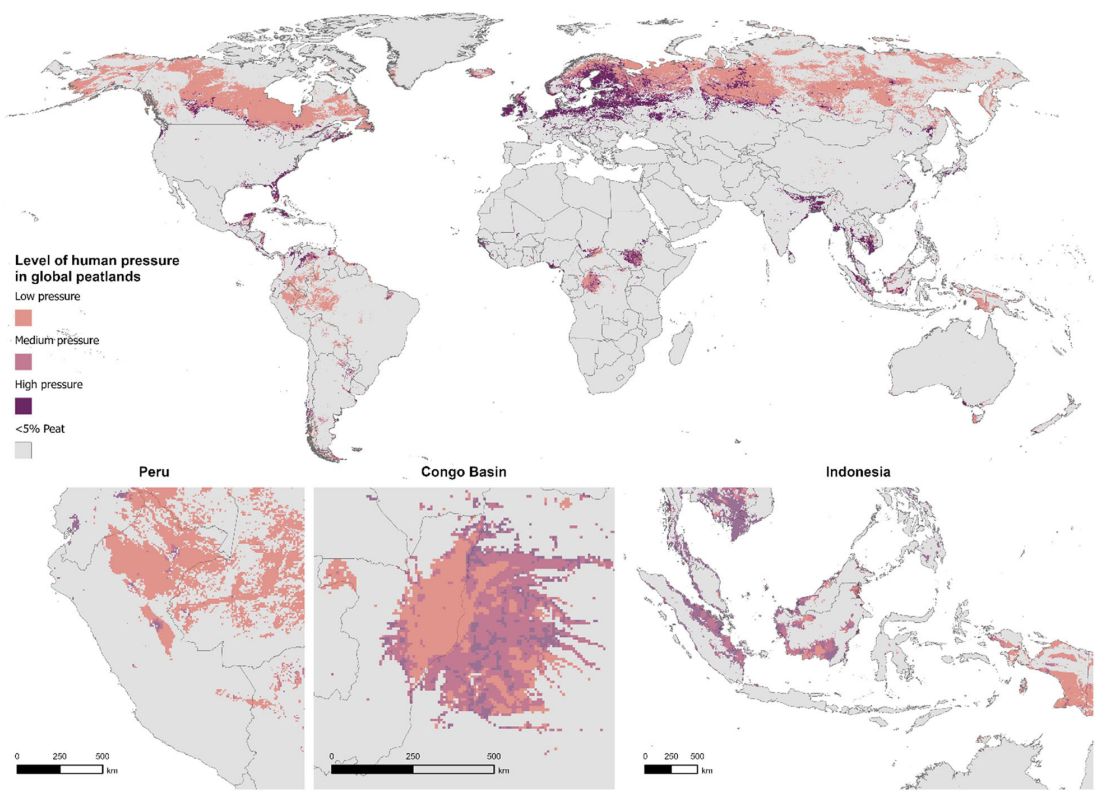
The authors find that globally, 22% percent of peatlands are under high human pressure, 12% are under medium pressure and 61% are under low pressure. The remaining 5% are in areas without reported HII data.
The authors find that almost half of peatlands in temperate regions are facing high human pressure, adding that Europe and the US east coast are under particular stress. At the other end of the scale, they estimate that human pressure is low in Brazil, the lowlands of Peru, the Republic of the Congo and eastern Indonesia.
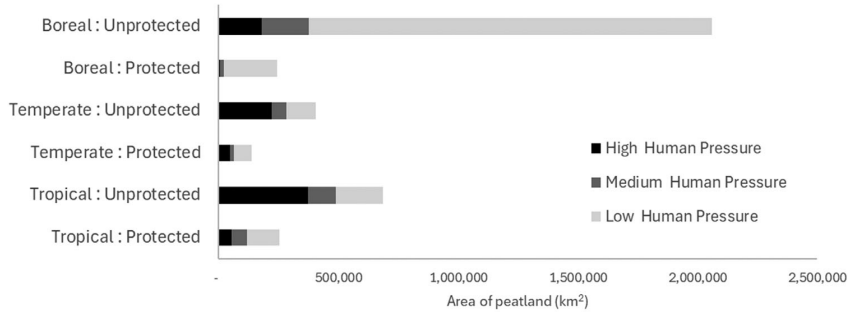
The study says that, as expected, human pressure is “somewhat higher” in unprotected peatlands than protected peatlands. However, it adds:
“Nearly one-third of global peatlands, and nearly half of temperate and tropical peatlands in protected areas and Indigenous people’s lands, still experience medium-to-high human pressure.”
The chart below shows the area of peatland in protected and unprotected boreal, temperate and tropical regions that is facing high (black) medium (grey) and low (light grey) human pressure.
Kalamandeen tells Carbon Brief that the study “underscores a fundamental disconnect between conservation priorities and real-world climate needs”.
However, she notes that there are some limitations to the methodology. For example, she tells Carbon Brief that the underlying peatland map “performs well in data-rich regions”, but says that “its accuracy drops where ground-truth data is lacking, notably in Africa, South America and boreal regions”.
Furthermore, the map only recognises peatlands deeper than 30cm, meaning that “shallower, but still ecologically valuable peatlands, are ignored”.
She continues:
“This study is an excellent starting point, but if we are serious about peatland protection, countries need to invest in better mapping and monitoring technologies such as using Earth observations and improving ground surveys to help refine conservation strategies.”
Peatland conservation
The new research “quantifies an issue that was previously known: that peatlands are under-protected when compared to other critical ecosystem types”, Dr Julie Loisel, a palaeoecologist at the University of Nevada, Reno, tells Carbon Brief. Loisel, who was not involved in the study, adds:
“In the face of rapid environmental change, ensuring that peatlands can ‘do their job’ of storing CO2 into their soils for the next few thousands of years is very important and any policy or land management effort that is enabling this simple goal should be put forth and prioritised.”
The study notes that several international policy frameworks, such as the global stocktake process under the Paris Agreement and the Kunming-Montreal Global Biodiversity Framework, can be applied to further the protection of wetlands.
For example, the authors note that Peru’s nationally determined contribution includes strategies for improving peatland management, such as establishing new conservation areas and recognising Indigenous peoples’ knowledge about peatlands.
However, Peru is one of the few countries with plans for the preservation of peatlands, alongside the UK, according to the study. Austin adds:
“Based on the nationally determined contributions countries have submitted to date, the continued disturbance and damage to global peatlands is getting very little attention as a significant and avoidable source of greenhouse gas emissions.”
In addition to protection of intact peatlands, peatland restoration “will be necessary for managing peat fires and meeting climate targets nationally”, the study says. Restoration typically involves altering the wetland’s water flows to “rewet” drained peat. It can also encompass controls on pollution, protection from burning and grazing and regrowing plants.

But while restoration can slow the release of CO2 and promote some ecosystem services, it is not an adequate substitute for peatland protection. The study notes:
“Notably, once emitted to the atmosphere, the carbon lost from peatlands cannot be restored on timescales that matter for preventing dangerous climate change.”
Promoting Indigenous peoples’ land rights is one way to support the protection of peatlands, Loisel says. She tells Carbon Brief:
“Conservation efforts do not necessarily imply ‘protection from use’, but are rather meant to ensure their ‘proper use’, or ‘sustainable use’. Indigenous community uses of peatlands have been known to be sustainable.”
Kalamandeen tells Carbon Brief that, while legal protections are “crucial”, their impact “depends on enforcement, management capacity and local engagement”. Meanwhile, she says that “Indigenous and community-managed lands, even without formal protection, often demonstrate strong conservation outcomes”.
Dr Adam Todd Hastie is the leader of the carbon and wetlands group at Charles University, and was not involved in the study. He agrees, calling Indigenous stewardship “often the best and most simple solution” to protecting peatlands.
However, he adds that global-north countries “need to be thoughtful in our calls for less economically developed countries to protect their peatlands”. He tells Carbon Brief:
“If we want less economically developed countries to take a different path of protecting their peatlands – and peat carbon – and to forgo short-term economic benefits, such as revenue from plantations or mining, we (especially Europe and North America) must contribute in real terms to developing alternative sustainable solutions, both environmentally and economically.”


The post Just 17% of world’s peatlands are protected, new study warns appeared first on Carbon Brief.
Just 17% of world’s peatlands are protected, new study warns

Drought and heatwaves occurring together – known as “compound” events – have “surged” across the world since the early 2000s, a new study shows.
Compound drought and heat events (CDHEs) can have devastating effects, creating the ideal conditions for intense wildfires, such as Australia’s “Black Summer” of 2019-20 where bushfires burned 24m hectares and killed 33 people.
The research, published in Science Advances, finds that the increase in CDHEs is predominantly being driven by events that start with a heatwave.
The global area affected by such “heatwave-led” compound events has more than doubled between 1980-2001 and 2002-23, the study says.
The rapid increase in these events over the last 23 years cannot be explained solely by global warming, the authors note.
Since the late 1990s, feedbacks between the land and the atmosphere have become stronger, making heatwaves more likely to trigger drought conditions, they explain.
One of the study authors tells Carbon Brief that societies must pay greater attention to compound events, which can “cause severe impacts on ecosystems, agriculture and society”.
Compound events
CDHEs are extreme weather events where drought and heatwave conditions occur simultaneously – or shortly after each other – in the same region.
These events are often triggered by large-scale weather patterns, such as “blocking” highs, which can produce “prolonged” hot and dry conditions, according to the study.
Prof Sang-Wook Yeh is one of the study authors and a professor at the Ewha Womans University in South Korea. He tells Carbon Brief:
“When heatwaves and droughts occur together, the two hazards reinforce each other through land-atmosphere interactions. This amplifies surface heating and soil moisture deficits, making compound events more intense and damaging than single hazards.”
CDHEs can begin with either a heatwave or a drought.
The sequence of these extremes is important, the study says, as they have different drivers and impacts.
For example, in a CDHE where the heatwave was the precursor, increased direct sunshine causes more moisture loss from soils and plants, leading to a drought.
Conversely, in an event where the drought was the precursor, the lack of soil moisture means that less of the sun’s energy goes into evaporation and more goes into warming the Earth’s surface. This produces favourable conditions for heatwaves.
The study shows that the majority of CDHEs globally start out as a drought.
In recent years, there has been increasing focus on these events due to the devastating impact they have on agriculture, ecosystems and public health.
In Russia in the summer of 2010, a compound drought-heatwave event – and the associated wildfires – caused the death of nearly 55,000 people, the study notes.

The record-breaking Pacific north-west “heat dome” in 2021 triggered extreme drought conditions that caused “significant declines” in wheat yields, as well as in barley, canola and fruit production in British Columbia and Alberta, Canada, says the study.
Increasing events
To assess how CDHEs are changing, the researchers use daily reanalysis data to identify droughts and heatwaves events. (Reanalysis data combines past observations with climate models to create a historical climate record.) Then, using an algorithm, they analyse how these events overlap in both time and space.
The study covers the period from 1980 to 2023 and the world’s land surface, excluding polar regions where CDHEs are rare.
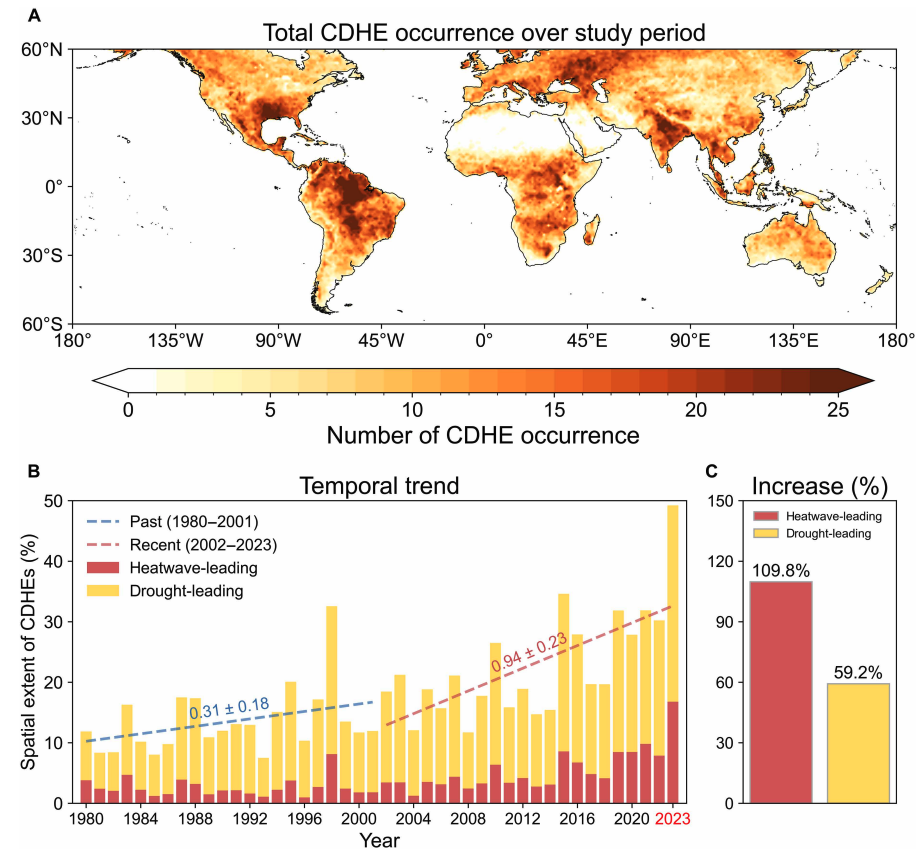
The research finds that the area of land affected by CDHEs has “increased substantially” since the early 2000s.
Heatwave-led events have been the main contributor to this increase, the study says, with their spatial extent rising 110% between 1980-2001 and 2002-23, compared to a 59% increase for drought-led events.
The map below shows the global distribution of CDHEs over 1980-2023. The charts show the percentage of the land surface affected by a heatwave-led CDHE (red) or a drought-led CDHE (yellow) in a given year (left) and relative increase in each CDHE type (right).
The study finds that CDHEs have occurred most frequently in northern South America, the southern US, eastern Europe, central Africa and south Asia.
Threshold passed
The authors explain that the increase in heatwave-led CDHEs is related to rising global temperatures, but that this does not tell the whole story.
In the earlier 22-year period of 1980-2001, the study finds that the spatial extent of heatwave-led CDHEs rises by 1.6% per 1C of global temperature rise. For the more-recent period of 2022-23, this increases “nearly eightfold” to 13.1%.
The change suggests that the rapid increase in the heatwave-led CDHEs occurred after the global average temperature “surpasse[d] a certain temperature threshold”, the paper says.
This threshold is an absolute global average temperature of 14.3C, the authors estimate (based on an 11-year average), which the world passed around the year 2000.
Investigating the recent surge in heatwave-leading CDHEs further, the researchers find a “regime shift” in land-atmosphere dynamics “toward a persistently intensified state after the late 1990s”.
In other words, the way that drier soils drive higher surface temperatures, and vice versa, is becoming stronger, resulting in more heatwave-led compound events.
Daily data
The research has some advantages over other previous studies, Yeh says. For instance, the new work uses daily estimations of CDHEs, compared to monthly data used in past research. This is “important for capturing the detailed occurrence” of these events, says Yeh.
He adds that another advantage of their study is that it distinguishes the sequence of droughts and heatwaves, which allows them to “better understand the differences” in the characteristics of CDHEs.
Dr Meryem Tanarhte is a climate scientist at the University Hassan II in Morocco, and Dr Ruth Cerezo Mota is a climatologist and a researcher at the National Autonomous University of Mexico. Both scientists, who were not involved in the study, agree that the daily estimations give a clearer picture of how CDHEs are changing.
Cerezo-Mota adds that another major contribution of the study is its global focus. She tells Carbon Brief that in some regions, such as Mexico and Africa, there is a lack of studies on CDHEs:
“Not because the events do not occur, but perhaps because [these regions] do not have all the data or the expertise to do so.”
However, she notes that the reanalysis data used by the study does have limitations with how it represents rainfall in some parts of the world.
Compound impacts
The study notes that if CDHEs continue to intensify – particularly events where heatwaves are the precursors – they could drive declining crop productivity, increased wildfire frequency and severe public health crises.
These impacts could be “much more rapid and severe as global warming continues”, Yeh tells Carbon Brief.
Tanarhte notes that these events can be forecasted up to 10 days ahead in many regions. Furthermore, she says, the strongest impacts can be prevented “through preparedness and adaptation”, including through “water management for agriculture, heatwave mitigation measures and wildfire mitigation”.
The study recommends reassessing current risk management strategies for these compound events. It also suggests incorporating the sequences of drought and heatwaves into compound event analysis frameworks “to enhance climate risk management”.
Cerezo-Mota says that it is clear that the world needs to be prepared for the increased occurrence of these events. She tells Carbon Brief:
“These [risk assessments and strategies] need to be carried out at the local level to understand the complexities of each region.”



The post Heatwaves driving recent ‘surge’ in compound drought and heat extremes appeared first on Carbon Brief.
Heatwaves driving recent ‘surge’ in compound drought and heat extremes
Greenhouse Gases
DeBriefed 6 March 2026: Iran energy crisis | China climate plan | Bristol’s ‘pioneering’ wind turbine
Welcome to Carbon Brief’s DeBriefed.
An essential guide to the week’s key developments relating to climate change.
This week
Energy crisis
ENERGY SPIKE: US-Israeli attacks on Iran and subsequent counterattacks across the Middle East have sent energy prices “soaring”, according to Reuters. The newswire reported that the region “accounts for just under a third of global oil production and almost a fifth of gas”. The Guardian noted that shipping traffic through the strait of Hormuz, which normally ferries 20% of the world’s oil, “all but ground to a halt”. The Financial Times reported that attacks by Iran on Middle East energy facilities – notably in Qatar – triggered the “biggest rise in gas prices since Russia’s full-scale invasion of Ukraine”.
‘RISK’ AND ‘BENEFITS’: Bloomberg reported on increases in diesel prices in Europe and the US, speculating that rising fuel costs could be “a risk for president Donald Trump”. US gas producers are “poised to benefit from the big disruption in global supply”, according to CNBC. Indian government sources told the Economic Times that Russia is prepared to “fulfil India’s energy demands”. China Daily quoted experts who said “China’s energy security remains fundamentally unshaken”, thanks to “emergency stockpiles and a wide array of import channels”.
‘ESSENTIAL’ RENEWABLES: Energy analysts said governments should cut their fossil-fuel reliance by investing in renewables, “rather than just seeking non-Gulf oil and gas suppliers”, reported Climate Home News. This message was echoed by UK business secretary Peter Kyle, who said “doubling down on renewables” was “essential” amid “regional instability”, according to the Daily Telegraph.
China’s climate plan
PEAK COAL?: China has set out its next “five-year plan” at the annual “two sessions” meeting of the National People’s Congress, including its climate strategy out to 2030, according to the Hong Kong-based South China Morning Post. The plan called for China to cut its carbon emissions per unit of gross domestic product (GDP) by 17% from 2026 to 2030, which “may allow for continued increase in emissions given the rate of GDP growth”, reported Reuters. The newswire added that the plan also had targets to reach peak coal in the next five years and replace 30m tonnes per year of coal with renewables.
ACTIVE YET PRUDENT: Bloomberg described the new plan as “cautious”, stating that it “frustrat[es] hopes for tighter policy that would drive the nation to peak carbon emissions well before president Xi Jinping’s 2030 deadline”. Carbon Brief has just published an in-depth analysis of the plan. China Daily reported that the strategy “highlights measures to promote the climate targets of peaking carbon dioxide emissions before 2030”, which China said it would work towards “actively yet prudently”.
Around the world
- EU RULES: The European Commission has proposed new “made in Europe” rules to support domestic low-carbon industries, “against fierce competition from China”, reported Agence France-Presse. Carbon Brief examined what it means for climate efforts.
- RECORD HEAT: The US National Oceanic and Atmospheric Administration has said there is a 50-60% chance that the El Niño weather pattern could return this year, amplifying the effect of global warming and potentially driving temperatures to “record highs”, according to