

Japan has led two major regional summits this month to promote carbon capture technologies, an effort that climate groups say could create a smokescreen for the continued use of fossil fuels.
Last week, Tokyo hosted the Japan CCUS Summit, focused on “carbon capture, utilisation and storage”, a conference that was attended by major domestic and international oil and gas firms, as well as government officials from the UK, Canada, Indonesia, Malaysia, Singapore, Thailand and South Australia.
The day after, energy ministers from Japan, Australia and nine Southeast Asian countries met in Kuala Lumpur under the Asia Zero Emission Community (AZEC), an initiative that Japan launched in 2023 to propel decarbonisation but has since been criticised as promoting and prolonging fossil fuel use.
In a joint statement, AZEC ministers confirmed their commitment to the COP28 deal in Dubai, in which countries agreed to transition away from fossil fuels, while also accelerating carbon capture. The AZEC statement stresses the importance of “various and practical pathways” to achieving carbon neutrality.
Carbon capture and storage (CCS) encompasses abatement technologies that capture the CO2 emissions of fossil fuel projects at the production site. While CCS is regarded as a solution to reduce emissions in sectors that are difficult to decarbonise like steel or cement, it has so far proved expensive, and capture rates have been lower than expected.
In the lead-up to the COP30 climate summit in Brazil next month, there are concerns about what Tokyo’s enthusiasm for CCUS means for broader emissions reduction efforts.
“There’s a lot of diplomatic muscle that Japan is deploying behind the promotion of CCS,” said James Bowen, a climate and energy policy analyst at Climate Analytics, a research organisation. “Japan has already played a significant role in previous COPs in pushing this idea of abated fossil fuels being a viable alternative to fossil fuel phaseout.”
-
Japan backs fossil fuels in Southeast Asian “zero emission” initiative
Japan’s Asia Zero Emission Community (AZEC) supported 56 projects using fossil fuel technologies in Southeast Asia — including LNG and carbon capture -
Carbon colonialism? Malaysia and Indonesia plan storage hubs for Asian emissions
Japan and South Korea have signed deals to export CO2 captured at their power and manufacturing plants to Southeast Asia -
Countries must confront fossil fuels head-on in their NDCs
Other nations should follow the rare example set by Colombia and Vanuatu, whose climate plans contain explicit goals for cutting back on oil, gas and coal


According to the Japanese government’s 7th Strategic Energy Plan published earlier this year, CCUS can support decarbonisation in sectors where electrification is hard to achieve only with renewables, by abating emissions from fossil fuel sources.
“CCUS is indispensable for simultaneously achieving energy security, economic growth and decarbonisation,” the plan says, adding that Japan will consider support systems to encourage investment and develop suitable sites, among other things.
Climate Home News contacted Japan’s Ministry of Economy, Trade and Industry for comment but had not received a response at the time of publication.
Lifeline for fossil fuels
The latest AZEC declaration adopts language often used by Japan to signal that it and other countries, especially in the Global South, “have to have (their) own pathway to reach net zero”, due to specific “limitations” and “conditions”, said Makiko Arima, a senior finance campaigner at Oil Change International, which recently published a fact sheet on Japanese financing of CCS.
Arima sees Japan’s approach as a smokescreen for continued justification for fossil fuels under the guise of decarbonisation.
Investing in CCS risks diverting resources from clean energy adoption in Southeast Asia, where renewables could make up around 90% of the power supply by mid-century but 99% of solar and wind energy potential remained untapped, according to a 2023 Ember report.
AZEC has led some progress on clean energy in Southeast Asia, with several recent agreements on solar energy, for example. But there is “a concerningly high share of various fossil technology-related agreements and projects”, said Hanna Hakko, senior policy advisor at climate change think-tank E3G.
For example, out of 17 projects in Indonesia focused on new and existing power facilities and industrial energy projects, seven were related to improving the efficiency and carbon footprint of existing fossil fuel power plants, including co-firing of alternative fuels with coal and gas, an E3G assessment of AZEC’s first years, published prior to last week’s ministerial meeting, shows.
Comment: Is “hard-to-abate” really that hard – or is it a justification for delay?
Among the almost 50 memoranda of understanding announced at the meeting this month, six are specifically focused on carbon capture and at least another three refer to it as one of several targeted technologies.
Of the projects announced this year, eight are directly related to fossil fuels, while another two are related to technologies often used to abate fossil fuels such as ammonia and CCS, while not explicitly mentioning fossil fuel-related use.
Later this month, another AZEC summit in Malaysia will bring together the heads of government of its 11 member states.
Costly and controversial technology
Carbon capture projects worldwide have so far failed to meet expectations due to exorbitant costs and technical hurdles. While scenarios aligned with the Paris Agreement goals assume CO2 capture rates of 95% or more in CCUS projects, real-world results have hovered around 50% on average.
Because of this under-performance, according to a report by Climate Analytics, “if Asian countries were to follow a high-CCS pathway, it could lead to additional cumulative GHG [greenhouse gas] emissions of almost 25 billion tonnes of CO2-equivalent by 2050″ – or more than double China’s annual emissions.
“People will eventually understand that [CCS is] an expensive and failure-prone technology and diverts attention away from more viable climate and economic strategies,” said Bowen, who worked on the report. “But in the meantime, it will delay climate action.”
While other regional players such as China and South Korea are also investing in carbon capture, Japan is leading the way. The world’s fifth-largest emitter aims to launch the technology commercially by the end of this decade and capture 120 million-240 million tonnes per annum (mtpa) of CO2 by mid-century. At the moment, all the world’s CCS plants combined can hold about 51 mtpa.

“One of the big drivers for pushing CCS is that it benefits high-emitting sectors, like coal-fired power plants, that the (Japanese) government doesn’t want to phase out,” said Ayumi Fukakusa, executive director of Friends of the Earth Japan, which contributed to Oil Change International’s research.
According to Fukakusa, the prevailing narrative is that Japan is not competitive in clean energy sectors, therefore its industries want to continue leveraging their perceived advantage in fossil fuel-based technologies.
While they don’t necessarily believe carbon capture will generate significant economic advantages – hence the reliance on Japanese government subsidies – “they can buy time by promoting CCS,” Fukakusa believes.
Business-as-usual energy policy
Over the past 11 years, Tokyo has spent $5.2 billion in public funds on domestic and overseas carbon capture – including blue hydrogen, where hydrogen is produced from natural gas and CO2 is captured in the process, according to Oil Change International. Its report frames Japan’s CCS policy as perpetuating fossil fuel-based industries while diverting finance from proven climate solutions such as renewable energy.
The country has also explored ways to ship captured CO2 to underground or undersea storage sites thousands of kilometres away in Southeast Asia, especially in Malaysia and Indonesia, and Australia.
Carbon colonialism? Malaysia and Indonesia plan storage hubs for Asian emissions
At last week’s AZEC ministerial meeting, a memorandum of understanding was announced between the Japanese economy ministry and the Malaysian government that foresees bilateral discussions through a joint committee to co-operate on carbon capture, including cross-border CCS.
“It’s very hard to imagine wide-scale uptake of CCS [in Southeast Asia] in the near future, whether supported by AZEC or not,” E3G’s Hakko added. “All these CCS-related initiatives and events are really part of Japan’s longer-term approach to energy policy.”
Consistent with the Japanese government’s approach of pushing “various realistic pathways”, according to Arima of Oil Change International, CCS is “giving a spin to not actually changing much, but making it seem that they’re addressing” the need to reduce climate-heating emissions.
The post Japan uses “diplomatic muscle” to push carbon capture as fossil fuel panacea appeared first on Climate Home News.
Japan uses “diplomatic muscle” to push carbon capture as fossil fuel panacea

The United Nations has said the world must cut greenhouse gas emissions by nearly 6% per year to limit global warming enough to be able to return to the 1.5C goal by 2100, as decades of insufficient climate action have now made an overshoot inevitable.
In a video message accompanying the UN Environment Programme’s (UNEP) 2026 Emissions Gap Report, UN Secretary-General António Guterres said the world could no longer avoid overshooting the 1.5C limit and that the consequences were already devastating. However, he said it was still possible to return average global temperatures to 1.5C above preindustrial times by the end of the century.
“Overshoot is not surrender,” he said, adding that the report, released on Wednesday, sets out what is needed to limit warming. That entails cutting global greenhouse gas emissions by 18% by 2030, 45% by 2035 and 69% by 2040, all compared with 2025 levels.
This implies average annual reduction rates of 5.7% for 2025-2035, higher than the pathways laid out by the Intergovernmental Panel on Climate Change in its last major scientific report, which required annual reduction rates of about 5%, UNEP said.
Paris Agreement committee names three countries snubbing it over NDCs
The more ambitious emissions reductions – which countries are still far off achieving – would put the world on the lowest-possible overshoot pathway, giving a 50% chance of limiting peak warming to 1.7–1.8C around mid-century before bringing global temperatures back to 1.5C or below by 2100, the report said. Reaching this scenario will also require carbon removal from the atmosphere, it added.
UNEP noted that if countries fully implement their current national climate plans (NDCs), they would only reduce emissions by 5-8% by 2030 and 11-15% by 2035, relative to 2025 levels.
UNEP Executive Director Inger Andersen said the world must not give up on the Paris Agreement’s most ambitious warming limit, adding that every additional fraction of a degree and additional year of heating above 1.5C increases climate change impacts and risks, such as the deadly floods, heatwaves and wildfires that have plagued many nations this year.
“We must pull out all the stops to minimise peak warming and return to 1.5C by the end of the century. This is possible,” she said, adding that governments must urgently implement policies that deliver rapid and sustained emissions reductions.
Climate pledges fall short
New climate pledges since last year’s report have made a negligible difference to projected emissions and warming, UNEP said. Under current policies, the world is on course for 2.8C of warming this century, while full implementation of national climate pledges and continued similar efforts would limit warming to 2.6C, the report found.
UNEP said its projections had deteriorated, attributing this to the withdrawal of the United States from the Paris Agreement under President Donald Trump and revised estimates of historical emissions.
Even with the most optimistic pledge-based scenario – which assumes countries deliver both their current national climate commitments and additional net-zero targets – warming would now only be limited to 2.1C this century, the report found.
IPCC scientists vow to press on with climate reports despite political deadlock
Speaking to journalists ahead of the report’s launch, co-author Anne Ohlhoff said the US exit from the Paris accord meant that its previous national climate target was no longer included in UNEP’s global projections. The country has also dropped its net-zero emissions goal, she said, affecting the outlook because the US is the world’s second-largest emitter.
She warned that there is still a large gap between countries’ emissions commitments for 2035 and the reductions needed under the report’s lowest-possible 1.5C overshoot scenario.
Every five years of carbon dioxide (CO₂) emissions at current levels pushes peak warming up by around 0.1C, she said, adding that without urgent action, it could quickly become impossible to keep peak warming below 1.7–1.8C.
Describing the emissions gap as a “leadership gap”, UN chief Guterres warned that current national climate plans and policies “fall dangerously short” of what is needed to limit warming. He urged countries to adopt credible roadmaps for transitioning away from fossil fuels, accelerate clean energy deployment and electrification, invest in electricity grids and storage, cut methane emissions and halt deforestation.
Carbon removal needed, but risky
Alongside deep emissions cuts, removal of CO₂ from the atmosphere needs to be accelerated throughout the century, the report found. The world will need to remove and permanently store about 320 billion tonnes of CO₂ from the atmosphere to return global temperatures to around 1.5C by 2100.
The estimated carbon removal is equivalent to around eight years of global CO₂ emissions at 2024 levels. However, UNEP cautions that removing carbon at this scale remains uncertain because of technological and socio-economic challenges.
Keywan Riahi, a contributor to the report, said carbon could be removed through nature-based approaches, such as planting forests and improving wetland management, which help ecosystems absorb carbon emissions, as well as engineering solutions that capture emissions from energy production or remove carbon directly from the air.
However, he warned that both nature-based and technological approaches face risks and might not deliver carbon removal at the scale needed. This is because nature solutions such as planetary sinks are weakening because of climate change while techno-fixes remain uncertain, he added.
“All of those technologies come with risks,” Riahi told reporters, adding that what the world needs is to try “to keep the overshoot as low as possible, so that we do not need to rely on these technologies to take CO₂ out of the atmosphere later on”.
Renewable energy supports emissions cuts
Despite the expected overshoot of the 1.5C warming limit, the UNEP Emissions Gap Report underscored that the rapid growth of renewable energy and the impact of climate policies so far show that deeper emissions cuts remain possible.
It stated that since the adoption of the Paris Agreement in 2015, global renewable electricity capacity has grown three times faster than anticipated, while solar photovoltaic (PV) deployment has increased sevenfold compared with projections made a decade ago.
Maintaining the recent pace of renewable energy expansion, alongside stronger policies, could put the world on track to meet the global goal of tripling renewable energy capacity by 2030, the report said. It could also increase the share of wind and solar in electricity generation to levels consistent with the pathway that limits the overshoot of 1.5C to the lowest possible level, it added.
SE Asia speeds up plan for connected clean power grid after oil shock
Andersen said the explosion of renewable energy and slower-than-projected growth in coal energy supply showed that accelerating climate action is possible. However, she warned that progress remains insufficient, particularly in phasing down fossil fuels and halting forest loss.
“Nations must understand that the point of return begins now, not later,” she said, calling for “fast, deep and sustained emissions reductions”. She urged governments to strengthen their climate action at upcoming UN climate talks and accelerate efforts to keep the 1.5C pathway within reach.
Bill Hare, chief executive of Climate Analytics, said major fossil fuel-producing countries need to take greater responsibility for reducing their emissions, saying that big polluters such as the US and Saudi Arabia need “to stop playing politics and face the scientific reality”.
“Right now they are looking at the fire, denying it exists and pouring more petrol on it, while their own citizens increasingly face searing heat, wildfires and other impacts,” he said. “Governments [need] to get on with enacting policies that cut fossil fuel use as soon as possible.”
The post UN sets steep emission cuts to reverse 1.5C overshoot by end of century appeared first on Climate Home News.
UN sets steep emission cuts to reverse 1.5C overshoot by end of century
When the Turkish COP31 presidency presented its priorities to international business leaders for the first time in New York in September, among those invited to give the private sector’s first response was Ali Koç, scion of one of Türkiye’s wealthiest families.
On stage, the vice chair of the board of Koç Holding said the family company, which weeks earlier had been announced as one of the top sponsors for the UN climate summit, can be seen as “quite exemplary” for its climate record.
What Koç did not mention was that the group’s biggest money-making arm – Türkiye’s largest oil refiner Tüpraş – plans to keep running its refineries “at maximum potential”. Nor did he say that, in 2025, both parent company and subsidiary cut their 2030 climate targets to a level they had already nearly achieved, as Climate Home News’ analysis of company records reveals.
The decision to hand Koç Holding a prominent role at COP31 – the company is also the summit’s “Global Business Partner” – has reignited a long-running controversy over the platforming of fossil fuel interests at the annual UN climate conference.
It has also thrown into question how COP sponsors are chosen and screened. The hosting agreement between the Turkish government and the UN climate secretariat (UNFCCC) says that a partner company’s “climate integrity” should be taken into account.
COP31 electrification pledge leaves out clean power commitment
But how that test is applied is unclear and the process for picking sponsors remains largely opaque. The Turkish COP31 presidency has not published its selection criteria, nor the financial terms of any of its partnership agreements, including Koç’s. The UNFCCC declined to clarify how it advises on such deals.
Campaigners have long argued that accepting sponsorship from polluting companies is wrong because it gives them a global stage, visibility and access to policymakers at talks that are meant to move the world away from fossil fuels, and tarnishes the reputation of the COPs.
Koç’s energy division, which is dominated by oil refiner Tüpraş, accounted for three-quarters of the parent firm’s income in the first half of 2026.
“How was Koç Holding ever chosen as a COP31 sponsor? Any corporation that makes most of its money from oil refining should not qualify as sustainable,” said Pascoe Sabido, a campaigner at Corporate Europe Observatory, which exposes company lobbying. “This is hugely embarrassing for the UNFCCC and its climate integrity check, which doesn’t appear to be worth the paper it’s written on.”
Koç Holding “is not just standing still but walking backwards”, he told Climate Home News.
Koç Holding and Tüpraş did not reply to multiple requests for comment. The UNFCCC secretariat and the Turkish COP31 presidency declined to respond to questions from Climate Home News on the sponsorship agreement.
Oil refining windfall
Türkiye’s biggest industrial group, Koç Holding has stakes in several key sectors of the economy, spanning vehicle manufacturing in a joint venture with Ford to electronics, home appliances and banking.
But the conglomerate’s crown jewel is oil refiner Tüpraş, which Koç controls. Last year its four refineries turned crude oil into 26.8 million tonnes of petrol, diesel, jet fuel and other products, enough to fill about 36 Olympic swimming pools every day.
The company plans to raise its production to 29 million tonnes in 2026 – already a bumper year so far with soaring profits, thanks to sky-rocketing refining margins driven by a crunch in global oil processing capacity caused by the Middle East crisis.
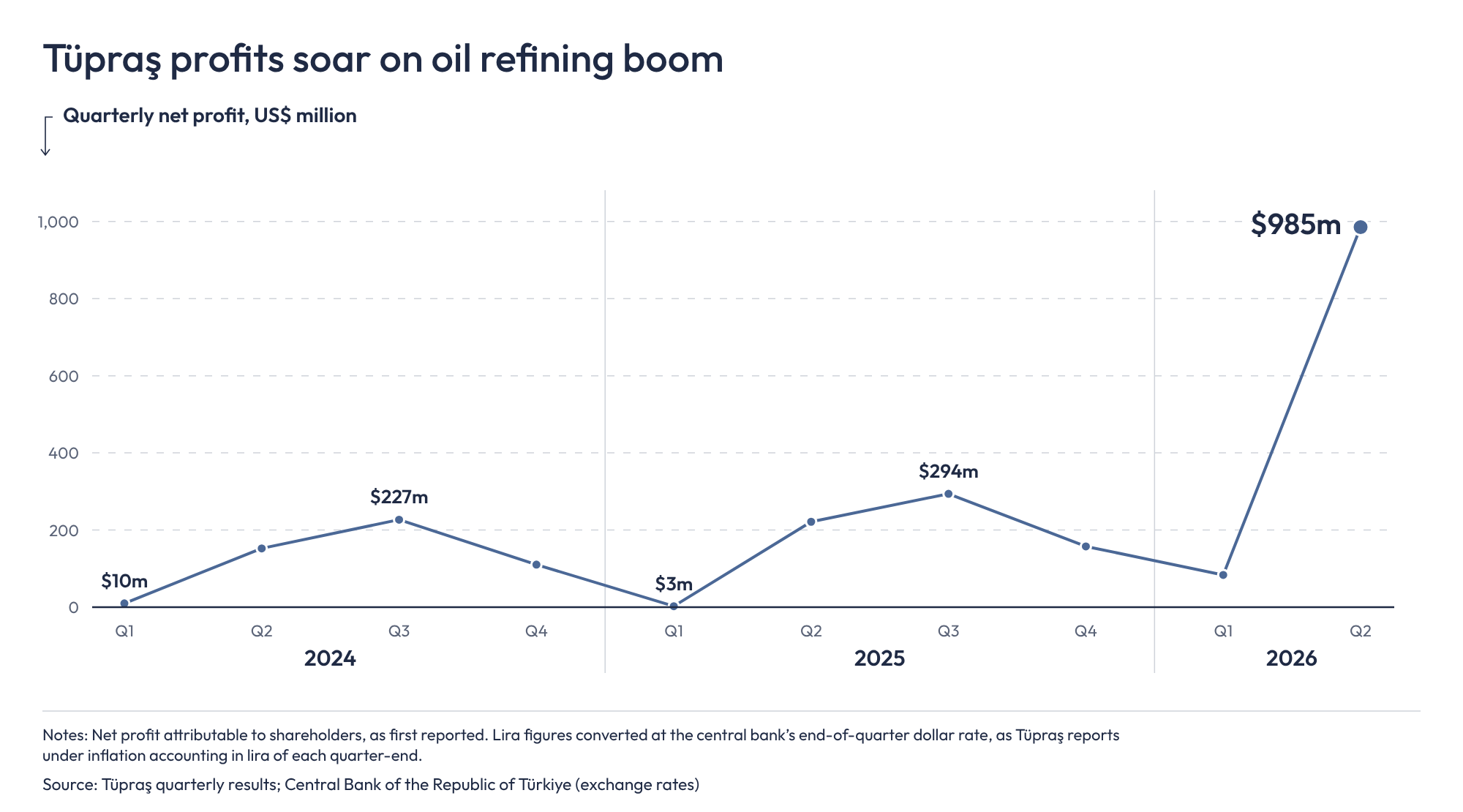
The oil business boom sits awkwardly with the climate and energy transition plans Koç and Tüpraş unveiled in 2021, when both pledged to become carbon neutral by 2050. Then, Tüpraş set out its aim to become “a leading carbon-neutral energy company”.
Despite these promises, in 2025, both companies lowered their targets for cutting emissions from their own operations by 2030, from 27% to 20% below 2017 levels. Tüpraş also cut its 2035 goal from 35% to 25%. The company still technically retains its long-term target of carbon neutrality by 2050, but the new plan will require much more drastic cuts after 2035.
Lowering the climate bar
Tüpraş blamed its weakening of climate ambition on “changing market