

Until recently, the Brazilian team running the COP30 UN climate summit next month had stated strongly that they had no plan to produce a negotiated cover decision at the end of the talks – but that position may be starting to shift as some governments are now said to be seeking one.
COP30 President André Corrêa do Lago told Climate Home News late Wednesday after the pre-COP meeting in Brasilia that he was listening to those requests.
“As the presidency, if I feel that the countries are willing to analyse the possibility of a cover decision, of course I will take it into consideration. Because I truly want COP30 to be a country-led COP,” he said in an interview.
A cover decision is a text agreed by governments that is not tied to any specific agenda item and spans various issues that countries want to address. From COP25 to COP27, cover decisions offered political guidance on climate action and put topics that were crucial to some delegations – but not covered by the formal agenda – on the table for future discussions.
At COP26, for example, a cover decision on the Glasgow Climate Pact mentioned fossil fuels for the first time, calling for efforts towards the phase down of unabated coal power. At COP27 in Sharm El-Sheikh, the cover decision marked the launch of both the Just Transition Work Programme and the Loss and Damage Fund, from then on thrusting them decisively into the negotiations.
-
At pre-COP in Brazil, climate finance roadmap to $1.3 trillion remains hazy
Ahead of COP30, Azerbaijan and Brazil provide scant details about a keenly awaited report on how to scale up finance for developing countries -
Momentum builds for strong adaptation outcome at COP30
At this week’s pre-COP, countries called for more political backing to finalise the Global Goal on Adaptation in Belem, but questions remain over finance -
World failing on goal to halt deforestation by 2030, raising stakes for Amazon COP
An annual progress report shows that agriculture and wildfires continue to decimate forests despite a global promise to stop their loss this decade


In July, Corrêa do Lago told Climate Home that he personally did not like the idea of a cover decision because he preferred “a more constructive, transparent and open diplomacy”. He has not changed his view on how he wants to see business done at COP30.
After a day of intense consultations with countries following the pre-COP meeting in Brasilia on Monday and Tuesday, the veteran Brazilian diplomat reiterated that he is not keen on a cover decision because it tends to “create a certain mystery” and “suddenly appears” in the midst of difficult negotiations.
“The other problem is that cover decisions have statistically proven to have no subsequent follow-up,” Correa do Lago added, arguing that “most countries felt a little abused by the cover decisions”.
‘Several countries’ want a cover decision
However, the game-changer this time around could lie in how such a document is landed and what it represents.
“The current situation is different,” said the incoming COP president. “Several countries are openly calling for a cover decision,” he explained. He emphasised that he had even received such a request in the bilateral meetings he held on Wednesday with some countries, without specifying which.
Those who have indicated they would support a cover decision in closed-door meetings include both developing and developed countries, as a way to give prominence to issues that are critical to their positions and interests, or could be complicated to address under set agenda items.
For Corrêa do Lago, if the COP30 conference begins with a cover decision already in mind, it could avoid the last-minute scramble and element of surprise that has occurred in the past, and instead “constitute a true element of negotiation”.
Vehicle for a ‘race to the top’
Some civil society organisations that follow the COP process have also called for COP30 to conclude with an ambitious cover decision.
Andreas Sieber, associate director of global policy and campaigns at 350.org, argues that a cover decision would be the most credible way to confront the gap in climate action head-on.
“A cover decision is no magic bullet to solve negotiation challenges, but it offers the best-placed procedural vehicle to balance different elements of the ambition package, allowing a race to the top instead of zero-sum trade-offs,” he wrote in an op-ed for Climate Home.
Over the past month, the possibility has also been raised that such a document could be presented as a so-called “omnibus decision” rather than a cover decision.
It is unclear what the difference would be, as the UN climate talks have never produced an omnibus decision – but the suggestion is that an omnibus decision would amalgamate key elements of COP30, including those that do not have a clear place in the talks.
Either way, issues of relevance to multilateral climate policy that are tricky to resolve or need strong political backing to drive them forward outside the talks could find a home in such a decision.
Home for finance goals and NDC gap?
Natalie Unterstell, president of the Brazilian Talanoa Institute, explained that a cover decision could be an option for formally incorporating a new climate finance target for adaptation which the poorest countries are pushing for.
Sieber added that this could be the space for countries to identify steps forward for the Baku to Belém Roadmap to $1.3 Trillion on boosting climate finance in the next 10 years, so that it does not end up as little more than an informational report.
Countries trail COP30 clash over global response to shortfall in national climate plans
Others have suggested a COP30 cover decision could be the place where countries set out how they plan to bridge the expected large gap in planned emissions reductions and the cuts needed to keep global warming to 1.5 degrees Celsius, as they pledged to aim for in the Paris Agreement.
Even with the growing possibility of having a cover or an omnibus decision in Belém, Corrêa do Lago said he would prefer the COP to proceed as normal – with the approval of the agenda at the start, negotiations on the agreed items, and then “to make decisions” on that basis.
However, he warned that even approving the agenda “could be a challenge because several countries are requesting new agenda items that we know would be very difficult to reach consensus on”.
The post COP30 president hints Brazil may be open to a cover decision in Belém appeared first on Climate Home News.
https://www.climatechangenews.com/2025/10/16/cop30-president-hints-brazil-may-be-open-to-a-cover-decision-in-belem/

Three countries have been named by the Paris Agreement’s compliance committee for failing to submit a nationally determined contribution (NDC) and repeatedly snubbing offers of help with their climate plans.
After months of internal debate over whether to identify serial non-responders, the Paris Agreement’s Implementation and Compliance Committee (PAICC) named the three countries which have failed to engage with it over their NDCs on Friday.
It named Democratic Republic of Congo, Senegal and North Korea in a footnote of its annual report, adding that it decided to name them “with a view to facilitating engagement”, adding that representatives of the three nations had been invited to its meeting in early 2027 “with the purpose of identifying any challenges and constraints”.
“The Committee noted the importance of Parties engaging with the Committee in a timely manner, while noting that some delays may be due to the national capabilities and circumstances of the Parties”, the report said.
-
Under US pressure, World Bank says it will back gas “where appropriate”
The US wants the World Bank to expand its gas support while climate campaigners are pushing for it to end – its head spoke this week of limited backing for the fossil fuel -
IPCC scientists vow to press on with climate reports despite political deadlock
After governments again failed to agree a timeline, nearly 120 IPCC authors pledged to complete their assessment on time and with full scientific rigour -
Paris Agreement committee snubbed over missing NDC climate plans
Many governments have still not submitted a nationally determined contribution to the UN, breaching a key requirement of the Paris Agreement

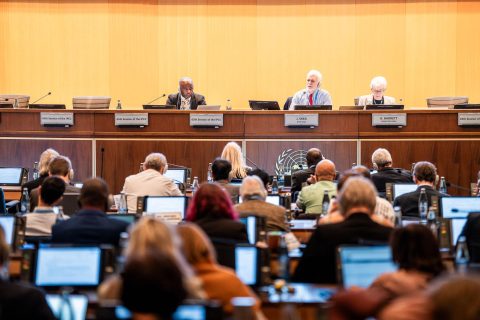

In July, PAICC said 12 countries had ignored its repeated attempts to discuss why they had not published an NDC as required every five years under the 2015 Paris accord.
Members of the committee had been divided over whether to name them, but at a September meeting decided to do so in their annual report to the annual climate COP summit.
By the time the report was published on Friday, only Congo, Senegal and North Korea “had not communicated an NDC or submitted a [Biennial Transparency Report] and had not yet responded to any of the Committee’s notifications, despite several reminders issued by the Committee in this regard”.
Rainforest and renewable energy ambitions
The silence from Congo and Senegal is notable because the former is home to much of the Congo Basin rainforest while the latter has sought billions of dollars in climate finance to support its renewable energy ambitions.
After Brazil, Congo has more rainforest than any country in the world. This forest, and the country’s peatlands, absorb huge amounts of greenhouse gas but are fast being lost to expanding farmland, charcoal production, logging and mining.
Senegal signed a Just Energy Transition Partnership with Canada and wealthy European nations in 2023, to help it meet its renewable energy targets under the-then government of Macky Sall. It was chair of the Least Developed Countries group between January 2022 and December 2023.

Tejas Rao, who is researching the PAICC as part of a doctoral thesis at Cambridge University, said the governments of the three countries should engage with the committee.
“Engagement costs these governments very little and the committee has shown it will listen,” he said.
“Silence leaves the committee with no basis to help, and it leaves the [governments] exposed to the narrative that they are simply disengaged,” he told Climate Home News.
Paris Agreement requirement
The 2015 Paris Agreement requires all parties to publish an NDC every five years outlining their emissions reduction targets, with each plan meant to be more ambitious than the country’s last NDC.
The latest set – the third round of plans, with new targets for 2035 – was due in February 2025. While most countries missed this deadline, all but around 30 – mostly small emitters but including Egypt, Vietnam and Argentina – have now submitted them.
Over the year, the PAICC – which is made up of government climate officials from developed and developing countries – has been communicating with governments that have not submitted NDCs and trying to overcome barriers to them doing so.
Some nations have cited exceptional circumstances as the reason for not submitting an NDC, a process that requires a significant amount of work in tracking emissions and consulting on how to curb them across the economy. For example, a letter from a Sudanese official to the PAICC, seen by Climate Home News, said that the country’s civil war had led to the suspension of its NDC preparation.
-
IPCC scientists vow to press on with climate reports despite political deadlock
After governments again failed to agree a timeline, nearly 120 IPCC authors pledged to complete their assessment on time and with full scientific rigour -
Under US pressure, World Bank says it will back gas “where appropriate”
The US wants the World Bank to expand its gas support while climate campaigners are pushing for it to end – its head spoke this week of limited backing for the fossil fuel -
Who shapes climate science? The equity question facing the IPCC
Early completion of the next global climate science assessment reports risks excluding research from the Global South, which is key to ensuring the findings are fair
The US and Iran are not signed up to the Paris Agreement and so do not have active NDCs, nor does Taiwan, which is not a UN member state.
Rao said that because the PAICC is “facilitative and non-punitive”, naming the countries “is meant to open a door, not close one – the invited consultation is the point”.
“In recent months, governments that explained their constraints, whether capacity, finance or domestic process, have been met with follow-up and support rather than sanction, and the number of silent governments has fallen sharply,” Rao said.
The post Paris Agreement committee names three countries snubbing it over NDCs appeared first on Climate Home News.
Paris Agreement committee names three countries snubbing it over NDCs