

As Caribbean nations tallied the destruction caused by the passage of Hurricane Beryl, the board of the fund set up to compensate for such devastating loss and damage held its second meeting this week.
“The level of damage is apocalyptic,” said Henrietta Elizabeth Thompson from Barbados, among the countries worst hit by the natural disaster, at the start of the four-day session in Incheon, South Korea.
The board needs to create a fund that “reflects the scale of the magnitude, of the risk, the damage and devastation faced by people across the world and the urgency required to respond to it,” she added.
But before the fund starts handing out any money in future, board members have to agree on procedural matters.
A name and a place
On the opening day, the Philippines was picked as the host of the fund’s board in a secret vote by members. The Southeast Asian nation defeated bids from seven other candidates: Antigua and Barbuda, Armenia, Bahamas, Barbados, Eswatini, Kenya and Togo.
Selecting a host country was one of the most pressing priorities for this week’s meeting. It represented a first necessary step for the board to take up a legal personality and enter into formal agreements with the World Bank, set to host the loss and damage fund on an interim basis.
Sign up to get our weekly newsletter straight to your inbox, plus breaking news, investigations and extra bulletins from key events
While the administrative staff of the fund will be based at the World Bank, the board will carry out some of its meetings in the Philippines in the future, likely in the capital Manila. The country’s proposal scored particularly high thanks to its abundant transport options and accommodation facilities and its visa free entry for short stays for most visitors, according to a background paper.

A man stands in a home where the roof was ripped apart, in the aftermath of Hurricane Beryl, in St. Elizabeth Parish, Jamaica, July 5, 2024. REUTERS/Maria Alejandra Cardona
The somewhat thorny issue of what to officially call the fund also landed on the table in South Korea.
For nearly all climate talks participants, it’s simply been the “loss and damage fund” since it was adopted at COP27, but the United States have made various attempts at a rebrand. At COP28 in Dubai, for example, then U.S. climate envoy John Kerry kept referring to the “fund for climate impact response” – a more neutral label that softened the suggestion of developed countries’ historical responsibility.
In consultations ahead of the meeting, the co-chairs of the board collected various options, from the minimalistic “the Fund” to the highly technocratic “Fund referred to in decisions 1/CP.28 and 5/CMA.5”.
Ultimately, members decided to go with “Fund for responding to Loss and Damage”, abbreviated as FLD, without spending much time debating the matter.
Beware the ‘billions’
Divisions cropped up when the discussion turned to the process of selecting the executive director (ED). Hoping to announce the name of the executive director at COP29 this November, the board had to agree at this session on the criteria for picking the fund’s boss, including the roles and responsibilities.
Several board members from developing countries wanted the ED’s job description to mention efforts to find additional money for the fund at the scale of billions. “If you have someone running a fund of 100 million, this is totally different from 10 billion, 55 billion, or 100 billion,” said Egypt’s Mohamed Nasr, “the scale of this fund is not confined to where it is”.
Where East African oil pipeline meets sea, displaced farmers bemoan “bad deal” on compensation
Countries have pledged around $700 million to the fund so far, with Italy, Germany, France and the United Arab Emirates among the biggest contributors. The United States has pledged only $17.5 million. South Korea pledged $7 million at this week’s meeting. The residual costs from loss and damage is projected to reach a total of $290 billion to $580 billion by 2030, according to a 2018 study.
But some developed country board members, including the US, rejected the proposal of including a reference to “billions”, according to observers.
“It is clear that developed nations…remain non-committal about scaling financial mobilisation,” said Harjeet Singh, global engagement director for the Fossil Fuel Non-Proliferation Treaty Initiative, who attended the meeting. “The initial commitments of a few hundred million dollars are merely a drop in the ocean compared to the real and escalating costs of climate change that developing countries endure,” he added.
Eventually, board members found a compromise wording. The ED will be asked to lead efforts to grow the fund’s resources “towards contributing to a response at scale to respond to climate-induced loss and damage”.
Global goal of tripling renewables by 2030 still out of reach, says IRENA
The recruitment process will now go underway with the goal of putting a shortlist of candidates in front of the board by the next meeting scheduled for September 18-20 in Baku, Azerbaijan.
Legal agreements
Between now and then, there will be little time for a summer break.
After approving last June the conditions of hosting the fund, the World Bank now has until August 12 to share with board members the draft text of the agreements detailing how that will work in practice. It will include things like provisions to handle the money and give access to recipients and the rules governing the relationship between the board and the World Bank.
Developing countries and civil society groups are eager to see guarantees that communities in hard-hit countries will be able to access funds directly without going through various intermediary agencies.
“Agreeing and certifying these agreements will be the most important decision at the next board meeting”, said Liane Schalatek, associate director of the Heinrich in Washington who attended the board meeting. “The World Bank has shared an outline of what they will include, but we are talking about legal agreements so the devil is in the detail”.
The post In Hurricane Beryl’s shadow, loss and damage fund makes progress on set-up appeared first on Climate Home News.
In Hurricane Beryl’s shadow, loss and damage fund makes progress on set-up

The conference is one of the largest aimed at preparing for hurricane season, which begins June 1. A task force report on potential reforms to the agency also remains on hold.
ORLANDO, Fla.—A major conference to help communities prepare for hurricane season kicked off Monday without the agency that coordinates federal disaster response.
Right now, Greenpeace activists are standing up to Big Gas at a major gas conference in Sydney.
Inside the Sheraton Grand Hotel, executives from fossil fuel companies have gathered alongside lobbyists, investors and political allies to plan the future of gas in Australia – and how to maximise their profits.
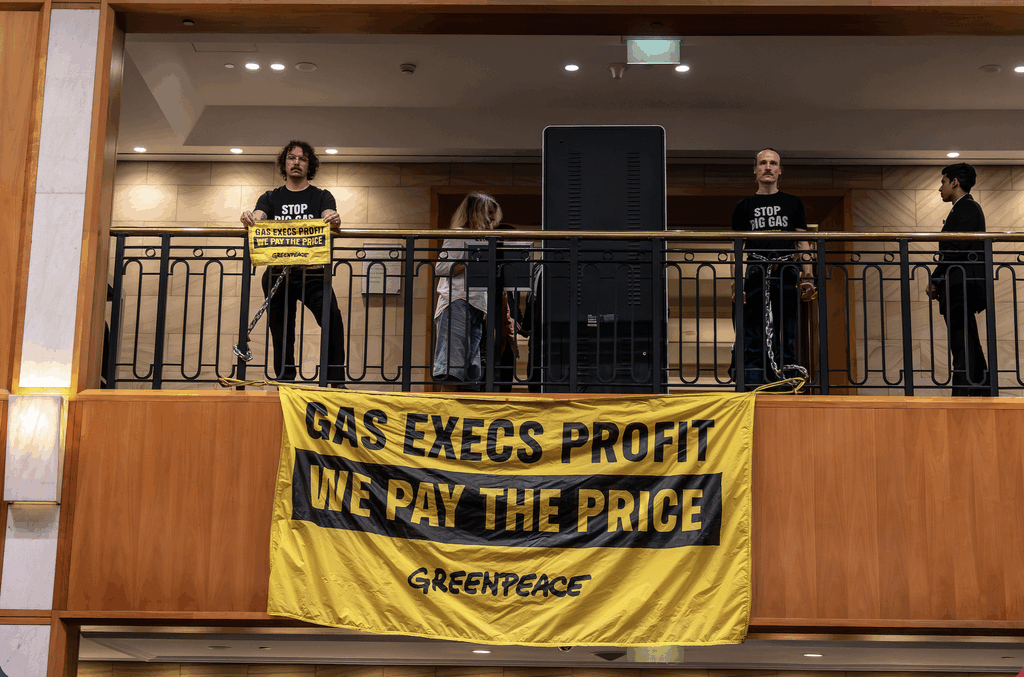
So Greenpeace has stepped in to call it out. Activists have dropped a banner inside the venue with a clear message: Gas Execs Profit. We Pay The Price.
We need your help to spread the message that we won’t stand by and let this happen.
What’s really going on
Gas corporations are making billions in windfall profits from global conflicts – from Ukraine to Iran – while Australians pay the price with higher energy bills and climate damage.
And they want more.
More drilling. More exports. More profit.
Why Greenpeace took action today
This conference is where it all comes together. Behind closed doors, gas executives, lobbyists, investors and political allies are meeting to push for more gas expansion, no doubt using global instability as their justification.
That’s why Greenpeace couldn’t let this gathering go uninterrupted.
Big Gas is counting on people not paying attention. Let’s prove them wrong.
Share the video to call out Big Gas.
What needs to happen now
Gas is expensive. It’s volatile. And it ties our energy system to global instability.
But there is a better way. Renewable energy is already cheaper, more reliable, and made right here in Australia. It’s the fastest path to lower bills, real energy security and a safer climate.
To get there, we need to:
- properly tax the gas industry and its exports
- stop expanding gas
- and speed up the transition to homegrown renewable energy.
Share this video far and wide to show just how much support there is to tax Big Gas properly and speed up the transition to renewable energy.
This is just the beginning
This action is part of a growing movement to stand up to Big Gas and challenge the power it holds over our government and society. The Federal Government has a role to play – starting by taxing gas corporations properly and then accelerating the transition to homegrown renewable energy.
Together, we can show just how much support there is for change and make it impossible for decision-makers to ignore.
What you can do
- Follow along on our social channels.
- Share the video far and wide to show how much support there is.
- Sign the petition to tell Albo to stand up to Big Gas – because if we can, he can.
BREAKING: Greenpeace activists disrupt major gas conference in Sydney
SYDNEY, Tuesday 31 March 2026 — Two Greenpeace Australia Pacific activists have been arrested following a peaceful protest at the Australian Domestic Gas Outlook conference in Sydney, where they dropped a banner that said — “Gas Execs Profit. We Pay The Price” and held banners saying “Tax Gas Profits”.
Photos and B Roll video of the protest and arrests are available here
Live updates on Greenpeace Instagram
The two activists were arrested by police around 9:00am AEDT and taken to Day Street Police Station. Information on this morning’s gas conference disruption can be found here.
Solaye Snider, Campaigner at Greenpeace Australia Pacific, said: “Greenpeace activists have taken a strong stand today against profit hungry gas corporations and lobbyists, who see horrific global wars as an opportunity to price gouge and profiteer, while everyday people pay the price.
“Australians have had enough of gas corporations like Santos and ConocoPhillips ripping us off, leaving us with nothing but empty pockets and climate damage. The gas industry is aggressively lobbying against being fairly taxed and pushing to drill for more gas. Change requires showing up and speaking out, and that’s what these activists have done today.
“Greenpeace Australia Pacific stands by our activists, and stands with all communities who are peacefully fighting for a safe and clean energy future. The right to peaceful protest is a fundamental pillar of a healthy democracy and a basic right of all Australians.”
-ENDS-
Media contacts:
Lucy Keller: +61 491 135 308 or lkeller@greenpeace.org or Kate O’Callaghan: +61 406 231 892 or kate.ocallaghan@greenpeace.org
Greenpeace activists arrested after disrupting major gas conference in Sydney



-
Climate Change8 months ago
Guest post: Why China is still building new coal – and when it might stop
-
Greenhouse Gases8 months ago
Guest post: Why China is still building new coal – and when it might stop
-

 Greenhouse Gases2 years ago
嘉宾来稿:满足中国增长的用电需求 光伏加储能“比新建煤电更实惠”
-
Climate Change2 years ago
Bill Discounting Climate Change in Florida’s Energy Policy Awaits DeSantis’ Approval
-

 Climate Change2 years ago
嘉宾来稿:满足中国增长的用电需求 光伏加储能“比新建煤电更实惠”
-
Climate Change Videos2 years ago
The toxic gas flares fuelling Nigeria’s climate change – BBC News
-

 Renewable Energy5 months ago
Sending Progressive Philanthropist George Soros to Prison?
-

 Carbon Footprint2 years ago
US SEC’s Climate Disclosure Rules Spur Renewed Interest in Carbon Credits