

The Russian government’s campaign for endorsement of “transitional fuels” succeeded at the Cop28 climate talks in Dubai.
Russia, the world’s second biggest gas producer, told the United Nations back in February that “natural gas as a transitional fuel… can be used for [emission-cutting] purposes” and this should be recognised at Cop28.
While the final Cop28 agreement does not specifically mention gas, it “recognizes that transitional fuels can play a role in facilitating the energy transition while ensuring energy security”.
It also calls on governments to transition away from fossil fuels in their energy systems so as to achieve net zero by 2050.
Diann Black-Layne from Antigua and Barbuda told the closing meeting of Cop28 that the “transitional fuel” language “is a dangerous loophole”. Coal, oil and gas are all fossil fuels and “we need to transition away from them,” she said.
But Barbados’s climate envoy Avinash Persaud later told Climate Home: “If you actually think about transitioning grids, transition fuels would help to transition with the lowest emissions. You can’t flip a switch and so in the mean time half switch. The challenge is to make sure that the slip road doesn’t become a parking lot.”
Persaud said that “more than a few” countries had supported the language “at some level and at varying degrees”. Another negotiator agreed it “wasn’t just Russia”.
Last-minute addition
Ahead of Cop28, governments and other organisations told a UN panel what they wanted to do to put the world on track to meet its climate goals, in a process known as the global stocktake.
A team of technical experts summarised all the submissions in October. The head of UN climate change, Simon Stiell, called for a “course correction”.
The technical summary included a line which called on governments to “recognise role of natural gas as an efficient transitional fuel”.
At Cop28, the UAE Presidency put together a 27-page document which included the language which made it into the final text, dropping the mention of gas but referring to “transitional fuels”.
Like many other parts of this document, it included an alternative option of no text. Three days later, after talking to governments, the UAE Presidency dropped it from their next version of the Dubai deal.
With all the attention on the broader issue of fossil fuel phase-out, this language was little noticed or commented on – either in the press or by negotiators.
It stayed off the radar until the scheduled end date for Cop28, 12 December. It appeared in a draft text, according to a source who saw the text, time-stamped 8pm that night.
But some negotiators didn’t see it until the text was published at 7am the following morning. Four hours later, the closing plenary meeting began and within minutes it had been approved.
‘An honest paragraph’
The strongest supporters of anti-fossil fuel language at Cop28 were developed nations, particularly the European Union, and small islands.
But on gas, developed countries did not want to resist, and small islands were still in a separate meeting room discussing the text when the decision was made.
Speaking to press shortly afterwards, German foreign minister Annalena Baerbock said the EU delegation had not had much time to discuss the text.
But, she said through a translator, “for me it is really an honest paragraph”. She said Germany and the EU have been accused of hypocrisy at previous Cops for continuing to use gas while asking other countries to move to renewables.
“We wanted to show that this does not happen from one day for another but it will happen slowly, slowly, slowly,” she said. Gas is “a bridge”, she said, and “every bridge has an end”.
Kaveh Guilanpour, from the Center for Climate and Clean Energy Solutions, said he’d rather the language had not been there “but in many ways its consistent with what lot of countries and regions are actually doing”.
The day before Cop28 closed, Brazil auctioned 193 oil and gas blocks. On the day it closed, the Italian export credit agency lent €400m ($436m) to a firm to supply Italy with gas. The day after, the board of a European public bank decided to keep lending to gas pipelines and power plants.
Small islands not there
The negotiating group for 39 small, developing island states (Aosis) was most likely to object to that language.
But, having seen the final text at 7am, when the plenary started they were still frantically discussing whether to support it or not.
As they entered the room with their comments on the text in hand, the room was already standing to applaud Cop28 president Sultan Al-Jaber’s announcement that it had been adopted.
Their lead negotiator Anne Rasmussen from Samoa took the microphone to say she “was a little confused about what happened”.
Delivering her prepared remarks, she said that because of the transitional fuels language – and other issues – that the “course correction has not been secured”.
“We have made incremental advancements over business as usual when what we really needed is an exponential step change,” she said.
To a standing ovation, she said the text includes a “litany of loopholes” for carbon capture and on the removal of fossil fuel subsidies.
The post How Russia won a ‘dangerous loophole’ for fossil gas at Cop28 appeared first on Climate Home News.
How Russia won a ‘dangerous loophole’ for fossil gas at Cop28

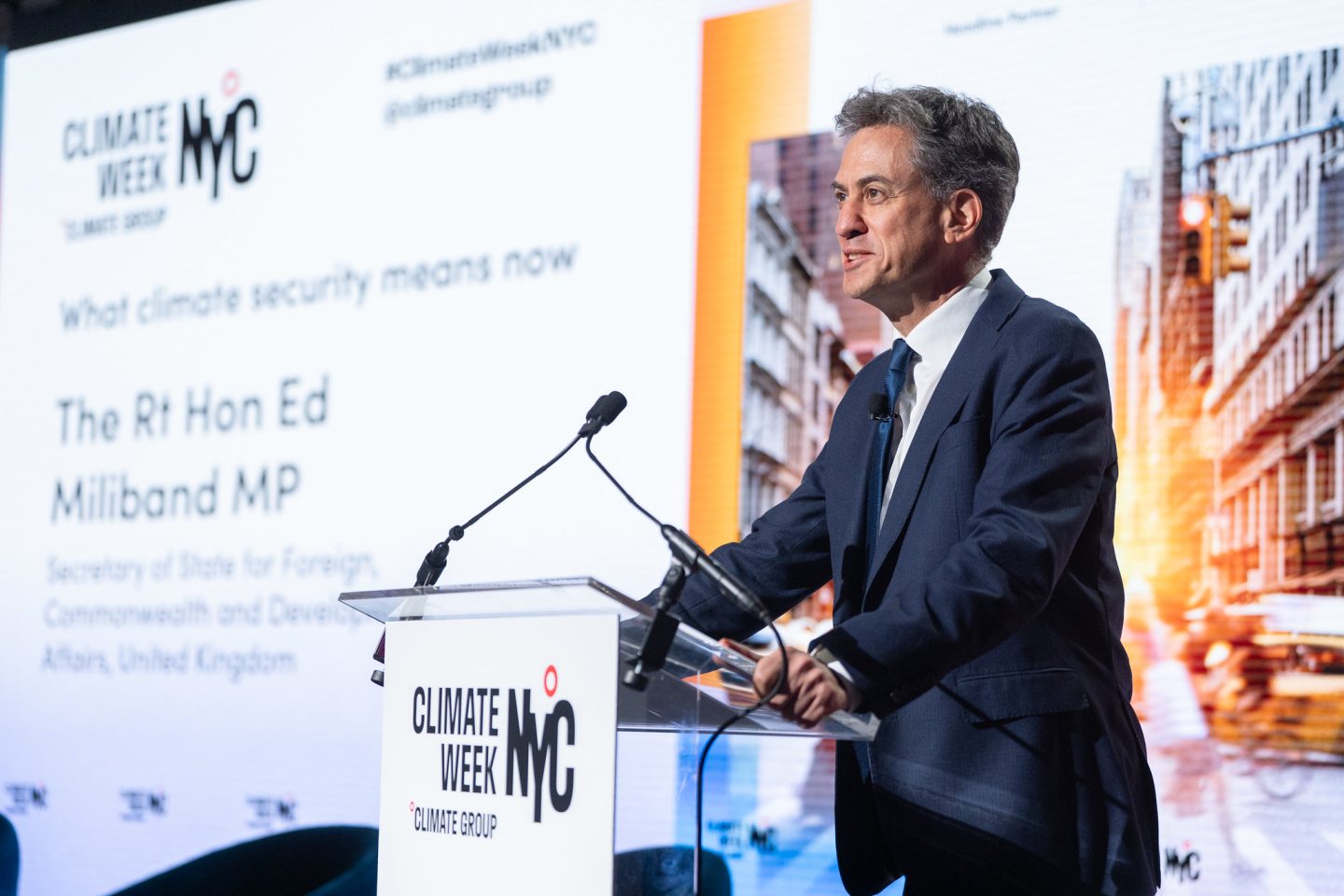
Governments need to start addressing climate change impacts and nature loss as a threat to national security and manage shocks before they hit rather than picking up the pieces afterwards, Britain’s foreign minister and other leaders told the opening of Climate Week NYC on Monday.
Ed Miliband – who was until July the UK’s energy minister – said the growing urgency and severity of extreme weather and related disasters require a shift in thinking, calling on governments to put the issues “front and centre”.
“Climate breakdown, in my view, must be an issue for foreign ministers and prime ministers, as well as energy and climate ministers – the security community, not just the activist community, the generals, not just the green campaigner,” he told an audience of policy and business leaders.
There is a need to assess risk differently, he added, by embedding climate and nature in national security systems, threat assessments and contingency planning. He also urged countries to pool information because climate shocks can travel fast through supply chains as well as influencing financial markets and migration patterns.
The framing of climate change as a threat to countries’ security and stability is not new, but it has gained greater emphasis as the impacts of global warming are biting harder in places like Europe, which is struggling with more intense heatwaves, drought and forest fires.
In mid-August, Miliband said in a social media post, reflecting on the UK’s hot and dry summer, that he would convene foreign ministers attending the UN General Assembly in late September to discuss how to respond to “this new national security threat” and build a coalition for action. But he did not give further details of that initiative on Monday.
-
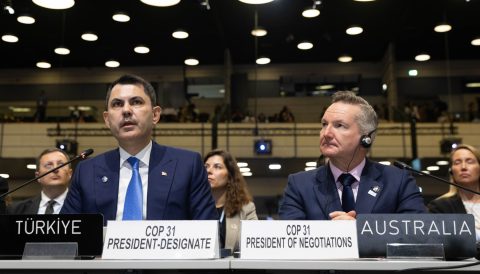
Fossil fuel expansion threatens COP31 hosts’ credibility, experts warn
Türkiye and Australia are pushing coal, oil and gas at home with no national timeline for their own fossil fuel phase-out -
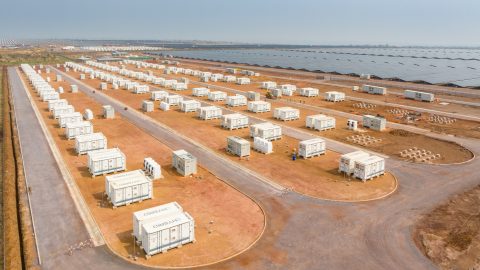
DR Congo’s power-hungry mining sector drives record solar surge
As solar deployment rapidly accelerates across Africa, miners in the DRC are driving significant demand for clean energy to replace expensive diesel
Australia calls for unified response
Other leaders in New York also reflected on the growing threat to their societies and economies from climate change impacts and exposure to volatile fossil fuel markets.
Australian Prime Minister Anthony Albanese said his country “understands the dangers of global warming and the urgency of climate action as well as any nation”.
“We have seen it up close – from increasingly intense bushfires and floods, to the damage warming oceans are wreaking on our vulnerable coastlines,” he said in a speech, adding that with a record-breaking El Nino forecast, Australia and Pacific nations are preparing for a potential summer of extreme heat, bushfires and floods.
With scientific forecasts of worsening impacts now coming to pass, “this means the global community cannot afford to be frozen in time as the world warms around us”, he added. People cannot be left to cope alone, he said, emphasising that as leaders, “we need to come together, to meet the problem head on”.
Australia will lead the negotiations at the upcoming COP31 climate summit, and has brought the existential threat to Pacific countries from sea level rise into the diplomatic limelight. The pre-COP gathering next month will be hosted in Fiji, with a visit by leaders to Tuvalu.
Speaking to Climate Home News in New York, Panama’s environment minister Juan Carlos Navarro said the small Central American country faces hundreds of millions of dollars in losses from drought in the Panama Canal due to El Niño.
The Panama Canal Authority estimates income could be reduced by between $225 million and $400 million due to slower maritime traffic passing through the strait.
“What a great irony,” Navarro said. “Panama being a small, carbon-negative country pays the price for the big carbon-emitting countries.”
Climate investment “critical” to stability
Amina J. Mohammed, deputy secretary-general of the United Nations, said there was a need for countries to stick with multilateral approaches to problems including climate change, despite the difficult geopolitical times the world is going through. She added, however, that it “does require your voices. It won’t happen by itself. We have to lean into it.”
The rest of the high-level UNGA week in New York will show the extent to which multilateral efforts to resolve the world’s problems – from climate change to poverty – have top-level support as leaders give their speeches, including the Brazilian and US presidents on Tuesday.
Kaysie Brown, associate director for climate diplomacy and geopolitics with think-tank E3G, said the statements by Miliband and other leaders at Climate Week NYC had underlined the political and government case to integrate climate considerations into security thinking and institutions at the highest level.
“In a world of escalating climate impacts and the record El Niño expected to heighten risks worldwide alongside energy volatility and geopolitical tensions, investing in global climate resilience and the clean energy transition are critical to credible strategies to enhance stability and national security,” she added in a statement.
Suneeta Kaimal from the Natural Resource Governance Initiative (NRGI) said that, while in previous years governments heavily focused their speeches on climate action, this year’s focus on energy security does not change the underlying challenge.
“The fact that the framing has changed from energy transition to energy security doesn’t change the reality that this transition needs to occur in energy systems. It’s just a different framework. It’s a more transactional framework, but it all points to the need for resilience,” she said.
Speaking at the opening session of Climate Week, Iceland’s Prime Minister Kristrún Frostadóttir described how her country had reacted to the spiralling costs it faced from the 1970s oil price crisis by investing in a large-scale district heating system fuelled instead by its abundant geothermal energy.
“Resilience wasn’t built while the crisis was happening. It was built in the years after – deliberately, patiently, as a national mission – so that the next shock wouldn’t hit as hard, if at all,” she said.
New COP goal on electrification
Speaking at a separate event on Monday, UN climate chief Simon Stiell pointed to a new voluntary target expected to be adopted at COP31 for 35% of global energy use to come from electricity by 2035 as a strategy that can help cushion countries, families and businesses from fossil fuel supply shocks and rising costs.
At the United Nations, the Turkish COP presidency gave more details of the electrification goal it first announced at the Bonn climate talks in June, including sharing with governments a final text of the pledge it wants them to get behind.
The pledge sets out a global ambition to advance electrification, highlighting the importance of supporting developing countries to identify their grid investment needs and access finance for electrification.
“It is a development strategy, an industrial strategy, a health strategy, and a security strategy,” Stiell said.
The post Climate change and energy transition rise up national security agenda appeared first on Climate Home News.
Climate change and energy transition rise up national security agenda
Climate Change
Albanese’s NY Climate Week address acknowledges scale of the climate challenge, but fossil fuels notably absent
SYDNEY, Tuesday 22 September 2026 — In response to Prime Minister Albanese’s keynote address at New York Climate Week, Dr Simon Bradshaw, COP31 Lead and climate expert at Greenpeace Australia Pacific, said:
“It is encouraging to see Prime Minister Anthony Albanese acknowledging the immediate and profound climate threat to communities in the Pacific, Australia and worldwide, and the need to work together, with bravery and compassion. Now we must match those words with real action to phase out fossil fuels.
“Earlier this month in Palau, Prime Minister Anthony Albanese committed Australia to helping accelerate the transition away from fossil fuels and defend the crucial goal of limiting warming to 1.5°C — a survival line for Pacific island countries and all those paying the cost of our fossil fuel addiction through worsening floods, fires, drought and sea level rise.
“However, Australia continues to undermine its aspirations for global climate leadership by expanding fossil fuel production. The Albanese Government has approved an astonishing 37 new, extended or expanded coal and gas projects since first elected. Every one of which compounds the threats to our shared security and wellbeing. Remarkably, in his major climate speech in New York overnight, the Prime Minister failed to even mention fossil fuels.
“As our Minister for Climate Change Chris Bowen has said, we are in a global fossil fuel crisis. Getting off fossil fuels through transitioning to renewable energy is the quickest pathway to greater security, stability and affordability for all. But right now Australia is throwing more fuel on the fire.
“We are now near certain to overshoot 1.5°C of warming. For the Pacific and Australia alike, this will be measured in more communities torn from their land and homes, and the loss of more people and places we love. There is a path back below 1.5°C of warming, and every fraction of a degree matters, but it will demand all minds and all hearts working together.
Australia fought hard for the privilege to chair the next round of global climate negotiations. The world is crying out for a clear vision and leadership from Australia as we head towards COP31 in Antalya.
“Australia must lead by example at home through an immediate end to new fossil fuel approvals, including rejecting Woodside’s mammoth Browse project. And must ensure that COP31 boosts our shared security by accelerating the transition away from fossil fuels. Get this right, and Australia will emerge as a responsible middle power and force for good in troubled times.”
-ENDS-
Media contact
Kate O’Callaghan on 0406 231 892 or kate.ocallaghan@greenpeace.org
This year’s so-called “super El Niño” is entering into record-breaking territory.
Sea surface temperatures in the tropical Pacific now equal the previous daily record set in 2015 and will likely keep rising in the days ahead.
El Niño is a naturally occurring climate phenomenon in the Pacific that reshapes weather patterns around the world and temporarily boosts global temperatures.
The current El Niño event – which has been underway since June and is expected to last until next year – has been developing faster than any previous event on record.
The strength of an event is tracked using the “Niño 3.4 anomaly”, which measures how much warmer sea surface temperatures in a section of the central Pacific are than average.
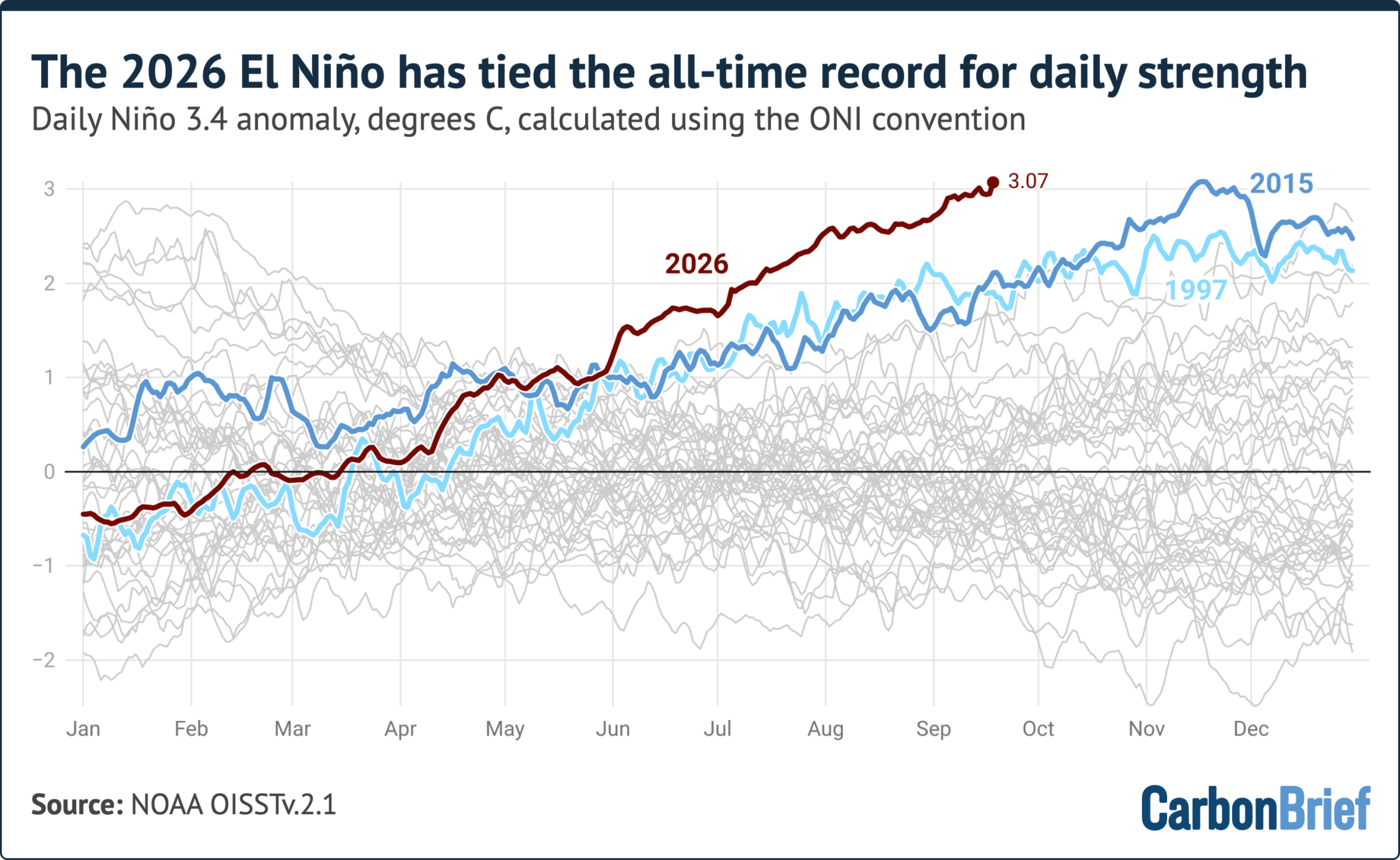
As of 19 September, the daily anomaly in the Niño 3.4 region stands at 3.07C, putting it in a statistical tie with the previous record of 3.08C.
Some scientists, using a different baseline for calculating the anomaly, have already called the new record.
Either way, this is remarkable, in part because of how early in the calendar year it is occurring. El Niño typically peaks in the winter months, most commonly in November or December.
Every strong El Niño on record has continued to strengthen after mid-September – and there is every reason to think that this one will as well.
(For more on El Niño, see Carbon Brief’s recent interactive explainer.)
Record territory
El Niño events are typically classed as “weak” when the Niño 3.4 anomaly reaches 0.5C, “moderate” above 1C, “strong” above 1.5C and “very strong” above 2.0C.
For this year’s event, the Niño 3.4 anomaly has now reached 3.07C, which puts it in a statistical tie with the record set on 18 November 2015, set during a “very strong” El Nino event.
The chart below shows how the strength of the current El Niño (red line) is dramatically outpacing both 2015-16 (blue) and another “very strong” event in 1997-98 (light blue).
To analyse the developing El Niño, Carbon Brief followed the convention of the US National Oceanic and Atmospheric Administration’s (NOAA) Oceanic Niño index (ONI).
ONI is calculated by subtracting the latest 30-year average temperature in the Nino 3.4 region from daily sea surface temperatures. This approach allows for the most recent years to be compared against the most recent 30-year period. It removes much of the influence of longer-term, human-driven warming from the index.
(While meteorological organisations typically track changes to ONI on a three-month rolling average basis, Carbon Brief’s analysis looked at how the metric is changing on a daily basis.)
If ONI is calculated using a baseline of 1991-2020 then the current El Niño has already set a new record.
Since the start of June, El Niño’s strength has been greater than any other year. In early September in both 1997 and 2015, anomalies were around 1.9C – more than one degree below where they are this year.
An alternative index
There is another commonly used metric – the relative Oceanic Niño index (RONI) – used to study El Niño.
Introduced by NOAA in 2024, the RONI index adjusts for tropical ocean warming linked to human-caused climate change. To do this, it takes sea surface averages in the Nino 3.4 region and subtracts out temperature anomalies observed across the tropical oceans (between the latitudes of 20 degrees north and south).
This approach may better remove the influence of climate change in this specific region, but can also diminish the apparent strength of strong El Niño events, such as the current one, which extend well outside the Niño 3.4 region.
The chart below shows daily RONI values, which are record setting for this time of year, but remain below an all-time daily record set during the 1982-83 El Niño event.
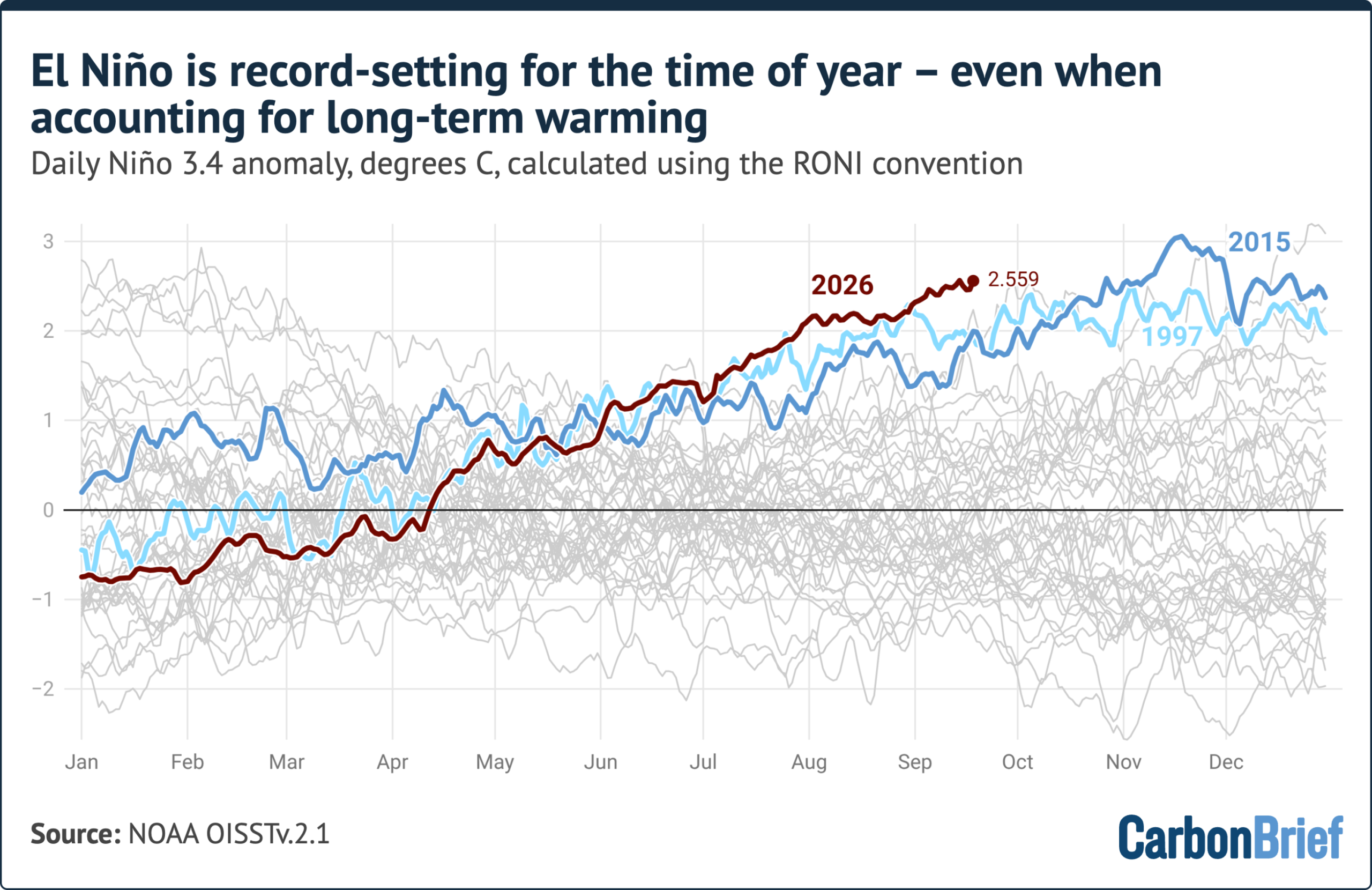
RONI stood at around 2.5C in mid-September, some 0.7C below the 1982 record.
However, that record was set in late December, at the peak of the event.
The 1982-83, 1997-98 and 2015-16 events added between 0.5C and 1.9C to their RONI values between mid-September and their peaks.
On track to smash monthly and seasonal records
Because daily El Niño values are noisy, scientists typically turn to monthly or seasonal averages to compare El Niño events.
The latest full calendar month for which data is available – August 2026 – had a Niño 3.4 anomaly of around 2.45C. This is higher than the peak of every prior El Niño event on record except 2015-16 – where the anomaly reached 2.75C – and 1877-78, when the anomaly sat at around 2.7C, based on a reconstruction of sea surface temperatures using sparse ship data.
The figure below shows the monthly evolution of the five strongest El Niño events on record alongside 2026, as well the current forecast from 14 seasonal forecast models.
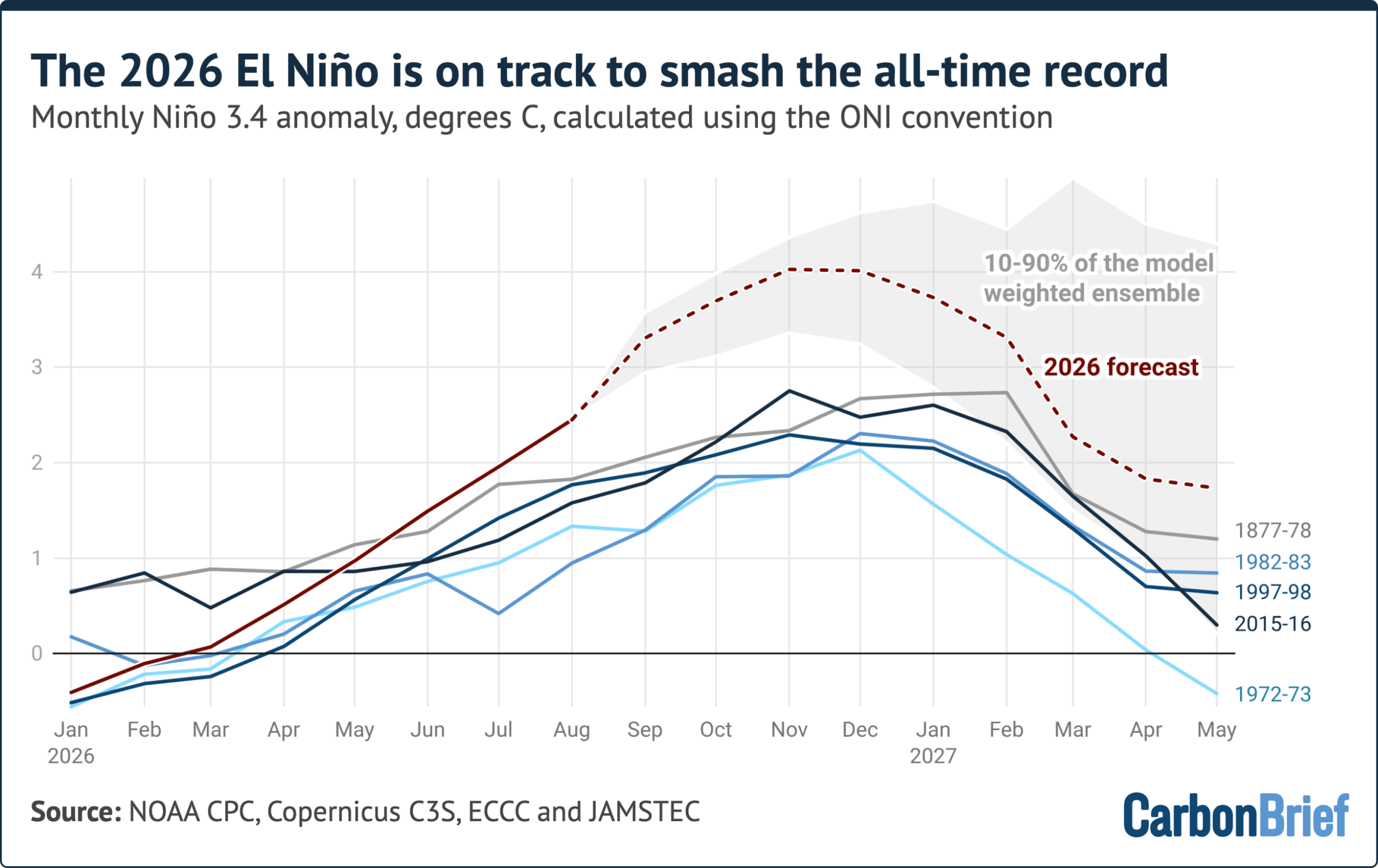
Taken together, the models project a peak monthly anomaly later this year of around 4.1C, with 80% of the 674 individual model runs falling between 3.4C and 4.6C.
Every single model run peaks above the 2015-16 record. The projected margin over that record, some 1.3C, is larger than the entire gap between the strongest and fifth-strongest El Niño of the past 150 years.
Some caution here is warranted, however. No seasonal forecast system has ever been verified against an event of this size, because none has ever occurred. The models also predicted temperatures slightly warmer than observed this summer, with real-world observations for August coming in around 0.3C below forecasts.
However, all strong El Niño events on record have continued to strengthen well into the winter – and the models are in near-unanimous agreement that this one will, too. If the forecast holds, the current event will peak between November and January at a level far beyond any event previously observed in the instrumental record.
El Nino’s effect on global temperatures typically lags rising ocean temperatures in the Pacific by several months, so most of the impact will be felt in 2027 rather than 2026.
Carbon Brief’s most recent “state of the climate” quarterly analysis found 2026 on track to be the warmest or second-warmest year on record. The next update in early October will examine what a record El Niño means for 2027.


The post Analysis: ‘Super El Niño’ reaches ‘remarkable’ all-time record appeared first on Carbon Brief.
Analysis: ‘Super El Niño’ reaches ‘remarkable’ all-time record



-

 Greenhouse Gases2 years ago
嘉宾来稿:满足中国增长的用电需求 光伏加储能“比新建煤电更实惠”
-
Climate Change1 year ago
Guest post: Why China is still building new coal – and when it might stop
-
Greenhouse Gases1 year ago
Guest post: Why China is still building new coal – and when it might stop
-

 Climate Change2 years ago
嘉宾来稿:满足中国增长的用电需求 光伏加储能“比新建煤电更实惠”
-

 Renewable Energy11 months ago
Sending Progressive Philanthropist George Soros to Prison?
-
Climate Change2 years ago
Bill Discounting Climate Change in Florida’s Energy Policy Awaits DeSantis’ Approval
-
Greenhouse Gases1 year ago
嘉宾来稿:探究火山喷发如何影响气候预测
-

 Carbon Footprint2 years ago
US SEC’s Climate Disclosure Rules Spur Renewed Interest in Carbon Credits