Extreme heat is one of the deadliest climate hazards, but no two heatwaves are the same.
Heat extremes that happen outside of the peak summer months are often more dangerous because they can catch people off guard.
Heatwaves that hit during the spring or the first heatwave of the summer are riskier because people’s bodies are not yet accustomed to the heat and cooling strategies, such as air conditioning or public cooling centres, might not be available.
On the other hand, heatwaves that happen in the autumn, after a long summer season of heat exposure, can place further strain on bodies and local infrastructure that are already under stress.
As the climate changes and global temperatures rise, research has shown that heatwaves are becoming more frequent, intense and lengthy.
Our study, published in AGU Advances, is the first to measure whether the timing of extreme heat during the calendar year is changing around the world.
We find that, in more than half of the world, extreme heat events are spreading into the “shoulder seasons”, but doing so unevenly – in other words, they tend to creep more into autumn or spring, depending on the location.
Defining heat seasons
Meteorological summer is often assumed to be the warmest three-month period of the year. It is simplistically defined as June to August in the northern hemisphere and December to February in the southern hemisphere.
However, extreme heat seasons vary from place to place and do not always neatly map on to these defined periods.
Our study, therefore, goes beyond traditional definitions of seasons and instead focuses on “local heat seasons”. We define these as the three consecutive months when extreme heat events happened most often in the 1980s.
From this starting point, our research looks at how extreme heat is creeping into the two-month periods before and after a local heat season. We call these periods “shoulder seasons”.
This flexible definition of heat and shoulder seasons allows us to measure how the timing of extreme heat has changed over time.
Specifically, we look at the percent of annual heat days that occurred in the heat season and shoulder seasons at each location on Earth and measure how those relative shares have shifted over the last 45 years.
For our analysis, we use climate data from 1980-2024 from the MERRA2 reanalysis dataset. To ensure our results were robust, we repeated the process using ERA5 reanalysis data.
We picked the 1980s as our baseline decade as it was the start of the common time period between the two reanalysis datasets. We compared this to climate data in the decade between 2015-24.
Comparing these two time periods – the opposite ends of our datasets – allowed us to register a larger magnitude change and account for cumulative effects of climate change.
We consider measures of both dry and humid heat, as each has distinct impacts. Dry heat tends to be more dangerous to plant and ecosystem health, while humid heat is more strenuous for humans.
We use the dry-bulb temperature and wet-bulb globe temperature as our measures of dry and humid heat, respectively.
Created in the 1950s by the US military, wet-bulb globe temperature has a long history as an international standard used for outdoor sports and occupational hazard monitoring. It combines measurements of temperature, humidity, wind speed and solar radiation.
Changing heat seasons
Our research finds that, in the 1980s, extreme heat around the world was closely confined to a single heat season. For example, some 93% of the world’s land area experienced more than 80% of extreme dry-heat days during its traditional dry-heat season.
Surprisingly, this was even true in the tropics, where there is much less of a seasonal swing in temperatures.
We also show that extreme dry- and humid-heat seasons are often different from one another, typically offset by one month. This is especially true in places influenced by monsoon systems, such as north-western Mexico and central India, where the extreme dry-heat season precedes the extreme humid-heat season.
But, the edges of these extreme heat seasons are starting to blur.
Extreme heat events are spreading out significantly in the calendar year in more than half of global land areas.
This extension of the extreme dry- and humid-heat seasons means that dangerous heat has started to creep into the shoulder seasons – but not equally so.
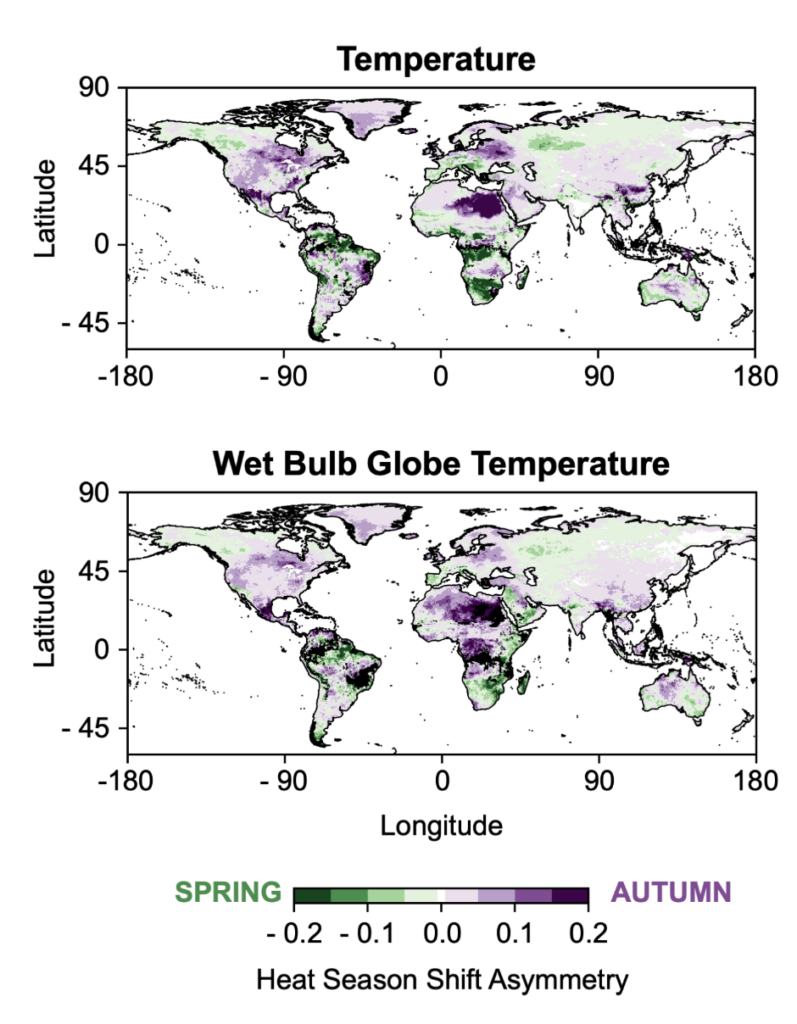
The maps below show how, in western Europe, southern Africa and north-western India, a larger fraction of each year’s extreme heat events are happening in the months before the historical dry- and humid-heat seasons. These regions are shaded in green.
On the other hand, in much of the US, eastern China, northern Africa and eastern Europe, extreme heat events are increasing in frequency in the months after the traditional heat seasons. These regions are shaded in purple.
Boosting existing seasons
It is possible that these observed changes have a straightforward – and somewhat simple – explanation.
In many regions, one shoulder season – spring or autumn – is warmer than the other. One hypothesis we explored was whether a simple step up in daily heat across the calendar year makes it more likely for extreme heat days to occur in one shoulder season over the other.
Our research shows that things are not so simple.
To investigate, we created a new, “synthetic” timeseries in order to identify the impact of annual average warming. To do this, we took the baseline 1980s timeseries and “shifted up” the data by the average change in local dry or humid heat between the first and last 10 years of our dataset (1980-89 compared to 2015-24).
We find that, in most locations, intensifying the baseline seasonality in a given location by warming evenly over the course of the year explains the changes in extreme heat timing within the traditional heat season.
However, annual average warming alone cannot explain the uneven changes in how extreme heat is occurring in the shoulder seasons.
As such, we conclude there must be other factors at play.
Long-term changes in seasonal precipitation and soil moisture – whether drying or moistening – could be contributing.
There could also be potential links to land-use changes, such as agricultural intensification or increased irrigation. Natural fluctuations in regional climates, caused by phenomena such as the Pacific Decadal Oscillation and Atlantic Multidecadal Oscillation, could also be playing an important role.
To tease out the contributions of each of these drivers, scientists will need to conduct more regionally-focused studies.
Managing hazards
The expansion of extreme heat events into the shoulder seasons indicates that key protections, such as heat early warning systems and the establishment of cooling centres, may be needed outside the traditional summer months.
Further research is also required to look into whether the overlap of extreme heat with other seasonal hazards is increasing.
For example, we find that, throughout much of the US, there is a larger expansion of the heat season into the autumn than the spring. In the western US, extreme heat which stretches later into the year could increase the overlap between the extreme heat and wildfire seasons.
Meanwhile, a similar extension of the heat season into the autumn in the eastern US could increase the overlap between the extreme heat and Atlantic hurricane seasons.
Understanding how the intersection of these seasonal hazards is changing is essential for developing targeted climate adaptation strategies, given that multiple hazards happening at once or in quick succession are much more dangerous than when they happen in isolation.
Ivanovich, C. et al. (2026) Extreme dry- and humid-heat seasons are changing asymmetrically, AGU Advances, doi:10.1029/2026AV002516
related

Guest post: Why tough methane cuts are crucial for keeping warming ‘well-below’ 2C

Guest post: France’s June heatwave caused more than 2,700 heat-related deaths
Guest post: Climate change has caused one-fifth of Pine Island glacier retreat

Q&A: What change of power in Colombia could mean for world’s fossil-fuel transition
The post Guest post: How extreme heat is ‘creeping’ from summer into autumn and spring appeared first on Carbon Brief.
Guest post: How extreme heat is ‘creeping’ from summer into autumn and spring

Dozens of countries – from big emerging economies to the world’s poorest nations – are calling for the UN’s new carbon market to reassess climate integrity rules, in a push that campaigners and researchers have blamed on industry lobbying.
At COP31 talks on the Paris Agreement Crediting Mechanism (PACM) this weekend, the Like-Minded Developing Countries – a group that includes Saudi Arabia, India and China – the Least Developed Countries (LDCs) and landlocked developing countries raised concerns about the requirements project developers must meet, according to sources familiar with the closed-door discussions.
They warned about the cumulative weight of those requirements developed under Article 6 of the Paris Agreement as barriers to implementation. Several countries, including Singapore and some Latin American states, said rules must keep projects financially viable, while South Korea asked for proportionate requirements, the sources said.
Their demands closely track arguments from carbon market industry groups, which claim PACM’s conservative approach to counting emission reductions is so strict that few projects will ever come to fruition.
Industry and NGOs lobby to weaken UN carbon credit rules in “coordinated” push
In a letter published ahead of COP31, the lobby groups asked governments to “raise implementation concerns” and to request that the Supervisory Body – the UN body that oversees the market – assess the “combined impact” of its rules on the feasibility of projects.
The letter was signed by the International Emissions Trading Association (IETA), a business group whose members include fossil fuel giants Shell, BP, Saudi Aramco and Chevron, along with the Project Developer Forum and the Wildlife Conservation Society, which develops forest conservation programmes.
Draft text reflects industry demands
Those demands are reflected in the first draft of the COP31 decision on the mechanism, published late on Saturday. To guard against over-crediting, PACM’s rules deliberately err on the side of issuing fewer credits when emissions cuts from projects are uncertain.
The document asks the Supervisory Body to look at how these cautious assumptions add up across its rules and what that means for the number of credits, project costs and prices. The aim, it says, is to avoid “excessive compounding of conservative adjustments”.
Other parts of the draft tell the body not to make its rules too cautious or too rigid. That includes efforts to guard against the risk that carbon captured by a project is later released. Most of these passages add that environmental integrity must be maintained.
Risk of another ‘failure’
“Weakening the rules is not climate ambition – it is a license to pollute,” said Erika Lennon, a senior attorney at the Center for International Environmental Law (CIEL). “As we are on the brink of permanently breaching 1.5C, we cannot afford to turn the carbon market into another loophole for polluters,” she added.
Axel Michaelowa, research director at Perspectives Climate Research, said that if attempts to weaken the rules succeed, it could lead to another failure of an international carbon market. Demand for credits rests on trust, he said, and the slightest doubt over integrity erodes buyers’ willingness to pay.
Calls to revise requirements “must be supported by scientific evidence, not unsupported claims of under-crediting – especially when these assumptions come from private actors whose revenues depend on the volume of transacted credits rather than real mitigation outcomes,” Michaelowa said.
The EU, Switzerland and Senegal are among a handful of countries pushing back against demands to re-assess the market rules, according to the sources, and are opposing requests to weigh up the profitability of projects or to lower standards.

Cookstove credits in focus
At the centre of the fight are new methodologies for projects that aim to cut emissions by distributing cleaner cookstoves – one of the carbon market’s most popular credit types and also one of its most criticised for overstating climate benefits. A 2024 study in Nature Sustainability found cookstove projects had been over-credited roughly tenfold.
Under the rules adopted by the Supervisory Body in October, cookstove project developers are required to set aside part of their credits in a buffer pool, in case the forests they claim to save later burn or are cleared.
The body rejected an exemption from this requirement sought by developers, corporate buyers, some conservation groups and the UN Environment Programme, in what critics called a coordinated lobbying campaign, as reported by Climate Home News.
Industry groups and some countries have seized on the cookstove methodologies to warn against excessively stringent requirements, which they say undercount emission reductions and deter developers. The LDCs told negotiators that developers had found some approved methodologies, including on clean cooking, difficult to apply.
Industry group calls for revisions
Industry representatives attacked the Supervisory Body’s approach in interventions that sources in the room described as very aggressive.
In a subsequent Linkedin post, IETA’s Andrea Bonzanni accused the regulator of following an unscientific approach that would deliver systematic under-crediting. He called on environmental integrity standards to be amended and rulebooks to be revised.
The mechanism “has had a false start”, he said, but countries in Antalya have a chance to agree on clear guidance that puts it back on track. “Unless the mechanism becomes workable across countries and activity types, its impact on the atmosphere risks remaining marginal,” he added.
IETA did not respond to a request for comment.
-
UN carbon market forces cookstove projects to protect against forest loss
Despite lobbying for an exemption, the UN regulator has for the first time made cookstove projects cover the risk that the trees they save are later destroyed -
Most “zombie credits” locked out of new UN carbon market after China and India snub
Fears of a flood of environmentally-dubious carbon credits have faded, with most old projects not able to transition to new UN market
Campaigners and researchers have pushed back on the claims. Arguing there is currently no evidence of under-crediting in the UN market, they stressed that more credits do not necessarily mean more emissions reductions if the rules underpinning them are not grounded on science.
“Having a Paris Agreement carbon crediting mechanism that cheats the atmosphere completely misses the point,” said Isa Mulder, a policy expert at Carbon Market Watch. “Countries should not allow Article 6 to become just another dangerous distraction from real, urgent climate action.”
The draft of the rules is an early version and will be negotiated during the COP31 summit’s final days. Under the Paris Agreement rules, the Supervisory Body must follow guidance that governments give through COP decisions.
The post Countries take up industry push to loosen UN carbon market rules at COP31 appeared first on Climate Home News.
Countries take up industry push to loosen UN carbon market rules at COP31
Mohamed Adow is director of Power Shift Africa.
International Energy Agency chief Fatih Birol celebrates the electricity demands of AI and electric cars, but the revolution must be about more than luxuries for the rich. It must bring clean, affordable power to the hundreds of millions still living without it.
The world is entering the age of electrification. But while wealthy countries focus on powering AI data centres, electric cars and other energy-hungry technologies, hundreds of millions of people across Africa and the developing world still lack access to electricity.
The real promise of the electricity revolution is not simply meeting the growing demands of those who already have plenty, but bringing clean, affordable power to those who have none.
So the decision by Türkiye and Australia to make electrification a flagship initiative at COP31 should be welcomed. Their proposed 35 by 35 goal, increasing electricity’s share of global final energy consumption to 35 per cent by 2035, could accelerate this transformation.
But who is this revolution actually for? Birol has celebrated the arrival of the electricity age, identifying AI data centres, electric transport and air conditioning as three major drivers of growing electricity demand.
-
Can AI data centres help power underserved African communities?
Three African countries join a pledge for sustainable AI at COP31, but the jury is still out on whether the energy-hungry industry can bring benefits for all -
COP31’s electrification pledge wins support, with caveats on clean power and finance
At least 14 countries