

Expensive accommodation, combined with restricted funding and accreditation, are set to limit the participation of Global South climate activists in COP30, casting doubt on Brazil’s promise to host the most inclusive UN climate summit ever.
Civil society groups told Climate Home News that the COP30 presidency’s failure to make affordable lodgings available in the Amazon city is pricing out many activists from countries at the forefront of the climate crisis, who are struggling to pay their way.
Campaigners had been enthusiastically preparing for this year’s talks in Brazil after their ability to demonstrate was severely limited at the last three COPs hosted in Egypt, the United Arab Emirates and Azerbaijan – authoritarian regimes with limited or no freedom to protest and poor human rights records.
But with basic rooms in Belém costing hundreds of dollars per night, many are being forced to stay at home this time around.
“Brazil has been a disappointment for a lot of us,” said Rachitaa Gupta, global coordinator of the Global Campaign to Demand Climate Justice (DCJ), a network of over 200 organisations primarily from the Global South.
-
NGOs urge Brazil to prevent fossil fuel capture of COP30 climate summit
More than 200 civil society groups are asking Brazil’s COP30 team to commit to “polluter-free” climate negotiations in Belém -
UN raises COP30 allowance to help with Belém accommodation crisis
But funding shortfalls risk reducing the number of government negotiators who can receive the payment unless more money is put on the table -
COP observers invited to reveal who is bank-rolling their participation at climate talks
As UN climate change body introduces new voluntary transparency measures, campaigners welcome “much needed step” to keep fossil fuel influence out of the talks


“This was a key moment for us because for the first time in many years we have been able to organise a huge people’s movement and mobilisation on the ground,” she added. “But we have had to scale that down significantly.”
A COP30 presidency spokesperson told Climate Home that the Brazilian government is taking concrete measures to ensure broad civil society participation, with a particular focus on the Global South, and has been responding to concerns expressed by organisations.
The measures include making available lower cost accommodation in university dormitories, schools and temporary housing facilities, they said, as well as negotiating discounted rates with hotels and transport providers.
Lula aims to host “the best COP in history”
Since President Luiz Inácio Lula da Silva first announced in early 2023 that Belém would host COP30, the Brazilian government has been talking up the symbolism of bringing the annual UN climate summit to the Amazon rainforest, which plays a vital role in absorbing planet-heating carbon and regulating the Earth’s climate.
“I leave Pará with the certainty that we will hold the best COP in history,” Lula said in February after he visited the northeastern state of Pará, whose capital is Belém.

Pará state governor, Helder Barbalho, told The Guardian in April that “it will be the COP with the greatest popular participation in history and that is something we have particularly encouraged”.
However, local hotels hiked rates to exorbitant levels in anticipation of high demand, despite efforts by the COP30 presidency to persuade them to bring them down. A deal was done to help developing-countries’ official delegations find cheaper accommodation at fixed rates, but those were not extended to non-governmental organisations, businesses or media.
Official booking platform late and “glitchy”
The DCJ’s Gupta said the logistical chaos has more to do with the COP presidency’s “complete planning failure”, rather than being an issue with an Amazon port city itself.
As room prices on commercial accommodation sites like Booking.com and Airbnb skyrocketed early this year, local officials insisted the market would “stabilise” once the COP30 team launched its own platform.
But when it finally appeared in mid-July after repeated delays, it was met with disappointment.
“There were frankly horrendous accommodation options that were very, very expensive,” Gupta said. She added that information is often “misleading” and those who managed to book couldn’t keep the accommodation because the system is “glitchy”.
Brazil launches COP30 accommodation platform after pressure from UN committee
When civil society groups voiced their concerns with the presidency in August, Gupta said the COP30 team responded with a plan to convert large buildings, such as schools and offices, into shared accommodation.
“For us, this was problematic because we cannot be seen as an afterthought and it’s not fair that civil society is reduced to being put into dormitory-style accommodation, like some kind of cattle being hoarded,” she said.
She added that many Global South campaigners come from conservative cultures and find it difficult to share rooms in mixed settings.
Reduced numbers attending
As a result, NGOs are slimming down the size of their delegations compared to COP28 in Dubai and what they had originally planned for Belém.
According to Gupta, many people in the DCJ network have ultimately decided against attending COP30 because of the pricey accommodation on top of costly flights to get there.
“It is specifically disappointing because we had anticipated doubling participation this year,” Gupta added.
Mariano Villares, co-founder of the Argentine organisation Sustentabilidad Sin Fronteras, told Climate Home that five members of their team had been planning to travel to Belém “to make the most of the COP’s return to Latin America after 11 years” – but only two will now be able to go.
“The prices and conditions of accommodation drive out civil society from the Global South. The climate conversation loses diversity when the voices most affected by the impacts are left out,” he said.

Marina Agortimevor, coordinator of the Africa Just Transition Network, told Climate Home the network had sent more than 15 of its members from grassroots organisations to past climate talks. But this time, because of funding cuts and the high cost of accommodation, it can barely manage to send four members to Belém.
While this COP has been billed as an inclusive conference, “inclusivity is still based on what is in your pocket”, Agortimevor said.
Other African civil society groups told Climate Home funders who had supported their attendance at previous climate talks had backed out of financing their participation at COP30 due to the high costs.
Limited accreditation allocations
In addition, Agortimevor said some Africa Just Transition Network members have struggled to get accreditation for the COP in Brazil, another factor that appears to be working against the wide participation of civil society.
Sustentabilidad Sin Fronteras said it had received less than a third of the accreditations it got last year, also limiting the size of its delegation in Belém.
One Latin American organisation – which asked not to be named – said it would have to divide up the three badges it had received so that some team members can attend the first week and others the second. “Some people need to be there for both weeks due to the work being done, and this situation has limited our activities,” they said.
The lower number of accreditations is a trend heard from most of the Latin American organisations Climate Home spoke with. Some are seeking other ways to get their staff into the conference, such as asking their countries’ governments to register them as “party overflow”.
When asked about this issue by Climate Home, a UN official said requests for COP accreditation by NGOs had increased “significantly” in recent years, with 4,000 organisations now registered as observer groups. The size of COP venues, however, has stayed the same, meaning that “the portions available to each organisation naturally become smaller”.
“This is not about restricting participation for any particular group, but rather a reflection of the growing interest, which affects everyone,” the official said, adding that the UN climate change body has been working specifically to enhance representation from developing countries as requested by governments at last year’s mid-year climate talks.

Blow to climate justice?
Osver Polo Carrasco, coordinator of the ambition and NDC working group of the CAN Latin America network, expressed concern about the limitations all this may pose on civil society in doing its job of monitoring and providing oversight of developments at COP30.
This problem was already been experienced at last week’s pre-COP in Brasilia, he added, “where access was very limited for civil society and also for the written press”.
One African Group negotiator – who is not attending COP30 because of the “prohibitive costs” – said the exclusion of himself and other representatives of governments and civil society from the continent “is not just an economic failure – it’s a political one”.
“It undermines representation, weakens multilateralism amid uncertainties like a potential US absence, and threatens the legitimacy and momentum needed for an inclusive and ambitious COP30,” he said.
He warned that “without the voices of those on the frontlines, climate justice becomes a hollow promise.”
The COP30 presidency said the substantive participation of Global South organisations “is essential for the credibility of the conference”, noting that it had already consulted with a wide range of groups, representing Indigenous peoples, youth and women among others, to ensure they can influence and engage in the summit.
“COP30 is being planned as a milestone for placing climate justice at the center, treating the full participation of civil society organisations as a pillar of this commitment,” the presidency spokesperson told Climate Home.
The post Global South campaigners question inclusivity of COP30 as some stay home appeared first on Climate Home News.
Global South campaigners question inclusivity of COP30 as some stay home

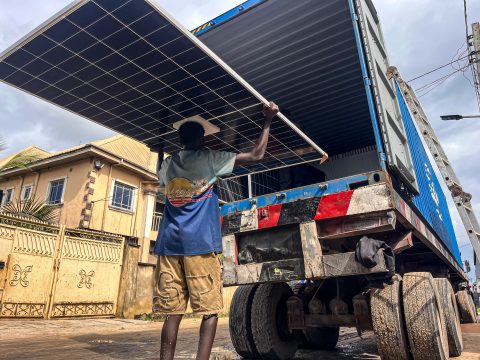
More than 300,000 solar panels and 120 battery containers are helping to power Africa’s largest copper mine with continuous clean energy in the Democratic Republic of the Congo, as miners turn to solar as an alternative to expensive diesel and energy imports.
The project at the Kamoa Copper mine in the south of the DRC, which became operational last month, is one of the largest solar and battery facilities generating baseload power on the continent.
The clean electricity is displacing millions of litres of polluting diesel and costs less than a fifth of the price of generator power per kilowatt hour, the mining company said.
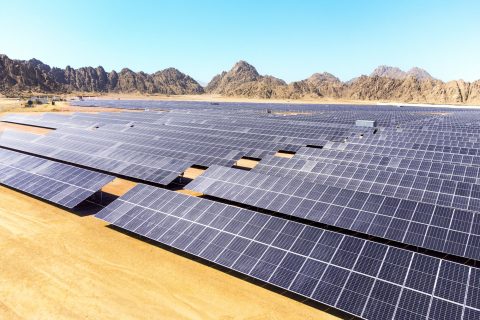
The project is part of a massive solar deployment across the continent. Recent data from global energy think-tank Ember found record solar capacity of 17 GW will be installed in Africa this year – a 45% rise from 2025.
Installed by CrossBoundary Energy, a developer of distributed renewable energy systems, the solar-battery facility at the DRC mine is “proof of concept” that solar and battery systems can provide the reliable power at scale needed by remote industrial operations, Annebel Oosthuizen, managing director at Kamoa Copper, told Climate Home News in an interview.
“There’s always been this perception in the DRC that solar isn’t ideal because it is raining half of the year. But it’s perfectly ideal. We are seeing a lot of interest from other mines that are still depending on generators and power imports,” she said.
Mining drives solar and battery surge
Like Kamoa Copper, a growing number of miners in the DRC are looking to solar power to compensate for the country’s chronic energy deficit at a lower cost as global diesel prices hit record highs amid ongoing attacks on oil infrastructure in the Middle East.
As a result, the mining sector has become a key driver of the country’s growing clean energy demand and one of the biggest importers of large-scale solar equipment.
Ember found the DRC is set to install a record 1.7 gigawatts (GW) of solar panels this year – a 544% increase compared to 2025 and the equivalent of adding more than 60% of the country’s entire 2023 grid capacity.
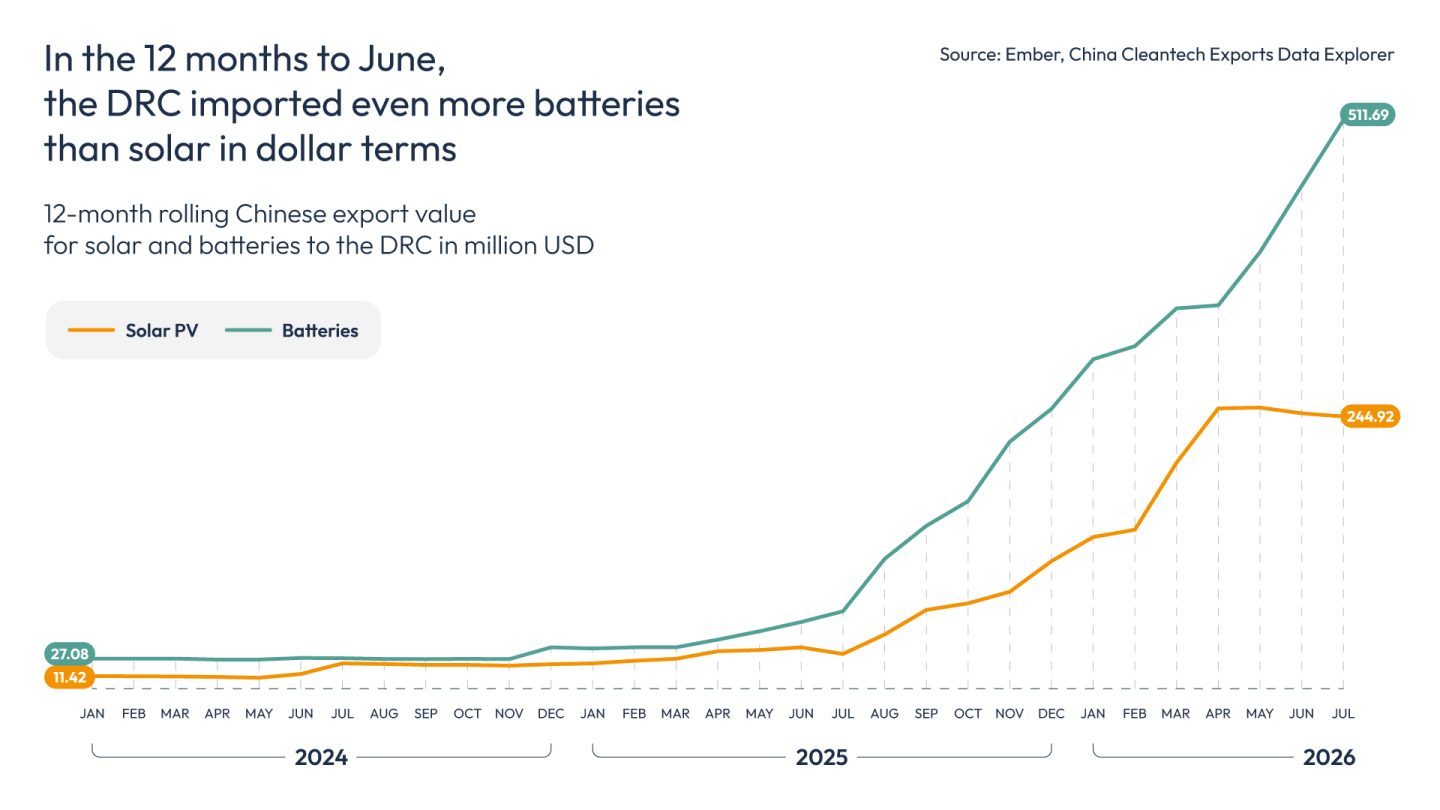
The deployment of combined solar and battery storage solutions to deliver stable energy supplies to mines has also caused battery imports to surge. In dollar terms, the DRC’s imports of batteries from China far exceeded that of solar in the year to June 2026, according to Ember.
A crippling power deficit
The DRC holds significant energy resources and some of the world’s largest reserves of the minerals required to manufacture clean energy technologies. It is the world’s largest producer of cobalt, which is needed to make batteries, and Africa’s top producer of copper – a metal sought after for its electrical conductivity which is pivotal to the world’s electrification efforts.
Yet just 22.5% of the DRC’s population had access to electricity in 2024 – one of the lowest rates in the world, according to the World Bank. And as mining expands and more of the minerals extracted are being processed in the country, unreliable power supply has become a major constraint for the sector, which contributed to more than a quarter of the country’s GDP in 2024, excluding oil and gas.
The country has enormous hydropower potential, with the hydroelectric potential of the Congo River estimated at around 100 GW. But only a fraction is being harnessed.
-
Made in Nigeria: The race to build an African solar industry from scratch
A solar power revolution is gathering pace in Africa and Nigeria wants a slice of the fast-growing industry, but competing with Chinese imports won’t be easy -
Can giant batteries unlock Africa’s green industrial future?
Battery energy storage systems (BESS) could drive clean tech manufacturing in Africa but shortfalls in finance and data are still limiting deployment at scale -
Egypt seeks to unlock renewable potential to power regional clean energy hub
Europe is investing in Egypt’s bid to position itself as a clean electricity exporter to reduce its emissions and generate a new source of income

Still, virtually all of the DRC’s grid-connected electricity is generated by hydropower by the state-owned utility, Société Nationale d’Électricité (SNEL).
The electricity then has to be transported more than 1,500 kilometres to reach the mining belt in the south – a challenge made more difficult by ageing grid infrastructure and limited transmission capability. SNEL did not respond to a request for comment.
“It is estimated that there’s around a 1 GW energy deficit for the DRC mining sector,” said Matt Tilleard, CEO of CrossBoundary Energy, which owns the solar and battery equipment at the Kamoa Copper mine and provides the power as a service.
“The interest in solar from the mining industry is not theoretical – it is already translating into large-scale solar and battery procurement for mining operations in the region,” he added.
Solar displaces gas, saves energy costs
The facility installed by CrossBoundary is part of a plan by Kamoa Copper to supply more of the electricity it needs with solar energy and batteries as its operations expand, a faster solution than relying on harder-to-build hydropower projects.
“Our processing capacity has increased drastically over the last couple of years. We’ve constructed the largest copper smelter in Africa and that is so power-intensive,” said managing director Oosthuizen.
A joint venture between Canadian firm Ivanhoe Mines, Chinese company Zijin Mining Group and the DRC government, the mine needs 235 megawatts (MW) of power, which is expected to nearly double to 450 MW in the next five years.
Kamoa Copper currently receives 100 MW from state utility SNEL – “and the rest we have to find a solution for”, said Oosthuizen.
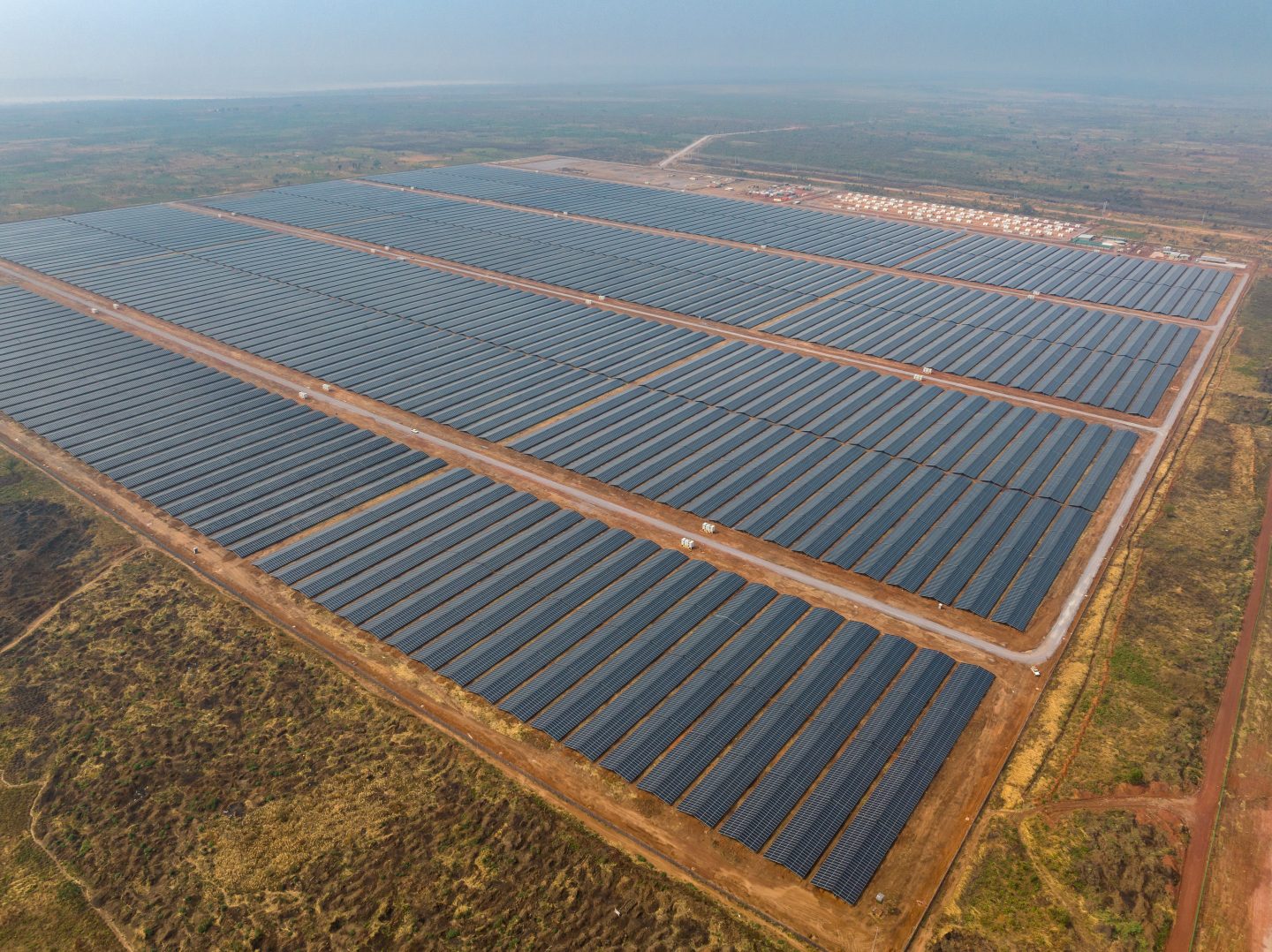
Another 30 MW solar and battery baseload facility is expected to come into operation this month, enabling around 25% of the mine’s power needs to be generated by solar energy. An additional 60 MW of continuous solar power will be added by the end of 2027, and the company is exploring options for more solar capacity and two hydropower projects.
The operational 30 MW of clean electricity provided by CrossBoundary Energy will power pumps that prevent 400 million litres of water from flooding the underground mine every day.
In August alone, the facility has reduced the mine’s diesel consumption by around four million litres, generating an estimated $11 million dollars in savings at current diesel prices, Oosthuizen said.
The mine still relies on generators to meet a 20-40 MW deficit and to power the trucks used in the mine, which Oosthuizen said would be difficult to electrify in the next five years because the technology isn’t yet ready to operate in the mine’s tough and wet conditions.
Avoiding a two-speed transition
To prevent a major imbalance between industrial players’ access to clean, reliable energy and the millions of Congolese who remain without power, the government requires private electricity producers to reserve at least 10% of their generated power for local communities living near rural production sites.
Delivering this, combined with rural electrification, mini-grid development and national grid expansion, is critical to prevent a two-speed energy transition that leaves people behind, said Catherine Mukobo, head of ACERD, the Congolese Association for Renewable and Decentralised Energies.
“Without implementing these policies, the DRC could get in a situation where mines have access to abundant modern energy while a large part of the population remains without electricity,” she said.
The post DR Congo’s power-hungry mining sector drives record solar surge appeared first on Climate Home News.
DR Congo’s power-hungry mining sector drives record solar surge
Climate Change
Commencement of NSW Forestry assessment a ‘chance to fix a broken system’ and deliver urgent forest protection
SYDNEY, Friday 18 September 2026 — In response to the Federal and NSW government’s announcement to commence an assessment of NSW forestry under the new national nature laws, Adele Chasson, Nature Policy Lead at Greenpeace Australia Pacific said:
“This is the Federal Government’s chance to fix a broken system that has enabled the destruction of NSW’s precious forests for far too long.
“Native forest logging continues to smash threatened species habitat. In NSW, it is pushing unique wildlife like koalas, greater gliders and glossy black cockatoos towards extinction. The state-owned logging agency has a disastrous record of environmental damage and breaches.
“The Regional Forest Agreement (RFA) system has failed, allowing the industrial logging of special forests for decades across Australia with no oversight. Thankfully, the Federal Government has started the process to finally remove the logging industry’s exemption from national nature laws.
“It’s time for the Federal Government to deliver the protection that forests urgently need, and that Australians overwhelmingly want. The Government must ensure a thorough assessment of the devastating impacts of native forest logging in NSW, and establish strong environmental rules that states must follow.
“These forests have been cared for by First Nations people for tens of thousands of years. They are some of the most biodiverse on the planet, store carbon, clean our air and water. It’s critical we protect them.”
ENDS
Media contact:
Kate O’Callaghan on 0406 231 892 or kate.ocallaghan@greenpeace.org
What happens when a love of marine life meets a playful imagination?
Sydney artist, illustrator and children’s author Sha’an d’Anthes, better known as Furry Little Peach, has teamed up with Greenpeace to create Happy Ocean Happy Planet: a joyful celebration of the extraordinary creatures that call our oceans home.
Sha’an felt inspired to create an illustration celebrating the beauty and resilience of marine life. Its hopeful message, A Happy Ocean is a Happy Planet, sparked a special collaboration with Greenpeace and a limited-edition t-shirt designed to help protect the oceans that inspired it.
The exclusive Furry Little Peach tee is available as a gift to new regular Greenpeace donors who give $30 or more and make at least three donations. By becoming a regular giver, you’ll help Greenpeace campaign for ocean protection.

ARTIST INTERVIEW: Sha’an d’Anthes (Furry Little Peach)
Sha’an shares the story behind the artwork, the local marine creatures featured in the design and why hope can be such a powerful force for action.
Hi Sha’an! Can you tell us a little about yourself and what you do?
My name is Sha’an d’Anthes, I also go by the pseudonym Furry Little Peach and I’m an illustrator, artist and children’s author based in Sydney, Australia. I love creating joyful, vibrant and nostalgic art that looks at the world through the lens of childlike wonder.

What do you love about drawing animals and nature?
I love all of the different shapes, colour and narrative you get to explore when drawing animals and nature. I’m also a city-slicker these days, and so I think that my work is a sort of escapism (for myself and hopefully for my audience).
How did the Greenpeace collaboration come about?
I went to the premiere of David Attenborough’s documentary Ocean, and felt compelled to create something to share the message of the film. This t-shirt is actually based off of that illustration including the tagline in I included when I shared it “A Happy Ocean is a Happy Planet”. I’m so grateful Greenpeace approached me for the project – it was a blast.
Where did you start when creating the Happy Ocean Happy Planet design?
The Happy Ocean tee starts the same as all of my work – with a brainstorm/braindump and really loose concept sketches.
How did you choose the animals for the illustration?
I actually asked Greenpeace to help me with the research of local marine life and they were so accommodating. They very quickly delivered me a huge list of local species of fish, mammals and coral and I just went through and looked up each creature and curated a little group of sea life that I thought would look sweet together – a mix of sizes, types, colours, textures and shapes.
What did you use to create the artwork?
So much of my work is traditional, but when it comes to things like t-shirts I always use digital drawing programs because I like to draw each colour in a separate layer which requires me to jump in and out of layers because it allows me to control colour and printing. When working digitally I always sketch in Procreate (an Australian digital art app), and then with this project I created final art in Adobe Fresco because it called for a vector graphic (an image that can be blown up to any size).
Do you have a favourite creature in the design?
I love painting Humpback Whales and always have, but I also have a soft spot for the sweet little Jelly Blubber jellyfish.
What did you want people to feel when they saw the artwork?
I specifically wanted to focus on the outcome that all of us want to see – a happy, thriving ocean where creatures are given the time and space to balance themselves. I feel that even when tackling tough subjects, leaning into hope is my natural inclination. As long as we have hope that things can be better, we will continue to take action.
What was the most fun part of creating it?
I actually documented the entire process of this project in a studio vlog on YouTube – and you can see how much fun I’m having doing final art jumping between layers and building the image. I had just come off completing final art for two books which are multi-year long projects, so being able to do a project that from start to finish in just a few days was really freeing at the time.
What does a “happy ocean” mean to you?
An ocean that given the time and space to repair and balance itself. Something I really took away from David Attenborough’s Ocean is that ocean ecosystems are actually really good at repairing themselves if we just let them do their thing.
How can people get their hands on the t-shirt?
The shirt is a reward for regular givers to Greenpeace – those who commit to at least 3 months of donations will receive the tee as a gift. Read about how at http://act.gp/flp-tee
How is Greenpeace helping to make our oceans happier places?
They have a deep focus on the health and happiness of our oceans through advocating for the set up of marine sanctuaries, holding big ocean polluters to account and calling for a ban on deep sea mining.
What are you working on next?
I will be jumping headfirst into Peachtober – an annual daily art challenge I run each year in October, if there are any artists reading this it’s a great time so please come join! In terms of publications my next picture book The Late Bird will be out in February 2027 (published by Harper Collins US) and then I have an creative activity book for adults coming out next August with Chronicle US and Penguin Australia. Otherwise you can always check out what I’m tinkering away with in my studio on Instagram and YouTube.




-

 Greenhouse Gases2 years ago
嘉宾来稿:满足中国增长的用电需求 光伏加储能“比新建煤电更实惠”
-
Climate Change1 year ago
Guest post: Why China is still building new coal – and when it might stop
-
Greenhouse Gases1 year ago
Guest post: Why China is still building new coal – and when it might stop
-

 Climate Change2 years ago
嘉宾来稿:满足中国增长的用电需求 光伏加储能“比新建煤电更实惠”
-

 Renewable Energy11 months ago
Sending Progressive Philanthropist George Soros to Prison?
-
Climate Change2 years ago
Bill Discounting Climate Change in Florida’s Energy Policy Awaits DeSantis’ Approval
-
Greenhouse Gases1 year ago
嘉宾来稿:探究火山喷发如何影响气候预测
-

 Carbon Footprint2 years ago
US SEC’s Climate Disclosure Rules Spur Renewed Interest in Carbon Credits