




- What timeline options were delegates debating?
- How did the timeline discussions unfold?
- What were the main points of disagreement?
- Why is the IPCC in a ‘serious funding crisis’?
- How have scientists reacted?
- What other issues remain unresolved?
- How are the IPCC AR7 reports progressing?
- How might the IPCC use AI and enhance gender inclusivity?

Gas flaring – where oil and gas companies burn off gas released during oil extraction – increased around the world last year to its highest level since 2019, despite a growing international push to regulate and curb the polluting practice.
According to satellite data released by the World Bank on Thursday, gas flaring increased by 7% in 2023, reversing a decline in 2022. The rise resulted in extra planet-warming emissions equivalent to 23 million tonnes of carbon dioxide (CO2) – similar to adding about 5 million cars to the roads, it said.
Gas flaring emits greenhouse gases including black carbon and methane, which has a warming effect about 80 times more potent than CO2 over a 20-year period.
The top flaring countries in 2023 were Russia, Iran, Iraq and the United States, with just nine countries responsible for 75% of gas flaring globally.
Last year also saw an uptick in the intensity of flaring, meaning the amount of gas flared per barrel of oil produced, as oil prices spiked above $90 a barrel in the autumn.
In some countries, such as Iran and Libya, increased flaring intensity was attributed to increased oil production, coupled with a lack of investment in and prioritisation of gas recovery and utilisation.
Intensity was also high in countries affected by conflict, such as Syria, where operators struggle to address flaring.
“We’re hopeful that this is somewhat of an anomaly and the longer-term trend will be dramatic reductions,” said Zubin Bamji, manager of the World Bank’s Global Flaring and Methane Reduction (GFMR) Partnership, which monitors flaring and supports governments and oilfield operators to reduce related emissions.
Decoupling trend
That hope is underpinned by the “decoupling of a long-standing correlation between oil production and gas flaring” since the late 1990s, Bamji explained in emailed comments.
Operators can minimise flaring through measures such as re-injecting gas back into the earth or capturing it for utilisation.
Demetrios Papathanasiou, director of the World Bank’s energy and extractives global practice, said in a statement on the data that if the wasted gas were captured and used, it could displace dirtier energy and generate enough power to double electricity supplies in sub-Saharan Africa.
EU warns “delaying tactics” have made plastic treaty deal “very difficult”
But others argue that using flared gas more efficiently – or regulating flaring and its related methane emissions – will not be eliminate the practice as long as fossil fuels are still being produced.
“The number one thing we need to do is put the oil and gas industry into decline,” said Lorne Stockman, research co-director at Oil Change International (OCI), a nonprofit group that campaigns against fossil fuels.
Pledges versus regulation
The increase in flaring suggests that growing global attention and initiatives to eliminate flaring have not been “sufficient or sustainable enough”, according to the World Bank’s report.
Operators and countries representing about 60% of flaring worldwide have endorsed the World Bank’s Zero Routine Flaring by 2030 (ZRF) initiative, while 155 countries have signed a Global Methane Pledge, launched at the COP26 climate summit in 2021, to collectively cut methane emissions.
Jonathan Banks, global director of methane pollution prevention at Clean Air Task Force, an environmental group focused on decarbonising energy, said those initiatives are “helpful”.
But, he added, governments and companies are still “not doing nearly enough” to stop flaring, whether in the form of policies to force businesses to take action or energy firms’ own plans and investments.
Despite dilution, officials say new nature law can restore EU carbon sinks
That is changing, Banks said, referring to recently introduced regulations in the United States, Canada and the European Union which aim to reduce methane emissions. “But those new policies take time to be implemented and enforced,” he noted.
The EU’s Methane Strategy, adopted in May, will include a methane transparency requirement on gas imports that looks to penalise gas flaring and venting – an even more polluting practice of releasing unignited gas.
“The potential to use access to the European market as a way to drive action is huge,” Banks said, adding that only a global standard, applied to all internationally traded oil and gas, could bring an end to flaring and venting.
US gas “certification”
Without such a standard, oil and gas companies are in practice policing themselves when it comes to curbing flaring and methane emissions more broadly.
In the US, for example, third-party gas “certification” companies track methane emissions coming from oil and gas infrastructure and tell consumers their gas is “responsibly sourced”.
According to OCI, there is no set standard for what level of methane leak reductions qualify natural gas for this label.
“Methane became a reputational issue for the US oil and gas industry a few years ago,” said OCI’s Stockman. “Suddenly we saw this proliferation of companies offering to monitor methane, and provide a certification to gas producers as an incentive to sign up.”
Gas certification is currently part of oil and gas companies’ voluntary efforts to act on their methane pollution – in the US, Colorado is the only state that directly measures methane emissions from oil and gas infrastructure. But, according to OCI, the industry is pressing regulators to use certification “as a proxy for regulatory oversight.”
Fossil fuel industry under pressure to cut record-high methane emissions
Research by Earthworks and OCI found that these certifying companies use unreliable technology, which missed all but one of the emissions “events” captured by researchers’ own monitoring equipment.
They also found conflicts of interest on the part of leaders and board members of certification companies, including holding investments in the same oil and gas clients they were working with and promoting fossil gas as a clean energy source.
While regulation is needed, Stockman said, it must be monitored by governments and is near impossible to enforce at scale, due to practical and technological limitations.
Even satellite technology is limited in its capacity to observe small-scale emissions events at “hundreds of thousands of individual sites”, he said.
“We can’t trust the industry,” he added. “The way to keep methane out of the atmosphere is to keep it in the ground.”
(Reporting by Daisy Clague; editing by Megan Rowling)
The post Gas flaring back on the rise, fuelling calls for stronger regulation appeared first on Climate Home News.
Gas flaring back on the rise, fuelling calls for stronger regulation
Continue Reading
Three countries have been named by the Paris Agreement’s compliance committee for failing to submit a nationally determined contribution (NDC) and repeatedly snubbing offers of help with their climate plans.
After months of internal debate over whether to identify serial non-responders, the Paris Agreement’s Implementation and Compliance Committee (PAICC) named the three countries which have failed to engage with it over their NDCs on Friday.
It named Democratic Republic of Congo, Senegal and North Korea in a footnote of its annual report, adding that it decided to name them “with a view to facilitating engagement”, adding that representatives of the three nations had been invited to its meeting in early 2027 “with the purpose of identifying any challenges and constraints”.
“The Committee noted the importance of Parties engaging with the Committee in a timely manner, while noting that some delays may be due to the national capabilities and circumstances of the Parties”, the report said.
-
Under US pressure, World Bank says it will back gas “where appropriate”
The US wants the World Bank to expand its gas support while climate campaigners are pushing for it to end – its head spoke this week of limited backing for the fossil fuel -
IPCC scientists vow to press on with climate reports despite political deadlock
After governments again failed to agree a timeline, nearly 120 IPCC authors pledged to complete their assessment on time and with full scientific rigour -
Paris Agreement committee snubbed over missing NDC climate plans
Many governments have still not submitted a nationally determined contribution to the UN, breaching a key requirement of the Paris Agreement
In July, PAICC said 12 countries had ignored its repeated attempts to discuss why they had not published an NDC as required every five years under the 2015 Paris accord.
Members of the committee had been divided over whether to name them, but at a September meeting decided to do so in their annual report to the annual climate COP summit.
By the time the report was published on Friday, only Congo, Senegal and North Korea “had not communicated an NDC or submitted a [Biennial Transparency Report] and had not yet responded to any of the Committee’s notifications, despite several reminders issued by the Committee in this regard”.
Rainforest and renewable energy ambitions
The silence from Congo and Senegal is notable because the former is home to much of the Congo Basin rainforest while the latter has sought billions of dollars in climate finance to support its renewable energy ambitions.
After Brazil, Congo has more rainforest than any country in the world. This forest, and the country’s peatlands, absorb huge amounts of greenhouse gas but are fast being lost to expanding farmland, charcoal production, logging and mining.
Senegal signed a Just Energy Transition Partnership with Canada and wealthy European nations in 2023, to help it meet its renewable energy targets under the-then government of Macky Sall. It was chair of the Least Developed Countries group between January 2022 and December 2023.

Tejas Rao, who is researching the PAICC as part of a doctoral thesis at Cambridge University, said the governments of the three countries should engage with the committee.
“Engagement costs these governments very little and the committee has shown it will listen,” he said.
“Silence leaves the committee with no basis to help, and it leaves the [governments] exposed to the narrative that they are simply disengaged,” he told Climate Home News.
Paris Agreement requirement
The 2015 Paris Agreement requires all parties to publish an NDC every five years outlining their emissions reduction targets, with each plan meant to be more ambitious than the country’s last NDC.
The latest set – the third round of plans, with new targets for 2035 – was due in February 2025. While most countries missed this deadline, all but around 30 – mostly small emitters but including Egypt, Vietnam and Argentina – have now submitted them.
Over the year, the PAICC – which is made up of government climate officials from developed and developing countries – has been communicating with governments that have not submitted NDCs and trying to overcome barriers to them doing so.
Some nations have cited exceptional circumstances as the reason for not submitting an NDC, a process that requires a significant amount of work in tracking emissions and consulting on how to curb them across the economy. For example, a letter from a Sudanese official to the PAICC, seen by Climate Home News, said that the country’s civil war had led to the suspension of its NDC preparation.
-
IPCC scientists vow to press on with climate reports despite political deadlock
After governments again failed to agree a timeline, nearly 120 IPCC authors pledged to complete their assessment on time and with full scientific rigour -
Under US pressure, World Bank says it will back gas “where appropriate”
The US wants the World Bank to expand its gas support while climate campaigners are pushing for it to end – its head spoke this week of limited backing for the fossil fuel -
Who shapes climate science? The equity question facing the IPCC
Early completion of the next global climate science assessment reports risks excluding research from the Global South, which is key to ensuring the findings are fair
The US and Iran are not signed up to the Paris Agreement and so do not have active NDCs, nor does Taiwan, which is not a UN member state.
Rao said that because the PAICC is “facilitative and non-punitive”, naming the countries “is meant to open a door, not close one – the invited consultation is the point”.
“In recent months, governments that explained their constraints, whether capacity, finance or domestic process, have been met with follow-up and support rather than sanction, and the number of silent governments has fallen sharply,” Rao said.
The post Paris Agreement committee names three countries snubbing it over NDCs appeared first on Climate Home News.
Paris Agreement committee names three countries snubbing it over NDCs
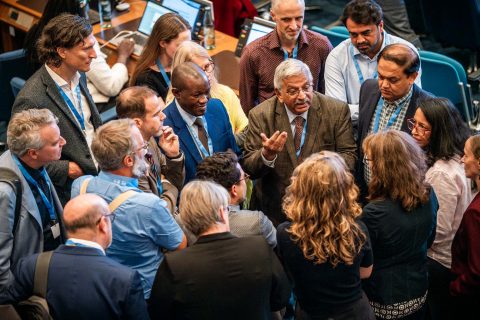
Countries have failed – for the sixth time running – to agree on the timeline for publishing the Intergovernmental Panel on Climate Change’s (IPCC) next set of influential reports.
The IPCC’s 65th session (IPCC-65) was seen by many to be the final opportunity for countries to agree on a schedule where its seventh assessment report (AR7) would be published in time for the UN’s second “global stocktake” of climate action.
Before last week’s meeting in Addis Ababa, Ethiopia, IPCC chair Prof Sir Jim Skea had warned that releasing the reports in time for the stocktake in 2028 would depend on a timelines being agreed by the end of 2026.
But the week-long meeting descended into fraught disagreements between governments, resulting in Skea “suspending” the talks on Friday evening with no decision made.
Countries were also unable to agree on the IPCC’s budget for the rest of the AR7 cycle, leaving the body with a “serious funding crisis”.
The IPCC has pledged to reconvene the meeting at the “earliest opportunity”; however, it has not yet given an indication of when this will be.
In his concluding remarks, Skea described the Addis Ababa summit as a “profound disappointment” and “among the most difficult IPCC meetings”, according to reporting from the