

China’s climate ambition at this year’s “two sessions” (两会), which ended on 11 March, was relatively subdued, with analysts expecting economic concerns to trump climate action in the year ahead.
The “two sessions”, which takes place every spring, is a major political event held in Beijing that gives an indication of China’s broad policy direction for the year.
It covers every area of governance, including energy and climate policy.
In this article, Carbon Brief outlines key signals from the 2025 “two sessions”, including: a new energy target for 2025; clean-energy and climate priorities; the ongoing development of coal in a “supporting role”; and China’s response to “green trade barriers”.
This is an update of Carbon Brief’s 6 March China Briefing newsletter, expanded to cover developments during the last few days of the event.
A key meeting
The “two sessions” (两会) is the annual gathering of the National People’s Congress (NPC) and the Chinese People’s Political Consultative Conference (CPPCC). This year, it ran from 4 to 11 March.
The gathering is attended by Chinese Communist party members, as well as members of other political parties, academics, industry leaders and other prominent figures, known as delegates or deputies.
Its centrepiece is the “government work report”, a speech delivered by the premier – the head of China’s State Council, the top body of the country’s central government. This outlines the previous year’s achievements and priorities for the year ahead, including the annual GDP target.
At the meeting, China also releases a report by the National Development and Reform Commission (NDRC), the country’s top economic planning body, as well as a central and local government budget report.
In addition, the event allows thousands of delegates to meet and raise policy proposals with senior government officials.
Low energy target
China pledged to reduce energy intensity – a measure of energy consumption per unit of GDP – by 3% in 2025, the work report said. (This measure now excludes renewables and nuclear, meaning it only applies to fossil fuels.)
This target means China is “on track to miss its 14th five-year plan energy intensity target”, Yao Zhe, global policy advisor at Greenpeace East Asia, tells Carbon Brief.
She adds that it was an “inconvenient truth” that China’s economy has not become much more energy efficient in recent years, “offset[ting]…the decarbonisation effects of renewable technology deployment”.
China is lagging behind on its 2026 targets for reducing both energy intensity and carbon intensity – the amount of CO2 emissions per unit of GDP. Analysis for Carbon Brief has shown that they would need to fall by 6% and 7% per year, respectively, to meet the targets.
In its report, the NDRC attributed the shortfall in China’s 2024 carbon-intensity reduction figures to “rapid growth in the energy consumption in industries and the civilian sector as a result of post-Covid economic recovery and frequent extreme weather events”.
Lauri Myllyvirta, lead analyst at the Centre for Research on Energy and Clean Air (CREA), wrote on Bluesky that the low target “shows the government is not prioritising controlling carbon dioxide (CO2) at the moment”.
He also said the new methodology for calculating energy intensity would, in theory, allow fossil-fuel demand to grow by 1.9% in 2025, pushing CO2 emissions up by more than 2%. (He added that he did not think this would actually happen.)
The 14th five-year plan’s carbon-intensity target, which measures CO2 emissions per unit of GDP, will likely also be missed, according to the Carbon Brief analysis. China does not typically announce annual carbon-intensity targets in the government work report.
The targets that were announced underscored that “economic growth remains the top priority, with environmental goals taking a backseat”, Li Shuo, director of the China climate hub and senior fellow at the Asia Society Policy Institute (ASPI), tells Carbon Brief.
The lack of an annual carbon-intensity target was “a further sign of carbon reduction being downplayed”, he adds.
Priorities in 2025
China’s climate and energy policy in 2025 will likely follow well-established priorities, such as balancing decarbonisation and energy security, based on the report’s language.
The state-run newspaper China Daily highlighted the report’s support of China’s “dual-carbon” goals on its frontpage, saying that China pledged to “diligently work” towards them.
According to the work report, China “will develop a package of major projects for climate change response and actively engage in and steer global environmental and climate governance”.
A number of climate measures were announced, but Li tells Carbon Brief that there were “no major surprises”, confirming his view that the “two sessions” has “increasingly become a platform to confirm pre-existing decisions rather than introduce new ones”.
Each year, the government work report lists a number of top priorities for the year ahead, as shown in the figure below.
For 2025, the report lowers the importance of high-quality development in favour of “expanding domestic demand”. The prioritisation of “low-carbon development” and other climate related tasks remained the same compared to 2024.

Ranking of key tasks in each government work report during the 14th five-year plan period (2021-2025). Source: Xinhua publications of the government work reports for 2025, 2024, 2023, 2022 and 2021.
The report discusses China’s climate and environment efforts for 2025 under the title:
“Making coordinated efforts to cut carbon emissions, reduce pollution, pursue green development, and boost economic growth and accelerat[e] the green transition in all areas of economic and social development.”
This stands in stark contrast to the climate section’s title last year, which only highlighted “enhancing ecological conservation and promoting green and low-carbon development”.
The expanded wording signals a more “comprehensive design at the policy level” to “systematically enhance the integration of different sectors for tackling environmental problems”, Xu Song, a registered environment evaluator in China, wrote on his WeChat account.
The work report lists a number of climate initiatives for the year ahead, including: expanding pilot programmes for local governments to peak carbon emissions; building “zero-carbon industrial parks”; accelerating the shift from “dual-control” of energy to dual-control of carbon emissions; and including more industries in the national carbon market.
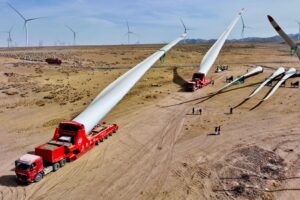
Most importantly, renewable energy buildouts will continue, with a particular focus on “new energy bases in desert areas, the Gobi and other arid areas”, as well as offshore wind. The report also recognises the need for China to upgrade its electricity grid to cope with vast renewables additions.
But the report also continues to commit to fossil-fuel infrastructure. It reiterates calls to “better ensure both development and security”, which for the energy sector means that China should pursue a low-carbon transition while ensuring sufficient energy supply by keeping some fossil-fuel capacity.
This year, it says China will launch “low-carbon upgrade trials” for coal-fired power plants, which are seen as necessary for energy security. (Recent analysis found that a “substantial amount” of new coal capacity will soon come online.)
The separate NDRC report also reinforces coal as having a “basic supporting role” , announcing that China will “continue to increase coal production”.
The table below compares the language used in relation to coal in government work reports from 2021-2025.
| 2021 | 2022 | 2023 | 2024 | 2025 |
|---|---|---|---|---|
| While promoting the clean and efficient use of coal, we will make a major push to develop new energy sources, and take active and well-ordered steps to develop nuclear energy on the basis of ensuring its safe use. |
We will work to upgrade coal-fired power plants to conserve resources, reduce carbon emissions, make operations more flexible, and upgrade heating facilities. | We leveraged the role of coal as a major source of energy, increased advanced coal production capacity and stepped up support for power plants and heat-supply enterprises to ensure energy supplies. | We will see that coal and coal-fired power play their crucial role in ensuring energy supply and our energy supply meets the needs of economic and social development. | Low-carbon upgrade trials will be launched in coal-fired power plants. |
A table comparing the language used around coal in government work reports during the 14th five-year plan period (2021-2025). Source: Xinhua publications of the government work reports for 2025, 2024, 2023, 2022 and 2021.
Ilaria Mazzocco, senior fellow with the trustee chair in Chinese business and economics at the Center for Strategic and International Studies (CSIS), tells Carbon Brief that the signal that coal would only have a supporting role in the future energy system was a “good sign”, but that the language underscored that there is “little interest” in phasing out coal “for now”.
The NDRC also pledged to reduce steel output and to encourage oil refiners to produce more petrochemical products instead of fuel.
Consumption and ‘involution’
Boosting domestic consumption is seen as key to achieving China’s 2025 GDP target of 5%. Consequently, it replaces fostering innovation as the top priority for policymakers for the year, as shown in the chart above.
China’s approach to boosting growth includes a number of stimulus measures. The net impact of these measures on China’s emissions, such via the building of energy-intensive infrastructure, is currently unknown, however.
At this year’s meeting, the government stated that domestic consumption will be the “main engine” for economic growth in 2025.
“The big question mark is real estate and construction”, Myllyvirta tells Carbon Brief. Real estate and construction have been the biggest driver of domestic consumption for decades.
However, Myllyvirta adds that the government would likely aim for stable growth in the sector, rather than stimulating it with rapid and energy-intensive growth.
In part, China is putting its hopes – and 300bn yuan ($41bn) – into a consumer trade-in programme, which will likely continue to allow drivers to swap combustion-engine cars for “new-energy” vehicles (NEVs, which refers to electric vehicles and plug-in hybrids).
The report also pledges to incentivise “eco-friendly consumption”.
While technological innovation remains a major priority, clean-energy technologies are not explicitly mentioned in the government work report in this context.
Last year’s government work report emphasised the need to “consolidate and enhance [China’s] leading position” in industries such as NEVs and hydrogen, as well as to “create new ways of storing energy”.
Nevertheless, according to power news outlet BJX News, this is not a signal that clean-energy technologies are out of favour, but rather a sign that they are already widely recognised as an essential part of China’s technology strategy.
Similarly, although hydrogen is not explicitly named as a “future industry” in the government work report, the NDRC confirmed it will receive support from a one trillion yuan ($138bn) fund that will be issued for “frontier fields”.
In its budget report, China’s Ministry of Finance pledges to “steadily promote” China’s climate action, such as by strengthening financial support for R&D for low-carbon technologies, enhancing the development of renewable energy, promoting NEVs and developing green finance standards and institutions.
This year’s government work report also emphasises the need to combat “rat-race competition” – a reference to what is described in China as “involution”. This term refers to the overcrowded markets and price wars plaguing some sectors, including NEVs and solar panels. The report states it will take “comprehensive” steps to address the problem.
The NDRC report notes that the government will take steps to “promote orderly development” of the NEV, lithium-ion battery and solar industries, underscoring government concerns about the sector.
Nevertheless, the government does recognise the importance of clean-energy technologies to economic growth, Mazzocco tells Carbon Brief. She explains:
“Energy is now seen as a tool to ensure the economy can grow rapidly and is meant to support technological transformation…Climate per se is not a goal that the Chinese government wants to prioritise over economic growth and international competition.”
Geopolitics
Trade tensions that underpinned the political atmosphere during last year’s two sessions have been exacerbated by a number of developments since then – particularly around export controls and tariffs.
This is reflected in the work report, which notes that “increasingly complex and severe” geopolitical tensions may “exert a greater impact on China in areas such as trade, science and technology”.
In response, the government will “take active steps to respond to green trade barriers” – pointing to the trade measures above as well as the EU’s carbon border adjustment mechanism (CBAM) – the report says.
However, in a press conference at the event, China’s foreign minister Wang Yi said that he believed China and the EU had the “capacity and wisdom” to resolve disagreements through consultations.
China will also continue to help African nations develop in “green sectors”, Wang said, building on language in the government work report that pledges to continue with “high-quality” projects in Belt and Road Initiative partner countries.
Extreme weather
There was continued recognition of the drag of “natural disasters” on China’s economic growth, with the work report pledging to “better guard against and respond” to floods, droughts, typhoons and other extreme weather events.
The report notes that floods “occurred frequently in some parts of China” last year. This was not explicitly linked to climate change.
However, the NDRC report attributes China’s failure to meet its energy-intensity goal in 2024 to, in part, “frequent extreme weather events”.
A recent Carbon Brief analysis found that, of 114 attribution studies for Chinese extreme weather events, 88 had their “severity or likelihood” increased by climate change.
Around the two sessions
Apart from the ministers and senior officials delivering work reports, side meetings between central leaders and local officials at the “two sessions” also send out political signals.
This year, President Xi Jinping met with a delegation from Jiangsu – an eastern province that is known for its affluent economy, manufacturing, strength in exports and technological innovation.
At the meeting, Xi emphasised the “need to upgrade traditional sectors and foster future sources of innovation”, although he also warned against creating industry “bubbles”, reports the Hong Kong-based South China Morning Post.
He added that policymakers should “actively promote high-end, intelligent and green development of industries”.
Meanwhile, MEE head Huang Runqiu emphasised the importance of low-carbon development, both in a meeting with a delegation from the northern Heilongjiang province and in a “minister’s corridor” press conference.
Delegates raised more than 700 policy proposals on “ecological civilisation” at this year’s meetings, energy news outlet BJX News reports, covering areas including addressing China’s industrial energy transition and developing the carbon market.
Among these, the US-based NPC Observer newsletter says, were two bills proposing the enactment of a “climate change response law” that would develop a legislative scheme for reducing carbon emissions.
Finally, as the meetings came to a close, NPC head Zhao Leji confirmed that the legislative body will continue to work on China’s environment and ecology code, according to news reports, as well as the atomic energy law in the year ahead.

The post Explainer: What does China’s ‘two sessions’ mean for climate policy in 2025? appeared first on Carbon Brief.
Explainer: What does China’s ‘two sessions’ mean for climate policy in 2025?

June Rubis is a steering group committee member for the Cali Fund, from Sarawak in Malaysian Borneo.
At COP16 in Cali, governments made a significant commitment: at least half of the funding from the new Cali Fund should support the self-identified needs of Indigenous Peoples and local communities, including women and youth. It was a watershed moment for multilateral benefit-sharing.
The challenge now is to translate that commitment into access arrangements that recognise the different institutions, priorities and decision-making processes of Indigenous Peoples and local communities.
For generations, biodiversity and traditional Indigenous knowledge have provided significant value to companies who depend on nature’s genetic diversity to discover new drugs that fight diseases, create products that improve health, and grow crops resilient to extreme heat and flooding events. While some compounds are sampled directly from the source country, increasingly the digital blueprints are held in online public databases which are freely accessible to use for innovation and research.
Countries urged to ramp up “insufficient” nature policies at COP17
The Cali Fund was established at COP16 to encourage commercial users of Digital Sequence Information, or DSI, to share benefits arising from its use. Estimates suggest it could generate over $3.5 billion a year – a stark contrast to the modest $10,656 currently committed to the fund from just five SMEs, underlining how much progress must be made at COP17 over the next two weeks.
The COP16 decision that set up the fund offers two routes for money to reach Indigenous Peoples and local communities: through government authorities, and through direct payments to institutions identified by Indigenous Peoples and local communities themselves.
Varied ways of organising
Indigenous Peoples and local communities organise through a wide range of institutions. Some have national or regional organisations experienced in managing international grants. Others work through territorial organisations, customary institutions, community associations, cooperatives or networks. Some have professional finance teams and audited accounts; others have extensive experience governing territories, collective resources or conservation work without having been organised around international funding requirements.
For direct access, some questions are already apparent. Which institutions should be able to receive funds? How should they be identified? What fiduciary standards should apply? How should safeguards and accountability work where institutional capacities differ? What support may be needed where institutions have strong community mandates but less experience with international finance?
Comment: Protecting nature is a public duty, not a Wall Street profit opportunity
If access is designed mainly around institutions that already meet the expectations of large international finance mechanisms, early funding will tend to favour those already familiar to funders. They will gain further experience and become better positioned for future funding, while institutions with less administrative capacity may remain outside the system despite strong community mandates and long histories of stewardship.
These first decisions matter most, because they set the terms for everyone who follows.
The role of intermediaries requires care. Some Indigenous organisations may want a fiscal host to hold and manage funds on their behalf. Communities may choose to work through an NGO they trust. Government-facilitated arrangements may work well in particular national contexts.
What matters is the function an intermediary performs and the authority that comes with it. Providing administrative support is different from deciding which Indigenous organisations qualify, which priorities can receive support, or how success will be assessed. Direct access means communities keep that decision-making authority.
Decision-making power
The COP16 decision refers to institutions that Indigenous Peoples and local communities identify. But authority among Indigenous Peoples does not sit in one kind of body. It may sit with territorial organisations, customary institutions, community associations or combinations of these. Legal recognition and customary authority do not always align neatly.
Global deforestation slowed in 2025 but Brazil’s election could undo “fragile” gains
An important feature of the Cali Fund’s governance is that Indigenous Peoples and local communities participate as full members of the Steering Committee, rather than as observers. Seven Indigenous Peoples and local community representatives, one from each of the seven socio-cultural regions, participate in consensus-based decision-making alongside representatives of governments and UN entities. Six additional representatives from civil society, scientific institutions and the private sector participate as observers.
That representation carries responsibility. Institutional legitimacy, access and representation take different forms across the seven socio-cultural regions. Indigenous Peoples and local communities members therefore have an important role in bringing those differences into the Fund’s governance and in ensuring that arrangements developed for one context do not become the assumed model for everyone else.
Safeguards and clear responsibilities
COP17 can establish the core principles and direction, while allowing operational pathways to develop in ways that respond to different regional contexts. The decisions countries take in Yerevan will shape how that flexibility is realised in practice.
The choices made around access will influence which institutions are able to participate, which routes become established and which forms of authority are recognised within the funding architecture. The aim should be an architecture with enough structure to maintain confidence while allowing for different forms of Indigenous and community governance.
A credible direct-access pathway will need safeguards, financial oversight and clear responsibilities. This would give the 50% commitment a stronger institutional foundation.
The Cali Fund’s importance will ultimately depend not only on how much funding reaches Indigenous Peoples and local communities, but on whether they are able to determine how the money is accessed, governed and used. This requires access pathways that recognise their institutions, priorities and decision-making processes, rather than requiring them to conform to a single predetermined model.
The post COP17 must settle who decides how Cali Fund money is disbursed appeared first on Climate Home News.
COP17 must settle who decides how Cali Fund money is disbursed
The UK government has approved extraction at the Jackdaw gas field in the North Sea, despite acknowledging that this decision could make it harder for Britain to convince other countries to move away from fossil fuel production.
UK energy secretary Miatta Fahnbulleh approved the drilling on Wednesday after months of high-profile debate, fuelled in part by interventions from US President Donald Trump. She argued that the project would boost energy security in the wake of the Middle East fossil fuel crisis, protect hundreds of jobs and add £2.9 billion ($3.88bn) to the UK economy.
She said Jackdaw’s gas would be cleaner than imported gas and would not prevent the UK from meeting its legally-binding carbon targets and its goal of net zero by 2050. As the field is already licensed, she said extraction was consistent with the Labour Party’s 2024 manifesto promise not to issue any new oil and gas licenses.
The same morning, the government announced a new Energy Wealth Fund to reinvest oil and gas revenues in the climate transition. It will start with £2 billion ($2.67bn) from the government and be topped up over time with tax revenues from offshore oil and gas production.

Climate campaigners in the UK and abroad were quick to condemn the decision, while a leading legal expert told Climate Home News it goes against the advice of the International Court of Justice. Meanwhile, the government’s own documents reveal that it recognises the drilling could damage the UK’s reputation and its ability to push forward the global transition away from fossil fuels.
“Climate leadership” blow
The 92-page decision document says Fahnbulleh “acknowledges that international standing on climate is important and accepts that a decision to grant consent may not further the UK’s international climate leadership.”
It adds: “She acknowledges concerns about the potential implications for the UK’s credibility and influence – including the difficulty inherent in encouraging other states to move away from fossil fuel production while the UK continues, in a limited and transitional way, to draw on its own domestic resources.”
While noting that Jackdaw has not been issued with a new license – just permission to extract gas – the document says Fahnbulleh “accepts this does not fully resolve the underlying tension in the UK’s position” but “considers this alongside the substance of the UK’s wider record [on emissions reduction], which remains significant”.
It continues that she accepts these concerns are “legitimate” and weigh against approving gas extraction, but only gives this argument a “moderate negative weight” set against the benefits of gas production.
“Huge” wrong signal
In international climate talks, the UK has long supported the transition away from fossil fuels and is one of very few major oil and gas producers to ban new licenses. Across the North Sea, the Norwegian government continues to make offshore areas available for oil and gas exploration through annual licensing rounds.
Climate experts and campaigners shared the concern, acknowledged in the decision document, that approving Jackdaw could set a precedent for fossil fuel production elsewhere. Sam Fankhauser, professor of climate change economics at Oxford University, said the direct climate impact of Jackdaw is “much smaller than the debate around it would suggest” but the “wrong signal it sends, however, is huge”.