

- Formal negotiations
- Turkish and Australian leadership
- Cover decision
- COP reform
- Adaptation
- Finance
- Just transition work programme
- Loss and damage
- Gender
- Article 6
- Agriculture and food security
- Mitigation work programme
- Response measures
- Action for climate empowerment
- Trade
- Second global stocktake
- Long-term goal review
- Around the COP
- Fossil fuels
- Action agenda
- Global leaders
- Electrification
- China at COP31
- Ocean
- Deforestation
- Methane
- New climate science
- Food and water
- NDCs
- Protests and access
- Road to COP32 and beyond

The European Union should “proactively negotiate” for a global regime that governs controversial technologies designed to cool the planet– and push to prevent their deployment, the union’s scientific advisors have said.
The recommendations from the EU’s chief scientific advisors mark the first time the union has received scientific advice on a highly divisive group of technologies known as “Solar Radiation Management” (SRM).
SRM technologies are designed to temporary relieve the world from extreme heat by blocking some of the sun’s warming impacts. This could include pumping aerosols into the high atmosphere, spraying saltwater into clouds to brighten them, or even sending mirrors into orbit to reflect more sunlight away from the Earth.
These technologies wouldn’t address the root cause of climate change – namely rising heat-trapping greenhouse gas emissions – nor could they address the impacts of those emissions on ocean acidification for example.
“At best, they would reduce warming from solar radiation on a temporary and local scale,” the scientific opinion notes.
Risky strategy
It’s a risky strategy. Deploying SRM carries major uncertainties and wide-ranging risks, that are poorly understood.
SRM deployment is “likely to bring substantial negative ecological and economic effects, including changing patterns of rainfall, impacts on ecosystems, a decrease in the security of food production and in the potential of solar energy,” the report warns.
World Bank raises $100 billion for poor nations in boost for climate finance
The EU doesn’t have an official position on SRM although it “does not consider SRM as a solution”, according to a policy scoping paper, which describes the technologies as “an unacceptable risk for humans and the environment”.
Last year, the EU’s then Green Deal chief Frans Timmermans requested advice from the union’s seven scientific advisors to help define a common position.
In response, the advisors have urged the EU to prioritise reducing greenhouse gas emissions and focus on adaptation to climate impact as the main solutions to global warming.
The uncertainties associated with deploying SRM are inconsistent with Europe’s “do no harm” principles and decision-makers should agree an EU-wide moratorium, they concluded.
At the same time, SRM is gaining more attention as a potential cheap and fast solution to reduce overheating as the world barrels towards overshooting the 1.5C warming threshold above which scientists have warned of catastrophic climate change. “Cooling credits”, which at least one company using SRM technology is already selling at small-scale, should be banned from being used to meet international climate obligations, the advisors added.
Wild West
Yet, there is no international framework governing SRM activities.
Biden uses only Africa visit to promote “game changer” railway for copper and cobalt
A de facto moratorium was agreed in 2010 by members of the UN Convention on Biological Diversity, with exceptions for small-scale scientific research studies – but the decision isn’t legally binding and the United States is not member to the treaty
The EU should take a leading role in negotiating a global governance system and push for the “non-deployment of SRM in the foreseeable future”, with exemption for “limited outdoor research” that meet a set of conditions and risk considerations, the advisors argue.
Besides a ban on large-scale outdoor experiments, they recommended the creation of “clear ethical requirements” and guidelines for smaller research projects. Any public funding for SRM research should not replace financing climate action and scientific evidence for researching and using the technology should be reassessed every five to 10 years, they added.
The EU Commission has previously expressed support for discussions on a global governance framework, including for research. But recent attempts to find a global consensus on how to regulate SRM activities have failed.
Hibaa Ismael, a lead negotiator for the African Group at the UN Environment Assembly, told Climate Home that the EU should “uphold its opposition to solar radiation management” and “collaborate with African and Pacific governments to champion a global non-use agreement, ensuring that this risky and uncertain technology is neither developed nor deployed”.
For Janos Pasztor, a veteran climate scientists and diplomat who has long argued for an SRM governance mechanism, the advice could put “oil on the wheels” to get the issue considered with the UN system.
The alternative is letting the nascent industry mark its own homework, he told Climate Home, citing his recent experience as a consultant for US-Israeli startup Stardust Solutions, which is developing its own code of conduct for launching reflective particles into the stratosphere.
“Governance is needed whether you want to you to make use of SRM or have a framework to ensure that you stop the kind of activities that we have seen, or provide a framework within which they can operate properly and safely,” he said.
But allowing outdoor research and testing of SRM technologies is highly contested, even at small-scale.
Proponents of research like Matthias Honegger, of the Brussels-based think-tank Centre for Future Generations, argue public-funded research is necessary to inform discussions and allow governments to make informed decisions on the potential use of SRM.
“If the EU doesn’t research it, there’s a real risk of not being ready to actually shape the global conversation,” he said, welcoming the advice.
Slippery slope
Critics argue allowing outdoor testing provides “a slippery slope” that risks normalising the technology towards future deployment.
Aarti Gupta, is a member of the expert group which reviewed evidence on which the advice was made and the co-initiator of an academic initiative calling for the non-use of solar geoengineering, which has been signed by more than 500 scientists.
She described the recommendations as going in the right direction but cautioned about allowing outdoor research, even with strong guardrails.
“There’s no amount of small-scale research or anything which will tell us what we actually want to know on the consequences of using SRM at planetary scale,” she told Climate Home.
“We find it very important that there should be an international norm shift, that we should not be talking about SRM as an option. It’s too risky to keep it on the table.”
(Reporting by Chloé Farand; editing Joe Lo)
The post EU should push for global deal not to deploy solar geoengineering, advisors say appeared first on Climate Home News.
EU should push for global deal to curb solar geoengineering, advisors say
Continue Reading
Climate Change
‘Ode to Scott Reef’: Indie-folk duo Hollow Coves performs at famous Australian reef in call for protection
SCOTT REEF, Tuesday 24 November 2026 — Released today, a new music video with Gold Coast duo Hollow Coves performing onboard the flagship Rainbow Warrior at Scott Reef calls for protection of the ancient ecosystem from oil and gas drilling proposed by multinational Woodside.
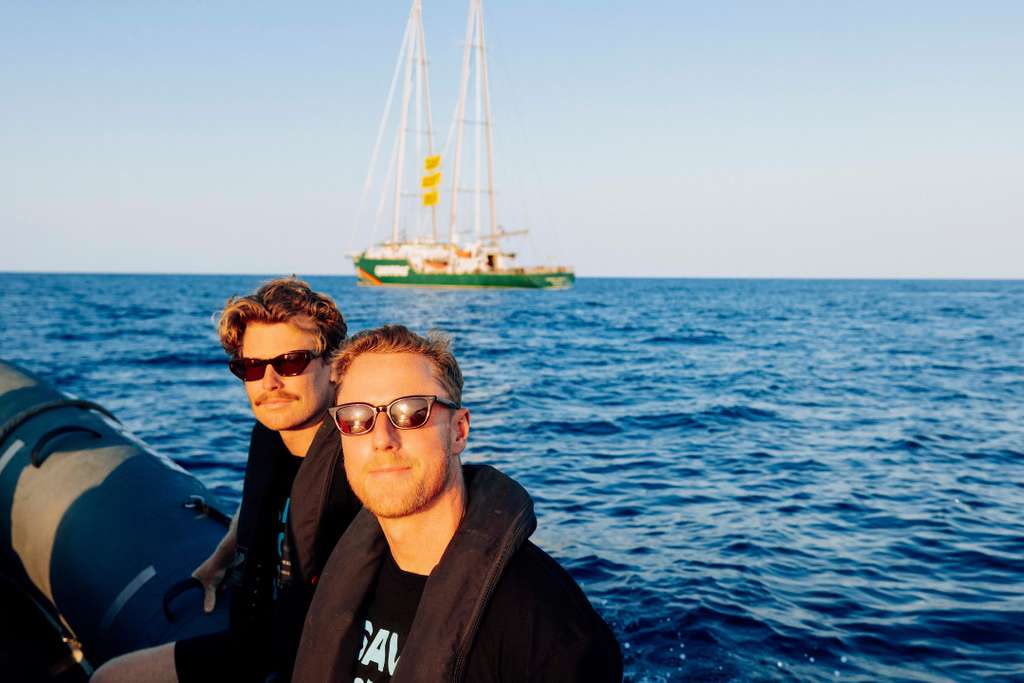
- Watch ‘Coastline’ shot at Scott Reef here and see visuals from the shoot at sea here
The new music video, in collaboration with Greenpeace Australia Pacific, captures a performance of Hollow Coves’ viral single ‘Coastline’, joining a nationwide push by Australian artists to protect heritage-nominated Scott Reef, located 270 kilometres off WA’s Kimberley coast. The video was shot on multiple cameras including a Bolex 16mm vintage movie camera, and boasts original underwater and aerial footage of Scott Reef.
Scott Reef is home to thousands of marine species, genetically unique green sea turtles and endangered pygmy blue whales but is threatened by oil and gas drilling proposed by multinational corporation Woodside, the Browse project.
Matt Carins, Hollow Coves musician, said: “It would be such a tragedy if gas drilling happened at Scott Reef. It’s such an incredible part of the world and is something that we want to pass on to future generations. Being a father myself, I want to share these places with my kids.
“There’s still hope in saving Scott Reef. I think it’s our time now to spread the word of how beautiful this place is. It may not have the same fame as other reef systems, but it’s just as amazing and just as important.”
Ryan Henderson, Hollow Coves musician, said: “Scott Reef is incredible. We were greeted by a pod of dolphins the first day we arrived. The whole place is brimming with wildlife.
“It would be such a shame to allow gas drilling to go ahead at Scott Reef. We wouldn’t allow drilling at the Great Barrier Reef so why should we allow it at Scott Reef which is also so beautiful and so precious. We want to preserve these places.
“There’s still hope. The Australian Government has an opportunity now to save Scott Reef and be on the right side of history.”
Hannah Schuch, Senior Campaigner at Greenpeace Australia Pacific, said: “It was a privilege to witness Hollow Coves playing their iconic single ‘Coastline’ live from Scott Reef, surrounded by wildlife and tranquil blue water.
“The ecological significance of Scott Reef to thousands of species, many of which are threatened, cannot be understated, but its surreal beauty is something that is so easy to capture and makes a perfect setting for a song like Coastline.
“Hollow Coves’ work is a perfect example of the symbiosis between Australian music and nature, and we are so excited to present this musical and cinematic ode to Scott Reef in collaboration with them.
“Drilling at Scott Reef is an unacceptable proposal, and Environment Minister Murray Watt has a generational opportunity to write a legacy of nature protection by putting a stop to Woodside’s plans and saving Scott Reef.”
Minister Watt is expected to decide if Woodside will be allowed to drill at Scott Reef for the Browse gas project in the coming months.
-ENDS-
Media contact
Emma Sangalli on 0431 513 465 or emma.sangalli@greenpeace.org
High res images and footage of Scott Reef can be found here
The COP31 climate talks in Antalya, Turkey, have failed to reach agreement on a “pact” that lacked clear references to curbing fossil fuels or scaling up climate finance.
The “Antalya pact”, proposed by the joint Turkish-Australian presidency, was rejected in the final hours by the EU, the UK and several climate-vulnerable nations.
Meanwhile, many developing countries criticised the lack of progress on climate finance and indecision on a proposed $120bn target for funding climate adaptation.
With stark divisions preventing agreement on the presidency-led pact, UNFCCC chief Simon Stiell expressed “deep disappointment”, speaking of “scope to improve, modernise and reform” the UN climate process.
Despite a chaotic endgame that saw the overrunning COP become the longest in history, it did not end in complete failure, with many items adopted in the closing plenary.
These included fairly limited or procedural outcomes on a new “mechanism” for global “just transitions”, plus support for countries struck by climate disasters.
There was some progress beyond the negotiations, though, with growing coalitions of nations championing “roadmaps” for “transitioning away” from fossil fuels.
With the presidency promoting “electrification” as a key theme, around 80 nations also signed up to a global target of securing 35% of final energy consumption from electricity by 2035.
Here, Carbon Brief provides in-depth analysis of all the key outcomes from Antalya, both inside and outside the COP31 negotiations.
(See Carbon Brief’s coverage of COP30, COP29, COP28, COP27, COP26, COP25, COP24, COP23, COP22, COP21 and COP20.)
- Formal negotiations
- Turkish and Australian leadership
- Cover decision
- COP reform
- Adaptation
- Finance
- Just transition work programme
- Loss and damage
- Gender
- Article 6
- Agriculture and food security
- Mitigation work programme
- Response measures
- Action for climate empowerment
- Trade
- Second global stocktake
- Long-term goal review
- Guidance on NDCs
- Rio synergies
- Around the COP
- Road to COP32 and beyond
Formal negotiations
Turkish and Australian leadership
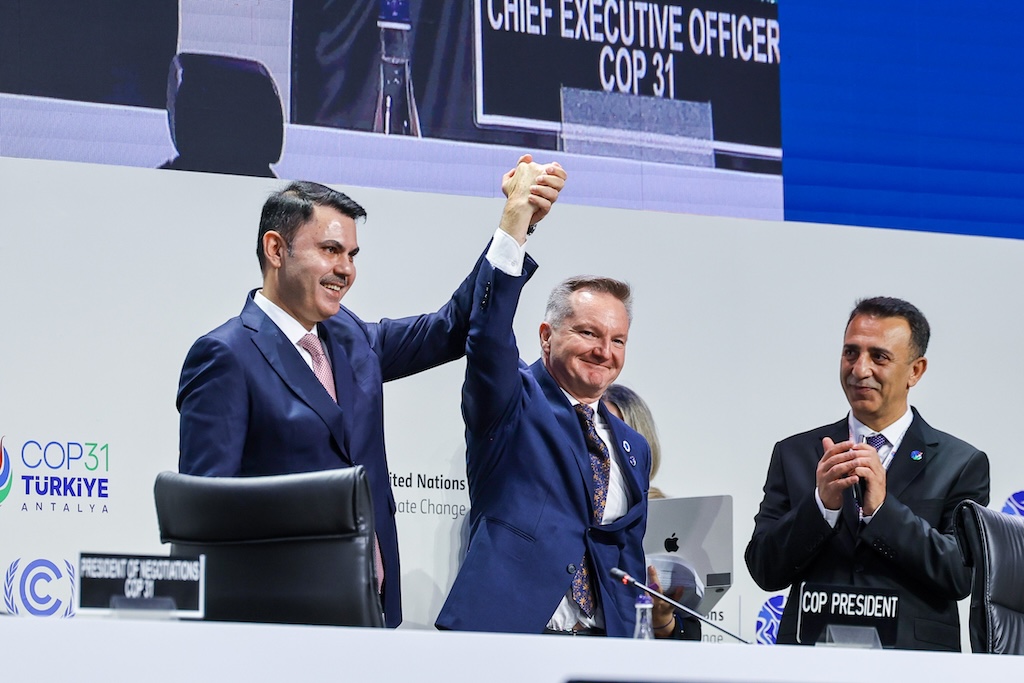
Turkey and Australia presided over the longest COP in history – and failed to find consensus on their proposed “cover decision”, exposing deep fractures between countries on key issues such as fossil fuels and the need for developed nations to meet climate-finance pledges.
Experts told Carbon Brief that, strictly, the talks did not “collapse” as several negotiated items were still adopted.
Rather, the rejection of the cover decision represented, for the first time, “those who want a higher level of ambition actively reject[ing] the lowest common denominator on offer”, said one veteran observer.
Dispute over who would host COP31 – representing the “western Europe and other states” region – had gone on for three years.
In the end, the two main rivals, Turkey and Australia, agreed to a deal last year at COP30 that the summit would take place in Antalya, Turkey, with Australia acting as “president of negotiations”.
Critics