

NADI, FIJI Sunday 4 October 2026 — As leaders and delegates gather for the Pacific Pre-COP in Fiji and Tuvalu, Greenpeace Australia Pacific is calling on the Australian government to uphold Pacific priorities on fossil fuels and climate finance, and respond to the urgency of the climate and energy crisis by accelerating the just transition away from fossil fuels.
The Pre-COP meeting in Fiji and atoll nation Tuvalu is an important milestone on the road to the COP31 climate summit in Türkiye, where Climate and Energy Minister Chris Bowen will take the reins as President of Negotiations. But another coal mine approval in the days before the Pre-COP has left Pacific leaders and civil society exasperated at Australia’s perceived ‘double talk’ and overshadowed the start of talks.
Speaking from Nadi, Shiva Gounden, Head of Pacific at Greenpeace Australia Pacific, said:
“This week we must focus on why the Pre-COP is so important. We must listen to Pacific leaders and communities who are sick of Australia’s double talk on climate, and want to see the actions of the most polluting nations respond to the urgency and scale of the crisis we face.
“Every cyclone, every storm blows with the deadly force of accumulated emissions and gives a warning of what is to come. The Pacific must not become a sacrifice zone for major polluters and fossil fuel corporations.
“1.5°C remains the scientific, moral and legal temperature limit. The landmark Pacific-led ICJAO ruling is clear — continuing down the fossil fuel path, and failing to align efforts with limiting warming to 1.5°C, is a breach of our international legal obligations. Our communities, our cultures and our very existence are under threat.
“As Australia prepares to chair the upcoming COP31 talks in partnership with the Pacific, it must do much more to turn empty rhetoric into real action to end the fossil fuel chokehold.”
Also in Nadi, Dr Simon Bradshaw, COP31 Lead and climate expert at Greenpeace Australia Pacific, said: “The Pacific Pre-COP is a critical milestone on the road to COP31. The Australian government must rise to the moment with concrete plans to accelerate the global transition away from fossil fuels, and respond to communities across the region facing soaring cost of living and the escalating impacts of the climate crisis.
“This week, the Australian government must deliver more than empty rhetoric. The Prime Minister’s recent keynote address at New York Climate Week acknowledged the urgency of the climate crisis, but failed to mention its cause, fossil fuels. Just last week we saw another new coal mine approval in Australia. This is on top of the 37 fossil fuel approvals by the Albanese Government since elected, despite recognising through the Belém Declaration that returning to 1.5°C is incompatible with new coal, oil and gas.
“At the Pre-COP, words must be matched with real action to phase out fossil fuels. We can not help decarbonise the world without action at home to halt fossil fuel approvals and phase out coal and gas exports. Don’t waste this important moment to back Pacific leadership and turn commitments into real action, including an immediate end to new fossil fuel approvals, and following other nations in developing a national roadmap away from fossil fuels.”
ENDS
Media contact: Kate O’Callaghan in Nadi on +61 406 231 892 (Whatsapp/Signal)

Following the close of COP31 in Antalya, Turkey, Carbon Brief’s journalists answered a range of questions in a CB Live panel discussion.
COP31 came to a dramatic conclusion nearly 50 hours after its scheduled close – making it the longest COP in history.
Less than 24 hours later, Carbon Brief published its 21,000-word summary, capturing everything that happened in the negotiations, the cover decision and more.
This includes the “Antalya pact”, proposed by the joint Turkish-Australian presidency, being rejected in the final hours of the summit by the EU, the UK and several climate-vulnerable nations.
There was some progress at COP31, including an agreement on the adaptation fund, as well as a raft of announcements within the “action agenda”.
Carbon Brief journalists – who followed every detail of the summit on the ground in Antalya and remotely answered a range of questions, including those sent ahead of time by CB+ members on CB Connect.
These covered climate finance, China, the “just transition mechanism”, the potential for COP reform and much more.
The discussion was moderated by Carbon Brief’s senior policy editor Dr Simon Evans and featured the following journalists:
- Daisy Dunne, associate editor
- Josh Gabbatiss, associate editor
- Aruna Chandrasekhar, policy journalist
- Molly Lempriere, policy section editor
- Anika Patel, China section editor
- Dr Giuliana Viglione, associate editor
A recording of the CB Live (below) is now available to watch on YouTube.
The post CB Live: Carbon Brief journalists discuss key COP31 outcomes appeared first on Carbon Brief.
CB Live: Carbon Brief journalists discuss key COP31 outcomes
Climate Change
COP31: Key outcomes for food, forests, oceans and nature at the UN climate talks in Antalya
The COP31 climate talks in Antalya, Turkey, failed to agree on a “pact” that – despite making no clear reference to fossil fuels or adaptation finance – had contained strong signals for oceans.
The “Antalya pact” took up much of the two weeks of negotiating time in Turkey, only to be rejected during the closing plenary by the EU, the UK and several climate-vulnerable countries.
Several countries expressed their regret during the plenary that significant work on advancing ocean-climate action would be lost.
The COP ran nearly 50 hours over time, but did not end with substantive outcomes on several key topics.
For the second year in a row, negotiations on agriculture and food security broke down and will now have to resume next year.
Food-systems advocates were, however, heartened by the explicit inclusion of “agroecology” in a decision within the “just transition work programme”.
Ocean-conservation groups noted an increased focus on ocean-climate links at this year’s COP, but said COP31 did not live up to its promise of being a “blue COP”.
There was also scant new funding for food systems and nature, with just a handful of small pledges to ocean initiatives and two newly announced contributions to the Tropical Forest Forever Facility.
Here, Carbon Brief analyses all of the key outcomes for food, forests, oceans and nature at COP31 – both inside and out of the negotiating rooms.
(See Carbon Brief’s coverage of food, forests, oceans and nature at COP30, COP29, COP28, COP27 and COP26.)
Formal negotiations
Cover decision
The final draft of a COP31 “cover decision” was rejected by at least 32 countries during a chaotic – and, at times, acrimonious – closing plenary in Antalya.
Other recent COPs have issued cover decisions, setting a firm precedent.
However, many parties remained unhappy about the existence of the cover decision, the process by which it was put together and the impact it had on time for other negotiations.
Ultimately, parties did not find consensus on the text, particularly around the removal of any reference to fossil fuels and the lack of concrete climate-finance targets.
The cover text was one of the places in the negotiations where ocean advocates were hoping to see ocean-climate linkages highlighted.
Marine Lecerf, head of international policy at Ocean & Climate Platform, told a press huddle:
“What we’re really asking for right now is to make sure we can recognise ocean-based interlinkages…We’re not asking for a new mandate. We are asking for acceleration of the work that is already undertaken.”
The first draft of the cover decision, published on 16 November, was a compilation of all the issues that parties had put forward for inclusion. It was accompanied by a short “presidency note” explaining that all elements were still in play, including whether or not they should appear in a final text.
This lengthy first draft had 21 references to the ocean, including recognising the impacts of climate change, support for ocean-observing systems, encouraging parties to strengthen ocean-climate action and a multi-year plan for the “ocean and climate change dialogue”, which occurs annually at the Bonn intersessional meetings in June.
Regarding that draft, Steven Guilbeault, former environment minister of Canada, told Carbon Brief:
“I don’t see why the elements that are in the cover decision right now on oceans should be controversial or problematic to any nations. If you’re serious about fighting climate change, there’s nothing in this text regarding oceans that should be problematic for you.”
(Earth Negotiations Bulletin reported that Russia opposed mentions of the ocean in the cover text during the ocean ministerial consultation.)
The next iteration of the text, on 19 November, retained many of the ocean elements, albeit with less detail than the first draft. The second text also removed references to post-2028 ocean work and a proposed high-level ministerial ocean dialogue.
In the end, oceans had 19 mentions in the rejected Antalya pact.
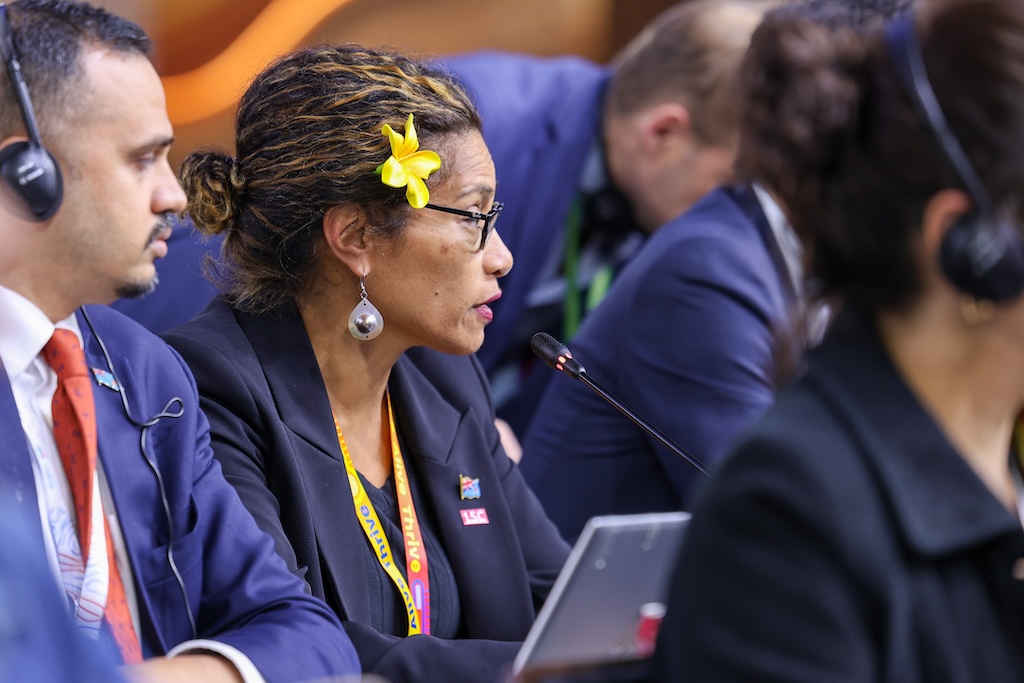
During the final plenary, Fiji’s Dr Sivendra Michael – co-chair of the ocean and climate change dialogue – appealed to the COP31 president to “humbly consolidate” the consensus on ocean as a “standalone ocean decision” and “directly submit” ten paragraphs with no objections in text as a “way to preserve” work done.
Lynda Tabuya, Fiji’s environment and climate change minister, said:
“The ocean-climate nexus is undeniable. We, the people of the Pacific, are deeply indebted, as the ocean is our home, our identity and it is what connects us. There is no climate action without ocean action. We hope this is not lost today and that parties will please consider keeping the ocean text alive.”
Other aspects of the natural world garnered significantly less attention in the cover text.
The final decision failed to mention the Brazil-led roadmap on deforestation, although it was “welcome[d]” in the initial draft. (See: Deforestation.)
Mentions of the “critical role” of forests in carbon storage, food security, biodiversity and community adaptation were also stripped from the text between the first and second iterations.
The final Antalya pact – that was rejected – did, however, retain wording on deforestation agreed by countries in the global stocktake at COP28 in Dubai.

The same draft also “recognises” the role of nature-based solutions and ecosystem-based approaches as “essential climate solutions” – although many experts reject the former term and warn that its vagueness leaves it open to deliberate misuse.
The final draft cover decision “emphasised the importance” of nature, forests, the ocean and other ecosystems as “natural infrastructure for resilience”, while “recogni[sing] that they play a critical role as sinks and reservoirs of greenhouse gases”.
Experts, however, were concerned that this language preceded a paragraph “welcoming” carbon dioxide removal, even if it “stressed” that these methods – that include tree planting – “should ensure environmental safeguards and respect the rights of Indigenous peoples”.