

Welcome to Carbon Brief’s DeBriefed.
An essential guide to the week’s key developments relating to climate change.
This week
Global heatwave
SOUTH ASIA: Extended and severe heatwaves that continue to grip 50% of northwest India have claimed at least 110 lives and caused 40,000 to suffer from suspected heatstroke, the Hindustan Times reported. Delhi recorded its highest ever minimum temperature in a 55- year record this week, when night-time temperatures did not drop below 35.2C, the Hindu reported. Reuters reported that a senior government official said “Indian cities have become heat traps” due to unbalanced urban growth reducing water availability.
EAST ASIA: Meanwhile, state-run newspaper China Daily reported that the nation is “experiencing more frequent and intense heatwaves due to global warming”, according to China’s National Climate Centre. It added that the average heatwave starting date has advanced by 2.5 days per decade. The Hong Kong-based South China Morning Post reported that extreme weather has continued in China this week, including deadly torrential rain and drought conditions.
DEADLY PILGRIMAGE: In the Middle East, more than 1,000 hajj pilgrims have reportedly died amid scorching heat in the holy city of Mecca in Saudi Arabia, Sky News reported. Agence France-Presse said that temperatures reached 51.8C in Mecca as around 1.8 million people took part in the “days-long, mostly outdoor” pilgrimage. It added that the death toll is expected to rise further as many continue to search for family members.
US FURNACE: Tens of millions of people in the US were under dangerous heat warnings this week as some cities faced record-breaking temperatures, the Associated Press reported. The Guardian reported that about 80% of the country’s population are experiencing “a kind of heatwave not seen in decades”, which brought prolonged periods of temperatures above 32.2C, “under a weather phenomenon known as a heat dome”.
‘BRUTAL’ EUROPE: After registering Europe’s highest recorded temperature of 48.8C in 2021, Sicily is again having to turn away tourists as “brutal heatwaves” have led to crops dying and farm animals facing slaughter, reported the Times. Elsewhere in Europe, a wildfire near Athens, Greece forced dozens to flee their homes, reported Reuters. Officials said the fire was the result of arson and spread quickly in hot, dry conditions, the newswire added.
Around the world
- G7 DROPPED: The G7 group of major economies has pledged to speed up their transition away from fossil fuels at a summit in Italy, Reuters reported. It added that activists were unhappy at the pace of progress.
- RECORD RENEWABLES: Wind and solar combined added more new energy to the global mix than any other source for the first time in history in 2023, according to Carbon Brief analysis of newly released data.
- PEAKING CHINA: China has reduced power from fossil fuels and boosted solar and hydro, “feeding hopes that the world’s biggest polluter may have peaked emissions years before its own deadline”, Bloomberg reported. Carbon Brief analysis in May found China may have peaked its emissions in 2023.
- CONFLICT DAMAGE: A UN report found that Israel’s assault on Gaza has caused environmental damage, “deeply harming people’s health, food security and Gaza’s resilience”, according to Reuters.
- NATURE WIN: After months of stagnation, the EU’s nature restoration law was voted through by ministers at the EU council, the Financial Times reported.
- STRANDED BY SLIDES: Al Jazeera reported that landslides triggered by heavy rain have left hundreds of thousands of people stranded and at least 15 dead in India and Bangladesh.
$1.1-1.3 trillion
The amount of climate finance developing countries at Bonn want developed countries to provide to them every year, according to Climate Home News.
Latest climate research
- New research in Environmental Research Letters suggested that the Arctic will be “ice-free” – that is, where sea ice extent drops below one million square kilometres – at the end of summer when global warming reaches between 1.5C and 2.2C above pre-industrial levels.
- Ocean-based carbon dioxide removal techniques such as ocean alkalinity enhancement have been “overlooked”, a research paper in Environmental Research Letters argued.
- The extreme heat that hit southwestern US, Mexico and Central America from May to June this year was 35 times more likely and 1.4C hotter due to climate change, new analysis by the World Weather Attribution network found.
(For more, see Carbon Brief’s in-depth daily summaries of the top climate news stories on Monday, Tuesday, Wednesday, Thursday and Friday.)
Captured

New Carbon Brief analysis by Dr Simon Evans revealed that the UK’s energy bills were £22bn higher over the past decade than they would have been if successive Conservative governments had not cut the “green crap” by rolling back climate policies for areas such as insulating homes, new home building standards and onshore wind and solar growth. The chart above shows how lack of progress on various climate measures has added to UK energy bills from 2015-2024. The cutting back on green measures has also raised net gas imports by a third, making the UK more reliant on gas imports and leaving customers more exposed to high gas prices, the analysis said. Carbon Brief is continuing to track where UK parties stand on climate change and energy ahead of the country’s general election.
Spotlight
Can beavers help the UK adapt to climate change?
This week, Carbon Brief looks at the evidence on the potential pros and pitfalls of reintroducing beavers to help deal with rising climate risks in the UK.
From Narnia to the Ice Age franchise, beavers have a spot as a charismatic, comical and – until recent years – somewhat mythical animal in British popular culture.
Beavers were hunted to extinction in Britain 400 years ago, and to near extinction in Europe. Memory of their presence in Britain survives in place names, such as Beverley Brook in London.
Given their reputation, it is perhaps surprising that they have also been called “climate heroes”, “ecosystem engineers” and, more recently, “heatwave heroes”.
Such labels come from beavers’ ability to alter the landscapes around them, offering benefits such as lowering flood risk or providing new habitats for biodiversity.
It is these benefits that have seen beavers reintroduced to some areas of England and Scotland.
Climate and biodiversity benefits
Beavers are a keystone species, which means they have an inordinately large impact on their natural environment, with the ability to define their ecosystem.
They use their huge front teeth to fell trees, building dams and lodges,which subsequently hold back huge volumes of water to create a wetland habitat.
The animals do this to create their ideal environment – one with deep water so they can hide from predators. However, they also inadvertently create an oasis for a variety of wildlife.

Earlier this week, the Guardian reported that, after living in the wild for 15 years in Scotland, beavers create the “perfect conditions” for endangered native water voles to flourish.
Prof Richard Brazier, director of the Centre for Resilience in Environment, Water and Waste at the University of Exeter, said the main climate benefits beavers can provide were enhancing water and carbon storage. He told Carbon Brief:
“Beaver ponds store a lot of carbon, nitrogen and phosphorus. Beavers coppice [chop down] species like willow. When they regrow, it enhances carbon storage in the landscape.”
Climate change is making many types of extreme weather events, including droughts, more likely and more intense.
Beaver wetlands are known to remain oases in otherwise cracked, dry land. The water stored in beaver ponds slowly seeps into the surrounding soil during dry periods, keeping the area green.
In the US, research found that wetland habitats created by beavers are resistant to wildfires because the area is simply too wet to burn.
Perhaps the most well-known link between beavers and climate adaptation is their alleviation of flood risks.
In March, the UK government’s Environment Agency reported that, after five years of beaver activity in an enclosed area, the impact of flooding was reduced in Spains Hall Estate, Essex.
In Devon, scientists last month concluded a 10-year study finding that beavers are “having a positive impact on flood and drought alleviation” by storing 24m litres of water and reducing storm flows by 30% during heavy rainfall, keeping downstream homes safer from floods.
Human-animal conflict
Other studies on beavers have warned that friction between the animals and adjacent landowners must be a central consideration for successful reintroduction.
Under certain circumstances, their natural engineering can interfere with human infrastructure and farming.
Some farmers are concerned that beaver activity causes flooding and damage to crops. Others worry that tree felling could cause damage to houses nearby.
Occasionally, beaver burrows can collapse, and damage property or machinery nearby.
Brazier told Carbon Brief that “tensions can arise” when humans “try to resist the natural instinct of the beaver to create deep water pools”. He added:
“If there are downsides, these relate to the ways in which, by building dams, beavers put water back on floodplains, when humans tend to want to remove this water, such as for agriculture. But these low-lying landscapes are floodplains, they are meant to be underwater periodically, and indeed, whether beavers are reintroduced or not, they will be more inundated by flooding in the future, under climate change scenarios.”
Beaver releases
Despite opposition from some groups, momentum has been gradually building for beavers’ return to the wild.
It is still illegal to reintroduce beavers in Britain without a licence.
In 2009, illegal releases were made in Tayside, Scotland and Devon, England. It is unknown where the beavers came from.
The first licence for beaver reintroduction was given for an enclosed area in Ham Fen in Kent in 2001.
In 2009, the first licensed reintroduction of beavers into the wild occurred in Knapdale, Scotland, with the animals shipped in from Norway.
In 2021, the government allowed the illegally released beavers in Devon to remain wild.
Beavers are also being reintroduced into cities. They were reintroduced in Enfield, north London in 2022 – and it was there that the first kit was born in London last summer.
Beavers were declared a native species in 2016 in Scotland and in 2022 in England.
However, the UK government is yet to introduce a national strategy for beaver reintroduction – “missing a huge opportunity to deliver profound benefits”, according to Brazier.
Watch, read, listen
MOVIE MAGIC: Showing in UK and Irish cinemas, Wilding tells the story of a couple who in 2001 handed over their 4,000-year-old estate and struggling farm to nature.
STORY TIME: With the help of woolly mammoths and dinosaurs, Christine Shearer and illustrator Kaz Clarke have published “The Everywhere Atom: A Journey Through The Carbon Cycle and Climate Change”, telling the story of the carbon cycle to children.
NATURE VOTE: With the UK general election two weeks away, Carbon Brief’s Dr Simon Evans spoke to Radio 4’s Rare Earth about how climate and the environment feature in the main political parties’ manifestos.
Coming up
- 22-30 June: London Climate Action Week
- 28 June: Iran presidential election
- 28 June: Mongolia parliamentary election
Pick of the jobs
- UN Environment Programme, project coordinator | Salary: Unknown. Location: Dominica
- West of England Combined Authority, south west net-zero hub programme manager | Salary: £60,204-£65,858. Location: Bristol, UK
- HM Treasury, policy adviser, green finance | Salary: £39,500-£48,720. Location: UK
- University of Cambridge, Climate Governance Initiative programme director. Salary: £61,823-£63,029. Location: Cambridge, UK
DeBriefed is edited by Daisy Dunne. Please send any tips or feedback to debriefed@carbonbrief.org.
This is an online version of Carbon Brief’s weekly DeBriefed email newsletter. Subscribe for free here.


The post DeBriefed: Deadly heat grips globe; Cost of cutting ‘green crap’ in UK; Rewilding with beavers appeared first on Carbon Brief.
DeBriefed: Deadly heat grips globe; Cost of cutting ‘green crap’ in UK; Rewilding with beavers

Drought and heatwaves occurring together – known as “compound” events – have “surged” across the world since the early 2000s, a new study shows.
Compound drought and heat events (CDHEs) can have devastating effects, creating the ideal conditions for intense wildfires, such as Australia’s “Black Summer” of 2019-20 where bushfires burned 24m hectares and killed 33 people.
The research, published in Science Advances, finds that the increase in CDHEs is predominantly being driven by events that start with a heatwave.
The global area affected by such “heatwave-led” compound events has more than doubled between 1980-2001 and 2002-23, the study says.
The rapid increase in these events over the last 23 years cannot be explained solely by global warming, the authors note.
Since the late 1990s, feedbacks between the land and the atmosphere have become stronger, making heatwaves more likely to trigger drought conditions, they explain.
One of the study authors tells Carbon Brief that societies must pay greater attention to compound events, which can “cause severe impacts on ecosystems, agriculture and society”.
Compound events
CDHEs are extreme weather events where drought and heatwave conditions occur simultaneously – or shortly after each other – in the same region.
These events are often triggered by large-scale weather patterns, such as “blocking” highs, which can produce “prolonged” hot and dry conditions, according to the study.
Prof Sang-Wook Yeh is one of the study authors and a professor at the Ewha Womans University in South Korea. He tells Carbon Brief:
“When heatwaves and droughts occur together, the two hazards reinforce each other through land-atmosphere interactions. This amplifies surface heating and soil moisture deficits, making compound events more intense and damaging than single hazards.”
CDHEs can begin with either a heatwave or a drought.
The sequence of these extremes is important, the study says, as they have different drivers and impacts.
For example, in a CDHE where the heatwave was the precursor, increased direct sunshine causes more moisture loss from soils and plants, leading to a drought.
Conversely, in an event where the drought was the precursor, the lack of soil moisture means that less of the sun’s energy goes into evaporation and more goes into warming the Earth’s surface. This produces favourable conditions for heatwaves.
The study shows that the majority of CDHEs globally start out as a drought.
In recent years, there has been increasing focus on these events due to the devastating impact they have on agriculture, ecosystems and public health.
In Russia in the summer of 2010, a compound drought-heatwave event – and the associated wildfires – caused the death of nearly 55,000 people, the study notes.

The record-breaking Pacific north-west “heat dome” in 2021 triggered extreme drought conditions that caused “significant declines” in wheat yields, as well as in barley, canola and fruit production in British Columbia and Alberta, Canada, says the study.
Increasing events
To assess how CDHEs are changing, the researchers use daily reanalysis data to identify droughts and heatwaves events. (Reanalysis data combines past observations with climate models to create a historical climate record.) Then, using an algorithm, they analyse how these events overlap in both time and space.
The study covers the period from 1980 to 2023 and the world’s land surface, excluding polar regions where CDHEs are rare.
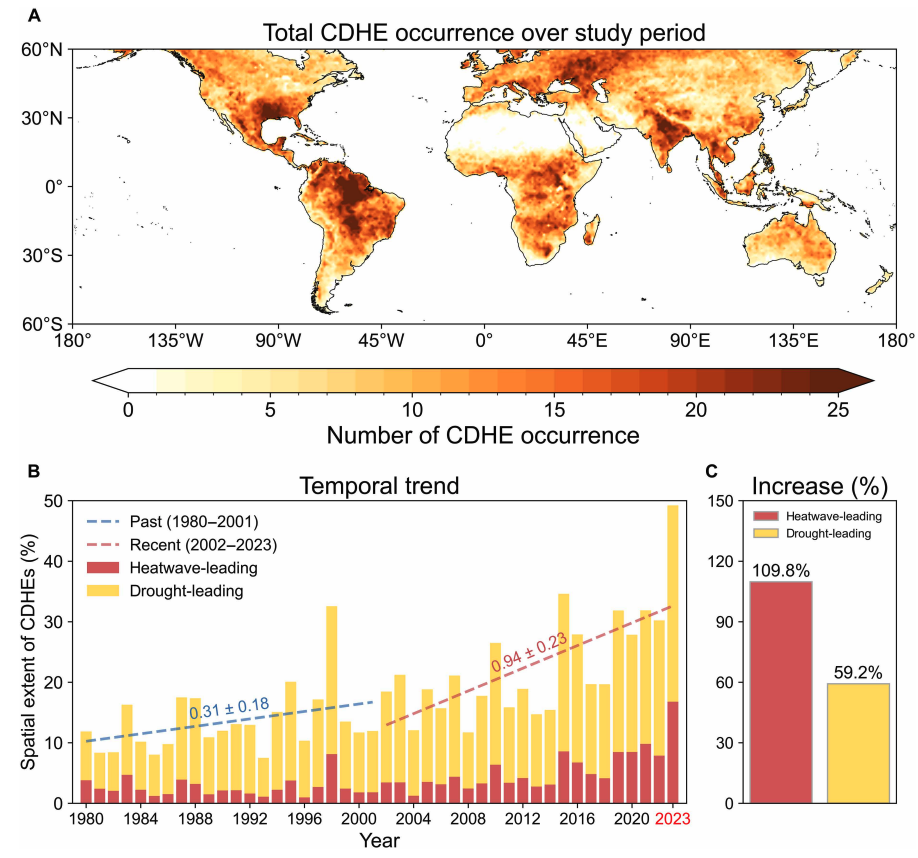
The research finds that the area of land affected by CDHEs has “increased substantially” since the early 2000s.
Heatwave-led events have been the main contributor to this increase, the study says, with their spatial extent rising 110% between 1980-2001 and 2002-23, compared to a 59% increase for drought-led events.
The map below shows the global distribution of CDHEs over 1980-2023. The charts show the percentage of the land surface affected by a heatwave-led CDHE (red) or a drought-led CDHE (yellow) in a given year (left) and relative increase in each CDHE type (right).
The study finds that CDHEs have occurred most frequently in northern South America, the southern US, eastern Europe, central Africa and south Asia.
Threshold passed
The authors explain that the increase in heatwave-led CDHEs is related to rising global temperatures, but that this does not tell the whole story.
In the earlier 22-year period of 1980-2001, the study finds that the spatial extent of heatwave-led CDHEs rises by 1.6% per 1C of global temperature rise. For the more-recent period of 2022-23, this increases “nearly eightfold” to 13.1%.
The change suggests that the rapid increase in the heatwave-led CDHEs occurred after the global average temperature “surpasse[d] a certain temperature threshold”, the paper says.
This threshold is an absolute global average temperature of 14.3C, the authors estimate (based on an 11-year average), which the world passed around the year 2000.
Investigating the recent surge in heatwave-leading CDHEs further, the researchers find a “regime shift” in land-atmosphere dynamics “toward a persistently intensified state after the late 1990s”.
In other words, the way that drier soils drive higher surface temperatures, and vice versa, is becoming stronger, resulting in more heatwave-led compound events.
Daily data
The research has some advantages over other previous studies, Yeh says. For instance, the new work uses daily estimations of CDHEs, compared to monthly data used in past research. This is “important for capturing the detailed occurrence” of these events, says Yeh.
He adds that another advantage of their study is that it distinguishes the sequence of droughts and heatwaves, which allows them to “better understand the differences” in the characteristics of CDHEs.
Dr Meryem Tanarhte is a climate scientist at the University Hassan II in Morocco, and Dr Ruth Cerezo Mota is a climatologist and a researcher at the National Autonomous University of Mexico. Both scientists, who were not involved in the study, agree that the daily estimations give a clearer picture of how CDHEs are changing.
Cerezo-Mota adds that another major contribution of the study is its global focus. She tells Carbon Brief that in some regions, such as Mexico and Africa, there is a lack of studies on CDHEs:
“Not because the events do not occur, but perhaps because [these regions] do not have all the data or the expertise to do so.”
However, she notes that the reanalysis data used by the study does have limitations with how it represents rainfall in some parts of the world.
Compound impacts
The study notes that if CDHEs continue to intensify – particularly events where heatwaves are the precursors – they could drive declining crop productivity, increased wildfire frequency and severe public health crises.
These impacts could be “much more rapid and severe as global warming continues”, Yeh tells Carbon Brief.
Tanarhte notes that these events can be forecasted up to 10 days ahead in many regions. Furthermore, she says, the strongest impacts can be prevented “through preparedness and adaptation”, including through “water management for agriculture, heatwave mitigation measures and wildfire mitigation”.
The study recommends reassessing current risk management strategies for these compound events. It also suggests incorporating the sequences of drought and heatwaves into compound event analysis frameworks “to enhance climate risk management”.
Cerezo-Mota says that it is clear that the world needs to be prepared for the increased occurrence of these events. She tells Carbon Brief:
“These [risk assessments and strategies] need to be carried out at the local level to understand the complexities of each region.”




The post Heatwaves driving recent ‘surge’ in compound drought and heat extremes appeared first on Carbon Brief.
Heatwaves driving recent ‘surge’ in compound drought and heat extremes