

Welcome to Carbon Brief’s DeBriefed.
An essential guide to the week’s key developments relating to climate change.
This week
EU leaders agreed climate goal ‘truce’
‘BREAKTHROUGH’: EU leaders have reached a “breakthrough” on climate issues that “increases the likelihood” that the bloc will be able to sign off on its 2040 climate goal before COP30 in November, reported Bloomberg. Leaders reached a “truce” after agreeing to a raft of “enabling conditions”, designed to support carmakers and other energy-intensive industries through a “green transition”, it added.
‘COMPETING GOALS’: Reuters reported that leaders agreed “to proceed with the 2040 target, but [to] leave details for ministers to approve at a 4 November meeting”. It added that the European Commission had “promised to amend some climate measures” to win support from member states, including “controlling” carbon prices in the upcoming market for heat and transport fuels. France24 noted that leaders discussed how to manage the bloc’s “competing goals” of supporting business while playing a “lead role in the climate fight”.
Shipping industry delayed carbon price
NEGOTIATIONS COLLAPSE: Just hours after the previous issue of DeBriefed was published, member states of the UN’s International Maritime Organization agreed to delay a vote on whether to formally adopt a global carbon price for shipping by a year, reported the National. It said the negotiations “collapsed under US pressure”, meaning they were unable to finalise a deal agreed in April that would have “made shipping the first global industry subject to a carbon pricing system”. [Carbon Brief covered the deal and what it would have meant for shipping emissions at the time.]
‘MAJOR VICTORY’: The Financial Times described the delay as a “major victory” for US president Donald Trump’s “campaign to block a climate agreement for the global shipping industry” and “part of the wider Trump administration drive to sell more of its oil, coal and gas”. According to Agence France-Presse, the UN called the delay a “missed opportunity” and the European Commission said it was “regrettable”
‘REGRETABLE DERAILMENT’: A Financial Times editorial said the outcome was a “regrettable derailment” and “one of Trump’s most successful attempts yet to force all countries, rich and poor, to back his push to prolong the era of fossil fuels”. Elsewhere, US secretary of state Marco Rubio wrote a letter to the Wall Street Journal, outlining how the administration had “thwarted the UN’s tax”, dubbing the delay a “diplomatic victory” for the US.
Around the world
- DISASTER ALERTS: A new report from the UN’s World Meteorological Organization has called for a worldwide disaster alerts system as extreme weather events are leaving millions of people vulnerable, reported Al Jazeera.
- FOREST FUND: The World Bank has agreed to host the Tropical Forest Forever Fund (TFFF), being pushed by the Brazilian COP30 presidency Brazil, according to Folha de São Paulo. Separately, the country’s state-owned oil company Petrobras has been granted permission to drill for oil near the mouth of the Amazon, reported the Guardian.
- ‘GREEN JOBS’: The UK government announced a national clean-energy jobs plan, designed to “create…an extra 400,000 green jobs” in the next five years, the Guardian said. Meanwhile, UK prime minister Keir Starmer made a “last-minute decision” to attend COP30 in Brazil in November, the Financial Times reported.
- ‘BEAUTIFUL CHINA’: After a meeting in Beijing, top Chinese policymakers have listed “building a Beautiful China” as a “primary objective” for the 15th five-year plan covering 2026-2030, said International Energy Net. The concept, described in Carbon Brief’s glossary, covers tackling pollution and meeting China’s carbon neutrality targets..
$101bn
The record-high cost of “climate disasters” in the US in the first half of 2025, according to new research from the Climate Central group reported by the Guardian.
Latest climate research
- Between 1997 and 2021, Antarctic ice shelves saw a decrease in “damaged area” | Nature Climate Change
- Reducing food waste and dietary shifts could help halve emissions related to meat consumption in US cities | Nature Climate Change
- In an “overshoot” scenario, where the world temporarily passes 1.5C of warming, permafrost area may “effectively recover” once temperatures fall, but carbon losses will be “largely irreversible” | Earth System Dynamics
(For more, see Carbon Brief’s in-depth daily summaries of the top climate news stories on Monday, Tuesday, Wednesday, Thursday and Friday.)
Captured
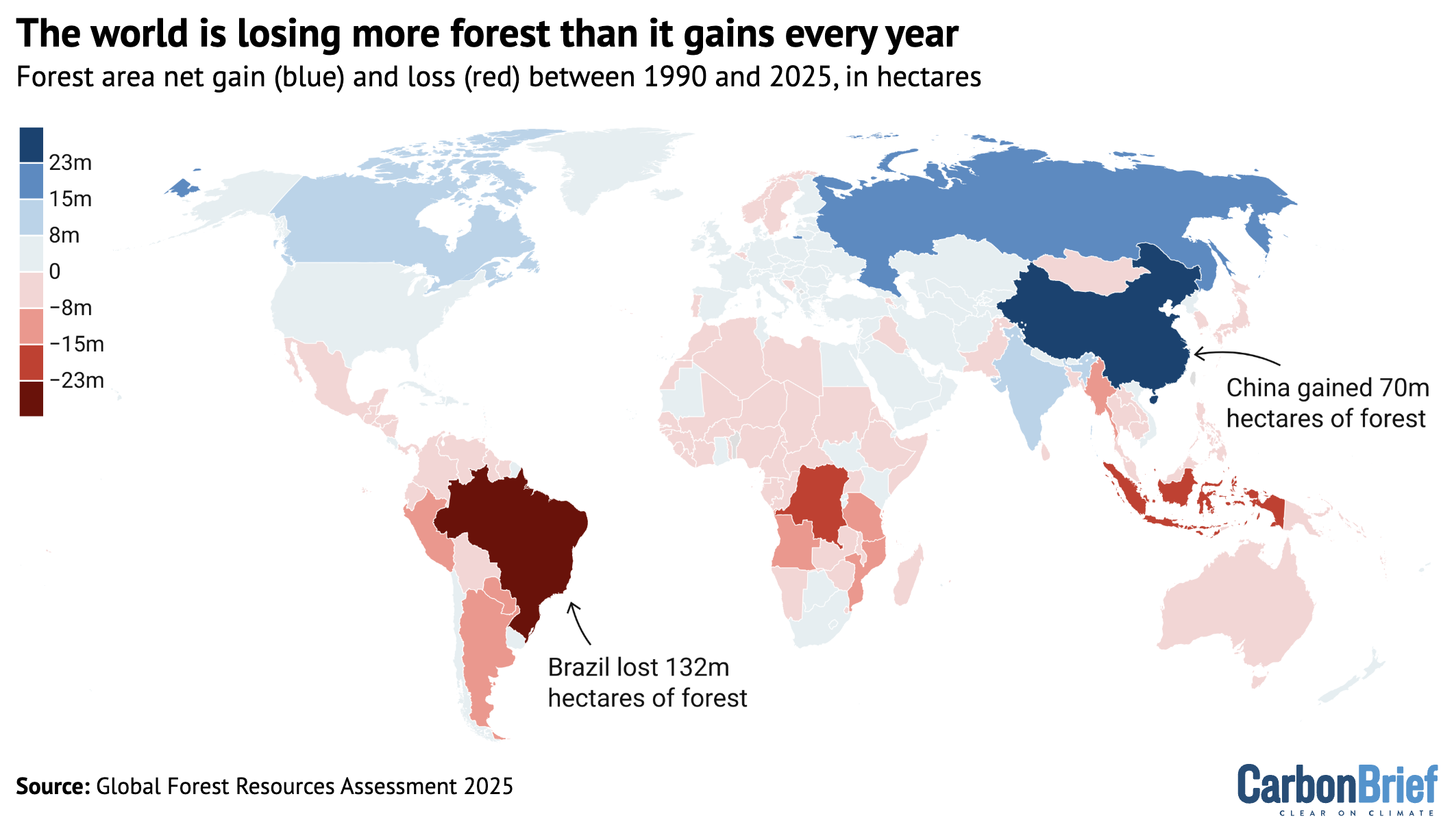
The amount of forest being lost around the world has reduced by millions of hectares each year in recent decades, Carbon Brief reported, based on the Global Forest Resources Assessment from the UN’s Food and Agriculture Organization. The report found that an estimated 10.9m hectares (Mha) of land was deforested each year between 2015 and 2025, nearly 7Mha less than the annual loss over 1990-2000. However, as the map above shows, more forest is still lost than gained each year. Between 2015 and 2025, there was an average 6.8Mha of forest growth each year, but 10.9Mha of loss.
Spotlight
The Sámi people take Finland to court
This week, Carbon Brief reports on the launch of a “landmark” legal claim by the Indigenous Sámi people against the government of Finland, focused on the interplay between climate change and cultural traditions.
In June, 33 members of the Muddusjärvi Reindeer Herders’ Cooperative (MPLK), a Sámi community in northern Finland, brought a legal complaint to the UN human rights committee in Geneva.
It alleged that the Finnish government had allowed multiple breaches of the International Covenant on Civil and Political Rights (ICCPR), which sets out the right to enjoy one’s culture, family life, non-discrimination and self-determination.
The MPLK has practised “nature-based Sámi reindeer herding” for centuries in Finland, as part of one of three remaining herding communities that use the endangered Inari Sámi language. The Sámi are the only Indigenous people recognised in Europe.

Changing conditions
Within its complaint, the MPLK said it is being dispossessed from land traditionally used for reindeer herding, as a result of climate change and decades of intensive logging by the Finnish state-owned forestry agency Metsähallitus. These have “severely damaged” the land they depend on, the group’s lawyers Hogan Lovells said.
In particular, the loss of lichen-rich, old-growth forests and changes to snow conditions have made it harder for reindeer to access natural food sources, creating an “existential threat” that “places in jeopardy the viability of the MPLK community’s way of life”, according to the complaint.
While there are additional funds provided by the Finnish government to compensate reindeer herders during harsh winters, this does not go far enough, the MPLK argued. For example, herders lost €32m between 2019 and 2020, but the MPLK only received €6m in compensation.
There have already been a number of lawsuits brought by the Sámi people across the Nordic countries, in an effort to protect their lands and traditions.
This includes the Norwegian government having to pay out millions to Sámi reindeer herders, an ongoing case in Sweden and two UN committees finding that Finland had violated Sámi rights to culture and land through mineral exploration permits on their territory.
A new precedent
For the MPLK case, Hogan Lovells are relying on a precedent set at the committee in 2022 in a case brought by an indigenous group in Australia, whereby the government was ordered to compensate Torres Straits islanders who argued that climate change had a direct harmful consequence on their livelihood, culture and traditional ways of life.
Finnish human rights law professor and human rights practitioner Martin Scheinin was involved in that case and is now co-counsel for the MPLK complaint. He told Carbon Brief that he had been “thrilled” by the 2022 outcome:
“The [UN committee] broke [a] new path by focusing on Australia’s adaptation obligations as positive human rights obligations. As the committee also established that the right of minorities and Indigenous peoples to enjoy their own culture includes the right to transmit a distinctive way of life to new and even future generations, it was natural that the Indigenous Sámi people in Finland…want to build upon all these elements in their own case before the same committee.”
A formal response from the Finnish government to the complaint is expected this month.
Watch, read, listen
INDONESIA’S ‘ENERGY PARADOX’: A new episode of the China-Global South Podcast discussed how China sits at the heart of Indonesia’s “energy paradox”.
‘RARE-EARTHS TRAP’: Simon Nixon, former chief leader writer for the Times, wrote on his Substack about how the “west lost” to China, after the country “spent decades laying its rare-earths trap”.
ANIMAL OBSTRUCTION: The latest episode of the Drilled podcast discussed how the animal agriculture industry has – and still does – “obstruct…climate policy”.
Coming up
- 28 October: NDC 3.0 synthesis report
- 28 October: Tanzania, presidential and parliament elections
- 29 October: UNEP Adaptation Gap Report 2025
- 29 October: Netherlands, parliamentary elections
- 29 October: UK’s “carbon budget delivery plan”
Pick of the jobs
- Imperial College London, project manager | Salary: £41,005-£45,616pa. Location: London, England.
- UN Food and Agriculture Organization, policy officer (environment and climate change) | Salary: Unknown. Location: Santiago, Chile
- Nature Energy, associate or senior editor | Salary: $80,000-$95,000. Location: New York, US.
- EBRD, analyst, climate risk | Salary: Unknown. Location: London, England.
- Local Storytelling Exchange, freelance associate storytellers | Salary: £12,000 for 60 days. Location: Wales.
DeBriefed is edited by Daisy Dunne. Please send any tips or feedback to debriefed@carbonbrief.org.
This is an online version of Carbon Brief’s weekly DeBriefed email newsletter. Subscribe for free here.


The post DeBriefed 24 October 2025: EU 2040 climate goal progress; Shipping industry carbon price delayed; Europe’s indigenous people take Finland to court appeared first on Carbon Brief.

Three countries have been named by the Paris Agreement’s compliance committee for failing to submit a nationally determined contribution (NDC) and repeatedly snubbing offers of help with their climate plans.
After months of internal debate over whether to identify serial non-responders, the Paris Agreement’s Implementation and Compliance Committee (PAICC) named the three countries which have failed to engage with it over their NDCs on Friday.
It named Democratic Republic of Congo, Senegal and North Korea in a footnote of its annual report, adding that it decided to name them “with a view to facilitating engagement”, adding that representatives of the three nations had been invited to its meeting in early 2027 “with the purpose of identifying any challenges and constraints”.
“The Committee noted the importance of Parties engaging with the Committee in a timely manner, while noting that some delays may be due to the national capabilities and circumstances of the Parties”, the report said.
-
Under US pressure, World Bank says it will back gas “where appropriate”
The US wants the World Bank to expand its gas support while climate campaigners are pushing for it to end – its head spoke this week of limited backing for the fossil fuel -
IPCC scientists vow to press on with climate reports despite political deadlock
After governments again failed to agree a timeline, nearly 120 IPCC authors pledged to complete their assessment on time and with full scientific rigour -
Paris Agreement committee snubbed over missing NDC climate plans
Many governments have still not submitted a nationally determined contribution to the UN, breaching a key requirement of the Paris Agreement

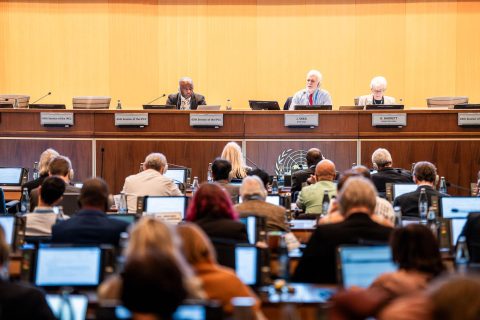

In July, PAICC said 12 countries had ignored its repeated attempts to discuss why they had not published an NDC as required every five years under the 2015 Paris accord.
Members of the committee had been divided over whether to name them, but at a September meeting decided to do so in their annual report to the annual climate COP summit.
By the time the report was published on Friday, only Congo, Senegal and North Korea “had not communicated an NDC or submitted a [Biennial Transparency Report] and had not yet responded to any of the Committee’s notifications, despite several reminders issued by the Committee in this regard”.
Rainforest and renewable energy ambitions
The silence from Congo and Senegal is notable because the former is home to much of the Congo Basin rainforest while the latter has sought billions of dollars in climate finance to support its renewable energy ambitions.
After Brazil, Congo has more rainforest than any country in the world. This forest, and the country’s peatlands, absorb huge amounts of greenhouse gas but are fast being lost to expanding farmland, charcoal production, logging and mining.
Senegal signed a Just Energy Transition Partnership with Canada and wealthy European nations in 2023, to help it meet its renewable energy targets under the-then government of Macky Sall. It was chair of the Least Developed Countries group between January 2022 and December 2023.

Tejas Rao, who is researching the PAICC as part of a doctoral thesis at Cambridge University, said the governments of the three countries should engage with the committee.
“Engagement costs these governments very little and the committee has shown it will listen,” he said.
“Silence leaves the committee with no basis to help, and it leaves the [governments] exposed to the narrative that they are simply disengaged,” he told Climate Home News.
Paris Agreement requirement
The 2015 Paris Agreement requires all parties to publish an NDC every five years outlining their emissions reduction targets, with each plan meant to be more ambitious than the country’s last NDC.
The latest set – the third round of plans, with new targets for 2035 – was due in February 2025. While most countries missed this deadline, all but around 30 – mostly small emitters but including Egypt, Vietnam and Argentina – have now submitted them.
Over the year, the PAICC – which is made up of government climate officials from developed and developing countries – has been communicating with governments that have not submitted NDCs and trying to overcome barriers to them doing so.
Some nations have cited exceptional circumstances as the reason for not submitting an NDC, a process that requires a significant amount of work in tracking emissions and consulting on how to curb them across the economy. For example, a letter from a Sudanese official to the PAICC, seen by Climate Home News, said that the country’s civil war had led to the suspension of its NDC preparation.
-
IPCC scientists vow to press on with climate reports despite political deadlock
After governments again failed to agree a timeline, nearly 120 IPCC authors pledged to complete their assessment on time and with full scientific rigour