

Welcome to Carbon Brief’s DeBriefed.
An essential guide to the week’s key developments relating to climate change.
This week
Crisis responses
OIL SUPPLIES: The International Energy Agency (IEA) warned that oil supply disruptions will worsen in April due to the Iran war, reported CNBC. The outlet added that the IEA was considering another release of strategic oil reserves. Meanwhile, US exports of liquefied natural gas (LNG) reached an “all-time high” in March, with shipments to Asia more than doubling from the previous month, said Reuters.
‘SLOWER GROWTH’: The International Monetary Foundation (IMF) warned that “all roads lead to higher prices and slower growth worldwide” if the war continues to choke oil, gas and fertiliser supplies, reported the Guardian. The IMF said the UK and Italy were “especially exposed by their reliance on gas-fired power”, the newspaper added.
EU PREPARES: The EU is considering “reviving energy-crisis measures” it used at the start of the Ukraine war, including “grid tariffs and taxes on electricity”, according to Reuters. France is considering new actions to electrify its economy and cut dependence on fossil imports, said Le Monde. Elsewhere, BBC News rounded up crisis responses from around the world – including fuel rationing, fuel tax cuts, home working and free public transport.
COAL ‘SHORT-LIVED’: Some countries announced plans to delay coal-plant shutdowns. Italy plans to push back its coal-power phaseout to 2038, according to Reuters. Germany will review whether to reactivate reserve plants, reported Bloomberg. South Korea also extended three plants set to close this year, said the Korea Times. However, a separate Bloomberg comment piece stated that “any shift to burn more coal in 2026 will be short-lived”
Around the world
- GAS SCRAPPED?: New Zealand’s government cast doubt over plans to build an LNG import terminal as rising gas prices have worsened the economics, said the New Zealand Herald. Separately, plans for Vietnam’s largest LNG power plant may be scrapped in favour of a new renewable energy project, according to Reuters.
- PHASEOUT SUMMIT: Climate Home News reported that 46 countries – including major oil producers – have confirmed they will attend the fossil-fuel phaseout summit being held in Colombia later this month.
- INDIAN SUMMER: India is “forecast to experience higher than normal heatwave days through June, raising the risk of power shortages” as the Middle East conflict worsens energy strains, reported Bloomberg.
- AFGHANISTAN FLOODS: Heavy rainfall and floods across Afghanistan have killed at least 48 people and damaged communities, following years of drought, said Kabul Now.
- WIND BUYOUTS: In an effort to halt remaining US offshore wind projects, the Trump administration is offering buyouts to developers in exchange for fossil-fuel investments, according to the Financial Times.
66%
The annual increase in forest loss in Indonesia in 2025, according to Indonesian biodiversity thinktank Auriga Nusantara, reported by Reuters.
Latest climate research
- New research explores “patterns of distributional justice” in the mitigation scenarios used in the IPCC’s sixth assessment | npj Climate Action
- Antarctic surface melt will expand by more than 10% by 2100, if future greenhouse gas emissions continue to be high | Nature Communications
- The evolution of the urban heat island effect in Chinese cities is “not unidirectional, but depends on localised urbanisation and greening dynamics” | PNAS Nexus
(For more, see Carbon Brief’s in-depth daily summaries of the top climate news stories on Monday, Tuesday, Wednesday and Thursday.)
Captured
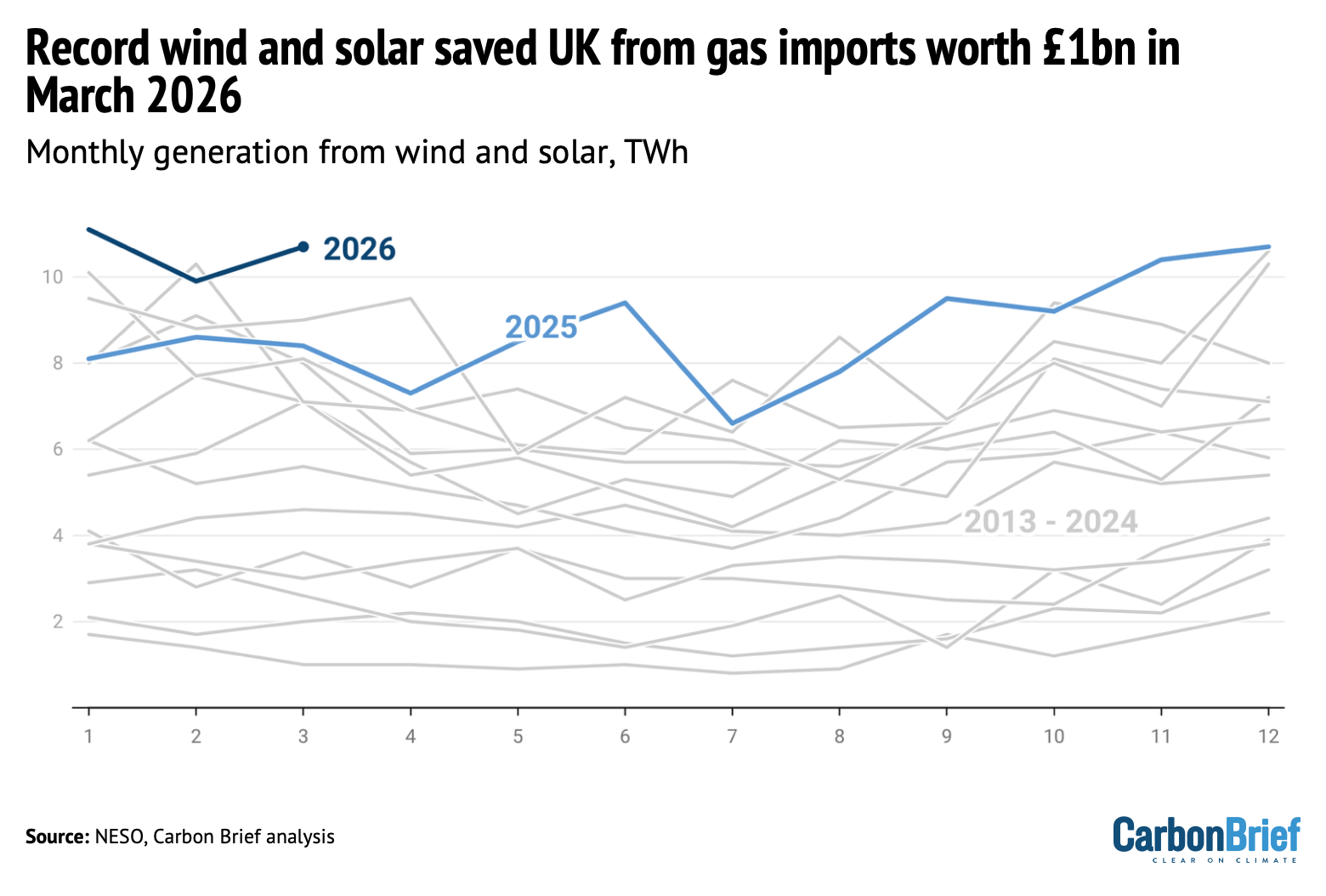
Carbon Brief analysis found that Great Britain has generated record levels of combined wind and solar output so far this year. The chart above shows monthly wind and solar output, which reached 11 terawatt hours (TWh) in March 2026. At current high gas prices, this saved the UK nearly £1bn worth of gas imports for the month, according to the analysis.
Spotlight
How ‘plug-in’ solar could reduce bills
This week, Carbon Brief analysis finds that plug-in solar panels could save a typical household £1,100 over a 15-year lifetime.
In response to the ongoing energy crisis, the UK government announced on 15 March a package of clean-energy measures to “boost” energy security. Among these was the introduction of “plug-in” solar panels to the UK.
Plug-in panels
Compared to rooftop solar, smaller plug-in solar systems consisting of one to two panels can be easily installed on balconies, in gardens and other outdoor spaces. They can be plugged directly into home sockets without the need for additional wiring, reducing electricity taken from the grid and thereby cutting bills.
Plug-in solar has already taken off in Germany, with official registrations already exceeding 1m installations (the actual number could be up to 4m). Other growing markets include France, Spain, the Netherlands and the US.
Panels could be available in the UK “within months” at retailers, such as Lidl and Sainsbury’s, according to the government. (Many of the products from EcoFlow, one of the main providers of plug-in solar in the UK, are already sold out online.)
The government said it will work with relevant bodies to update electrical regulations to allow the use of plug-in solar. The Institution of Engineering and Technology (IET) has advised homes to get their wiring checked before installing.
Costs and benefits
To assess the potential impact of plug-in solar, Carbon Brief conducted a cost-benefit analysis for an 800-watt (W) installation in a typical two-to-three bedroom home in London. The assumptions are approximate and will vary for different locations and set-ups.
Optimally placed panels – south-facing and tilted at around 40 degrees – would generate around 820 kilowatt hours (kWh) each year in London – at a “load factor” of 12% – according to the EU’s PVGIS database.
Actual output is likely to be lower, due to sub-optimal placement – such as vertically on balconies – as well as orientation and shading.
A report by trade body Solar Power Europe noted these factors could cut 30-60% from optimal output. This analysis assumes a 45% reduction from optimal output.
If a household is able to use 90% of the output – typical for such installations – then the panels would provide 400kWh of electricity each year, enough to meet 15% of typical demand.
This will vary on the household usage patterns, but running appliances such as washing machines during peak daylight hours could improve capture rates.
This could save £110 on electricity bills each year, meaning the upfront cost of around £500 could be paid back within 5 years, according to Carbon Brief’s analysis.
Assuming the panels last 15 years, total net savings over their lifetime could reach £1,100.
These savings assume a fixed unit cost of 27p/kWh, based on predictions for July 2026.
If electricity prices surged to 34p/kWh for a prolonged period – as they did during the 2022 gas price crisis – then annual savings could increase to around £140, further reducing the payback time.
If module costs fall over time as more suppliers enter the market, this could reduce the upfront cost and payback time.
If 3m households take up plug-in solar – comparable to Germany’s current deployment – this would generate 1.2 terawatt hours (TWh), less than 1% of UK demand.
While this would not significantly cut UK emissions overall, it could still save the households more than £330m in total and avoid around two tankers’ worth of imported liquified natural gas (LNG) each year, according to Carbon Brief’s analysis.
Unlocking participation
Aside from its economic benefits, plug-in solar could unlock participation in the clean-energy transition for a wider percentage of the population.
For example, renters make up around one-third of UK households and lack control over the installation of rooftop solar and heat pumps. Plug-in solar would enable them to engage in and benefit from clean energy in their homes.
This spotlight was also published on Carbon Brief’s website.
Watch, read, listen
HEAT HEADS: The BBC’s Climate Question podcast spoke to two women from Sierra Leone and Mexico about their role as “chief heat officers” for their cities.
OYSTER DIE-OFF: A feature in the Guardian explored how warming seas are causing mass die-offs of Japan’s oysters, threatening the shellfish trade.
SOLAR SWITCH: Climate Home News examined how Nigerian homes and businesses are increasingly switching from backup generators to solar power.
Coming up
- 8 April: International Energy Agency rare earth special report launch, Paris
- 10 April: Djibouti presidential election
Pick of the jobs
- Grantham Institute for Climate Change, research fellow | Salary: £49,017-£57,472. Location: London (hybrid)
- Stop Climate Chaos Scotland, advocacy lead | Salary: £35,000. Location: Scotland (remote)
- The 19th News,contract climate reporter | Salary: $50 per hour. Location: US (remote)
DeBriefed is edited by Daisy Dunne. Please send any tips or feedback to debriefed@carbonbrief.org.
This is an online version of Carbon Brief’s weekly DeBriefed email newsletter. Subscribe for free here.


The post DeBriefed 2 April 2026: Countries ‘revive’ energy-crisis measures | Record UK renewables | Plug-in solar savings appeared first on Carbon Brief.

A milder winter can sound like welcome news. But for a community waiting for a winter road to carry fuel and building supplies, or a family relying on safe ice to reach harvesting areas, warmer conditions can bring difficult trade-offs. The significance of the coming El Niño is not simply how much temperatures might rise, but what changing winter conditions could mean for food, travel, health, and community life.
One of the strongest El Niño events in the modern record may be developing in the tropical Pacific. NOAA’s October 8 assessment placed an 83% probability on its October–December three-month Relative Oceanic Niño Index reaching at least +2.5°C—a threshold it identifies with an event stronger than previous El Niños in its record dating back to 1950.
For First Nations, Inuit, and Métis communities, the implications will depend on location, local conditions, and the systems people rely on. This is not a forecast of the same experience everywhere: it is an opportunity to consider how a large-scale climate event could interact with existing community priorities and risks.
El Niño, not La Niña
El Niño and La Niña are the warm and cool phases of the El Niño–Southern Oscillation, or ENSO. During El Niño, unusual warming in the central and eastern tropical Pacific changes atmospheric circulation, influencing weather far beyond the Pacific.
El Niño is a naturally occurring climate pattern, distinct from long-term human-caused climate change, although the two can combine to influence temperatures and extreme-weather risks. A strong event changes the odds of particular conditions; it does not determine the weather in any individual community.
What the forecasts suggest
NOAA’s October assessment indicated that a strong-to-very-strong El Niño was likely through January–March 2027. The World Meteorological Organization’s September update also anticipated a very strong event peaking near the end of 2026, with impacts continuing into 2027.
Environment and Climate Change Canada’s August assessment pointed toward a milder winter across much of Canada, with the possibility of drought and wildfire risks extending into the following spring and summer. Its August-issued winter outlook favoured above-normal temperatures across much of British Columbia, the Yukon, Manitoba, Ontario, Quebec, and Atlantic Canada, while parts of western Canada were more likely to be drier than normal.
These are seasonal outlooks, not predictions of conditions on a particular day or travel route. Cold spells, heavy snow, freezing rain, and other dangerous weather can still occur during an otherwise mild winter.
Winter roads, essential connections
For some remote First Nations, winter roads provide a limited seasonal window for moving heavy freight that supports daily life and planned construction. When conditions prevent trucks from carrying full loads, the consequences can reach well beyond transportation.
In February 2024, Nishnawbe Aski Nation Chiefs-in-Assembly declared a winter-roads state of emergency after unusually warm conditions restricted freight movement. NAN identified fuel and construction deliveries among the essential supplies at risk. That experience illustrates why another potentially warm winter deserves attention, although it does not establish what the 2026–27 road season will bring.
The practical planning question is therefore larger than whether a road will open: it includes how essential deliveries and community projects will be supported if the operating season is disrupted. Seasonal forecasts can inform contingency planning, but decisions about road access and load limits must remain grounded in actual local conditions.
Food, culture, and seasonal relationships
Changing winter conditions can also affect access to harvested foods and the relationships sustained through harvesting and sharing. Inuit Tapiriit Kanatami identifies country food as central to Inuit well-being and sharing practices, while highlighting climate-related pressures on access to locally harvested foods. Safe travel is therefore about more than reaching a destination; it also supports food systems and connections between generations.
These concerns take different forms elsewhere. Along the British Columbia coast, El Niño-associated ocean warming can affect fisheries and shellfish, creating another reason to monitor conditions important to harvesting and livelihoods. In Ontario, the Métis Nation of Ontario has identified increasingly unpredictable harvesting seasons among the climate changes affecting Métis citizens.
These are existing climate concerns, not proof that a particular harvest will fail in 2027. The connection to El Niño is the possibility that another season of unusual conditions could add pressure to food systems already adapting to environmental change.
Looking beyond winter
Some of the most consequential risks may emerge after the snow melts. Reduced snowpack, limited spring runoff, and warm, dry conditions can contribute to drought and a more favourable environment for wildfire. ECCC’s August-issued outlook for spring 2027 indicated a high probability of above-normal temperatures across much of western Canada.
For communities facing wildfire, preparedness involves more than protecting buildings. Fires can threaten harvesting areas and medicinal plants, while evacuations require continuity of health care, access to medications, mental-health support, and culturally safe services.
The First Nations Health Authority’s wildfire response resources reflect that broader understanding of safety through support for clean-air spaces, health-service access, counselling, and cultural supports. These considerations belong in early planning wherever local assessments identify elevated risk—not because El Niño guarantees a severe fire season, but because preparation takes time.
Different places, different risks
A national headline about a warmer winter can obscure important regional differences. ECCC’s review found that parts of Nunavut experienced colder-than-normal winters during previous very strong El Niño events, even while much of the country was warmer. The historical sample is small, so that pattern should be treated as a tendency rather than a community-level prediction.
Coastal communities may also face a different combination of concerns, including heavy rain, storm surge, and coastal flooding. Neither a warm national outlook nor an expectation of colder conditions elsewhere can establish whether local ice is safe: community observations and current conditions remain essential.
Indigenous leadership already at work
Indigenous communities are not approaching these risks without knowledge, experience, or solutions. First Nations, Inuit, and Métis climate strategies identify their own priorities for preparedness, food systems, infrastructure, and community well-being.
SmartICE provides one practical example of locally grounded adaptation. Its community-based services bring Indigenous and local ice knowledge together with monitoring technology to support travel decisions. Information is shared through tools including SIKU, as well as local communication channels. Monitoring supports knowledge and decision-making; it does not replace the judgement of experienced ice users.
Land stewardship offers another example. In spring 2026, Gitanyow Land Guardians and Firekeepers carried out cultural burns intended, in part, to support food and medicinal plants. Such initiatives should not be presented as responses to the coming El Niño; they demonstrate stewardship and adaptation work already underway.
The Assembly of First Nations’ National Climate Strategy places First Nations jurisdiction, knowledge systems, and self-determined priorities at the centre of climate action. Inuit Tapiriit Kanatami similarly calls for Inuit-led decisions and partnerships that support Inuit priorities. Preparing for the coming season should build on that leadership rather than treat communities only as recipients of emergency advice.
Preparing on community terms
A useful starting point is to connect updated forecasts with the decisions communities already make about transportation, harvesting, water, health, and emergency readiness. Depending on local priorities, planning could include:
- Reviewing essential deliveries. Identify supplies and projects exposed to winter-road disruption, and discuss contingency arrangements before shortages develop.
- Supporting local monitoring. Resource community-selected approaches to observing ice, snow, water, and travel conditions, alongside current weather information.
- Protecting food access. Consider support for harvesters, food sharing, storage, and alternative supplies where access may be disrupted.
- Preparing for smoke and evacuation. Review clean-air spaces, transportation, medication access, health-service continuity, and culturally safe supports.
- Following regional updates. Revisit plans as ECCC’s monthly seasonal forecasts and local assessments provide a clearer picture.
Planning also requires resources and clear responsibilities beyond the community itself. The AFN’s climate strategy calls for sustained funding and direct partnership with First Nations rights and title holders, including action on infrastructure and emergency-management capacity. Inuit climate priorities likewise identify infrastructure gaps and the need for partnerships shaped by Inuit decisions.
A very strong El Niño does not guarantee a particular winter-road season, harvest, drought, or wildfire outcome. Its value as an early warning lies in the time it provides to prepare—and in whether that time is matched with the resources and decision-making authority communities need to act on their own priorities.
By:Rye Karonhiowanen Barberstock
Photo by: Goran Vinko at Unsplash
The post A Supersized El Niño: What Winter 2026–27 and 2027 Could Mean for Canada appeared first on Indigenous Climate Hub.
A Supersized El Niño: What Winter 2026–27 and 2027 Could Mean for Canada
Australia is looking to South Korea to help turn its vast renewable energy and mineral resources into new export industries supplying low-emissions materials to Korean manufacturers – a deal which campaigners hope will shift trade between the two nations away from fossil fuels.
In an agreement signed on the sidelines of the COP31 climate summit in Antalya, Türkiye, the two countries established a cooperation framework to connect South Korea’s growing industrial power demand with Australia’s clean energy resources.
The deal also aims to support investment in power grids, clean energy supply chains, and greening industries to accelerate emissions cuts.
Analysts say the agreement can help build competitive clean energy supply chains and attract long-term investment into decarbonising industrial processes.
Richie Merzian, CEO of the Clean Energy Investor Group (CEIG), an Australian industry body representing institutional investors in clean energy, told Climate Home News this was “a great example” of a government-to-government agreement that would give investors confidence to invest in green technologies.
-
SE Asia speeds up plan for connected clean power grid after oil shock
Countries are redoubling efforts to link their grids to bolster energy security and reduce their dependence on fossil fuels – but many challenges remain -
As COP31 weighs 35×35 pledge, IEA says Hormuz crisis driving electrification
The report estimates that a planned transition away from fossil fuels and into renewables can add energy jobs and cut energy bills -
Southeast Asia’s fragile grids threaten billions in clean energy investment
Renewables developers need reliable electricity infrastructure and stable policies to help the region meet climate goals and surging demand for power
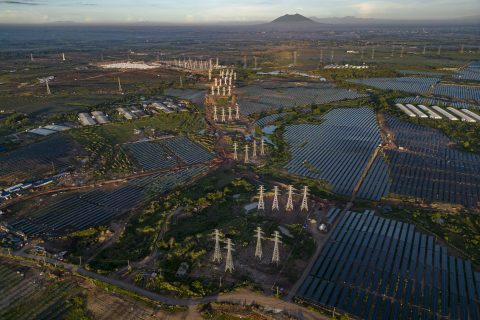

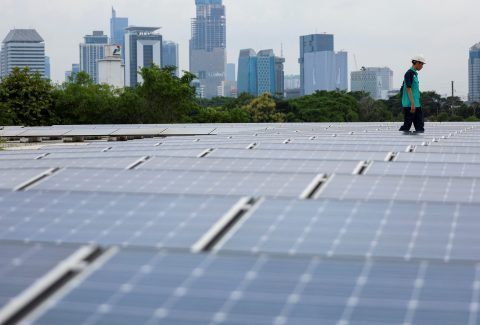
For example, the deal could support Australian exports of green iron and other low-emissions materials, while giving Korean manufacturers access to cleaner inputs for steelmaking, batteries and other industries.
That in turn could help attract investments in Australian renewable po