

Welcome to Carbon Brief’s DeBriefed.
An essential guide to the week’s key developments relating to climate change.
This is an online version of Carbon Brief’s weekly DeBriefed email newsletter. Subscribe for free here.
This week
Atlantic and Amazon ‘tipping points’
CURRENT COLLAPSE?: New research found the Atlantic Meridional Overturning Circulation (AMOC), a large system of ocean currents that helps keep western Europe milder, “may already be on course to a tipping point”, the Press Association reported. The Associated Press said: “An abrupt shutdown of Atlantic Ocean currents that could put large parts of Europe in a deep freeze is looking a bit more likely and closer than before.”
QUESTION MARKS: The Daily Telegraph quoted Prof Jonathan Bamber, director of the Bristol Glaciology Centre, saying the new research was “entirely unrealistic for even the most extreme warming scenario over the next century”. But on the scientific blog RealClimate, ocean scientist Prof Stefan Rahmstorf noted that it was “observational data from the South Atlantic which suggest the AMOC is on tipping course” and that the model simulation was “just there to get a better understanding of which early warning signals work and why”.
AMAZON STRESS: Another study found that up to half of the Amazon is facing combined stress from rising heat, drought, deforestation and other factors that could push the rainforest towards a tipping point by 2050, Reuters reported. The research is the first to assess the cumulative impact of multiple threats, the New York Times reported. Carbon Brief also covered the findings.
‘Troika’ tout 1.5C target
COP30 COUNTDOWN: The United Arab Emirates, Azerbaijan and Brazil – hosts of the COP28, COP29 and COP30 climate summits – are teaming up to push for higher ambition towards the 1.5C limit, Al Jazeera reported. The “troika” wants countries to submit more ambitious pledges ahead of COP30 in Belem, Brazil next year, the outlet said.
MISSION 1.5C: Their efforts were mandated by the COP28 outcome, which launched an undefined “set of activities” known as “road map to mission 1.5C”. Meanwhile, Azerbaijan is on track to raise its gas output by 35% in a decade, Agence France-Presse reported.
MINISTERIAL MEETING: The International Energy Agency (IEA) held its 50th ministerial meeting this week, where leaders pledged in a communique to strengthen energy security and speed efforts towards 1.5C, Bloomberg reported. The IEA, which currently has 31 full members, also opened talks with India over joining the club, Press Trust of India reported.
Around the world
- INDONESIA ELECTS: Defence minister Prabowo Subianto, a “veteran…with a hardline military past”, will be the country’s next president, the Jakarta Post reported. He owns a coal business and “could increase deforestation and coal use”, said NPR.
- DRY JANUARY: A lack of rain in January caused Mexico’s “worst drought” for 12 years, Excélsior reported. Chile is clearing up after devastating forest fires, said El Mercurio, while Peru has issued warnings over heat stroke, El Comercio reported.
- MIGRATORY THREAT: One in five migratory species are under threat from human impacts including climate change, according to a UN report covered by BBC News.
- SAUDI TRANSITION ADMISSION: Oil giant Aramco dropped its expansion plans because of the energy transition, CNBC reported, quoting Saudi Arabia’s energy minister. The surprise move late last month had “spark[ed] questions” over the kingdom’s “concerns over the future of oil demand”, the outlet added.
- AFRICAN MYSTERY: New research casts doubt on earlier findings that Africa’s tropical ecosystems are releasing 6bn tonnes of carbon dioxide a year, Carbon Brief reported. Both sides agree on-the-ground data is needed to unravel the mystery.
- SHELL GAME: Demand for liquified natural gas (LNG) will “surge 50% by 2040” according to Shell, the Financial Times reported. The forecast, from the “world’s largest private LNG trader”, was “slightly lower” than last year, the paper said.
€881 billion
The record value of global carbon markets in 2023, according to a report from London Stock Exchange Group covered by BusinessGreen.
Latest climate research
- A new report from Climate Analytics translated the global goal of tripling renewable capacity by 2030 into regional targets and said only Asia was broadly on track.
- Research in Nature Energy explained how different types of lower-income coal, oil and gas producers can transition away from fossil fuels.
- Global warming “will lead to widespread increases in locust outbreaks”, found a study in Science Advances.
(For more, see Carbon Brief’s in-depth daily summaries of the top climate news stories on Monday, Tuesday, Wednesday, Thursday and Friday.)
Captured

Only a fifth of the population of the Democratic Republic of the Congo (DRC) has access to electricity, with per-capita consumption below that of an average UK fridge, reported Carbon Brief in its latest country profile. Despite using hardly any fossil fuels, the country is one of the world’s biggest greenhouse gas emitters, the profile explained, as a result of human-caused land use changes in its major forests and peatlands.
Spotlight
‘Underestimated’ global public support for climate action
This week, Carbon Brief interviews the authors of new research finding that “almost universal” global support for climate action is “systematically underestimated”.
Carbon Brief: Your survey of nearly 130,000 people in 125 countries found “almost universal” support (86%) for climate action. Were you surprised?
Prof Peter Andre, Prof Teodora Boneva, Prof Felix Chopra and Prof Armin Falk: We were indeed surprised to find that the percentage of the population approving of pro-climate social norms and demanding more political action from their national government is very high in almost all countries in our sample. We were probably misled by the same pessimism that we found to be so widespread across the globe. A broad majority of people across the globe is willing to pay a personal cost [to fight global warming]. However, in 110 out of 125 countries, the majority thinks that they are in the minority.
CB: Do you think this would hold for specific policies, such as a carbon tax?
PA, TB, FC and AF: One cannot simply equate support in the survey with support for specific policy proposals. [However], in a representative US sample, we do find that the general demand for more political action is strongly correlated with demand for specific climate policies, such as a carbon tax.
CB: There has been a resurgence of anti-climate rhetoric from politicians and the media in many countries. Do you think public opinion has shifted since your survey in 2021-22?
PA, TB, FC and AF: We do not detect any clear time trend within our samples from 2021 and 2022, but do not have data for the most recent months. If we were to speculate, we would not want to fall victim to the same pessimism one more time. Our best guess is that the support for climate action has increased rather than decreased in the last two years.
CB: You found stronger willingness to contribute among respondents in poorer, hotter and more vulnerable countries. Why do you think richer people are less willing to pay their way?
PA, TB, FC and AF: Two potential explanations come to mind. First, richer countries are still strongly dependent on fossil fuels. The mitigation costs could therefore be perceived as relatively high and the required lifestyle changes as too drastic. At the same time, richer countries may be more resilient: A country’s GDP per capita reflects its economic capacity to cope with climate change. The most direct and immediate consequences are likely to be concentrated in more vulnerable countries, which have fewer resources to mitigate the negative consequences of the climate crisis.
CB: You found people systematically underestimated the willingness of their peers to contribute to climate action. Why do you think that is – and how could it be changed?
PA, TB, FC and AF: The reasons for this perception gap are likely to be manifold. In the past, media and public discussions have given a lot of focus to the small number of climate change sceptics and have fallen prey to the efforts of special interest groups. Moreover, climate change is difficult to tackle. People might mistakenly infer that the slow progress in combating climate change is due to a widespread lack of personal commitment.
In our view, correcting this perception gap is more important than understanding its origin. Humans are (what behavioural scientists call) “conditional cooperators”. They contribute more to the public good if they believe that others contribute as well. For this reason, pessimism about others’ contributions is harmful. It can constitute a critical obstacle for climate action. We thus conclude in the paper that, “[r]ather than echoing the concerns of a vocal minority that opposes any form of climate action, we need to effectively communicate that the vast majority of people around the world are willing to act against climate change and expect their national government to act”. We hope that our study sparks a debate on this topic, and increases awareness about the large global support for climate action.
This interview was edited for length. A full transcript will be published on Carbon Brief’s website later today.
Watch, read, listen
‘UNINSURABLE WORLD’: A Financial Times “big read” looked at rising insurance premiums as extreme weather events become more frequent.
TRUMP WARNING: An election win for former US president Donald Trump would “spell disaster for climate action in Africa”, wrote Nathaniel Mong’are, adviser to the Kenyan cabinet secretary, in an article for SciDevNet.
WTF?: Popular Indian podcast WTF is? tackled climate change, interviewing researcher Prof Navroz Dubash, activist Sunita Narain and others.
Coming up
- 11-17 February: COP14 for migratory species, Samarkand, Uzbekistan
- 17-18 February: African Union summit, Addis Ababa, Ethiopia
- 19 February to 1 March: Sixth UN Environment Assembly, Nairobi, Kenya
- 20 February: International Energy Agency (IEA) beyond COP28 event, Paris, France
- 21-23 February: Climate and Clean Air Conference, Nairobi, Kenya
Pick of the jobs
- Global Witness, investigator and senior investigator of climate disinformation | Salary: £44,837 and £52,494, respectively. Location: London (hybrid)
- California-China Climate Institute, University of California, Berkeley, climate policy fellow | Salary: $70,500-$86,900. Location: Berkeley, California
- Small World Consulting, sustainability consultants for carbon management and land use | Salary: £29,000-£40,000. Location: Lancaster, UK
- Common Wealth, principal or senior analyst for transatlantic energy | Salary: £43,500 for senior analyst or £50,500 for principal analyst. Location: London or US east coast
DeBriefed is edited by Daisy Dunne. Please send any tips or feedback to debriefed@carbonbrief.org

The post DeBriefed 16 February 2024: Atlantic and Amazon ‘tipping points’; New ‘troika’ for 1.5C; Global support for climate action ‘underestimated’ appeared first on Carbon Brief.

A temporary breach of the 1.5C global-warming limit is now “inevitable” following “decades of insufficient climate action”, says the UN Environment Programme (UNEP).
In its “sobering” annual assessment of the global “emissions gap”, UNEP says that exceeding the Paris Agreement’s 1.5C limit is “imminent and unavoidable”.
This year’s report, titled “The point of return”, says the “task now” is to minimise the size and scale of a temperature “overshoot” and to “establish a credible return path to 1.5C by the end of the century”.
Even the “lowest possible” overshoot scenario for 1.5C would first see global warming peak at around 1.7-1.8C in the middle of the century before declining, says the report.
This scenario – which is “still aligned with the long-term temperature goal of the Paris Agreement” – would require global emissions cuts of 18% by 2030 and 45% by 2035, while ramping up “removals” of carbon dioxide (CO2) from the atmosphere, says UNEP.
In contrast, it notes that the current climate pledges by countries around the world – even if fully implemented – would only reduce emissions by 5-8% by 2030 and 11-15 % by 2035, relative to 2025 levels.
Nonetheless, the report identifies “ample opportunity to accelerate action”, concluding that “countries can still limit peak warming, shorten the duration of overshoot and keep the goals of the Paris Agreement within reach”.
(See Carbon Brief’s detailed coverage of previous reports in 2014, 2015, 2016, 2017, 2018, 2019, 2020, 2021, 2022, 2023, 2024 and 2025.)
Emissions ‘comparable’ between 2024 and 2025
The report says that emissions in 2025 were “comparable” to those of 2024.
Global greenhouse gas emissions in 2025 totalled 58.4bn tonnes of CO2 equivalent (GtCO2e), according to the report. This is around 0.16GtCO2e lower than 2024 levels – albeit, with high levels of uncertainty around the numbers.
In addition, because the figures presented in the 2025 report are “provisional”, the report says, it is “not possible to conclude on the overall direction of emissions in 2025”.
The emissions growth rate has been slowing down in recent decades: the growth rate over 1990-2015 was, on average, 1.7% per year, while emissions have increased by an average of 0.8% per year since 2016.
The chart below shows the total human-driven emissions between 1990 and 2025, separated by greenhouse gas: CO2 from fossil-fuel combustion (dark grey), methane (light grey), nitrous oxide (blue), fluorinated gases (orange) and CO2 from land-use change (green).
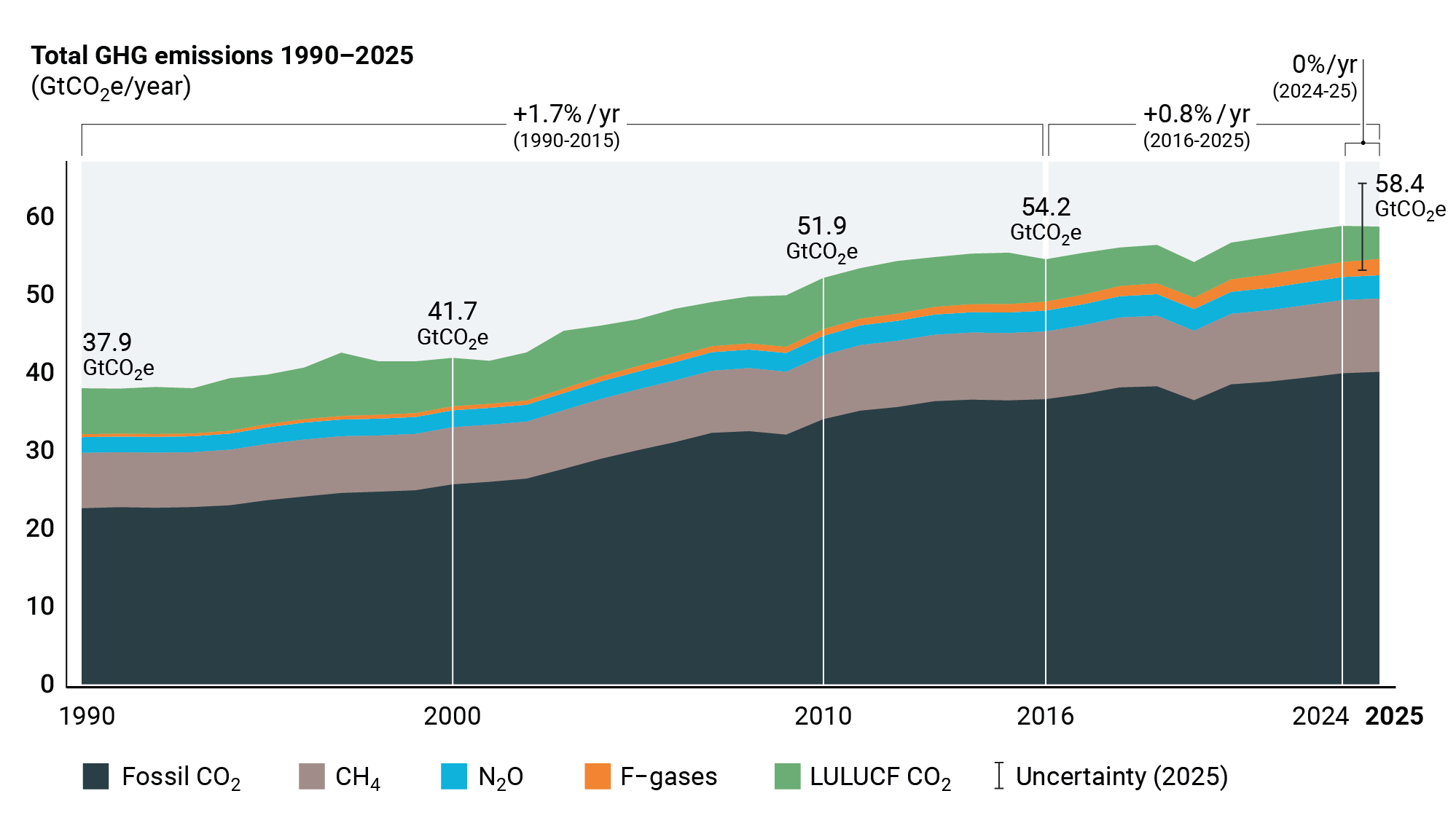
Compared to 2024, emissions from fossil fuels increased slightly, by between 0.4-1.1%, says the report. Emissions of both nitrous oxide and fluorinated gases increased by even higher rates, but since these comprise such a small part of total greenhouse gas emissions, “their contribution to the overall trend is relatively less significant”, it adds. Methane emissions remained steady over that time.
A reduction in the CO2 emissions from land use, land-use change and forestry (LULUCF) “slightly overcompensates” for the rise in emissions of fossil-fuel CO2 and other gases, according to the report. (For more on falling land-use emissions, see Carbon Brief’s explainer.)
The decrease in LULUCF emissions was “partially driven” by a decline in global wildfire emissions, particularly in Africa, South America and parts of south-east Asia. The report notes that these decreases were “likely connected to the ceasing of El Niño conditions”. The ongoing “super” El Niño is likely to cause LULUCF emissions to increase in 2026.
The report also examines countries’ contributions to the increase in greenhouse gas emissions – although here, it excludes LULUCF due to a lag in national-level emissions inventories for the sector.
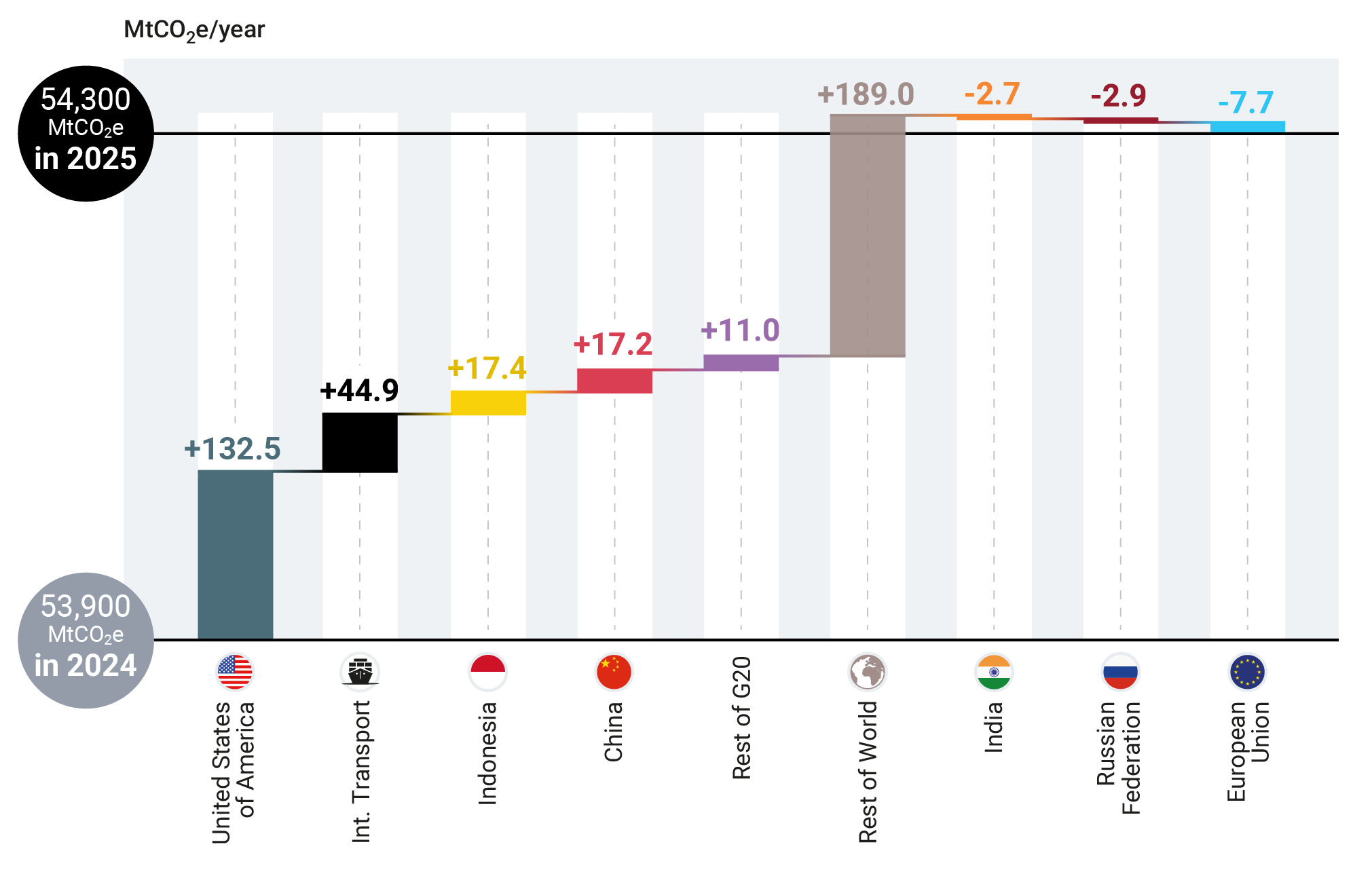
Among the top six emitters, only the US saw a notable increase in 2025, says the report, whereas emissions in China, the EU, India, Russia and Indonesia were relatively flat. Emissions in the US grew by 133m tonnes of CO2e (MtCO2e) in 2025, due to increased electricity demand and a “rebound” of coal power. This growth in US emissions is likely due to a combination of market factors, including increased heating demand due to a colder winter, higher gas prices and overall increased electricity demand.
The changes for the six largest emitters, the rest of the G20 countries, international transport and the rest of the world can be seen in the chart below.
Across most sectors, progress towards decarbonisation has been “modest”, says the report. The most notable decreases have occurred in the power sector and the transport sector, due to the growth of solar power and electric vehicles. The report notes:
“There are emerging signs of transport sector electrification and decarbonisation, but at rates and levels that are not yet sufficient to drive emissions reductions at the global level.”
However, emissions from the transport sector have continued to grow, due to increased demand for international aviation and shipping.
The report notes that while electricity demand from data centres is “projected to double” by 2030, data centres at present account for less than 1% of total emissions.
New NDCs would reduce emissions ‘far from what is needed’
All countries were meant to submit new UN climate pledges for 2035, known as the third nationally determined contribu