

Welcome to Carbon Brief’s DeBriefed.
An essential guide to the week’s key developments relating to climate change.
This week
Trump’s latest climate rollback
RULES REPEALED: The US Environmental Protection Agency (EPA) has begun dismantling Biden-era regulations limiting pollution from power plants, including carbon dioxide emissions, reported the Financial Times. Announcing the repeal, climate-sceptic EPA administrator Lee Zeldin labelled efforts to fight climate change a “cult”, according to the New York Times. Politico said that these actions are the “most important EPA regulatory actions of Donald Trump’s second term to date”.
WEBSITE SHUTDOWN: The Guardian reported that the National Oceanic and Atmospheric Administration (NOAA)’s Climate.gov website “will imminently no longer publish new content” after all production staff were fired. Former employees of the agency interviewed by the Guardian believe the cuts were “specifically aimed at restricting public-facing climate information”.
EVS TARGETED: The Los Angeles Times reported that Trump signed legislation on Thursday “seeking to rescind California’s ambitious auto emission standards, including a landmark rule that eventually would have barred sales of new gas-only cars in California by 2035”.
UK goes nuclear
NEW NUCLEAR: In her first spending review, UK chancellor Rachel Reeves announced £14.2bn for the Sizewell C new nuclear power plant in Suffolk, England – the first new state-backed nuclear power station for decades and the first ever under a Labour government, BBC News reported. The government also announced funding for three small nuclear reactors to be built by Rolls-Royce, said the Times. Carbon Brief has just published a chart showing the “rise, fall and rise” of UK nuclear.
MILIBAND REWARDED: The Times described energy secretary Ed Miliband as one of the “biggest winners” from the review. In spite of relentless negative reporting around him from right-leaning publications, his Department of Energy Security and Net Zero (DESNZ) received the largest relative increase in capital spending. Carbon Brief’s summary has more on all the key climate and energy takeaways from the spending review.
Around the world
- UN OCEAN SUMMIT: In France, a “surge in support” brought the number of countries ratifying the High Seas Treaty to just 10 short of the 60 needed for the agreement to become international law, according to Sky News.
- CALLING TRUMP: Brazil’s president Luiz Inácio Lula da Silva said he would “call” Trump to “persuade him” to attend COP30, according to Agence France-Presse. Meanwhile, the Associated Press reported that the country’s environmental agency has fast tracked oil and highway projects that threaten the Amazon.
- GERMAN FOSSIL SURGE: Due to “low” wind levels, electricity generation from renewables in Germany fell by 17% in the first quarter of this year, while generation from fossil-fuel sources increased significantly, according to the Frankfurter Allgemeine Zeitung.
- BATTERY BOOST: The power ministry in India announced 54bn rupees ($631m) in funding to build 30 gigawatt-hours of new battery energy storage systems to “ensure round-the-clock renewable energy capacities”, reported Money Control.
-19.3C
The temperature that one-in-10 London winters could reach in a scenario where a key Atlantic ocean current system “collapses” and global warming continues under “intermediate” emissions, according to new research covered by Carbon Brief.
Latest climate research
- A study in Science Advances found that damage to coral reefs due to climate change will “outpace” reef expansion. It said “severe declines” will take place within 40-80 years, while “large-scale coral reef expansion requires centuries”.
- Climatic Change published research which identified “displacement and violence, caregiving burdens, early marriages of girls, human trafficking and food insecurity” as the main “mental health” stressors exacerbated by climate change for women in lower and middle-income countries.
- The weakening of a major ocean current system has partially offset the drying of the southern Amazon rainforest, research published in Environmental Research has found, demonstrating that climate tipping elements have the potential to moderate each other.
(For more, see Carbon Brief’s in-depth daily summaries of the top climate news stories on Monday, Tuesday, Wednesday, Thursday and Friday.)
Captured
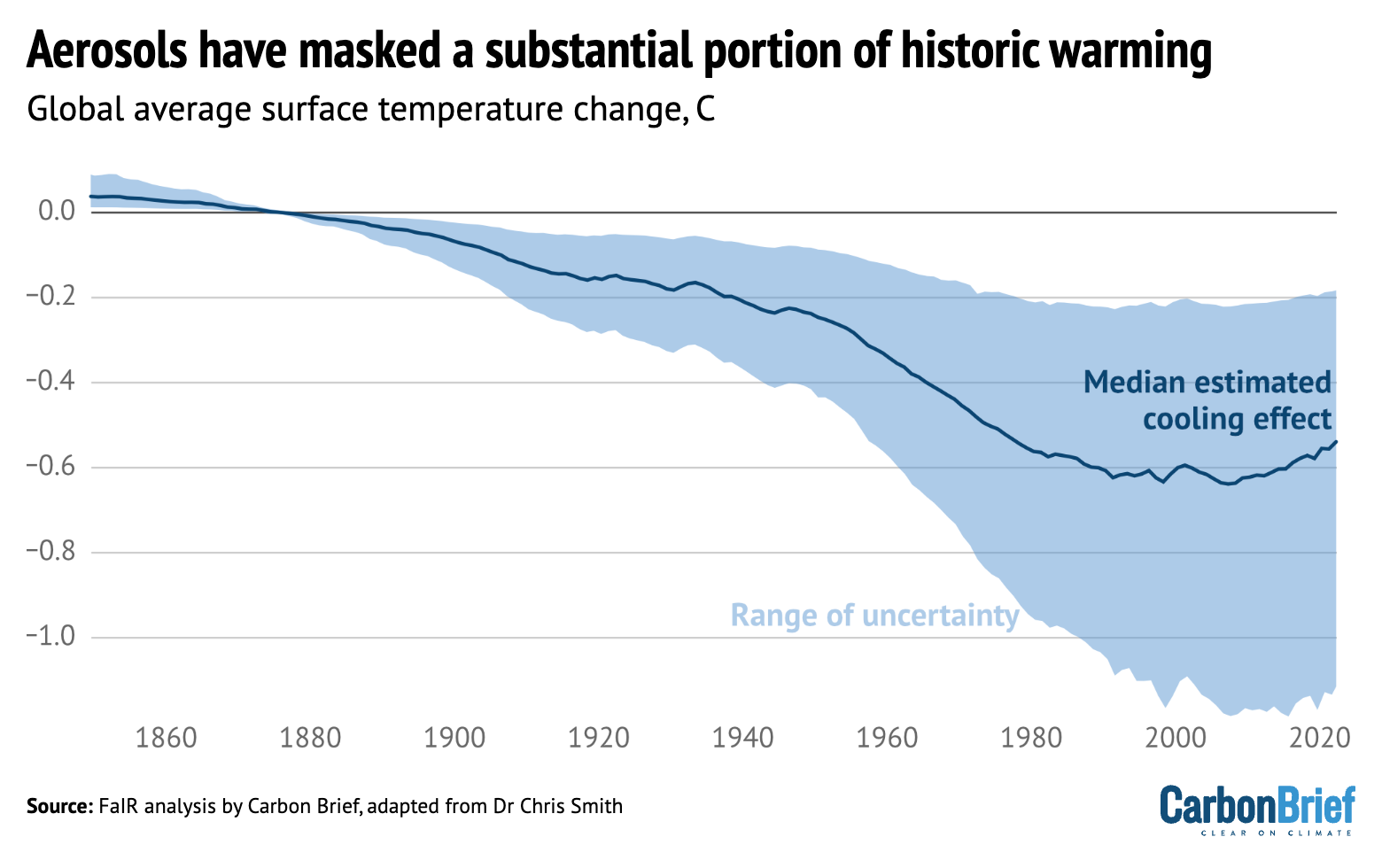
Aerosols – tiny light‑scattering particles produced mainly by burning fossil fuels – absorb or reflect incoming sunlight and influence the formation and brightness of clouds. In this way they have historically “acted as an invisible brake on global warming”. New Carbon Brief analysis by Dr Zeke Hausfather illustrated the extent to which a reduction in aerosol emissions in recent decades, while bringing widespread public health benefits through avoided deaths, has “unmasked” the warming caused by CO2 and other greenhouse gases. The chart above shows the estimated cooling effect of aerosols from the start of the industrial era until 2020.
Spotlight
How Carbon Brief turns complex research into visuals
This week, Carbon Brief’s interactive developer Tom Pearson explains how and why his team creates visuals from research papers.
Carbon Brief’s journalists will often write stories based on new scientific research or policy reports.
These documents will usually contain charts or graphics highlighting something interesting about the story. Sometimes, Carbon Brief’s visuals team will choose to recreate these graphics.
There are many reasons why we choose to spend time and effort doing this, but most often it can be boiled down to some combination of the following things.
Maintaining editorial and visual consistency
We want to, where possible, maintain editorial and visual consistency while matching our graphical and editorial style guides.
In doing this, we are trying to ease our audience’s reading experience. We hope that, by presenting a chart in a way that is consistent with Carbon Brief’s house style, readers will be able to concentrate on the story or the explanation we are trying to communicate and not the way that a chart might have been put together.
Highlighting relevant information
We want to highlight the part of a chart that is most relevant to the story.
Graphics in research papers, especially if they have been designed for a print context, often strive to illustrate many different points with a single figure.
We tend to use charts to answer a single question or provide evidence for a single point.
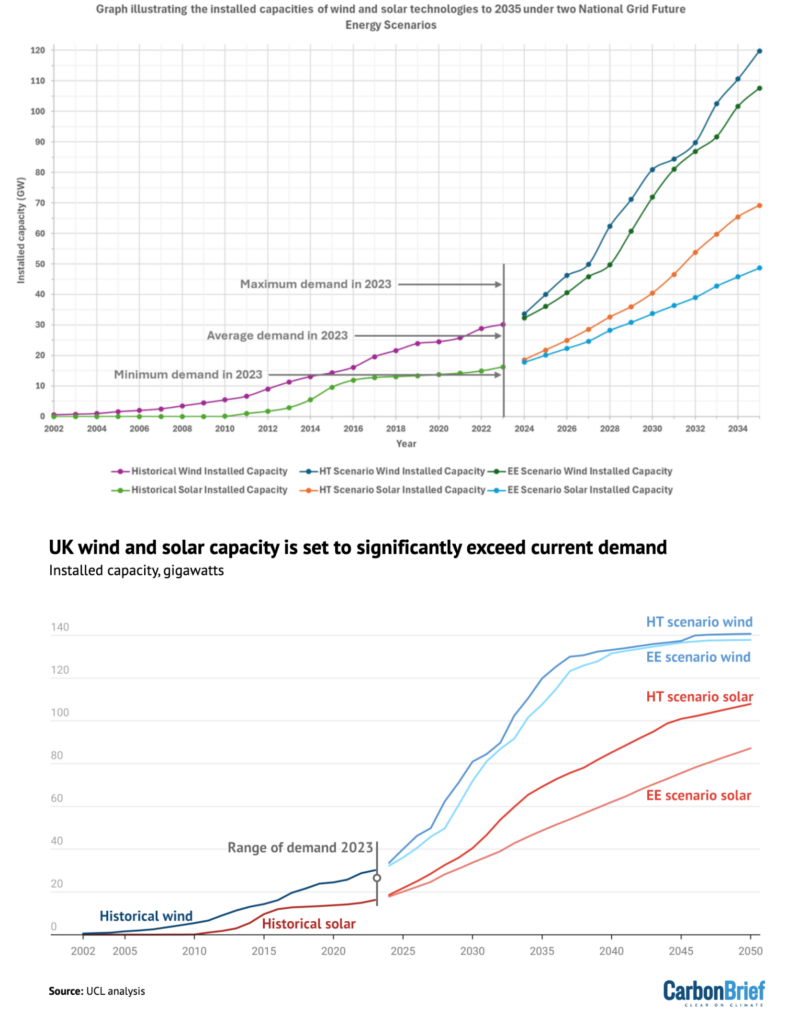
Paring charts back to their core “message”, removing extraneous elements and framing the chart with a clear editorial title helps with this, as the example below shows.
Ensuring audience understanding
We want to ensure our audience understands the “message” of the chart.
Graphics published in specialist publications, such as scientific journals, might have different expectations regarding a reader’s familiarity with the subject matter and the time they might be expected to spend reading an article.
If we can redraw a chart so that it meets the expectations of a more general audience, we will.
Supporting multiple contexts
We want our graphics to make sense in different contexts.
While we publish our graphics primarily in articles on our website, the nature of the internet means that we cannot guarantee that this is how people will encounter them.
Charts are often shared on social media or copy-pasted into presentations. We want to support these practices by including as much context relevant to understanding within the chart image as possible.
Below illustrates how adding a title and key information can make a chart easier to understand without supporting information.

When we do not recreate charts
When will we not redraw a chart? Most of the time! We are a small team and recreating data graphics requires time, effort, accessible data and often specialist software.
But, despite these constraints, when the conditions are right, the process of redrawing maps and charts allows us to communicate more clearly with our readers, transforming complex research into accessible visual stories.
Watch, read, listen
SPENDING $1BN ON CLIMATE: New Scientist interviewed Greg de Temmerman, former nuclear physicist turned chief science officer at Quadrature Climate Foundation, about the practicalities and ethics of philanthropic climate-science funding.
GENDER HURDLES: Research director Tracy Kajumba has written for Climate Home News about the barriers that women still face in attending and participating in COPs.
OCEAN HEATWAVES: The New York Times presented a richly illustrated look at how marine heatwaves are spreading across the globe and how they affect life in the oceans.
Coming up
- 16-26 June: Bonn climate talks, Bonn, Germany
- 16 June: 79th meeting of the World Meteorological Organization executive council, Geneva, Switzerland
- 17 June: International Energy Agency (IEA) Oil 2025 report launch
Pick of the jobs
- Inside Climate News, California environmental reporter | Salary: Unknown. Location: Southern California
- Natural Resources Wales, lead marine and energy policy advisor | Salary: £45,367-£50,877. Location: Wales
- Children’s Investment Fund Foundation, senior manager, climate | Salary: £82,000. Location: London/hybrid
- Green Party,social media and digital content officer | Salary: £33,211. Location: London/remote
DeBriefed is edited by Daisy Dunne. Please send any tips or feedback to debriefed@carbonbrief.org.
This is an online version of Carbon Brief’s weekly DeBriefed email newsletter. Subscribe for free here.


The post DeBriefed 13 June 2025: Trump’s ‘biggest’ climate rollback; UK goes nuclear; How Carbon Brief visualises research appeared first on Carbon Brief.

Next week, diplomats from around the world will descend on Yerevan, Armenia, to negotiate a series of decisions under the UN Convention on Biological Diversity (CBD).
Between 19 and 30 October, 196 parties will gather to hammer out the precise wording of the dozens of legal texts that make up the decisions under the Conference of the Parties (COP) to the CBD.
This year’s summit is particularly significant, as it marks the halfway point between the agreement of the Kunming-Montreal Global Biodiversity Framework and the deadline for achieving its targets.
The CBD has found that countries are currently not on track to meet 22 out of the framework’s 23 targets.
During the fortnight, delegates will also be negotiating decisions relating to the two supplemental protocols to the CBD: the Cartagena Protocol, which covers biosafety; and the Nagoya Protocol, which covers access and benefit-sharing for the use of genetic resources.
(The Cartagena and Nagoya Protocols, which are each governed by a “meeting of the parties”, or “MOP”, have fewer parties than the CBD as a whole, with 173 and 141, respectively.)
Carbon Brief is tracking the progress of countries towards consensus on dozens of negotiating texts using the interactive table below.
The tracker includes texts from the COP, as well as the MOPs for the Cartagena and Nagoya protocols. It also includes draft decisions from the most recent subsidiary body meetings, as these form the starting point for the negotiations in Yerevan.
The CBD has three subsidiary bodies: the subsidiary body on scientific, technical and technological advice (SBSTTA), the subsidiary body on implementation (SBI) and the subsidiary body on article 8(j) and other provisions (SB8J).
SB8J focuses on issues related to the Indigenous peoples and local communities. It was established at COP16 in Cali, Colombia, in 2024.
The first two columns of the interactive tracker list the topic of each agenda item and the relevant body, with subsequent columns including dates, page counts and links to the original documents.
The table is searchable and can be sorted using the arrows in the header.
Areas of disagreement in UN draft texts are denoted by square brackets. Counting the brackets in a particular iteration of a text therefore gives a sense of how far parties are from reaching consensus.
The bracket column is colour-coded, with dark green indicating a low number of brackets and red indicating a high number of brackets remaining.
Texts can also present parties with choices using “options” or alternatives (“alt”), which are counted together in the sixth column of the table.
The key discussions in Yerevan will centre around two agenda items in particular. The first is the global review, which will assess progress towards the GBF and make recommendations for accelerating action.
The second is finance, which can be separated into two parts: resource mobilisation and the financial mechanism. On resource mobilisation, biodiverse global south countries are likely to push for an increased amount of international finance for conservation.
Disagreement over the creation of the financial mechanism led to the suspension of COP16 in Cali in October 2024, as parties failed to find agreement on the mobilisation of finance before the end of the summit.
Global south countries want the establishment of a separate financial mechanism under the control of the CBD; global north countries largely prefer to maintain the existing mechanism, which sits under the Global Environment Facility.
At the resumed session of COP16 in Rome in early 2025, countries agreed on a roadmap that would lead to the establishment of a permanent mechanism.
related

Analysis: Lula presidency saved at least 20,000km2 of Brazilian Amazon since 2022
Why land-use emissions have fallen by a third this century – in six charts

Analysis: 84% of nations miss deadline to identify ‘nature-harming’ subsidies by 2025
UK withdraws millions in funding from world’s second-largest rainforest in Congo
The post Interactive: Tracking negotiating texts at the COP17 biodiversity summit appeared first on Carbon Brief.
Interactive: Tracking negotiating texts at the COP17 biodiversity summit
A beacon of love
On an outer island of Fiji, two thousand nautical miles from Sydney, is a shining light of hope and resilience for our troubled world.
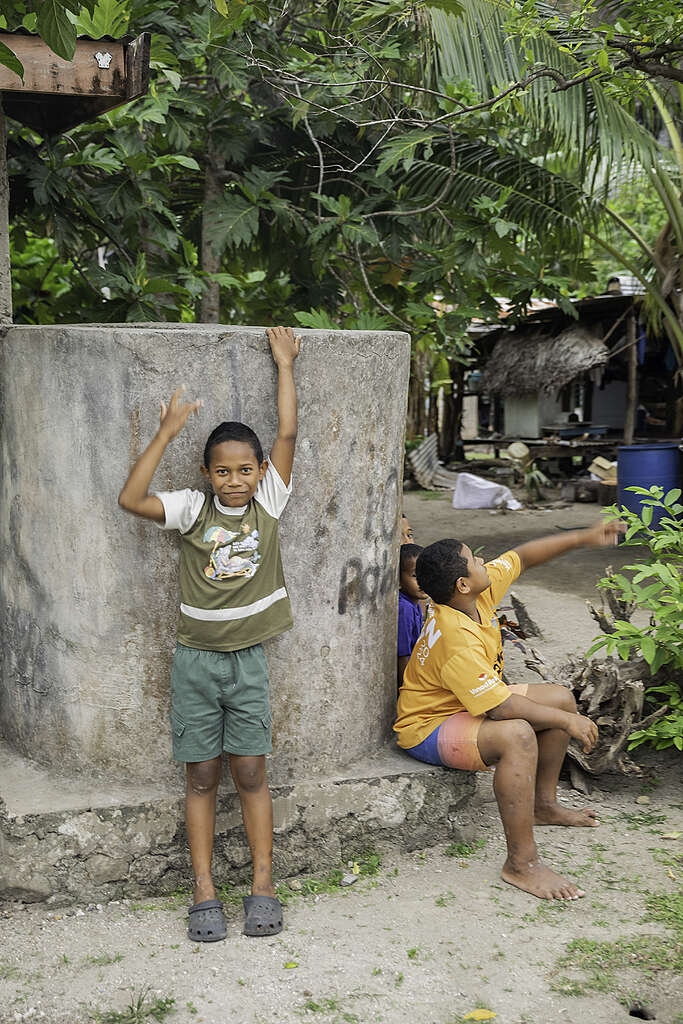
The island of Kioa is home to a Tuvaluan community who migrated from their atoll of Vaitupu in the late 1940s. It is a land of warm hearts, big smiles, and deep cultural roots; a place where the sound of a conch still summons the island together, where islanders paddle out to fish in carved outrigger canoes, and healthy happy children walk barefoot to school.
Here, culture is life. Kioans live sustainably through their traditional knowledge and practices. The island is alive with song, dance and the rhythms of a life tied to the tides, the winds, and the seasons.
Facing the future
Greenpeace has been lucky to have a relationship with Kioa for a number of years now, and we are continually learning from this remarkable community.
Last week, as part of our Voyaging Oceania project, we returned to the island. Our purpose was twofold —- to carry messages from the island to leaders gathering in Nadi this week for the Pacific Pre-COP, and to support the Kioa community in their efforts to improve water security for the island.
Unlike Tuvalu itself, with its eight atolls, Kioa is a mountainous, forested and richly fertile island. It will remain habitable far into the future. Kioans did not initially migrate from Vaitupu due to climate change, but the move was prophetic. They now have a lifeboat.
However, even Kioa faces challenges on our rapidly warming planet, in particular when it comes to water. Climate change is shifting once reliable rainfall patterns. On top of this, the island is already feeling the effect of this year’s intensifying El Niño event, which for Fiji means reduced rainfall and prolonged dry spells.
Right now, fresh water has to be carefully rationed, and is only available for a few hours a day. During last week’s visit aboard our campaigning ship Oceania, Greenpeace was privileged to work with the Kioa community on a new solar-powered water distribution project for the island.
Designed and led by the island, the project involves using a solar pump to move water from a reliable source to a storage tank and then using gravity to distribute the water around the village.
It was a lesson in how local knowledge and ingenuity can be the backbone of today’s climate solutions. To build a dam around the source, the local community knew the exact spo