

Welcome to Carbon Brief’s DeBriefed.
An essential guide to the week’s key developments relating to climate change.
This week
Sweltering Earth
RECORD YEAR?: Global temperatures “breached the threshold of 1.5C for each of the past 12 months and seas reached their warmest for 15 months in a row”, the Financial Times reported, setting the scene for 2024 to be the hottest year on record. Reuters, also quoting the EU’s climate change monitoring service, said last month was the hottest June on record, the 13th month in a row to be the warmest recorded.
SCORCHING SUMMER: Japan issued a heat stroke alert for 26 of the country’s 47 prefectures, urging people to stay indoors, use air conditioners and drink lots of water, the Guardian reported. Covering Pakistan’s heatwave, the New York Times said “hundreds of patients suffering from heat-related illnesses pour into the hospitals every day, pushing them far past their capacity.” About 36 million people in the US are under excessive heat warnings, Reuters reported.
STORMY TIMES: Hurricane Beryl reached Texas after causing destruction in the Caribbean last week and knocked out power to nearly three million homes and businesses, the Associated Press reported. According to the Indian Express, record rains descended on Mumbai, leading to traffic chaos and train cancellations across the city. In Cape Town, South Africa, nearly 1,000 homes were destroyed by gale-force winds, the Associated Press reported.
Labour makes early moves
WIND POWER: Days after its historic election win, the new Labour government in the UK lifted a “de-facto ban” on building new onshore wind turbines in England, the Guardian reported. According to the Daily Mail, chancellor Rachel Reeves described the ban as “absurd” and said it would hold back progress towards Labour’s ambition to make the UK a “clean-energy superpower”.
GREEN INDUSTRY: Labour also announced that a new £7.3bn national wealth fund, aimed at cutting emissions from the UK’s heavy industry, will begin investing in areas such as green steel and gigafactories “immediately”, the Financial Times reported. Reeves said the funds are to be spent over five years and disbursed by the state-run UK Infrastructure Bank, the newspaper added. And Chris Stark was appointed to head a “Covid vaccine-style taskforce aimed at delivering clean and cheaper power by 2030”, said the Guardian.
FOSSIL BUSINESS: The new government said that a proposed coal mine in Cumbria had been approved unlawfully, reported the Guardian, as the carbon emissions of coal from the mine should have been taken into account in the planning decision. Meanwhile, a Daily Telegraph article on North Sea oil and gas licensing was described by the government as a “complete fabrication”, noted City AM.
Around the world
- NO TURNING BACK: The EU has resisted calls from industries and countries to delay its flagship deforestation law, which is set to take effect from 30 December, Reuters reported.
- MORE TREES: The amount of forest lost in Colombia fell by 36% between 2022 and 2023, its lowest level in 23 years, the Guardian reported.
- CLEAN POWER: South Africa’s new energy minister vowed to be “ultra-aggressive” on renewable energy as the country celebrated more than 100 days with no power cuts – a record following years of crippling blackouts, Reuters reported.
- ELECTION ANXIETY: Scientists in France said they were relieved that the right-wing party National Rally was defeated in the country’s parliamentary elections, over fears of budget cuts to research and the introduction of climate scepticism into government, Nature reported.
- END TIMES: Fossil-fuel company BP said oil demand is expected to peak in 2025 under current climate policies and fossil fuels will decline to about two-thirds of the global energy mix by 2050, as more renewable capacity is installed, said the Times.
- RECORD PENALTY: Petroleum company Marathon Oil must pay a record $64.5m penalty to resolve alleged violations of the Clean Air Act, the Washington Post reported.
760,000
The number of hectares (1.8m acres) that have already burned across the Brazilian Pantanal – the world’s largest wetland and one of the most biodiverse places on Earth – in 2024, reported the Guardian.
Latest climate research
- As the world reduces emissions and approaches net-zero, it will be “difficult” to identify specifically when warming has “stopped”, according to a new study published in Environmental Research Letters, potentially creating confusion among policymakers and the general public.
- New research in Scientific Reports found that climate change-driven desertification in the Gobi Desert could threaten several species of dung beetle.
- Methane emissions from livestock in China are projected to rise 13% by 2030, but there is the “technical potential” to cut them by 36%, a new study in Nature Food suggested.
(For more, see Carbon Brief’s in-depth daily summaries of the top climate news stories on Monday, Tuesday, Wednesday, Thursday and Friday.)
Captured

Clean energy generated a record-high 44% of China’s electricity in May 2024, pushing coal’s share down to a record low of 53%, despite continued growth in demand, according to new analysis published by Carbon Brief. Coal lost seven percentage points compared with May 2023, when it accounted for 60% of generation in China. Generation from clean energy sources grew by a record 78 terawatt hours (TWh), including a record rise from solar of 41TWh (78%), a recovery from earlier drought-driven lows for hydro of 34TWh (39%) and a modest rise for wind of 4TWh (5%). If current rapid wind and solar deployment continues, then China’s CO2 output is likely to continue falling, making 2023 the peak year for the country’s emissions, the analysis said.
Spotlight
Solutions to West Africa’s fishing crisis
Carbon Brief examines the link between climate change and the declining fortunes of fishing communities in West Africa.
In June, a new paper in Scientific Reports suggested that global warming was contributing to changes in the distribution of small pelagic (open ocean) fish species in a marine ecosystem that stretches from Morocco to Senegal.
“These changes serve as an early indicator of potential future challenges regarding availability, holding profound implications for the food security of millions of citizens across West Africa,” the authors wrote.
The study was one of the latest in an ongoing effort by scientists to improve the understanding of climate change’s impact on marine ecosystems in West Africa.
Nearly seven million people directly derive their livelihoods from small-scale fisheries in West Africa, but the fatal combination of overfishing and ocean warming has resulted in reduced productivity in marine resources, threatening to further impoverish coastal communities in the region.
For example, the coastal catch dropped by nearly 40% in Côte d’Ivoire between 2003 and 2020. And, in Ghana, annual landings of round sardinella, an economically important fish in the country, fell by 90% between 1992 and 2019.
Maximum catch potential is expected to continue to decline as ocean warming – which accounts for about 90% of global warming – accelerates, according to Robert Paarlberg, an emeritus professor at Wellesley College in Massachuchets, who has spent the past three decades researching food and agricultural policy in several African countries.
Coastal adaptation
In 2023, Paarlberg, a co-investigator at a Harvard research cluster focused on climate adaptation in the Gulf of Guinea, spent three weeks visiting coastal communities in Ghana, Côte d’Ivoire and Nigeria. He returned to Ghana in May 2024. His goal was to study adaptation strategies for fishing communities in the region.
“Finding alternative income for traditional fishing communities is essential, since the stocks of small pelagic fish will continue to decline, at least in the Gulf of Guinea where I have focused my research,” Paarlberg tells Carbon Brief.
In a recent article, Paarlberg advocated for conditional cash transfer policies at the national level to help fishing communities stay in school longer, arguing that more education could empower them to find non-fishing jobs.
But he believes the international community can also play a role. He tells Carbon Brief:
“US AID [Agency for International Development] has been scaling up a vocational training program for fishers in Ghana, to help them transition to alternative livelihoods, but the US AID budget is not big enough to scale up such programmes for all those in need. The UN Green Climate Fund has started to provide this kind of assistance in West Africa and, together with the World Bank, could be doing even more.”
One way to slow down the impact of climate change is to significantly curb the overfishing practices of local and foreign trawlers. According to Paarlberg, regional cooperation can help, due to the transnational nature of the coast:
“Countries such as Ghana and Cote d’Ivoire have been imposing ‘closed seasons’ to combat overfishing in July and August. But if Togo does not follow suit too, many canoes will simply go down the coast and fish in Togolese waters.”
Watch, read, listen
FEEDING THE PLANET: For the first guest on her new podcast, Prof Sarah Bridle, interviewed Prof Rosie Green about plant-based alternative foods, their environmental impact and what to look for when choosing plant milk.
CLIMATE THEATRE: For Nature, Prof Peter Stott reviewed the premiere of a new UK play, Kyoto, which depicts the drama behind the scenes at the 1997 Kyoto Protocol negotiations.
ROAD TO COP29: In an opinion piece for African Arguments, chair of the African Group of Negotiators (AGN) at the climate talks in Bonn in June 2024, Ali Mohamed, said a pan-African stance is the only path to climate justice.
Coming up
- 15 July: Rwandan general elections
- 15 July – 2 August: 2nd Part of the 29th Annual Session of the International Seabed Authority, Kingston, Jamaica
- 16–17 July: G7 Trade ministers’ meeting, Reggio Calabria, Italy
- 18 July: Meeting of the European Political Community, Blenheim Palace, Woodstock, UK
Pick of the jobs
- The African Climate Foundation, programme manager, sustainable finance | Salary: Unknown. Location: Remote, preference will be given to candidates based in Kenya, Ethiopia and South Africa
- International Institute for Sustainable Development-Experimental Lakes Area, programme manager | Salary: CAD$80,000-CAD$100,000. Location: Winnipeg, Manitoba (hybrid)
- US South Central Climate Adaptation Science Center, New Mexico tribal liaison | Salary: $48,000-$52,000. Location: Oklahoma
- The India Climate Collaborative, senior manager – capacity building | Salary: Unknown. Location: Mumbai (preferred) or remote
DeBriefed is edited by Daisy Dunne. Please send any tips or feedback to debriefed@carbonbrief.org.
This is an online version of Carbon Brief’s weekly DeBriefed email newsletter. Subscribe for free here.


The post DeBriefed 12 July 2024: 12 consecutive months above 1.5C; Labour sets UK climate agenda; West Africa’s fishing crisis appeared first on Carbon Brief.

Drought and heatwaves occurring together – known as “compound” events – have “surged” across the world since the early 2000s, a new study shows.
Compound drought and heat events (CDHEs) can have devastating effects, creating the ideal conditions for intense wildfires, such as Australia’s “Black Summer” of 2019-20 where bushfires burned 24m hectares and killed 33 people.
The research, published in Science Advances, finds that the increase in CDHEs is predominantly being driven by events that start with a heatwave.
The global area affected by such “heatwave-led” compound events has more than doubled between 1980-2001 and 2002-23, the study says.
The rapid increase in these events over the last 23 years cannot be explained solely by global warming, the authors note.
Since the late 1990s, feedbacks between the land and the atmosphere have become stronger, making heatwaves more likely to trigger drought conditions, they explain.
One of the study authors tells Carbon Brief that societies must pay greater attention to compound events, which can “cause severe impacts on ecosystems, agriculture and society”.
Compound events
CDHEs are extreme weather events where drought and heatwave conditions occur simultaneously – or shortly after each other – in the same region.
These events are often triggered by large-scale weather patterns, such as “blocking” highs, which can produce “prolonged” hot and dry conditions, according to the study.
Prof Sang-Wook Yeh is one of the study authors and a professor at the Ewha Womans University in South Korea. He tells Carbon Brief:
“When heatwaves and droughts occur together, the two hazards reinforce each other through land-atmosphere interactions. This amplifies surface heating and soil moisture deficits, making compound events more intense and damaging than single hazards.”
CDHEs can begin with either a heatwave or a drought.
The sequence of these extremes is important, the study says, as they have different drivers and impacts.
For example, in a CDHE where the heatwave was the precursor, increased direct sunshine causes more moisture loss from soils and plants, leading to a drought.
Conversely, in an event where the drought was the precursor, the lack of soil moisture means that less of the sun’s energy goes into evaporation and more goes into warming the Earth’s surface. This produces favourable conditions for heatwaves.
The study shows that the majority of CDHEs globally start out as a drought.
In recent years, there has been increasing focus on these events due to the devastating impact they have on agriculture, ecosystems and public health.
In Russia in the summer of 2010, a compound drought-heatwave event – and the associated wildfires – caused the death of nearly 55,000 people, the study notes.

The record-breaking Pacific north-west “heat dome” in 2021 triggered extreme drought conditions that caused “significant declines” in wheat yields, as well as in barley, canola and fruit production in British Columbia and Alberta, Canada, says the study.
Increasing events
To assess how CDHEs are changing, the researchers use daily reanalysis data to identify droughts and heatwaves events. (Reanalysis data combines past observations with climate models to create a historical climate record.) Then, using an algorithm, they analyse how these events overlap in both time and space.
The study covers the period from 1980 to 2023 and the world’s land surface, excluding polar regions where CDHEs are rare.
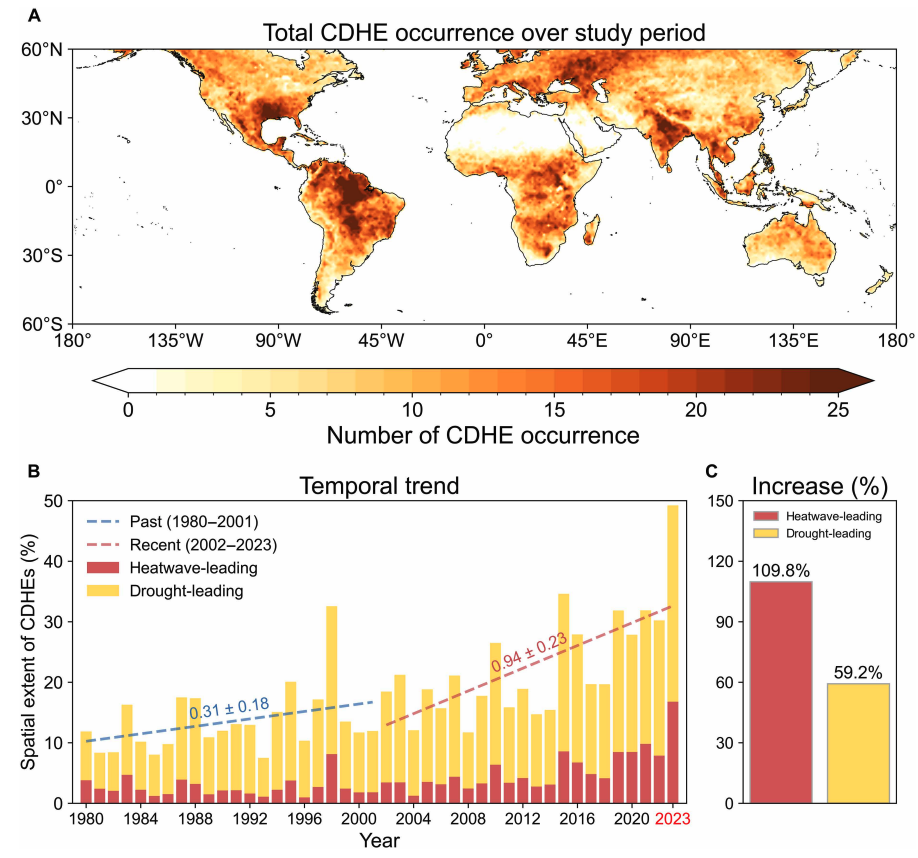
The research finds that the area of land affected by CDHEs has “increased substantially” since the early 2000s.
Heatwave-led events have been the main contributor to this increase, the study says, with their spatial extent rising 110% between 1980-2001 and 2002-23, compared to a 59% increase for drought-led events.
The map below shows the global distribution of CDHEs over 1980-2023. The charts show the percentage of the land surface affected by a heatwave-led CDHE (red) or a drought-led CDHE (yellow) in a given year (left) and relative increase in each CDHE type (right).
The study finds that CDHEs have occurred most frequently in northern South America, the southern US, eastern Europe, central Africa and south Asia.
Threshold passed
The authors explain that the increase in heatwave-led CDHEs is related to rising global temperatures, but that this does not tell the whole story.
In the earlier 22-year period of 1980-2001, the study finds that the spatial extent of heatwave-led CDHEs rises by 1.6% per 1C of global temperature rise. For the more-recent period of 2022-23, this increases “nearly eightfold” to 13.1%.
The change suggests that the rapid increase in the heatwave-led CDHEs occurred after the global average temperature “surpasse[d] a certain temperature threshold”, the paper says.
This threshold is an absolute global average temperature of 14.3C, the authors estimate (based on an 11-year average), which the world passed around the year 2000.
Investigating the recent surge in heatwave-leading CDHEs further, the researchers find a “regime shift” in land-atmosphere dynamics “toward a persistently intensified state after the late 1990s”.
In other words, the way that drier soils drive higher surface temperatures, and vice versa, is becoming stronger, resulting in more heatwave-led compound events.
Daily data
The research has some advantages over other previous studies, Yeh says. For instance, the new work uses daily estimations of CDHEs, compared to monthly data used in past research. This is “important for capturing the detailed occurrence” of these events, says Yeh.
He adds that another advantage of their study is that it distinguishes the sequence of droughts and heatwaves, which allows them to “better understand the differences” in the characteristics of CDHEs.
Dr Meryem Tanarhte is a climate scientist at the University Hassan II in Morocco, and Dr Ruth Cerezo Mota is a climatologist and a researcher at the National Autonomous University of Mexico. Both scientists, who were not involved in the study, agree that the daily estimations give a clearer picture of how CDHEs are changing.
Cerezo-Mota adds that another major contribution of the study is its global focus. She tells Carbon Brief that in some regions, such as Mexico and Africa, there is a lack of studies on CDHEs:
“Not because the events do not occur, but perhaps because [these regions] do not have all the data or the expertise to do so.”
However, she notes that the reanalysis data used by the study does have limitations with how it represents rainfall in some parts of the world.
Compound impacts
The study notes that if CDHEs continue to intensify – particularly events where heatwaves are the precursors – they could drive declining crop productivity, increased wildfire frequency and severe public health crises.
These impacts could be “much more rapid and severe as global warming continues”, Yeh tells Carbon Brief.
Tanarhte notes that these events can be forecasted up to 10 days ahead in many regions. Furthermore, she says, the strongest impacts can be prevented “through preparedness and adaptation”, including through “water management for agriculture, heatwave mitigation measures and wildfire mitigation”.
The study recommends reassessing current risk management strategies for these compound events. It also suggests incorporating the sequences of drought and heatwaves into compound event analysis frameworks “to enhance climate risk management”.
Cerezo-Mota says that it is clear that the world needs to be prepared for the increased occurrence of these events. She tells Carbon Brief:
“These [risk assessments and strategies] need to be carried out at the local level to understand the complexities of each region.”



The post Heatwaves driving recent ‘surge’ in compound drought and heat extremes appeared first on Carbon Brief.
Heatwaves driving recent ‘surge’ in compound drought and heat extremes
Greenhouse Gases
DeBriefed 6 March 2026: Iran energy crisis | China climate plan | Bristol’s ‘pioneering’ wind turbine
Welcome to Carbon Brief’s DeBriefed.
An essential guide to the week’s key developments relating to climate change.
This week
Energy crisis
ENERGY SPIKE: US-Israeli attacks on Iran and subsequent counterattacks across the Middle East have sent energy prices “soaring”, according to Reuters. The newswire reported that the region “accounts for just under a third of global oil production and almost a fifth of gas”. The Guardian noted that shipping traffic through the strait of Hormuz, which normally ferries 20% of the world’s oil, “all but ground to a halt”. The Financial Times reported that attacks by Iran on Middle East energy facilities – notably in Qatar – triggered the “biggest rise in gas prices since Russia’s full-scale invasion of Ukraine”.
‘RISK’ AND ‘BENEFITS’: Bloomberg reported on increases in diesel prices in Europe and the US, speculating that rising fuel costs could be “a risk for president Donald Trump”. US gas producers are “poised to benefit from the big disruption in global supply”, according to CNBC. Indian government sources told the Economic Times that Russia is prepared to “fulfil India’s energy demands”. China Daily quoted experts who said “China’s energy security remains fundamentally unshaken”, thanks to “emergency stockpiles and a wide array of import channels”.
‘ESSENTIAL’ RENEWABLES: Energy analysts said governments should cut their fossil-fuel reliance by investing in renewables, “rather than just seeking non-