

Welcome to Carbon Brief’s DeBriefed.
An essential guide to the week’s key developments relating to climate change.
This week
‘Catastrophic’ climate impacts
RECORD HEAT: Western Europe experienced its hottest June on record – some 3C above average – according to analysis covered by the Guardian. It said the finding came “as the UK enters its third heatwave of the year and wildfires ravage France and Spain”. Le Monde said 10,000 people had been evacuated due to wildfires in southern France.
‘EXCESS DEATHS’: The June heatwave killed more than 2,700 people in France, according to a guest post analysis for Carbon Brief. Similar analysis for Germany said there had been more than 5,000 “excess deaths”, reported Bloomberg. Meanwhile, an ongoing heatwave in the US has killed at least 30 people, said USA Today.
STORM TEST: Floods have killed 39 people in Guangxi province in southern China, said state-run newspaper China Daily. Scientists warned that climate change and the weather phenomenon El Niño are exposing China to “catastrophic storms” that will test its resilience in 2026, reported Reuters. The nation’s latest official climate report found that “extreme weather and climate events…have become more frequent and severe”, said China National Radio.
Around the world
- EU ELECTRIFICATION: The European Commission is set to unveil a 2040 target for EU electrification on 17 July, reported Bloomberg. Citing a leaked draft, it said the plan would aim to cut oil use in half and gas use by two-thirds.
- PEAKING PLAN: China has published an “action plan” for peaking emissions during the 15th five-year plan period to 2030, reported Xinhua. It lists targets including “new energy vehicles” making up 30% of cars on the road by 2030, said Reuters.
- CLIMATE ‘FLAT EARTHER’: The Trump administration has appointed Matthew Wielicki, described by Politico as a “climate critic”, to lead the office in charge of the US national climate assessment. Common Dreams quoted a scientist describing the move as “like putting a flat-earther in charge of NASA”.
- UGANDAN SUIT: A group of farmers from Uganda have launched a legal suit in London against the East African oil pipeline, according to Climate Home News.
23%
The share of Irish electricity used by data centres in 2025, reported the Irish Times.
2%
The share of global electricity used by data centres in the same year, according to Carbon Brief analysis of the Energy Institute statistical review.
Latest climate research
- Meltwater from the western Himalayan glaciers will peak at around 2C of warming, before declining at higher warming levels | Environmental Research Letters
- Current coral restoration efforts may be unsuitable for temperate reefs, including those in the Mediterranean | Nature Ecology & Evolution
- People tend to underestimate the level of “broad public support” for climate action | Nature Climate Change
(For more, see Carbon Brief’s in-depth daily summaries of the top climate news stories on Monday, Tuesday, Wednesday, Thursday and Friday.)
Captured
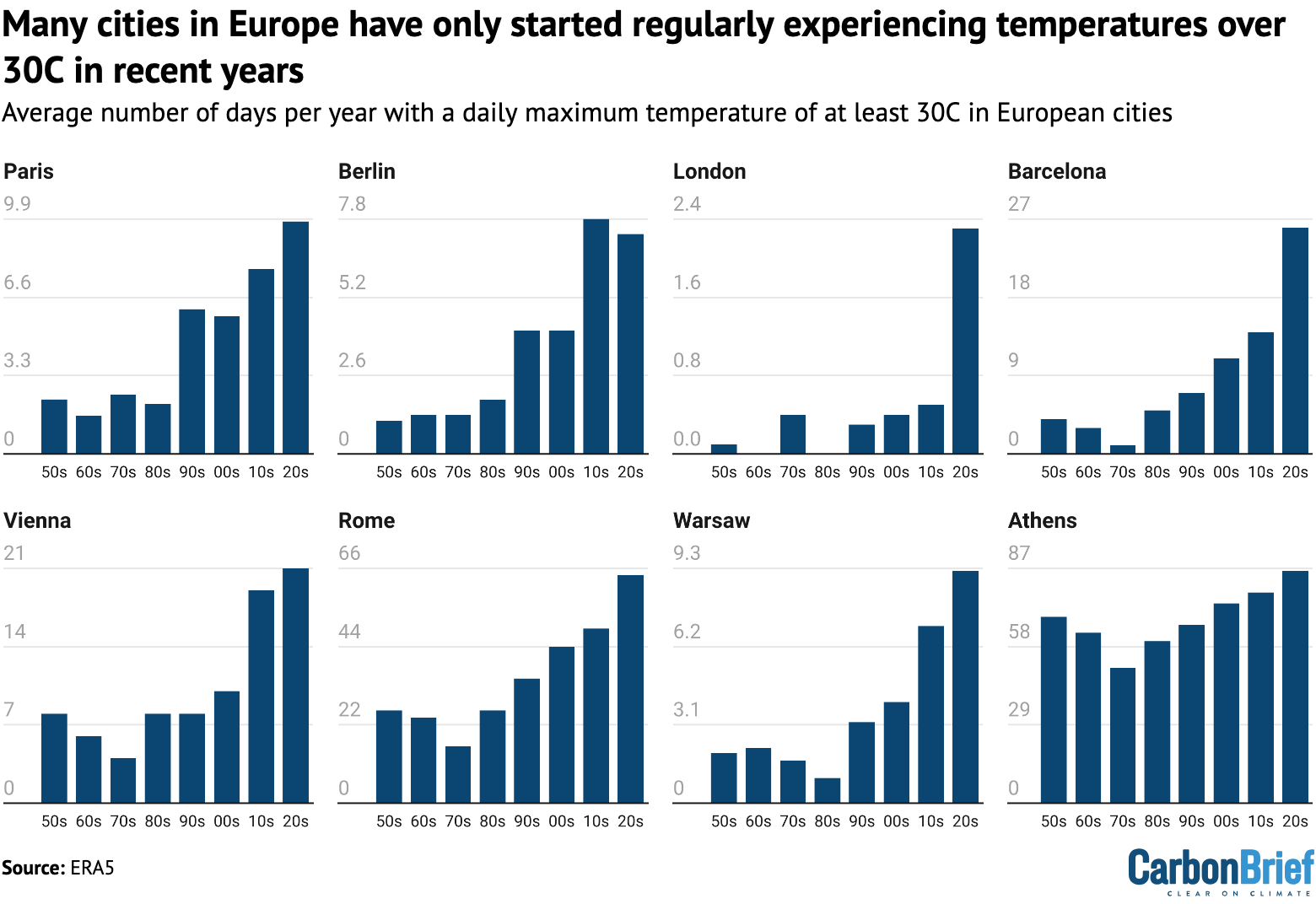
Carbon Brief explained – via eight facts – why air conditioning rates in some parts of Europe are relatively low, as the technology emerges as a new front in the global “culture war” over climate action. Analysis for the article illustrated that, in many parts of the world’s fastest-warming continent, air conditioning simply was not needed in the past.
Spotlight
COP31 president speaks to Carbon Brief on electrification
This week, Carbon Brief interviews Murat Kurum, president-designate of the COP31 UN climate talks in November and Turkey’s minister of environment, urbanisation and climate change, on his target to boost global electrification.
Carbon Brief: You recently launched a target for 35% of the world’s final energy to come from electricity by 2035. Where did this idea come from?
Murat Kurum: The “35 by 35” target is grounded in technical data and based on the IEA [International Energy Agency] and IRENA [International Renewable Energy Agency] analysis of what is needed to keep [the 1.5C Paris Agreement target] within reach. The level was not chosen politically. Rather, it reflects what the science and the energy modelling tell us is required.
CB: Why do you think an electrification target is important right now?
MK: The case for the target is urgent right now. The latest war in the Gulf has made energy diversification – and, in particular, renewable energy transition and electrification – a top global priority, because it is the surest and cleanest way to protect citizens around the world from high and volatile energy prices.
At a time of real fragmentation in international relations, a single, shared target is needed to focus global efforts by aligning governments, businesses and investors behind a common benchmark and to send a clear market signal.

CB: Which countries are supporting this target so far?
MK: The reaction so far has been extremely positive and, while we presented our target at the UN June climate meetings in Bonn, our earlier conversations with parties at both the Petersberg and Copenhagen climate dialogues paved the way for this launch.
For example, the EU, UK, and Canada have welcomed the target, as have the Brazilian COP30 and Ethiopian COP32 presidencies. All have confirmed it will be central to discussions at COP31.
This support has been reflected in the business community as well, with polling by the We Mean Business Coalition showing that 90% of businesses expect to have largely electrified their operations by 2035 and that 88% expect electrification will make their business more competitive.
CB: How do you hope and expect to see this taken forward at the COP? Could it be in the formal COP outcomes, or part of the second global stocktake?
MK: We are now taking electrification forward as an “action agenda” initiative to bring actors together and drive progress. The action agenda and the [formal COP] negotiations are separate, but complementary, with different processes and thresholds, and it is too early to say what all countries might be able to agree in the negotiations. That is for parties to determine as the year progresses.
We are focused and determined to use COP31 as a moment to spark a global conversation about electrification.
CB: What are the key priorities for reaching the target?
MK: The critical sectors for reaching the target are buildings, transport and industry, which together account for around 45% of global emissions. Financial support for the developing world and investment in grids and infrastructure is also crucial.
The target also builds on COP28’s target to triple renewable energy capacity and seeks to take advantage of the tumbling cost of renewable power and other technologies critical to the energy transition. This is a journey that Turkey itself is taking ambitious steps on, including our plan to reach 120GW [gigawatts] of renewable capacity by 2035.
Watch, read, listen
HEATED: A Financial Times long read asked if Europe – the world’s fastest-warming continent – is “prepared for a world of extreme heat”.
LITIGATED: The Outrage and Optimism podcast spoke to Prof Joana Setzer and Catherine Higham about the latest trends in climate litigation.
‘SHATTERED’: Confidence in fossil-fuel exports via the strait of Hormuz has been “shattered”, wrote IEA chief Fatih Birol for Foreign Policy.
Coming up
- 13-17 July: Meeting of open-ended working group on the Montreal Protocol, Bangkok, Thailand
- 13-24 July: International Seabed Authority Council, Kingston, Jamaica
- 16 July: International Energy Agency critical minerals outlook 2026, online
Pick of the jobs
- Wellcome Trust, head of policy – climate and health | Salary: £84,640-£105,800. Location: London
- Financial Times, senior reporter, Sustainable Views | Salary: Unknown. Location: London
- North Texas Public Broadcasting, climate, energy and environment reporter | Salary: $70,000-$78,000. Location: Fort Worth, Texas
- Energy & Climate Intelligence Unit, head of communications and engagement | Salary: £65,000-£70,000. Location: London
DeBriefed is edited by Daisy Dunne. Please send any tips or feedback to debriefed@carbonbrief.org.
This is an online version of Carbon Brief’s weekly DeBriefed email newsletter. Subscribe for free here.


The post DeBriefed 10 July 2026: Deadly Europe heat | EU electrification leak | COP31 president interview appeared first on Carbon Brief.
DeBriefed 10 July 2026: Deadly Europe heat | EU electrification leak | COP31 president interview

Elisa Morgera is the UN Special Rapporteur on Climate Change and Human Rights.
For years, governments and international financial institutions have justified the mining boom by arguing that the energy transition cannot happen without critical minerals.
Increasingly, however, they are securing those minerals for something else: weapons and artificial intelligence (AI).
At COP31, governments must make clear what a sustainable and fair energy transition requires and reject demand for minerals that fuels war and other climate-harming uses.
Independent research shows that mineral demand is increasingly driven by AI and militarisation. Yet, both undermine climate action.
Major armed conflicts are linked to fossil fuel expansion, generate emissions that are unaccounted for under the Paris Agreement, and deliver record profits to fossil fuel and petrochemical companies through price spikes and disrupted access to fuel and food.
Meanwhile, AI infrastructure risks undoing the progress of the renewable energy transition by driving fossil fuel expansion to meet data centres’ vast new energy demand.
-
We need no-go mining zones for the energy transition to be just: Here’s how it could work
As rising demand for critical minerals is compounding threats to fragile ecosystems, NGOs have mapped out areas that should be off-limits to mining -
Rush for critical minerals tests Europe’s resolve to protect nature
A Climate Home News investigation found that more than half of the EU’s “strategic” mineral projects lie on, or within a kilometre, of protected Natura 2000 sites -
Major financiers neglect energy transition risks from mining as demand booms
Financial institutions are lacking safeguards to prevent harms caused by mining the resources needed for the energy transition, analysis of the sector’s financing finds



UN Secretary-General António Guterres and the head of UN Climate Change Simon Stiell have both warned of the climate harm of unchecked, fossil fuel-powered AI and data centre growth.
In addition, AI equipment and infrastructure require huge amounts of copper – one of the minerals most in demand for the energy transition. A recent academic study found that copper makes up roughly 82-83% of the mineral mass in data centres.
None of this demand serves the energy transition. Instead, the climate case for mining is being used to legitimise uses that undermine a sustainable future.
Mining still relies heavily on fossil fuels and often harms the environment, so it must be limited to extracting the resources strictly necessary for the energy transition. Otherwise, states breach their binding obligations to protect the environment and human rights, as the International Court of Justice (ICJ) has made clear.
National security is the new mining fast track
Campaigners have long warned that when minerals become a matter of national security, governments are more tempted to deregulate and fast-track mining projects. Communities pay the price.
Extraction without adequate consultation is a global pattern linked to killings of land and environmental defenders. More than half of transition mineral projects are located on or near Indigenous lands, and allegations of abuses linked to mining transition minerals surged 73% in 2025 alone.
Security and climate are not separate problems. Both are rooted in the fossil fuel-based global economy, now joined by the unchecked growth of AI and data centres.
Who should benefit from minerals?
Not every demand for minerals can or should be met. Minerals are finite and must be used to address the worsening climate crisis as a priority.
The COP31 presidency’s push for electrification will have significant implications for mineral demand. At the same time, electrification doesn’t necessarily help to phase out fossil fuels. Governments must be clear about how minerals are being used and prioritise uses that genuinely advance the energy transition.
- Climate action comes first: Mineral demand for the wind and solar projects that power communities and essential public services such as local food systems should be met first. Priority uses should include community-led wind and solar projects and renewable power for public transport.
- No support for climate-harming activities: Mineral demand projections for the energy transition should exclude the military-industrial complex and data centres, and governments should reconsider public spending on militarisation. Mineral demand for electrification should also be scrutinised to avoid deepening fossil fuel dependence.
- Cut demand before expanding supply: High-consuming countries should use less primary material through efficiency, longer-lasting products and by reducing car dependence, rather than exporting waste and harm to the Global South.
- Prioritise energy needs: Those without access to energy must be served first. Overproduction and overconsumption must be curbed, otherwise the transition will neither mitigate climate change nor reduce poverty.
- No mining without consent: No project should receive financing or permits without the Free, Prior and Informed Consent of Indigenous Peoples and genuine consultations with affected communities.
- No-go zones: States should establish no-go mining zones in ecologically sensitive areas, on land and at sea, and ensure that mining does not cause significant harm to biodiversity.
What can COP31 do?
Last year, governments agreed to develop a Just Transition Mechanism, but explicit provisions on transition mineral governance were dropped. At COP31, negotiators are reconsidering the issue. I urge negotiators in Antalya to:
- Reflect states’ obligations underpinning the ICJ Advisory Opinion and the UN Secretary-General’s Critical Energy Transition Minerals Panel principles in the Just Transition Work Programme.
- Keep mineral demand for the military and digital infrastructure separate from demand that serves climate protection.
- Require traceability and end-use disclosure, so it is publicly known whether a mineral ends up in a battery, a missile or a data centre.
- Respect the human rights of Indigenous Peoples, peasants and environmental human rights defenders, including the right to say no, protection from reprisals and access to remedy.
At COP31, transition minerals should be unequivocally linked to everyone’s human right to a safe climate and a healthy environment.
The post Minerals for the planet or for war and AI? COP31 must make clear what we prioritise appeared first on Climate Home News.
Minerals for the planet or for war and AI? COP31 must make clear what we prioritise
Dozens of countries – from big emerging economies to the world’s poorest nations – are calling for the UN’s new carbon market to reassess climate integrity rules, in a push that campaigners and researchers have blamed on industry lobbying.
At COP31 talks on the Paris Agreement Crediting Mechanism (PACM) this weekend, the Like-Minded Developing Countries – a group that includes Saudi Arabia, India and China – the Least Developed Countries (LDCs) and landlocked developing countries raised concerns about the requirements project developers must meet, according to sources familiar with the closed-door discussions.
They warned about the cumulative weight of those requirements developed under Article 6 of the Paris Agreement as barriers to implementation. Several countries, including Singapore and some Latin American states, said rules must keep projects financially viable, while South Korea asked for proportionate requirements, the sources said.
Their demands closely track arguments from carbon market industry groups, which claim PACM’s conservative approach to counting emission reductions is so strict that few projects will ever come to fruition.
Industry and NGOs lobby to weaken UN carbon credit rules in “coordinated” push
In a letter published ahead of COP31, the lobby groups asked governments to “raise implementation concerns” and to request that the Supervisory Body – the UN body that oversees the market – assess the “combined impact” of its rules on the feasibility of projects.
The letter was signed by the International Emissions Trading Association (IETA), a business group whose members include fossil fuel giants Shell, BP, Saudi Aramco and Chevron, along with the Project Developer Forum and the Wildlife Conservation Society, which develops forest conservation programmes.