

Welcome to Carbon Brief’s DeBriefed.
An essential guide to the week’s key developments relating to climate change.
This is an online version of Carbon Brief’s weekly DeBriefed email newsletter. Subscribe for free here.
This week
EU passes nature law
NATURE LAW: On Tuesday, the European parliament approved its “flagship” law to restore nature, reported Reuters, despite a backlash “ignited” by protests from farmers across Europe in recent weeks. The long-awaited “nature restoration” law commits countries to restoring nature on a fifth of their land and sea by 2030, the newswire said, and it includes specific targets such as restoring peatlands “so they can absorb CO2 emissions”. Carbon Brief published a Q&A unpacking the law and the challenges it has faced.
‘POPULISM AND FEAR-MONGERING’: The vote was subject to a “last-ditch attempt from rightwing parties” that “threatened to sink the deal”, reported the Guardian. The law – which now needs final approval from the EU council – was adopted with 329 votes in favour, 275 against and 24 abstentions, reported Deutsche Welle.
‘MANURE, BURNING TYRES AND TEARGAS’: The vote came amid a backdrop of continuing demonstrations by farmers across Europe, protesting against “the EU’s green policies, price pressures and import competition”, reported Politico. On Monday, farmers “locked down” the European quarter in Brussels and were “assaulting police barricades”, the outlet said. Elsewhere, Reuters reported that farmers “blocked a border crossing between Poland and Germany”.
UN environment assembly resolutions
TRANSITIONAL METALS: At the UN environment assembly in Nairobi, which comes to a close today, African leaders called for better controls on demands for the minerals and metals needed for a clean energy transition, the Guardian reported. A resolution supported by mainly African countries including Senegal, Burkina Faso, Cameroon and Chad would “promote equitable benefit-sharing” and attempt to avoid the “injustices” associated with fossil fuel extraction, the outlet explained. A UN press release confirmed that the resolution text was adopted.
SRM NO-GO: Also at the meeting, governments failed to agree on a resolution led by Switzerland to set up a UN expert panel on solar geoengineering, reported Climate Home News. After going through six revisions over the two-week meeting, the resolution was withdrawn on Thursday, said Reuters. The Earth Negotiations Bulletin reported earlier in the week that the resolution “was moving from the realm of the achievable”.
‘BALANCE’ WITH NATURE: At an event during the assembly, leading Islamic scholars published a “groundbreaking” document described as a “Muslim sibling” to Pope Francis’ 2015 Papal Encyclical, reported EarthBeat. The text, titled “Al-Mizan: a covenant for the Earth”, urges Islamic countries and corporations “to transition swiftly from fossil fuels” toward renewable energy in response to climate change, the outlet said.
Around the world
- WINTER WORRY: A “historic” winter heatwave across the central US “demolished” temperature records and contributed to “massive wildfires” in Texas, the Washington Post reported. One of the fires is now the second-largest wildfire in US history, noted BBC News.
- ‘SERIOUS CONCERNS’: The UK’s aid spending watchdog has warned that the government will struggle to meet its commitment to spend £11.6bn over five years up to 2025-26 helping poorer countries deal with climate change, according to the Press Association.
- INDIAN INSTALLATIONS: India’s solar and wind deployment is set to increase by more than 30% in 2024, reported Bloomberg, but this pace is “still not fast enough to meet its clean energy goal of 500 gigawatts by the end of this decade”.
- US ENERGY ACCESS: The US government announced a $366m plan to fund 17 projects to expand access to renewable energy on Native American reservations and in other rural areas, said the Associated Press.
- ‘SUSPECTED SABOTAGE’: Denmark is closing its inquiry into the blasts that “tore apart” two Nord Stream gas pipelines in the Baltic Sea in 2022, BBC News reported. The investigation concluded that the pipelines had been “sabotaged”, but there was “no basis for pursuing a criminal case”.
40,000 tonnes
The amount of wood from old-growth forests in Canada burned by North Yorkshire’s Drax power station in 2023, according to a BBC News Panorama investigation. Drax responded by denying it takes wood from primary forests.
Latest climate research
- A four-year farm trial has shown how using “enhanced weathering” in the corn belt of the US could draw down carbon dioxide and raise crop yields, reported a study in the Proceedings of the National Academy of Sciences.
- A Plos Climate study of apes across 363 sites in Africa warned that they “are and will be increasingly exposed to climate change impacts”.
- A Journal of Climate study identified a “remarkable” increase over six decades in Europe’s summer wet-bulb temperature – a “useful indicator” for heat stress.
(For more, see Carbon Brief’s in-depth daily summaries of the top climate news stories on Monday, Tuesday, Wednesday, Thursday and Friday.)
Captured

This week, the Climate Change Committee (CCC) – the UK’s official advisor – issued “unequivocal” advice to the government that the “surplus” from previous carbon budgets should not be carried forward, reported Carbon Brief. The UK overachieved on its carbon budget for 2018-22, leaving it with an emissions “surplus” – but this was largely down to external factors such as the Covid-19 pandemic rather than policies, the CCC said. It warned that carrying the emissions surplus over could allow the UK’s emissions to rise by 15% (red line on the chart) during the fourth carbon budget period of 2023-27.
Spotlight
Guest post: The climate ‘memory loss’ of melting glaciers

Dr Andrea Spolaor from the Institute of Polar Sciences of the National Research Council of Italy, explains how rapidly melting glaciers are washing away crucial evidence of the world’s past climates.
Ice cores, extracted from glaciers and polar ice sheets, hold vital clues to Earth’s climate history.
These cylindrical samples provide a timeline of past temperatures and ancient atmospheres. Analysing the chemical composition, gas concentrations and other markers within the ice layers enables scientists to uncover how Earth and its climate has changed over millions of years.
As a result, ice cores are essential for understanding natural climate variability and human-induced changes, as well as helping predict future trends. They contribute crucial data to climate models and efforts to address climate change.
However, as the world warms, glaciers are retreating at an unprecedented pace, leading to the loss of the crucial information they hold.
In a recent study, published in the Cryosphere, my colleagues and I found that this memory loss extends to the glaciers of the Svalbard archipelago, located in the Arctic Circle.
Our study investigated the impact of rising temperatures on the “signal” of a changing climate contained within the glaciers of the Holtedahlfonna ice field.
The direct consequence of warming has been an increase in summer melt and more meltwater percolating through the ice. This meltwater can wash chemical constituents throughout the layers of ice, potentially disrupting the climate signal they preserve. Eventually, this can compromise the complete preservation of climatic information within the ice cores.
Our study revealed a worrying trend – the climate signal stored in the ice had deteriorated. In just seven years, the markers that allowed us to separate out the different seasons in a core extracted in 2012 had completely vanished in a core from 2019.
Despite the loss of the seasonal signal, the overall imprint of atmospheric warming still persists in the ice. This suggests that the site remains suitable for reconstructing past climates over an extended period. However, with the current pace of warming in the Svalbard archipelago, Holtedahlfonna and other ice fields at similar altitudes may not provide reliable records of past climatic conditions for much longer.
The Svalbard archipelago is particularly sensitive to climate changes due to the relatively low altitude of its main ice caps and the rapid warming of the Arctic region. Nonetheless, similar losses have also been observed in other parts of the world.
To preserve these archives, researchers involved in the Ice Memory and Sentinel projects concluded a complex ice drilling campaign in 2023 on the Holthedalfonna glacier, successfully extracting three deep ice cores. We hope that these samples still contain climatic information representative of the region.
Our research has emphasised the need to preserve these glacial archives and the crucial climatic insights they contain.
Watch, read, listen
ENVOYS WILL BE ENVOYS: The Diplomat profiled the new climate envoys for the US and China and what the reshuffle means for climate engagement between the two countries.
CLEANEST, CHEAPEST OR FAIREST?: Climate Home News explored the tricky question of “who should get to drill, pump and sell” the world’s final supplies of oil and gas.
‘THE OTHER IRA’: A BBC Radio 4 programme looked at how the US Inflation Reduction Act will impact global trade and the economy – and the prospects for a similar bill in the UK.
Coming up
- 1 March: Parliamentary and assembly of experts elections in Iran
- 4-5 March: 1st G20 global mobilization against climate change task force meeting, Vila Do Conde, Brazil
- 6 March: UK 2024 spring budget, London, UK
Pick of the jobs
- UN Environment Programme, regional sub-programme coordinator (climate action) | Salary: Unknown. Location: Nairobi, Kenya
- ODI, research officer and senior research officer (climate and sustainability) | Salary: £31,000-39,000 and £37,000-47,000, respectively. Location: London (hybrid)
- Climate & Development Knowledge Network, gender and social inclusion lead | Salary: Unknown. Location: Cape Town, South Africa
- Church of England, net-zero carbon programme officer | Salary: £46,577. Location: Home-based (with regular meetings in London)
DeBriefed is edited by Daisy Dunne. Please send any tips or feedback to debriefed@carbonbrief.org

The post DeBriefed 1 March 2024: EU’s ‘flagship’ nature law approved; Glaciers losing their climate ‘memory’; UN environment assembly resolutions appeared first on Carbon Brief.

Drought and heatwaves occurring together – known as “compound” events – have “surged” across the world since the early 2000s, a new study shows.
Compound drought and heat events (CDHEs) can have devastating effects, creating the ideal conditions for intense wildfires, such as Australia’s “Black Summer” of 2019-20 where bushfires burned 24m hectares and killed 33 people.
The research, published in Science Advances, finds that the increase in CDHEs is predominantly being driven by events that start with a heatwave.
The global area affected by such “heatwave-led” compound events has more than doubled between 1980-2001 and 2002-23, the study says.
The rapid increase in these events over the last 23 years cannot be explained solely by global warming, the authors note.
Since the late 1990s, feedbacks between the land and the atmosphere have become stronger, making heatwaves more likely to trigger drought conditions, they explain.
One of the study authors tells Carbon Brief that societies must pay greater attention to compound events, which can “cause severe impacts on ecosystems, agriculture and society”.
Compound events
CDHEs are extreme weather events where drought and heatwave conditions occur simultaneously – or shortly after each other – in the same region.
These events are often triggered by large-scale weather patterns, such as “blocking” highs, which can produce “prolonged” hot and dry conditions, according to the study.
Prof Sang-Wook Yeh is one of the study authors and a professor at the Ewha Womans University in South Korea. He tells Carbon Brief:
“When heatwaves and droughts occur together, the two hazards reinforce each other through land-atmosphere interactions. This amplifies surface heating and soil moisture deficits, making compound events more intense and damaging than single hazards.”
CDHEs can begin with either a heatwave or a drought.
The sequence of these extremes is important, the study says, as they have different drivers and impacts.
For example, in a CDHE where the heatwave was the precursor, increased direct sunshine causes more moisture loss from soils and plants, leading to a drought.
Conversely, in an event where the drought was the precursor, the lack of soil moisture means that less of the sun’s energy goes into evaporation and more goes into warming the Earth’s surface. This produces favourable conditions for heatwaves.
The study shows that the majority of CDHEs globally start out as a drought.
In recent years, there has been increasing focus on these events due to the devastating impact they have on agriculture, ecosystems and public health.
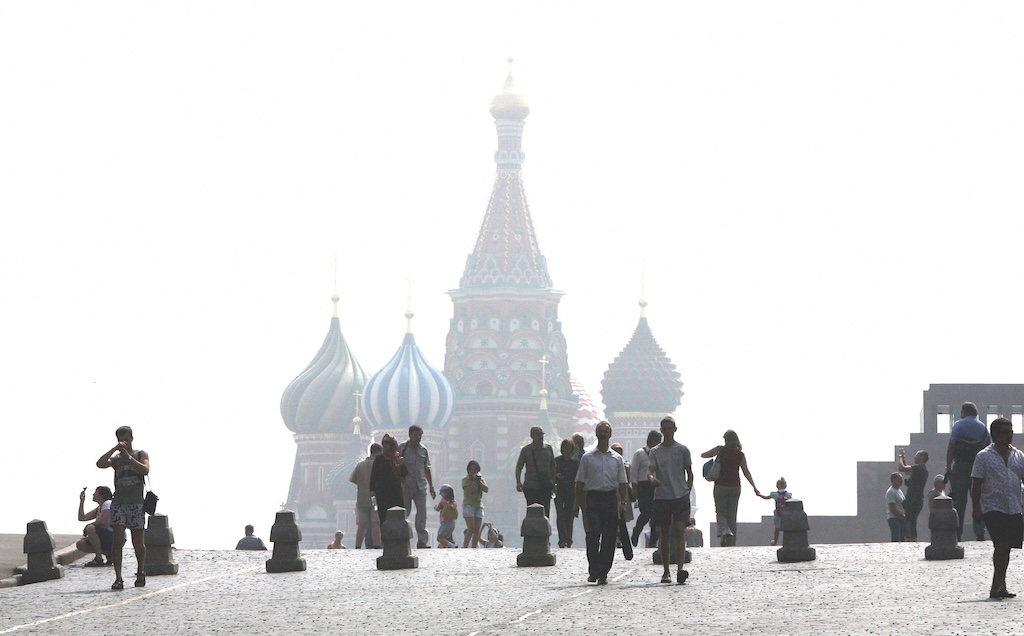
In Russia in the summer of 2010, a compound drought-heatwave event – and the associated wildfires – caused the death of nearly 55,000 people, the study notes.
The record-breaking Pacific north-west “heat dome” in 2021 triggered extreme drought conditions that caused “significant declines” in wheat yields, as well as in barley, canola and fruit production in British Columbia and Alberta, Canada, says the study.
Increasing events
To assess how CDHEs are changing, the researchers use daily reanalysis data to identify droughts and heatwaves events. (Reanalysis data combines past observations with climate models to create a historical climate record.) Then, using an algorithm, they analyse how these events overlap in both time and space.
The study covers the period from 1980 to 2023 and the world’s land surface, excluding polar regions where CDHEs are rare.
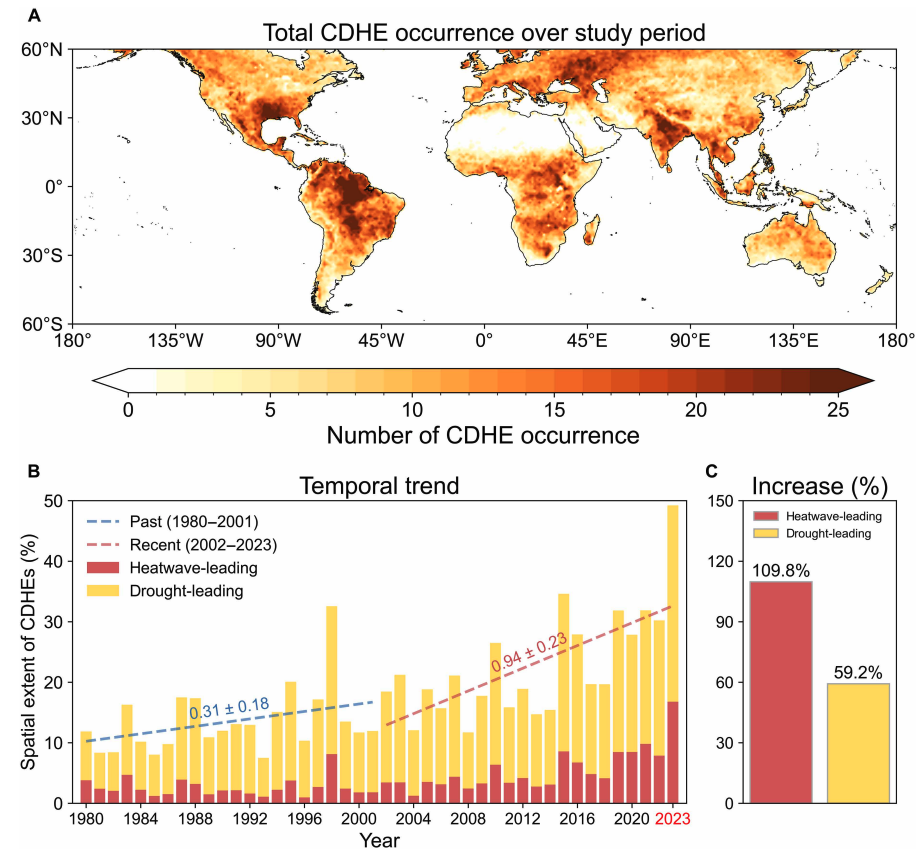
The research finds that the area of land affected by CDHEs has “increased substantially” since the early 2000s.
Heatwave-led events have been the main contributor to this increase, the study says, with their spatial extent rising 110% between 1980-2001 and 2002-23, compared to a 59% increase for drought-led events.
The map below shows the global distribution of CDHEs over 1980-2023. The charts show the percentage of the land surface affected by a heatwave-led CDHE (red) or a drought-led CDHE (yellow) in a given year (left) and relative increase in each CDHE type (right).
The study finds that CDHEs have occurred most frequently in northern South America, the southern US, eastern Europe, central Africa and south Asia.
Threshold passed
The authors explain that the increase in heatwave-led CDHEs is related to rising global temperatures, but that this does not tell the whole story.
In the earlier 22-year period of 1980-2001, the study finds that the spatial extent of heatwave-led CDHEs rises by 1.6% per 1C of global temperature rise. For the more-recent period of 2022-23, this increases “nearly eightfold” to 13.1%.
The change suggests that the rapid increase in the heatwave-led CDHEs occurred after the global average temperature “surpasse[d] a certain temperature threshold”, the paper says.
This threshold is an absolute global average temperature of 14.3C, the authors estimate (based on an 11-year average), which the world passed around the year 2000.
Investigating the recent surge in heatwave-leading CDHEs further, the researchers find a “regime shift” in land-atmosphere dynamics “toward a persistently intensified state after the late 1990s”.
In other words, the way that drier soils drive higher surface temperatures, and vice versa, is becoming stronger, resulting in more heatwave-led compound events.
Daily data
The research has some advantages over other previous studies, Yeh says. For instance, the new work uses daily estimations of CDHEs, compared to monthly data used in past research. This is “important for capturing the detailed occurrence” of these events, says Yeh.
He adds that another advantage of their study is that it distinguishes the sequence of droughts and heatwaves, which allows them to “better understand the differences” in the characteristics of CDHEs.
Dr Meryem Tanarhte is a climate scientist at the University Hassan II in Morocco, and Dr Ruth Cerezo Mota is a climatologist and a researcher at the National Autonomous University of Mexico. Both scientists, who were not involved in the study, agree that the daily estimations give a clearer picture of how CDHEs are changing.
Cerezo-Mota adds that another major contribution of the study is its global focus. She tells Carbon Brief that in some regions, such as Mexico and Africa, there is a lack of studies on CDHEs:
“Not because the events do not occur, but perhaps because [these regions] do not have all the data or the expertise to do so.”
However, she notes that the reanalysis data used by the study does have limitations with how it represents rainfall in some parts of the world.
Compound impacts
The study notes that if CDHEs continue to intensify – particularly events where heatwaves are the precursors – they could drive declining crop productivity, increased wildfire frequency and severe public health crises.
These impacts could be “much more rapid and severe as global warming continues”, Yeh tells Carbon Brief.
Tanarhte notes that these events can be forecasted up to 10 days ahead in many regions. Furthermore, she says, the strongest impacts can be prevented “through preparedness and adaptation”, including through “water management for agriculture, heatwave mitigation measures and wildfire mitigation”.
The study recommends reassessing current risk management strategies for these compound events. It also suggests incorporating the sequences of drought and heatwaves into compound event analysis frameworks “to enhance climate risk management”.
Cerezo-Mota says that it is clear that the world needs to be prepared for the increased occurrence of these events. She tells Carbon Brief:
“These [risk assessments and strategies] need to be carried out at the local level to understand the complexities of each region.”




The post Heatwaves driving recent ‘surge’ in compound drought and heat extremes appeared first on Carbon Brief.
Heatwaves driving recent ‘surge’ in compound drought and heat extremes
Greenhouse Gases
DeBriefed 6 March 2026: Iran energy crisis | China climate plan | Bristol’s ‘pioneering’ wind turbine
Welcome to Carbon Brief’s DeBriefed.
An essential guide to the week’s key developments relating to climate change.
This week
Energy crisis
ENERGY SPIKE: US-Israeli attacks on Iran and subsequent counterattacks across the Middle East have sent energy prices “soaring”, according to Reuters. The newswire reported that the region “accounts for just under a third of global oil production and almost a fifth of gas”. The Guardian noted that shipping traffic through the strait of Hormuz, which normally ferries 20% of the world’s oil, “all but ground to a halt”. The Financial Times reported that attacks by Iran on Middle East energy facilities – notably in Qatar – triggered the “biggest rise in gas prices since Russia’s full-scale invasion of Ukraine”.
‘RISK’ AND ‘BENEFITS’: Bloomberg reported