

We handpick and explain the most important stories at the intersection of climate, land, food and nature over the past fortnight.
This is an online version of Carbon Brief’s fortnightly Cropped email newsletter. Subscribe for free here.
Key developments
COP30 build-up
FOREST FIX: In the run-up to COP30, Brazil announced that deforestation in the Brazilian Amazon dropped by 11% between August 2024 and July 2025, the Associated Press reported. Data showed that almost 5,800km2 of forest was cleared during this time, the outlet said – a “significant drop from the previous year and the lowest level in nearly a decade”. Mongabay noted that deforestation also fell by around 11% in the Cerrado ecosystem in the past year. The Times, meanwhile, assessed global progress on a pledge to halt and reverse deforestation by 2030.
AIMS AND AMBITION: Malaysia and Indonesia, two of the world’s most biodiverse countries, announced updated climate targets ahead of COP30, according to Eco-Business. Malaysia’s new pledge outlined that its greenhouse gas emissions will peak between 2029-34, the outlet reported, while Indonesia’s pledge detailed plans to hit peak emissions by 2030. Antara reported that Indonesia’s environment minister, Hanif Faisol Nurofiq, said “large-scale reforestation” in the land-use sector will be key to achieving these targets.
NATURE TALKS: Elsewhere, intersessional talks for UN biodiversity negotiations failed to agree on a “clear set of recommendations” for the next major round of discussions, to be held in October 2026, Down to Earth reported. Countries focused on a number of topics, including the first global report on progress towards meeting 2030 nature targets. Another Down to Earth article reported on the outcomes of the first meeting of the permanent body for Indigenous peoples, which “ended with recommendations for how this new body will function”, the outlet said. These will be put forward to countries at the COP17 summit in Armenia next year.
Deadly cyclones damage crops
‘HEAVY BLOW’: Hurricane Melissa – “one of the strongest landfalling Atlantic hurricanes ever recorded” – tore through several Caribbean nations and dealt a “heavy blow” to fisherfolk and farmers in Jamaica, the Associated Press reported. The island is still recovering from last year’s Hurricane Beryl, causing farmers to “warn of food shortages”, according to the Guardian. The Gleaner, a Jamaican newspaper, wrote that fisherfolk in the country’s largest parish, St. Ann, “credited early and proactive preparations” for averting the loss of “boats, equipment and livelihoods”.
AG SECTOR SUFFERS: The same week, Cyclone Montha “battered” the eastern coast of India, “bringing heavy rain and gusty winds that damaged crops”, Reuters said. It added that the storm killed 120 animals in the southern state of Andhra Pradesh and that the agricultural sector “suffered the highest losses”. According to the Press Trust of India, nearly 80,000 farmers in the state were affected by flooding and damaged crops. One farmer died by suicide “after his cotton and maize crops were damaged” by the storm, Telangana Today reported.
-
Sign up to Carbon Brief’s free “Cropped” email newsletter. A fortnightly digest of food, land and nature news and views. Sent to your inbox every other Wednesday.
‘RUN OF DISASTERS’: Earlier this week, Typhoon Kalmaegi killed 66 people in the Philippines, the Guardian reported. Al Jazeera said that the country is still “recovering from a run of disasters, including earthquakes and severe weather events, in recent months”. In the Philippine Daily Inquirer, retired scientist Prof Teodoro Mendoza wrote that the country is “at a crossroads of food fragility and food security”. He called for “rooting strategies in local knowledge, climate adaptation and food sovereignty”.
News and views
CARBON COMMITMENT: Nigeria approved a “new national carbon market framework”, with an aim to “unlock up to $3bn annually in carbon finance”, Carbon Pulse reported. The Premium Times noted that, in addition to the framework, the country approved the operationalisation of a national climate change fund and reinstated funding for the National Council on Climate Change. The newspaper added that Nigerian president Bola Tinubu had “reaffirmed his administration’s commitment to mainstreaming climate action into national development”.
DEGRADATION TRENDS: Around 1.7 billion people worldwide are living in places where human-driven land degradation is leading to falling crop yields, representing a “growing threat to agricultural productivity and food security”, according to a new report from the UN Food and Agriculture Organization. The annual “state of food and agriculture” report said the large-scale degradation was a “troubling pattern” that “may drive further agricultural expansion into fragile ecosystems” – with implications for climate change and biodiversity loss.
‘DECISIVE WIN’: Argentine president Javier Milei’s La Libertad Avanza party secured a “decisive win” in the country’s midterm elections, Reuters said. Before the vote, Reuters reported that farmers were “renewing their vote of confidence” in Milei for “lowering unpopular export taxes”. In September, Reuters reported that these lowered taxes were increasing soya bean exports to China, particularly in the face of “Washington’s trade war with Beijing”.
LICENCE TO KRILL: Russia “spark[ed a] diplomatic row” after illegally detaining a Ukrainian biologist, the Guardian reported. Russia has accused Dr Leonid Pshenichnov of “high treason” by encouraging restrictions to krill harvesting around Antarctica, which “would harm the economic interests of Russia”, according to arrest documents seen by the newspaper. It added: “This year, for the first time, the amount of krill fished in Antarctic waters reached what scientists believe is an unsustainable level.”
JUST CAUSE: American pop star Billie Eilish announced that she will be donating $11.5m of the proceeds from her upcoming tour to “causes dedicated to food equity, climate justice and reducing carbon pollution”, CBS News reported. Eilish also called for the world’s “ultra-wealthy” to donate more of their money to helping others, the outlet added. Meanwhile, Sir David Attenborough has “urged” people to support an effort to raise £30m to purchase the Rothbury Estate in north-east England, “with plans to boost wildlife, restore bogs and promote nature-friendly farming”, BBC News said.
EEL-EGAL TRADE: Eel trafficking is “Europe’s biggest wildlife crime” – an industry worth about €2.5bn annually – and, combined with “habitat loss, pollution and the climate crisis”, is driving the slippery fish towards extinction, the Guardian said. The newspaper noted that despite international policing efforts – including a European ban on eel exports 15 years ago – the “fish are still ending up on plates around the globe”. In a separate piece, the Guardian reported on “mounting pressure” in Britain to ban mercury dental fillings. The mercury in fillings can be released into the environment after death and subsequently builds up in wildlife, causing detrimental effects.
Spotlight
Betting on trees
This week, Cropped examines Brazil’s flagship new forest fund and what COP30 could mean for nature and climate finance.
The COP30 UN climate talks begin in the heart of the Amazon rainforest next week, but they are not taking place in a vacuum.
The talks in Belém, Brazil come after a year of aid cuts and the fallout from finance negotiations in Baku last year.
The Brazilian COP presidency’s most high-profile solution to address the funding gap has been a new funding mechanism: the Tropical Forest Forever Facility (TFFF).
Through the TFFF, Brazil hopes to raise $125bn from donor countries, philanthropists and private investors, reassuring them of returns, while “rewarding” up to 74 tropical forest countries that sufficiently protect their forests.
However, days before the summit, Bloomberg reported that the UK would not be investing in the TFFF and Brazil’s finance minister was quoted saying the fund “could raise $10bn by next year”, less than half the original target.
While 20% of funds raised are supposed to go to Indigenous peoples and local communities, critics warn that TFFF puts investor returns first, with uncertain rewards going to countries and those tasked with preserving forests.
Another concern is that the TFFF is not designed to serve as an official fund for any of the UN’s three treaties – climate, biodiversity and land degradation – forged in Brazil at the historic “Earth Summit” in 1992.
Forest ecologists, meanwhile, worry that the low threshold for defining intact forests is “not scientifically credible” and “would allow payments even where industrial logging is occurring in primary forests”. Others deem the proposed $4 per hectare in rewards as “ridiculous” and not enough to displace intensive agriculture in these forests.
However, TFFF argues that “including forest areas with lower canopy cover does provide an incentive for maintaining these areas”.
But that is not all.
Just as COP28 pushed to include a goal to “triple renewable capacity”, Brazil – the world’s second largest biofuels producer – could ask countries to “quadruple the global use of ‘sustainable fuels’, including controversial biofuels”, reported the Guardian
(For more on biofuels and their climate impacts, see Carbon Brief’s explainer.)
At the same time, biodiversity offsets and carbon credit markets are seeing an additional boost in time for COP30.
Carbon Pulse reported that nine states in the Brazilian Amazon are set to launch a unified biodiversity crediting scheme, while Nigeria has greenlighted its national carbon market framework.
So far, only a third of all countries have submitted new climate pledges for 2035, despite a deadline well in advance of COP30 (although more pledges may roll in at the summit).
Liane Schalatek, a climate finance expert at German policy thinktank Heinrich-Böll-Stiftung tells Carbon Brief that 10 years after the Paris Agreement, “all of the discourse” about finance from developed countries is now around private sector involvement, instead of their legal obligations. She says:
“Seen in this context, [the TFFF] is weakening [the official funds that] we already have. And we’re doing that right at COP30, when we know that not only are NDCs too weak, but even for what developing countries have [pledged so far], they are not going to see the funding. It’s just sad.”
To Frederic Hache, co-founder of the Green Finance Observatory thinktank, the “funding gap narrative is basically a lot of political choices” that avoid tackling the “root drivers” of tropical forest loss. Hache tells Carbon Brief:
“If you say the issue is a lack of funding and the government is powerless, you empower private finance to say they hold a solution, [that] we need to cajole them so that they very kindly agree to participate and help and save us.
“But change diets, shift harmful subsidies and – boom – [this results in] less deforestation for agriculture that is not used to feed humans. That would be a serious political commitment and unlock serious grant money for countries to have the right incentives.”
Watch, read, listen
GREENWASHING GLOSSARY: With agriculture high on the COP30 agenda, DeSmog published a list of “big agwashing” buzzwords to watch out for.
TALKING TRAFFICKING: The Hindu’s In Focus podcast spoke with Vivek Menon – the new chair of the IUCN species survival commission – about the rise of online wildlife trafficking.
SULAWESI POSTCARD: A New York Times interactive feature offered a glimpse into life in the rainforests and reefs of Sulawesi island, off the eastern coast of Borneo.
LOGGING OFF: A Veza News longread looked at logging activities threatening “Nigeria’s last rainforest”.
New science
- Expanding irrigation “substantially decreases” net flows of water from the atmosphere to the land, leading to “enlarged” rates of depletion of terrestrial water and “further aggravating the existing drying trends caused by climate change” | Nature Water
- A literature review found “substantial limitations” in current research surrounding the environmental impacts of farming insects for human or animal consumption | Biological Reviews
- Ammonia emissions – largely resulting from farming – can significantly increase the formation of aerosols in the upper atmosphere, “with potential implications for climate” | Proceedings of the National Academy of Sciences
In the diary
- 10-21 November: COP30 UN climate talks | Belém, Brazil
- 24-29 November: Eleventh session of plant treaty negotiations | Lima, Peru
- 24 November-5 December: COP20 UN talks on the international trade of endangered species | Samarkand, Uzbekistan
Cropped is researched and written by Dr Giuliana Viglione, Aruna Chandrasekhar, Daisy Dunne, Orla Dwyer and Yanine Quiroz. Please send tips and feedback to cropped@carbonbrief.org
The post Cropped 5 November 2025: Nature finance at COP30; Storms devastate crops; Brazilian deforestation decline appeared first on Carbon Brief.

Drought and heatwaves occurring together – known as “compound” events – have “surged” across the world since the early 2000s, a new study shows.
Compound drought and heat events (CDHEs) can have devastating effects, creating the ideal conditions for intense wildfires, such as Australia’s “Black Summer” of 2019-20 where bushfires burned 24m hectares and killed 33 people.
The research, published in Science Advances, finds that the increase in CDHEs is predominantly being driven by events that start with a heatwave.
The global area affected by such “heatwave-led” compound events has more than doubled between 1980-2001 and 2002-23, the study says.
The rapid increase in these events over the last 23 years cannot be explained solely by global warming, the authors note.
Since the late 1990s, feedbacks between the land and the atmosphere have become stronger, making heatwaves more likely to trigger drought conditions, they explain.
One of the study authors tells Carbon Brief that societies must pay greater attention to compound events, which can “cause severe impacts on ecosystems, agriculture and society”.
Compound events
CDHEs are extreme weather events where drought and heatwave conditions occur simultaneously – or shortly after each other – in the same region.
These events are often triggered by large-scale weather patterns, such as “blocking” highs, which can produce “prolonged” hot and dry conditions, according to the study.
Prof Sang-Wook Yeh is one of the study authors and a professor at the Ewha Womans University in South Korea. He tells Carbon Brief:
“When heatwaves and droughts occur together, the two hazards reinforce each other through land-atmosphere interactions. This amplifies surface heating and soil moisture deficits, making compound events more intense and damaging than single hazards.”
CDHEs can begin with either a heatwave or a drought.
The sequence of these extremes is important, the study says, as they have different drivers and impacts.
For example, in a CDHE where the heatwave was the precursor, increased direct sunshine causes more moisture loss from soils and plants, leading to a drought.
Conversely, in an event where the drought was the precursor, the lack of soil moisture means that less of the sun’s energy goes into evaporation and more goes into warming the Earth’s surface. This produces favourable conditions for heatwaves.
The study shows that the majority of CDHEs globally start out as a drought.
In recent years, there has been increasing focus on these events due to the devastating impact they have on agriculture, ecosystems and public health.
In Russia in the summer of 2010, a compound drought-heatwave event – and the associated wildfires – caused the death of nearly 55,000 people, the study notes.

The record-breaking Pacific north-west “heat dome” in 2021 triggered extreme drought conditions that caused “significant declines” in wheat yields, as well as in barley, canola and fruit production in British Columbia and Alberta, Canada, says the study.
Increasing events
To assess how CDHEs are changing, the researchers use daily reanalysis data to identify droughts and heatwaves events. (Reanalysis data combines past observations with climate models to create a historical climate record.) Then, using an algorithm, they analyse how these events overlap in both time and space.
The study covers the period from 1980 to 2023 and the world’s land surface, excluding polar regions where CDHEs are rare.
The research finds that the area of land affected by CDHEs has “increased substantially” since the early 2000s.
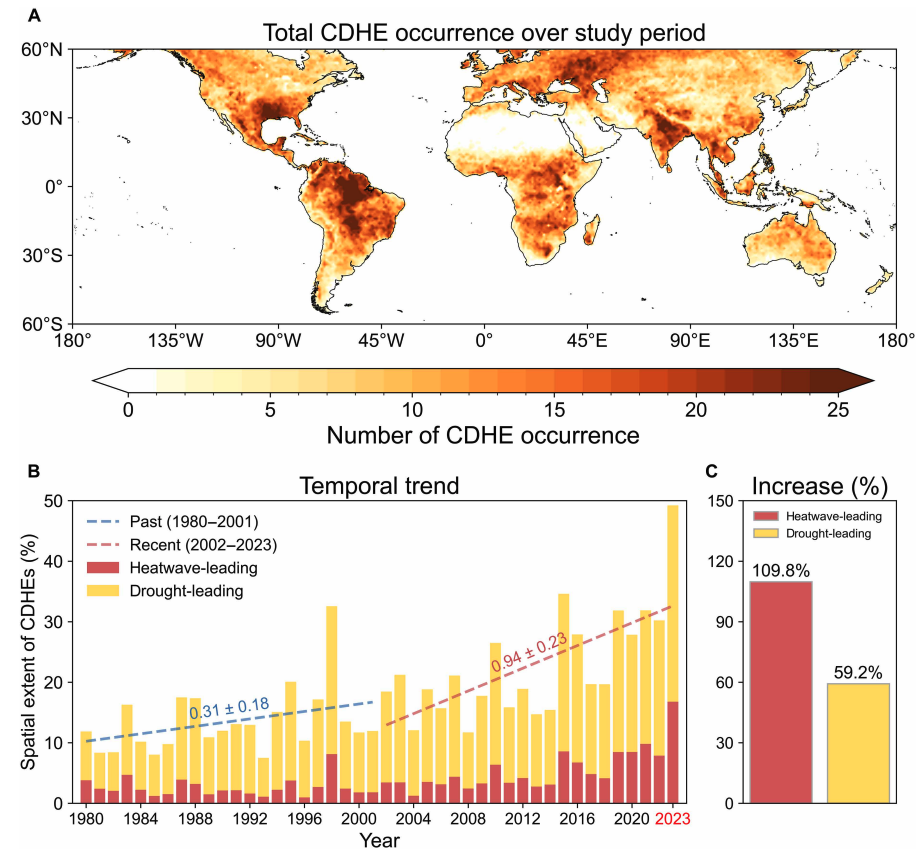
Heatwave-led events have been the main contributor to this increase, the study says, with their spatial extent rising 110% between 1980-2001 and 2002-23, compared to a 59% increase for drought-led events.
The map below shows the global distribution of CDHEs over 1980-2023. The charts show the percentage of the land surface affected by a heatwave-led CDHE (red) or a drought-led CDHE (yellow) in a given year (left) and relative increase in each CDHE type (right).
The study finds that CDHEs have occurred most frequently in northern South America, the southern US, eastern Europe, central Africa and south Asia.
Threshold passed
The authors explain that the increase in heatwave-led CDHEs is related to rising global temperatures, but that this does not tell the whole story.
In the earlier 22-year period of 1980-2001, the study finds that the spatial extent of heatwave-led CDHEs rises by 1.6% per 1C of global temperature rise. For the more-recent period of 2022-23, this increases “nearly eightfold” to 13.1%.
The change suggests that the rapid increase in the heatwave-led CDHEs occurred after the global average temperature “surpasse[d] a certain temperature threshold”, the paper says.
This threshold is an absolute global average temperature of 14.3C, the authors estimate (based on an 11-year average), which the world passed around the year 2000.
Investigating the recent surge in heatwave-leading CDHEs further, the researchers find a “regime shift” in land-atmosphere dynamics “toward a persistently intensified state after the late 1990s”.
In other words, the way that drier soils drive higher surface temperatures, and vice versa, is becoming stronger, resulting in more heatwave-led compound events.
Daily data
The research has some advantages over other previous studies, Yeh says. For instance, the new work uses daily estimations of CDHEs, compared to monthly data used in past research. This is “important for capturing the detailed occurrence” of these events, says Yeh.
He adds that another advantage of their study is that it distinguishes the sequence of droughts and heatwaves, which allows them to “better understand the differences” in the characteristics of CDHEs.
Dr Meryem Tanarhte is a climate scientist at the University Hassan II in Morocco, and Dr Ruth Cerezo Mota is a climatologist and a researcher at the National Autonomous University of Mexico. Both scientists, who were not involved in the study, agree that the daily estimations give a clearer picture of how CDHEs are changing.
Cerezo-Mota adds that another major contribution of the study is its global focus. She tells Carbon Brief that in some regions, such as Mexico and Africa, there is a lack of studies on CDHEs:
“Not because the events do not occur, but perhaps because [these regions] do not have all the data or the expertise to do so.”
However, she notes that the reanalysis data used by the study does have limitations with how it represents rainfall in some parts of the world.
Compound impacts
The study notes that if CDHEs continue to intensify – particularly events where heatwaves are the precursors – they could drive declining crop productivity, increased wildfire frequency and severe public health crises.
These impacts could be “much more rapid and severe as global warming continues”, Yeh tells Carbon Brief.
Tanarhte notes that these events can be forecasted up to 10 days ahead in many regions. Furthermore, she says, the strongest impacts can be prevented “through preparedness and adaptation”, including through “water management for agriculture, heatwave mitigation measures and wildfire mitigation”.
The study recommends reassessing current risk management strategies for these compound events. It also suggests incorporating the sequences of drought and heatwaves into compound event analysis frameworks “to enhance climate risk management”.
Cerezo-Mota says that it is clear that the world needs to be prepared for the increased occurrence of these events. She tells Carbon Brief:
“These [risk assessments and strategies] need to be carried out at the local level to understand the complexities of each region.”



The post Heatwaves driving recent ‘surge’ in compound drought and heat extremes appeared first on Carbon Brief.
Heatwaves driving recent ‘surge’ in compound drought and heat extremes
Greenhouse Gases
DeBriefed 6 March 2026: Iran energy crisis | China climate plan | Bristol’s ‘pioneering’ wind turbine
Welcome to Carbon Brief’s DeBriefed.
An essential guide to the week’s key developments relating to climate change.
This week
Energy crisis
ENERGY SPIKE: US-Israeli attacks on Iran and subsequent counterattacks across the Middle East have sent energy prices “soaring”, according to Reuters. The newswire reported that the region “accounts for just under a third of global oil production and almost a fifth of gas”. The Guardian noted that shipping traffic through the strait of Hormuz, which normally ferries 20% of the world’s oil, “all but ground to a halt”. The Financial Times reported that attacks by Iran on Middle East energy facilities – notably in Qatar – triggered the “biggest rise in gas prices since Russia’s full-scale invasion of Ukraine”.
‘RISK’ AND ‘BENEFITS’: Bloomberg reported on increases in diesel prices in Europe and the US, speculating that rising fuel costs could be “a risk for president Donald Trump”. US gas producers are “poised to benefit from the big disruption in global supply”, according to CNBC. Indian government sources told the Economic Times that Russia is prepared to â