

Billed as the “Amazon COP”, the UN climate talks will see the debut of Brazil’s flagship fund to “reward” tropical countries for keeping their forests intact.
The Tropical Forest Forever Facility (TFFF) will be launched at the COP30 leaders’ summit on 6 November.
The fund aims to raise and invest $125bn from a range of sources, with excess returns channelled to up to 74 developing countries that sufficiently protect their forests.
This, according to Brazil, would make it one of the biggest multilateral investment funds for nature.
(For comparison, the Green Climate Fund’s portfolio is around $18bn.)
While Brazil expects TFFF to “transform the world’s approach to environmental conservation”, many critics remain unconvinced.
They argue that conservation funding for climate-critical forests should not depend on “betting on stock market prices” and instead call for new biodiversity finance.
Here, Carbon Brief takes a closer look at where the fund came from, how it will be set up and how it is supposed to work.
What is the Tropical Forest Forever Facility?
First officially proposed by Brazil at COP28 in Dubai in 2023, the Tropical Forest Forever Facility aims to pay up to 74 developing tropical forest countries for keeping their existing old-growth forests intact.
It plans to do this by raising $25bn in capital from wealthy “sponsor” governments and philanthropies, which – it hopes – will attract an additional $100bn in private investment.
Returns on these investments will go towards paying back investors and making “forest payments” to countries that increase or maintain their forest cover.
On 4 November, Brazil’s finance minister Fernando Haddad told Bloomberg that “he believed the fund could raise $10bn by next year”, less than half the original target.
While the facility’s official launch is slated for COP30, its rules are still being finalised after several iterations of “concept notes” and consultations.
However, the idea that underpins the fund is not new.
Former World Bank treasurer Kenneth Lay first floated the idea of a Tropical Forest Finance Facility around 15 years ago.
Lay and others later envisioned the TFFF as a “pay-for-performance” sovereign wealth fund for forests. In their design of the TFFF, loans from developed countries and private investors would have been invested in the debt markets of tropical forest countries, with excess returns being allocated annually as “rainforest rewards”.
In their thinking, TFFF offered a “highly-visible, large-scale reward for successfully tackling deforestation without increasing funding demands” on developed countries, according to a 2018 article for the Center for Global Development.
Others central to the TFFF’s current design are Christopher Egerton-Warburton – founder of London-based Lion’s Head Global Partners, who is credited with engineering the facility’s financial structure – and Garo Batmanian, director of Brazil’s forestry service.
What is it designed to achieve?
The ultimate goal of the TFFF is to pay for the conservation of the world’s major rainforests, which provide a range of ecosystem services, including carbon storage.
In a statement from the COP30 presidency, André Aquino, special advisor on economy and environment at Brazil’s ministry of environment, said:
“What the TFFF seeks is for the world to remunerate part of these services. It is to remunerate forests as the basis of life, as the basis of the economy, for our well-being.”
On the ground, this mechanism could help landowners to conserve trees and forests by ensuring that the value they bring as standing forests is higher than from cutting them down.
The facility also intends to finance long-term objectives for forest conservation, including policies and programmes for sustainable use and restoration.
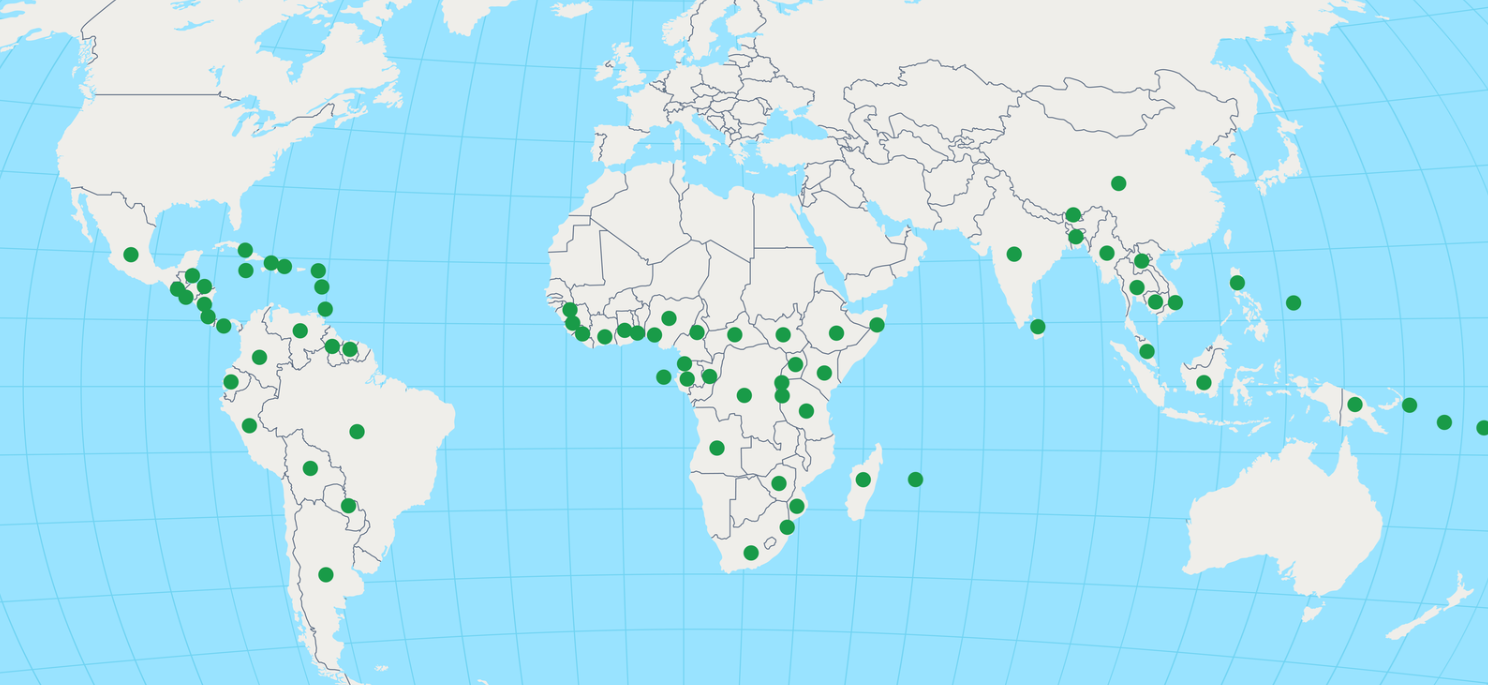
More than 70 developing countries that are home to more than 1bn hectares of tropical and sub-tropical forests could be potential recipients from this facility. These countries span the Amazon, Congo and Mekong basins, as well as many other regions.
The following map shows the countries that host tropical rainforests and are potentially eligible to receive funds from the TFFF.
To be selected as beneficiaries, countries will require transparent financial management systems and must commit to allocating 20% of the funds to Indigenous peoples and traditional communities, according to the draft rules.
These countries would need to have a deforestation rate – averaged over the previous three years – of no more than 0.5% of their total forested area, with standing forest areas having a canopy cover of at least 20-30% in each hectare to be eligible for payments.
The TFFF’s third concept note says that areas that transition from above to below this 20-30% threshold would be “considered deforested”.
In a recent Yale Environment 360 article, forest ecologists warned that the low level of this threshold – for what counts as a forested area – is “not scientifically credible” and “would allow payments even where industrial logging is occurring in primary forests”.
However, TFFF argues that “including forest areas with lower canopy cover does provide an incentive for maintaining these areas”.
Additionally, payments would be reduced for each hectare of forest loss and for each hectare degraded by fire.
The funds for Indigenous peoples would be “put aside in a different account, following different rules”, Aquino said during a press briefing attended by Carbon Brief.
Brazil’s ministry of environment and climate change invited five countries with rainforests to support the creation of the fund: Colombia, the Democratic Republic of Congo, Ghana, Indonesia and Malaysia.
Individual national governments that are beneficiaries of the scheme would be free to define how and where the generated funds would be distributed.
How will the fund work?
The TFFF is split into two entities, with a secretariat to coordinate between them.
The facility is the first of these. It is tasked with setting up the rewards system, eligibility criteria, monitoring methodologies and disbursement rules, as well as engaging with participating recipient countries.
The other is the TFFF’s main financial arm, the Tropical Forest Investment Fund (TFIF) – responsible for raising and managing the TFFF’s resources.
So far, five potential sponsor countries have shown interest in supporting the fund: France, Germany, Norway, the United Arab Emirates and the UK.
These countries, along with five potential recipient countries – Brazil, Colombia, the DRC, Ghana, Indonesia and Malaysia – formed an interim steering committee to shape TFFF’s development.
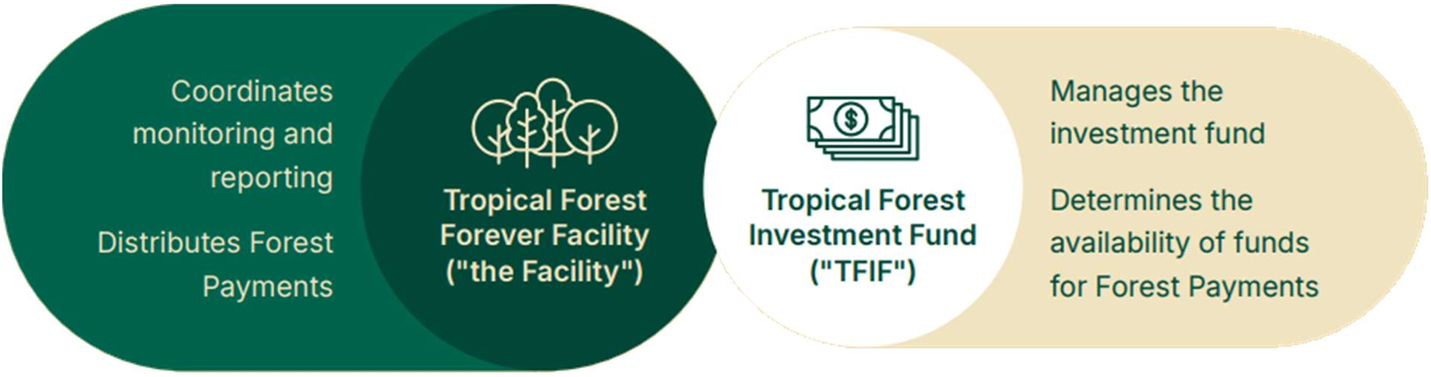
According to its third concept note, published in October, the TFIF would be a “blended finance vehicle”, pooling public, philanthropic and private funding.
The TFIF is split into two tranches. The first is a “sponsor” tranche, where donor countries and philanthropies are invited to contribute long-term, low-cost capital investment to the tune of $25bn, either from long-term loans, guarantees or outright grants.
So far, Brazil’s initial pledge of $1bn to the facility is the only such pledge. Other governments, such as the UK, have played an “active part” in establishing the TFFF.
(Five days before COP30 kicked off, Bloomberg reported that the UK would not be investing in the TFFF, after the government’s treasury department warned that the investment is “not something the UK can afford at a time when it’s trying to tackle its surging debt burden”.)
This $25bn from sponsor countries, in turn, would be expected to absorb risk, cover losses and serve as a catalyst to raise $100bn from institutional investors in the global bond market.
(This sum raised from private investors is described as the “senior market debt” tranche of investment: if the markets see a downturn, private investors are protected first, making their interests “senior” to donor and recipient countries.)
TFIF and its asset managers then invest this $125bn of capital into a mixed portfolio of investments, including public and corporate market bonds, but excluding those with a significant environmental impact. (In a joint letter, issued in October, advocacy and research groups called for a more detailed exclusion criteria.)
Income from these investments, in turn, will be used to pay investors first, then interest to donor countries and, finally, to pay participating forest countries. The payments to participating countries will be roughly $4 per hectare of standing forest (subject to annual adjustment for inflation), as verified by satellite imagery.
The World Bank confirmed in September 2025 that it will serve as a trustee to the facility and host its interim secretariat.
Liane Schalatek, a climate finance expert and associate director of German policy thinktank Heinrich-Böll-Stiftung’s Washington office, tells Carbon Brief:
“It’s a very clear hierarchy: you serve the money raised on the market and capital investors first before you go to the intended purpose of the fund – and that is compensating countries for basically leaving their tropical forest standing. To me, it seems that the focus is on the money, not necessarily on the outcome. That is really worrisome.”
While sponsor countries are guaranteed their money back over a 40-year period, payouts to forest countries depend on investment returns. These are subject to market risks and volatility and, therefore, are not guaranteed.
According to Frederic Hache, co-founder of the EU Green Finance Observatory thinktank, payouts promised by the TFFF are “really not appropriate to the emergency of the [biodiversity and climate] crises” and do not address their “root drivers”. Hache tells Carbon Brief:
“Even if you meet the very hard criteria as a country to get this money, obtaining this conservation funding is conditional upon financial market conditions and the skill of an asset manager. That’s not very generous and that’s not very appropriate.”
Hache warns that if the fund does not make enough money or experiences losses, the “first thing that is impacted is the forest payment”, which could be put on hold, while “sponsor capital protects private investors with taxpayer money”.
What issues might the fund face?
Civil-society organisations and climate finance experts have warned of several risks and gaps within the facility.
Finance fragmentation
Experts who spoke to Carbon Brief expressed concerns that TFFF could erode the legitimacy of existing, but under-resourced, multilateral funds for climate and biodiversity, as well as dilute the legal obligations of developed countries to pay their “fair share” of nature finance.
While the TFFF hopes to contribute to the goals of all three UN conventions – climate, biodiversity and land degradation – the fund is not officially part of any of the three treaties.
To Schalatek, the fact that the “biggest thing that is going to come out of COP30” is “outside” the UN Framework Convention on Climate Change (UNFCCC) and depends to a large extent on private investment is cause for disappointment.
A keenly awaited report ahead of COP30 is a roadmap towards a wider climate finance target of $1.3tn a year, which could include various sources beyond the jurisdiction of the UN climate process.
Schalatek tells Carbon Brief:
“While we’re trying to have a discussion about protecting the provision of public finance from developed to developing countries [after Baku and amid aid cuts], TFFF is almost contributing to a further undermining of the financial mechanism of the UNFCCC and the Paris Agreement.”
Sarah Colenbrander, director of the climate and sustainability programme at the UK-based global development thinktank ODI, tells Carbon Brief:
“The creation of the Tropical Forest Forever Facility risks not increasing total resources for climate and biodiversity finance, but rather fragmenting the funds already available.”
Potential financial risk
Given the fund’s long-term horizon, a significant challenge is managing financial risk down the line.
This could take the form of a debt crisis in emerging markets, which could “wipe out” sponsor capital and “halt rainforest flows, possibly before they even begin”, economists Max Alexander Matthey and Prof Aidan Hollis wrote in a Substack post in September.
Higher return rates for investors – as mentioned in the third draft of TFFF’s concept note – in combination with high financial fees and operational costs, have left several experts questioning what remains in the way of “rewards” to rainforest countries.
Hache tells Carbon Brief that the TFFF might be “fantastic” for investors who get a “AAA-rated investment without sacrificing any returns”, but real risk is borne by tropical forest countries.
In addition, the mooted payments of $4 a hectare is “ridiculous and not enough to displace alternatives” such as growing cash crops for export, he says, adding:
“$125bn sounds much better than, ‘Oh, we put $2.5bn on the table conditionally’. While there is very little political appetite for giving grant money, this is one of these mechanisms where innovation can obfuscate the lack of ambition and generosity by global-north countries.”
Commodification and transparency
Other experts fear that the new facility could contribute to the commodification of forests and a possible lack of adequate accountability.
The Global Forest Coalition (GFC), an alliance of not-for-profit organisations and Indigenous groups working on forest issues worldwide, have urged countries, Indigenous peoples and civil society to reject the TFFF.
In a press release in October, the GFC said that the TFFF views forests as “financial assets” and warned that the fund is “subject to investment returns, liquidation risks and payouts that are not even guaranteed”.
The press release quotes Mary Louise Malig, policy director at the GFC, who said:
“This is not about conserving forests; it is about conserving the power of elites over forests. It is the continuation of a free market model dressed up as climate finance.”
Information on transparency and governance of the TFFF is unavailable at the moment, says Tyala Ifwanga, forest governance campaigner at Fern, a civil-society organisation that works to protect forest people’s rights in the EU. She tells Carbon Brief that this makes it difficult to assess whether the facility can ensure payments meet the fund’s objectives, adding:
“Corruption is not the only issue we should have in mind here. Some tropical forest countries have autocratic regimes and very limited civic space.”
Pablo Solón, executive director of the Solón Foundation, is also quoted in the GFC press release. He warned:
“The TFFF is a distraction that diverts attention and resources from real solutions like regulation, corporate accountability and direct financing for Indigenous and local initiatives.”
Low Indigenous involvement
Another concern highlighted by the GFC is that while Indigenous peoples and local communities are expected to have “consultative roles”, the “decision-making power rests with governments and financial institutions”.
According to Fern’s Ifwanga, the Global Alliance for Territorial Community – a political platform bringing together coalitions of Indigenous peoples and local communities for defending nature – was involved in developing the TFFF concept notes related to Indigenous peoples and local communities.
She says that although the alliance agrees with the facility, “they are very aware that a lot of work remains to be done to ensure that their voices are heard at every level of the mechanism”.
She also encourages countries to increase direct access to funds for Indigenous communities.
Schalatek says that it is “sinister” that forest communities are being asked to “provide continued stewardship” and preserve forests “without any predictability on how much they’re going to receive for it”, while fund managers can get their money back. She concludes:
“This [TFFF] is exactly the kind of vehicle that gives developed countries the sick leave to not contribute to the GCF [Green Climate Fund], not contribute to the Adaptation Fund…We all know the world has changed, but that doesn’t apply to legal obligations you have signed on to.
“One could probably argue that the Brazilians put a lot more effort into the TFFF than in, for example, thinking about how to deal with the finance agenda within COP30.”
The post COP30: Could Brazil’s ‘Tropical Forest Forever’ fund help tackle climate change? appeared first on Carbon Brief.
COP30: Could Brazil’s ‘Tropical Forest Forever’ fund help tackle climate change?

Drought and heatwaves occurring together – known as “compound” events – have “surged” across the world since the early 2000s, a new study shows.
Compound drought and heat events (CDHEs) can have devastating effects, creating the ideal conditions for intense wildfires, such as Australia’s “Black Summer” of 2019-20 where bushfires burned 24m hectares and killed 33 people.
The research, published in Science Advances, finds that the increase in CDHEs is predominantly being driven by events that start with a heatwave.
The global area affected by such “heatwave-led” compound events has more than doubled between 1980-2001 and 2002-23, the study says.
The rapid increase in these events over the last 23 years cannot be explained solely by global warming, the authors note.
Since the late 1990s, feedbacks between the land and the atmosphere have become stronger, making heatwaves more likely to trigger drought conditions, they explain.
One of the study authors tells Carbon Brief that societies must pay greater attention to compound events, which can “cause severe impacts on ecosystems, agriculture and society”.
Compound events
CDHEs are extreme weather events where drought and heatwave conditions occur simultaneously – or shortly after each other – in the same region.
These events are often triggered by large-scale weather patterns, such as “blocking” highs, which can produce “prolonged” hot and dry conditions, according to the study.
Prof Sang-Wook Yeh is one of the study authors and a professor at the Ewha Womans University in South Korea. He tells Carbon Brief:
“When heatwaves and droughts occur together, the two hazards reinforce each other through land-atmosphere interactions. This amplifies surface heating and soil moisture deficits, making compound events more intense and damaging than single hazards.”
CDHEs can begin with either a heatwave or a drought.
The sequence of these extremes is important, the study says, as they have different drivers and impacts.
For example, in a CDHE where the heatwave was the precursor, increased direct sunshine causes more moisture loss from soils and plants, leading to a drought.
Conversely, in an event where the drought was the precursor, the lack of soil moisture means that less of the sun’s energy goes into evaporation and more goes into warming the Earth’s surface. This produces favourable conditions for heatwaves.
The study shows that the majority of CDHEs globally start out as a drought.
In recent years, there has been increasing focus on these events due to the devastating impact they have on agriculture, ecosystems and public health.
In Russia in the summer of 2010, a compound drought-heatwave event – and the associated wildfires – caused the death of nearly 55,000 people, the study notes.

The record-breaking Pacific north-west “heat dome” in 2021 triggered extreme drought conditions that caused “significant declines” in wheat yields, as well as in barley, canola and fruit production in British Columbia and Alberta, Canada, says the study.
Increasing events
To assess how CDHEs are changing, the researchers use daily reanalysis data to identify droughts and heatwaves events. (Reanalysis data combines past observations with climate models to create a historical climate record.) Then, using an algorithm, they analyse how these events overlap in both time and space.
The study covers the period from 1980 to 2023 and the world’s land surface, excluding polar regions where CDHEs are rare.
The research finds that the area of land affected by CDHEs has “increased substantially” since the early 2000s.
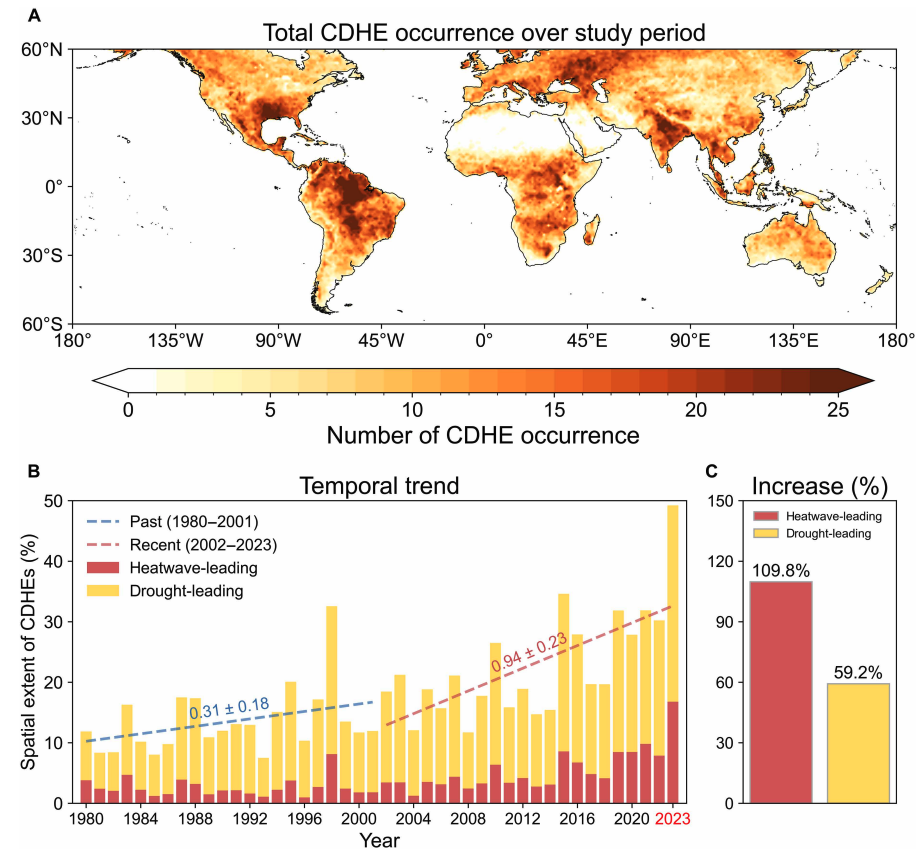
Heatwave-led events have been the main contributor to this increase, the study says, with their spatial extent rising 110% between 1980-2001 and 2002-23, compared to a 59% increase for drought-led events.
The map below shows the global distribution of CDHEs over 1980-2023. The charts show the percentage of the land surface affected by a heatwave-led CDHE (red) or a drought-led CDHE (yellow) in a given year (left) and relative increase in each CDHE type (right).
The study finds that CDHEs have occurred most frequently in northern South America, the southern US, eastern Europe, central Africa and south Asia.
Threshold passed
The authors explain that the increase in heatwave-led CDHEs is related to rising global temperatures, but that this does not tell the whole story.
In the earlier 22-year period of 1980-2001, the study finds that the spatial extent of heatwave-led CDHEs rises by 1.6% per 1C of global temperature rise. For the more-recent period of 2022-23, this increases “nearly eightfold” to 13.1%.
The change suggests that the rapid increase in the heatwave-led CDHEs occurred after the global average temperature “surpasse[d] a certain temperature threshold”, the paper says.
This threshold is an absolute global average temperature of 14.3C, the authors estimate (based on an 11-year average), which the world passed around the year 2000.
Investigating the recent surge in heatwave-leading CDHEs further, the researchers find a “regime shift” in land-atmosphere dynamics “toward a persistently intensified state after the late 1990s”.
In other words, the way that drier soils drive higher surface temperatures, and vice versa, is becoming stronger, resulting in more heatwave-led compound events.
Daily data
The research has some advantages over other previous studies, Yeh says. For instance, the new work uses daily estimations of CDHEs, compared to monthly data used in past research. This is “important for capturing the detailed occurrence” of these events, says Yeh.
He adds that another advantage of their study is that it distinguishes the sequence of droughts and heatwaves, which allows them to “better understand the differences” in the characteristics of CDHEs.
Dr Meryem Tanarhte is a climate scientist at the University Hassan II in Morocco, and Dr Ruth Cerezo Mota is a climatologist and a researcher at the National Autonomous University of Mexico. Both scientists, who were not involved in the study, agree that the daily estimations give a clearer picture of how CDHEs are changing.
Cerezo-Mota adds that another major contribution of the study is its global focus. She tells Carbon Brief that in some regions, such as Mexico and Africa, there is a lack of studies on CDHEs:
“Not because the events do not occur, but perhaps because [these regions] do not have all the data or the expertise to do so.”
However, she notes that the reanalysis data used by the study does have limitations with how it represents rainfall in some parts of the world.
Compound impacts
The study notes that if CDHEs continue to intensify – particularly events where heatwaves are the precursors – they could drive declining crop productivity, increased wildfire frequency and severe public health crises.
These impacts could be “much more rapid and severe as global warming continues”, Yeh tells Carbon Brief.
Tanarhte notes that these events can be forecasted up to 10 days ahead in many regions. Furthermore, she says, the strongest impacts can be prevented “through preparedness and adaptation”, including through “water management for agriculture, heatwave mitigation measures and wildfire mitigation”.
The study recommends reassessing current risk management strategies for these compound events. It also suggests incorporating the sequences of drought and heatwaves into compound event analysis frameworks “to enhance climate risk management”.
Cerezo-Mota says that it is clear that the world needs to be prepared for the increased occurrence of these events. She tells Carbon Brief:
“These [risk assessments and strategies] need to be carried out at the local level to understand the complexities of each region.”



The post